

P0700 on 2006-2011 Honda Civic: Transmission System Fault Guide
P0700 on a 2006-2011 Honda Civic means the transmission computer has detected a fault. This is often caused by a failed transmission fluid pressure switch, a common issue for this car. You'll need a scanner that can read transmission codes to find the specific problem.
- P0700 is a general alert from your transmission; it's not the root problem.
- You MUST use a scanner that can read transmission-specific codes to find the real issue.
- On a 2006-2011 Civic, the most likely cause is a faulty transmission fluid pressure switch, often indicated by a flashing 'D' light.
- Always check transmission fluid level and condition first, as low or dirty fluid can cause numerous problems.
- Use only Honda Genuine ATF-DW1 transmission fluid for any service to ensure proper operation.
What's Unique About the 2006-2011 Honda Civic
The 8th generation Honda Civic (2006-2011) is well-known for issues with its automatic transmission fluid pressure switches. These switches can fail, leading to a P0700 code accompanied by more specific pressure switch codes (like P0843, P0847, or P0848) and a flashing 'D' (Drive) indicator light on the dashboard. While other issues can occur, a faulty pressure switch is a very common and well-documented starting point for diagnosis on this particular vehicle.
Symptoms You May Notice
- Check Engine Light is on
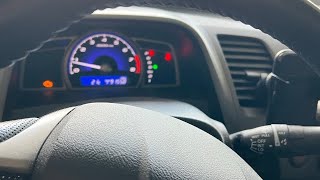
- Flashing 'D' (Drive) indicator light on the instrument cluster
- Harsh or delayed shifting
- Transmission slipping between gears
- Vehicle stuck in one gear (limp mode)
- Poor acceleration and reduced fuel economy
- Replacing the entire transmission without first diagnosing the specific TCM codes. Many P0700 issues are caused by inexpensive external sensors or solenoids.
- Assuming the P0700 code itself points to a specific failure. It is only an indicator that other codes are present in the TCM.
Most Likely Causes
- Failed Transmission Fluid Pressure Switch 🔴 High Probability → Shop Transmission Assembly These switches are a known, high-failure point on this generation of Honda vehicles. They can become stuck or fail electronically, sending incorrect pressure readings to the TCM, most commonly for the 2nd or 3rd gear clutches.
How to confirm: Scan the TCM for specific pressure switch codes (e.g., P0843 for 2nd clutch, P0847/P0848 for 3rd clutch). A technician can test the switch's circuit for proper voltage and continuity. Unplugging the switch and seeing if the code changes from 'circuit low' to 'circuit high' (or vice-versa) can also help confirm a bad switch versus a wiring issue. For P0848 (Circuit High), a key test is to check for 5 volts at the disconnected harness connector with the key on; if 5V is present, the PCM and wiring are good, pointing to a bad switch.
Typical fix: Replace the faulty pressure switch and its corresponding crush washer. It is a simple repair requiring a 22mm deep socket or wrench. It is also wise to perform a transmission fluid drain-and-fill at the same time.
Est. part cost: $40-$100 - Low or Dirty Transmission Fluid 🟡 Medium Probability → Shop Transmission Assembly Neglected maintenance can lead to fluid breakdown, which affects hydraulic pressure and can cause shifting problems or sensor faults. Honda transmissions are particularly sensitive to fluid type and condition.
How to confirm: Check the transmission fluid dipstick for level and condition. The fluid should be bright red and not smell burnt. Note that some newer vehicles may not have a dipstick.
Typical fix: Perform a transmission fluid drain-and-fill using only Honda Genuine ATF-DW1 fluid. A full flush is sometimes not recommended on high-mileage transmissions.
Est. part cost: $40-$80 for fluid - Faulty Shift Solenoid ⚪ Low Probability → Shop Transmission Valve Body
How to confirm: Scan the TCM for solenoid-specific codes (e.g., P0753, P1758). A technician can test the solenoid's resistance with a multimeter and check for a 'click' by applying power directly to it.
Typical fix: Replace the faulty shift solenoid. The solenoids are often located on the exterior of the transmission case and can be replaced without removing the transmission.
Est. part cost: $100-$250
Rare But Worth Checking
- Faulty Transmission Control Module (TCM) or Powertrain Control Module (PCM): → Shop Engine Control Module (ECM) While rare, a module failure can cause a P0700 code, sometimes with no other accompanying codes. This should only be considered after all other possibilities (sensors, fluid, wiring) have been ruled out. A manufacturer service bulletin for other Honda models, TSB Bulletin #A25-044, notes that a rich air/fuel mixture fouling spark plugs can sometimes cause the PCM to misread sensors and trigger P0700 alongside engine-related codes.
- Damaged Wiring Harness: A short or open circuit in the wiring between the TCM and a transmission sensor or solenoid can trigger a fault. This can be caused by corrosion, chafing, or rodent damage.
Diagnosis Steps
- Connect an OBD-II scanner capable of reading transmission codes to the vehicle's diagnostic port.
- Read and record all codes from both the Engine Control Module (ECM) and the Transmission Control Module (TCM). Note the flashing 'D' light, which is Honda's primary indicator of a transmission fault.
- Prioritize diagnosis based on the specific transmission codes found (e.g., a P0847 points to the 3rd clutch pressure switch).
- Check the transmission fluid level and condition. The fluid should be at the proper level, bright red, and free of debris or a burnt smell. Use only Honda ATF-DW1.
- Inspect the wiring harness and connectors going to the transmission for any visible damage, corrosion, or loose connections, paying close attention to the connectors for the pressure switches and solenoids.
- Following the diagnostic procedure for the specific TCM code, test the suspected component (e.g., pressure switch, solenoid) and its circuit using a multimeter. A 22mm deep socket is needed for the pressure switches.
- If no specific codes are present or if testing points to a module issue, investigate the possibility of a faulty TCM/PCM, but only after ruling out all other causes.
Parts You'll Likely Need
- Transmission Fluid Pressure Switch (3rd Clutch)
(OEM #28600-RPC-004 (this part number has superseded 28600-RPC-003 and 28600-RPC-013))— This is the most frequent cause of P0700 on this platform, often failing electronically and triggering codes like P0847 or P0848.
Trusted brands: Honda Genuine, Dorman, Rostra
OEM price range: $60-$90
Aftermarket price range: $30-$60 - Transmission Fluid Pressure Switch (2nd Clutch)
(OEM #28600-RPC-004 (may be same as 3rd clutch switch) or 28610-RPC-003)— This switch can also fail and cause a P0700, typically accompanied by code P0843. It is less common than the 3rd clutch switch failure.
Trusted brands: Honda Genuine
OEM price range: $60-$90
Aftermarket price range: $30-$60 - Crush Washer / Gasket (10mm)
(OEM #90471-PW7-A00)— A new crush washer is required when replacing a pressure switch to ensure a proper seal and prevent leaks.
Trusted brands: Honda Genuine
OEM price range: $2-$5
Aftermarket price range: $1-$3 - Honda Genuine ATF-DW1 Automatic Transmission Fluid
(OEM #08200-9008)— Using the correct OEM fluid is critical for Honda automatic transmission longevity and performance. Low or dirty fluid is a common cause of shifting issues.
Trusted brands: Honda Genuine
OEM price range: $10-$15 per quart
Aftermarket price range: N/A
Related Codes That Often Appear With This One
- P0843, P0847, P0848 — These codes point directly to faults in the 2nd or 3rd clutch transmission fluid pressure switch circuits, a very common failure on this Civic. P0847 indicates the 3rd clutch switch circuit is low (stuck on), while P0848 indicates the circuit is high (open).
- P0753, P0756, P0766, P1758 — These codes indicate problems with specific shift solenoids or the torque converter clutch solenoid.
- P0717, P0720 — These codes relate to the input (turbine) or output speed sensors, which can also fail and trigger a general transmission fault.
Technical Service Bulletins (TSBs) & Recalls
- TSB #SB-08-003: Warns that repeatedly shifting between Reverse and Drive at high wheel speeds, such as when stuck in snow, can cause transmission damage.
- TSB Bulletin #A25-044: While specifically for the Accord Hybrid, this bulletin notes that P0700 can sometimes be triggered by engine-side issues like fouled spark plugs causing PCM miscalculations.
Platform-Specific Known Issues
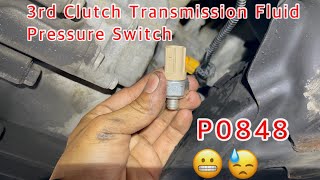
- Pressure Switch Locations and Confusion: The two most commonly failed pressure switches have specific locations. The 3rd clutch pressure switch (associated with codes P0847/P0848) is located on the front of the transmission, near the bottom, making it very easy to access from underneath the car. The 2nd clutch pressure switch (associated with code P0843) is located on the top of the transmission case, which is more difficult to access. Due to part number supersessions, there is often confusion, but forum users and parts diagrams confirm these locations.
- Owner Experience: DIY Pressure Switch Replacement: Numerous owners on forums like 8thcivic.com and in YouTube videos have documented the process of replacing the 3rd clutch pressure switch to fix a P0700/P0847 code with a flashing 'D' light. The repair is consistently described as simple, taking less than an hour with basic tools (a 22mm wrench or deep socket) and saving hundreds of dollars compared to a shop diagnosis.
Mechanic-Grade Diagnostic Values
- Shift Solenoid Resistance — expected: 12 - 25 Ohms. Failure: A reading of infinite resistance (open circuit) or near-zero (short circuit).
- A/T Clutch Pressure Control Solenoid Resistance — expected: 3 - 10 Ohms. Failure: Resistance outside of the specified range.
- Transmission Fluid Pressure Switch Connector Voltage (Key On, Connector Unplugged) — expected: 5 Volts (Reference from PCM). Failure: No voltage indicates an open circuit in the wiring harness or a PCM fault. If 5V is present, the wiring and PCM are likely good, pointing to a faulty pressure switch.
- Battery/System Voltage (Engine Running at Idle) — expected: 13.0 - 14.5 Volts. Failure: Low voltage can cause various electronic modules, including the TCM, to malfunction and set false codes.
Hidden / Shadow Codes Worth Checking
- P0843, P0847, P0848, etc.: P0700 is a generic request code from the TCM to the ECM. The actual, specific fault codes (like pressure switch or solenoid codes) are stored within the Transmission Control Module (TCM) itself. (see via A scan tool that can access the transmission control module is required. Basic engine code readers will often only show P0700. Examples include the Honda HDS, Foxwell NT-series, Autel, or BlueDriver.)
Scan Tool Commands That Help
- Honda HDS (or equivalent bidirectional scanner): A/T Data List & Inspection Menu — To monitor the live status (ON/OFF) of the transmission pressure switches. For a P0847 code ('Circuit Low'), a technician would check if the scan tool shows the switch as 'ON' even when it should be off (e.g., in Park), confirming the switch is stuck.
- Honda HDS (or equivalent bidirectional scanner): Actuator/Solenoid Test — To command a specific shift solenoid or clutch pressure solenoid to activate. The technician can listen for a 'click' from the solenoid, confirming the electrical part of the solenoid is responding to commands. This helps differentiate a wiring/TCM issue from a failed solenoid.
Wiring & Ground Locations
- Pressure Switch Connector — Varies by switch. The common 3rd clutch pressure switch is on the front of the transmission, near the bottom, with a single-wire connector.. This is the primary test point for diagnosing pressure switch codes like P0847/P0848. A technician will unplug this connector and test for 5V reference from the PCM to confirm the wiring harness and PCM are good.
- TCM/PCM Ground — General location on the vehicle's chassis or engine block.. While no single ground point is a famous failure for this code, a poor or corroded ground for the control module can cause erratic voltage readings and false transmission codes. Verifying a clean, tight ground connection is a fundamental step if wiring issues are suspected.
Real Owner Repair Stories
- YouTube user 'RB The Mechanic' (2009 Honda CR-V (similar platform and common issue)) — Flashing 'D' light, code P0847.
✅ What actually fixed it The video diagnoses the issue by locating the 3rd clutch pressure switch, noting its location and how to identify it. The fix was replacing this specific pressure switch. - YouTube user 'DIY Honda Garage' (2006 Honda Civic 1.8L) — Check Engine Light on, Flashing 'D' light, code P0848 (Transmission Fluid Pressure Switch 'B' Circuit High).
❌ Tried (didn't work) The user first checked the transmission fluid level and condition, which were fine.
✅ What actually fixed it The owner used a multimeter to test the unplugged switch connector and confirmed 5V was present, correctly ruling out a wiring or PCM issue. This confirmed the pressure switch itself was faulty. Replacing the 3rd clutch pressure switch (P/N 28600-RPC-013) and clearing the codes fixed the problem. - NHTSA ODI #11174984 — An owner of a similar Honda platform reported that within a week of driving, the check engine light came on with codes P0700, P0705, and P0740 present, all relating to the automatic transmission.
- NHTSA ODI #10479205 — A driver reported that the Check Engine, D4, and TCS lights came on simultaneously; a repair shop identified codes P0700 (Automatic Transmission Fault) and P0740 (Torque Converter Clutch Malfunction).
OEM Part Supersession History
28600-RPC-003, 28600-RPC-013→28600-RPC-004— Part update/revision by Honda to address failure rates.
Heads up: The replacement part may be a different color than the original (e.g., original green or gray replaced by black or white). This is normal and does not indicate an incorrect part if the part number is correct for the application.
Model Year Variations Within This Range
- 2006-2011: The core 1.8L R18A1 engine and 5-speed automatic transmission were used consistently throughout the 8th generation. The 2009 model year received a cosmetic facelift, but the powertrain and the common causes for P0700 (specifically, failing pressure switches) remained the same across the entire 2006-2011 range.
Diagnostic Flowchart
Other Known Issues on This Vehicle
Issues unrelated to this code that are worth knowing about as an owner of this generation:
- Cracked Engine Block (R18A1) 🔴 High — Common on 2006-2008 and early 2009 models. A manufacturing defect can cause a crack, leading to coolant loss and overheating. (Ref: Honda TSB 10-048 extended the warranty to 10 years with no mileage limit, but this has now expired for all affected vehicles.)
- Defective Rear Upper Control Arms 🟠 Medium — Widespread issue causing premature and uneven inner rear tire wear (cupping). (Ref: A class-action lawsuit was filed, and Honda issued TSB 13-047 recommending the installation of redesigned, adjustable control arms.)
- Failing Passenger-Side Engine Mount 🟠 Medium — The hydraulic passenger-side engine mount is prone to leaking and collapsing, causing excessive engine vibration to be felt in the cabin, especially at idle. (Ref: Honda TSB 06-060 addresses a rattle or knock from the right-front, pointing to this mount as the cause.)
- Failing Sun Visors 🟡 Low — Extremely common. The plastic clips holding the visor break, causing it to droop or fall down. A class-action lawsuit was filed over this issue.
- A/C Compressor Clutch Failure 🟠 Medium — Many owners report issues with the A/C system, often traced back to a failed A/C compressor clutch or relay.
Used vs. New Parts: Buying Guide for This Vehicle
When a used part is the smart pick: For this specific P0700 issue, which is most commonly caused by small electronic sensors, using used parts is not recommended. If a catastrophic internal failure occurred requiring a full transmission replacement, a low-mileage used transmission from a reputable salvage yard could be a cost-effective option.
Donor-vehicle mileage cap: roughly under 80000 miles for the part to have meaningful remaining life.
What to inspect on the donor part:
- Check fluid on dipstick (if possible): should be red, not brown or black.
- Ask for vehicle history to verify mileage and check for accidents.
- Inspect casing for cracks or heavy corrosion.
- Ensure all connectors and sensors are intact and undamaged.
OEM-only on this vehicle (don't cheap out):
- Transmission Fluid (Honda ATF-DW1 is strongly recommended)
- Transmission Control Module (TCM/PCM) - must be programmed to the vehicle's VIN.
Aftermarket brands forum-validated for this vehicle:
- Rostra (for pressure switches and solenoids)
- NTK (for sensors, if applicable)
Brands owners have reported issues with on this vehicle:
- Unbranded, no-name electronic parts from online marketplaces are a high risk for premature failure.
Real Owner Stories
Aggregated from forums and TSBs cited above. Mileages and costs reflect what owners reported in those sources.
2009 Honda Civic
Symptoms: The green 'D' (Drive) light on the instrument cluster was flashing and the scanner showed code P0717.
What fixed it: The issue was resolved by replacing the input speed sensor, specifically part number 28810-RPC-013.
Source hint: owner_reports
2008 Honda Civic
Symptoms: Flashing 'D' light and code P0847.
What fixed it: Replacing the 3rd clutch pressure switch. The owner described the repair as simple, taking less than an hour with a 22mm wrench.
Source hint: 8thcivic.com - 'P0847 Fix - 2008 Civic'
Honda Pilot (Cross-Model Reference)
Symptoms: An owner reported that after a diagnostic test, the transmission failure was identified with codes P0730, P0700, P07A6, P07A8, and P07A4 (NHTSA ODI #11713610).
Honda Pilot (Cross-Model Reference)
Symptoms: A system report indicated permanent transmission codes of P0716 and P0700; neither the body shop nor the dealership could initially pinpoint the issue (NHTSA ODI #11451395).
Related OBD-II Codes
Frequently Asked Questions
My 2008 Civic has a flashing 'D' light and code P0700. Which pressure switch is likely the problem?
Can I use any transmission fluid to fix the shifting issues on my 2006-2011 Civic?
Is there a TSB for transmission damage caused by getting stuck in snow?
I have a 2007 Civic with a cracked engine block; is this related to the P0700 code?
What tool do I need to replace the transmission pressure switches myself?
Does the Acura CSX suffer from the same P0700 transmission issues as the Civic?
Helpful Videos

We Have This Part in Stock

The information in this article is provided for general reference and educational purposes only. Vehicle specifications, procedures, and part compatibility can vary by production date, trim level, and region. Always consult your vehicle's factory service manual and verify part numbers before purchasing or performing repairs. Safety-critical components such as airbags, seat belts, and braking systems should be installed by a qualified professional.
- Honda Civic:
- 🧭 Diagnostic Flowchart
- 🎬 Helpful Videos
- 🛍️ Shop This Part
- What's Unique About the 2006-2011 Honda Civic
- Symptoms You May Notice
- Most Likely Causes
- Rare But Worth Checking
- Diagnosis Steps
- Parts You'll Likely Need
- Related Codes That Often Appear With This One
- Technical Service Bulletins (TSBs) & Recalls
- Platform-Specific Known Issues
- Mechanic-Grade Diagnostic Values
- Hidden / Shadow Codes Worth Checking
- Scan Tool Commands That Help
- Wiring & Ground Locations
- Real Owner Repair Stories
- OEM Part Supersession History
- Model Year Variations Within This Range
- Other Known Issues on This Vehicle
- Used vs. New Parts: Buying Guide for This Vehicle
- Real Owner Stories
- 2009 Honda Civic
- 2008 Honda Civic
- Honda Pilot (Cross-Model Reference)
- Honda Pilot (Cross-Model Reference)
- Related OBD-II Codes
- Frequently Asked Questions
- 🎟️ Get 5% Off