

P0700 on 2007-2012 Hyundai Santa Fe: Transmission Control System Fault Causes and Fixes
P0700 on a 2007-2012 Santa Fe means the transmission computer has detected a fault. It's a general code, but the most common specific cause is a faulty inhibitor switch (neutral safety switch). This is a well-known issue confirmed by Hyundai TSBs. You'll need a more advanced scanner to read the specific transmission codes (like P0705-P0708) to confirm the diagnosis.
- P0700 is a general alert from your transmission; you MUST scan for more specific codes.
- For the 2007-2012 Santa Fe, the most likely culprit is a faulty inhibitor switch (part # 42700-39055), a known issue confirmed by a TSB.
- Always check the transmission fluid level and condition first, as it's a simple and common cause of transmission problems.
- Do not drive the vehicle extensively with this code, as you risk causing more serious transmission damage.
What's Unique About the 2007-2012 Hyundai Santa Fe
On this generation of Hyundai Santa Fe (known as the 'CM' platform), the P0700 code is very frequently a precursor to more specific codes related to the inhibitor switch (also called a transmission range sensor or neutral safety switch). Hyundai has issued Technical Service Bulletins (TSB 17-AT-005, later superseded by 19-AT-024H) that directly address the failure of this switch on 2007-2012 models. This failure can cause a no-start condition, incorrect gear display, and force the transmission into a fail-safe mode (often stuck in 4th gear). While the TSB focuses on codes P0705-P0708, P0700 is the general fault code that alerts the driver by turning on the check engine light.
Symptoms You May Notice
- Check Engine Light is on
- Vehicle may be stuck in 'limp mode' (fail-safe gear, often 4th).
- Harsh or erratic shifting.
- Inability to shift gears
- Hesitation or stalling.
- Incorrect or no gear position indicated on the dashboard.
- Engine will not start or has an intermittent no-start condition (may start in Neutral but not in Park).
- Traction control (ESC) or other warning lights may also illuminate.
- Replacing the entire transmission without first diagnosing the specific fault. Many issues that trigger P0700 are external electronic components like the inhibitor switch.
- Blaming the Engine Control Module (ECM) when the fault lies within the transmission system.
- Ignoring the code because the vehicle still drives, which can lead to being stranded or causing more severe and expensive damage.
Most Likely Causes
- Faulty Inhibitor Switch (Transmission Range Sensor) 🔴 High Probability → Shop Transmission Park Inhibitor Switch This is a well-documented failure point for this vehicle, as acknowledged by Hyundai's Technical Service Bulletins (17-AT-005 and 19-AT-024H). The switch is mounted on top of the transmission, where it is exposed to heat and moisture, making it susceptible to internal corrosion and wear.
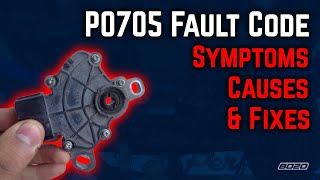
How to confirm: Use a scan tool to check for codes P0705, P0706, P0707, or P0708 🎬 Watch: Understanding the P0705 code and how to fix it stored in the TCM. A common real-world test is to see if the car starts in Neutral but not in Park. You can also use a scan tool's live data to watch the gear position signal as you move the shifter; any dropouts or incorrect readings confirm a bad switch.
Typical fix: Replace the inhibitor switch. This requires removing the air intake, battery, and battery tray for access. The new switch must be correctly aligned in the Neutral position using a 5mm pin or bolt before tightening the lever nut.
Est. part cost: $40-$100 - Low or Degraded Transmission Fluid 🟡 Medium Probability → Shop Transmission Assembly
How to confirm: Check the transmission fluid level and condition using the dipstick with the engine warm and running. The fluid should be bright red and not smell burnt. Dark, brown, or fluid with metal particles indicates a serious internal problem.
Typical fix: If low, top off with Hyundai-specific fluid (e.g., SP-IV or equivalent). If dirty or degraded, perform a transmission fluid and filter change. Note that if the fluid has never been changed at high mileage, a fluid change can sometimes cause issues.
Est. part cost: $50-$150 for fluid and filter - Faulty Shift Solenoid(s) ⚪ Low Probability → Shop Transmission Valve Body
How to confirm: A transmission-capable scan tool will show specific solenoid-related trouble codes (e.g., P0750-P0774). The faulty solenoid can be identified and its circuit tested with a multimeter.
Typical fix: Replace the specific faulty shift solenoid. This usually requires removing the transmission oil pan and sometimes the valve body.
Est. part cost: $50-$150 per solenoid
Rare But Worth Checking
- Damaged Wiring or Connectors: Check the wiring harness leading to the transmission and the inhibitor switch for any signs of corrosion, chafing, or damage. The main connector at the transmission case is a key inspection point. A poor ground connection can also cause similar electrical faults.
- Faulty Transmission Control Module (TCM): → Shop Transmission Assembly TCM failure is rare but possible. This should only be considered after all other possibilities (sensors, solenoids, wiring) have been thoroughly ruled out. A P0700 code with no other accompanying codes can sometimes point to a faulty TCM, but this is uncommon.
- Weak or Failing Battery: → Shop Vehicle Battery A battery with low voltage can cause a variety of erroneous codes to be set by different modules, including the TCM. Before diving into complex diagnostics, ensure the battery and charging system are healthy.
Diagnosis Steps
- Check the transmission fluid level and condition. Ensure it is full, clean, and does not smell burnt.
- Use a scan tool capable of reading transmission-specific codes. A basic OBD-II reader will only show P0700.
- Record all codes stored in the Transmission Control Module (TCM).
- If codes P0705-P0708 are present, the inhibitor switch is the primary suspect. Try starting the vehicle in Neutral; if it starts in 'N' but not 'P', this strongly indicates a faulty inhibitor switch.
- If other codes are present (e.g., for solenoids or speed sensors), diagnose those specific components first.
- Inspect the wiring harness and connectors at the transmission, especially the inhibitor switch connector, for any visible damage, corrosion, or loose connections.
- If no other codes are present and the fluid is good, investigate the possibility of a wiring issue or, as a last resort, a faulty TCM.
Parts You'll Likely Need
- Inhibitor Switch / Transmission Range Sensor
(OEM #42700-39055)— This is the most frequent cause of P0700 and related transmission codes on the 2007-2012 Santa Fe, as documented in TSB 17-AT-005 and its successor. This part number supersedes the older 42700-39050.
Trusted brands: Hyundai (OEM), Standard Motor Products, Dorman
OEM price range: $80-$120
Aftermarket price range: $40-$80
Related Codes That Often Appear With This One
- P0705, P0706, P0707, P0708 — These codes directly relate to the inhibitor switch (transmission range sensor) circuit, which is the most common point of failure on this vehicle and the direct cause of the P0700 light. 🎬 Watch: Common causes and fixes for range sensor malfunctions
- P0715-P0728 — These codes relate to input/output speed sensors, which can also trigger a general transmission fault if they fail.
- P0750-P0774 — These codes point to issues with specific shift solenoids, another possible but less common cause for transmission problems on this platform.
Technical Service Bulletins (TSBs) & Recalls
- TSB 17-AT-005: Addresses diagnosis for inhibitor switch DTCs P0705, P0706, P0707 & P0708, which are a primary cause for P0700 on this vehicle.
- TSB 19-AT-024H: Supersedes TSB 17-AT-005, updating the service procedure and expanding the list of applicable vehicles with the same inhibitor switch issue.
Platform-Specific Known Issues
- A widely known issue with the inhibitor switch (transmission range sensor) is documented in Hyundai TSB 17-AT-005 and later TSB 19-AT-024H, which applies to the 2007-2012 Santa Fe. Symptoms include MIL illumination, 4th gear fail-safe, no gear indication on the cluster, and intermittent no-start conditions. Owners on forums frequently report solving these exact symptoms by replacing this switch.
Mechanic-Grade Diagnostic Values
- Inhibitor Switch Signal Voltage — expected: With the key on, approximately 12V at the specific output pin for the selected gear, and 0V on the others.. Failure: 0V on the pin corresponding to the selected gear indicates an internal switch failure or an open circuit.
- Inhibitor Switch Connector Pin Voltages — expected: Pin 3: ~12V (Power In). Pin 8: ~12V in Park. Pin 4: ~12V in Reverse. Pin 7: ~12V in Neutral. Pin 9: ~12V in Drive.. Failure: No voltage on Pin 3 indicates a fuse or power supply issue. No voltage on the corresponding signal pin when a gear is selected points to a bad switch.
- Shift Solenoid Resistance (for 6-speed automatics, 2010-2012) — expected: On/off type solenoids (typically two) should measure ~10-11 ohms. Pulse-width modulated (PWM) solenoids (typically six) should measure ~5 ohms.. Failure: A reading of infinite resistance (OL) indicates an open coil. A reading near zero indicates a short. A value significantly outside the expected range indicates a failing solenoid.
- Ground Point Voltage Drop — expected: Less than 0.2V (200mV) between the ground point (e.g., transmission case) and the negative battery terminal.. Failure: Voltage greater than 0.2V indicates high resistance in the ground connection, which can cause erratic behavior of electronic components.
Hidden / Shadow Codes Worth Checking
- N/A - Standard P-codes in TCM: Hyundai does not use proprietary 'shadow' or 'hidden' codes for this fault. The P0700 in the ECM is triggered by standard, but more specific, P-series diagnostic trouble codes (e.g., P0705, P0750) stored within the Transmission Control Module (TCM). (see via These codes are not visible with a basic OBD-II reader but can be accessed using a more advanced scan tool that can communicate directly with the TCM.)
Scan Tool Commands That Help
- Hyundai GDS (Global Diagnostic System) or equivalent professional scanner: Solenoid Actuation Test / Actuation Test — This bidirectional command is used to manually trigger a specific shift solenoid. If a solenoid's resistance tests as good but a shifting problem persists for that circuit, this test can determine if the solenoid is mechanically stuck. Hearing a 'click' confirms the solenoid is moving; no click suggests it's seized.
- Hyundai GDS (Global Diagnostic System) or equivalent professional scanner: Reset Adaptive Values / Resetting Auto T/A Values — After replacing major transmission components like the valve body or solenoids, or performing a fluid service, resetting the transmission's adaptive learning values is recommended. This forces the TCM to relearn shift pressures and timing with the new components, which can resolve harsh or erratic shifting.
Wiring & Ground Locations
- Inhibitor Switch Connector — On top of the transmission housing, located underneath the battery and battery tray.. This is the primary connection point for the most common failing part. Corrosion (green/white powder) or backed-out pins in this connector can mimic a failed switch, causing codes P0705-P0708 and triggering the P0700.
- TCU / TCU2 Fuses — Located in the engine compartment junction box (fuse box).. These fuses supply power to the transmission control circuits, including the inhibitor switch. A blown fuse will cause a loss of signal and trigger a fault code.
- Transmission Case Ground — A ground wire or strap bolted directly to the metal case of the transmission, near the inhibitor switch area.. A loose or corroded transmission ground can create a high-resistance path, causing erratic voltage signals from all transmission sensors. This can lead to multiple, seemingly unrelated transmission codes and is often missed during diagnosis.
- ECM/PCM Location — For the 2007-2012 Santa Fe, the Engine Control Module is located under the hood, near the battery.. The TCM is often integrated with or located next to the ECM. Knowing its location is critical for inspecting the main harness connectors for corrosion or damage and for testing wiring continuity back from the transmission sensors.
Real Owner Repair Stories
- hyundai-forums.com user report (2007 Hyundai Santa Fe) — Check engine light on with codes P0700 and P0707. Vehicle would not crank/start when the gear selector was in Park.
❌ Tried (didn't work) Initial diagnosis was inconclusive without checking for the common symptom.
✅ What actually fixed it Owner confirmed the vehicle would start when shifted into Neutral. Based on this classic symptom, they replaced the inhibitor switch (transmission range sensor), which completely resolved the no-start condition and cleared the codes. - NHTSA ODI #10143151 — In a related manufacturer case, a dealer invoice noted a failed transmission range switch and failed transmission pulse generators after scanning for codes P0700 (TR switch short) and P0722 (output speed sensor open/short).
OEM Part Supersession History
42700-39050→42700-39055— Component revision and improvement by the manufacturer.
Heads up: The newer part number 42700-39055 is the correct and direct service replacement for the older 42700-39050 part used on this vehicle generation.
Model Year Variations Within This Range
- 2007-2009: Pre-facelift models used either a 2.7L V6 with a 4-speed automatic or a 3.3L V6 with a 5-speed automatic transmission.
- 2010-2012: The facelifted models received new powertrains: a 2.4L I4 or a 3.5L V6, both paired with a new 6-speed automatic transmission. While the P0700 code is the same, the specific internal components (like shift solenoids) and their diagnostic values may differ from the earlier 4 and 5-speed transmissions.
Diagnostic Flowchart
Real Owner Stories
Aggregated from forums and TSBs cited above. Mileages and costs reflect what owners reported in those sources.
2007 Hyundai Santa Fe 2.2 CRDi
Symptoms: Transmission stuck in 3rd gear, low power, limp mode. CEL with code P0700.
What fixed it: Replaced the Input Shaft Speed (ISS) sensor, which did not fully resolve the issue but changed the fault code from P0700 to P0765 (Shift Solenoid D malfunction).
Source hint: Reddit r/MechanicAdvice
2009 Hyundai Santa Fe 2.2 diesel automatica — 139836 miles
Symptoms: Check engine light on with P0700, transmission felt like it was slipping from 2nd to 3rd gear.
What fixed it: Changed the transmission fluid and filter, which turned off the check engine light.
Source hint: Opinautos forum
2007 Hyundai Santa Fe
Symptoms: Car wouldn't start, threw codes P0700 and P0707, but would start in Neutral.
What fixed it: Replaced the inhibitor switch (part #42700-39055).
Source hint: hyundai-forums.com - Thread titled '2007 Santa Fe won't start, P0707'
Related OBD-II Codes
Frequently Asked Questions
Does Hyundai have any Technical Service Bulletins for the P0700 code on the 2007-2012 Santa Fe?
My 2007 Santa Fe has a P0700 code and won't start in Park, but it starts fine in Neutral. What does this mean?
Where is the inhibitor switch located on the 2007-2012 Santa Fe, and how hard is it to replace?
Are there any special steps required when installing a new inhibitor switch on this vehicle?
What transmission fluid should I use if I'm doing a fluid change to fix a P0700 code?
Can a bad shift solenoid cause the P0700 code on my Santa Fe?
Helpful Videos


We Have This Part in Stock


The information in this article is provided for general reference and educational purposes only. Vehicle specifications, procedures, and part compatibility can vary by production date, trim level, and region. Always consult your vehicle's factory service manual and verify part numbers before purchasing or performing repairs. Safety-critical components such as airbags, seat belts, and braking systems should be installed by a qualified professional.
- Hyundai Santa Fe:
- 🧭 Diagnostic Flowchart
- 🎬 Helpful Videos
- 🛍️ Shop This Part
- What's Unique About the 2007-2012 Hyundai Santa Fe
- Symptoms You May Notice
- Most Likely Causes
- Rare But Worth Checking
- Diagnosis Steps
- Parts You'll Likely Need
- Related Codes That Often Appear With This One
- Technical Service Bulletins (TSBs) & Recalls
- Platform-Specific Known Issues
- Mechanic-Grade Diagnostic Values
- Hidden / Shadow Codes Worth Checking
- Scan Tool Commands That Help
- Wiring & Ground Locations
- Real Owner Repair Stories
- OEM Part Supersession History
- Model Year Variations Within This Range
- Real Owner Stories
- 2007 Hyundai Santa Fe 2.2 CRDi
- 2009 Hyundai Santa Fe 2.2 diesel automatica — 139836 miles
- 2007 Hyundai Santa Fe
- Related OBD-II Codes
- Frequently Asked Questions
- 🎟️ Get 5% Off