

P0700 on 1997-2006 Jeep Wrangler 4.0L: Causes and Fixes for Transmission Faults
P0700 on a Jeep Wrangler TJ means the transmission has a problem. The most likely cause depends on the year: for 2003-2006 models with the 42RLE transmission, it's often a faulty solenoid pack (~$150-$300). For 1997-2002 models with the 32RH, it's less common but may point to a governor pressure solenoid. You must scan the TCM for specific codes to know the exact issue.
- P0700 is a general alert from your transmission. You MUST use an advanced scanner to read the specific codes stored in the Transmission Control Module (TCM) to find the real problem.
- For 2003-2006 Wranglers with the 4-speed 42RLE automatic, the most likely cause is a failed transmission solenoid pack.
- For 1997-2002 Wranglers with the 3-speed 32RH automatic, check the governor pressure solenoid and sensor.
- Always check your transmission fluid level and condition first. Use only Mopar ATF+4 fluid.
- Do not replace the main computer (PCM/TCM) unless all other possibilities, including wiring and sensors/solenoids, have been ruled out.
What's Unique About the 1997-2006 Jeep Wrangler
The 1997-2006 Jeep Wrangler TJ's reliability with code P0700 is a tale of two different transmissions. Early TJs (1997-2002) used the simpler, hydraulically-controlled 32RH 3-speed automatic, where P0700 is less frequent. The later TJs (2003-2006) introduced the electronically complex 42RLE 4-speed automatic, which is notoriously prone to issues with its solenoid pack, making it the most common source of P0700 on these later models. Owners of 2003-2006 models often find themselves dealing with limp mode caused by this specific, well-documented failure point. For 2005-2006 models, the PCM and TCM are integrated into a single unit, which is also a known failure point that can cause P0700 along with other codes.
Generation note: The 1997-2006 Jeep Wrangler TJ is a single generation, but it used two different automatic transmissions with the 4.0L engine. This is a critical distinction for diagnosing P0700. - 1997-2002: Used the 3-speed 32RH automatic transmission. This is a more robust, hydraulically controlled unit with fewer electronic failure points. - 2003-2006: Used the 4-speed 42RLE automatic transmission. This unit is more electronically complex and is known for specific, common failure points that trigger P0700, particularly the solenoid pack and, on 05-06 models, the integrated PCM/TCM.
Symptoms You May Notice
- Check Engine Light (Malfunction Indicator Lamp) is on.
- Transmission entering "limp mode" (stuck in 2nd or 3rd gear).
- Harsh or erratic shifting.
- Delayed gear engagement.
- Vehicle stalling at low speeds or when coming to a stop, especially when the transmission is warm.
- Inability to shift into higher gears.
- Reduced fuel economy.
- Replacing the Transmission Control Module (TCM/PCM) first. Module failure is less common than sensor or solenoid failure, though it is a known issue on 2005-2006 models. Always diagnose sensors, solenoids, and wiring first.
- Clearing the code without reading the specific TCM codes. P0700 is just a messenger; ignoring the underlying codes stored in the TCM means you are ignoring the real problem.
- Replacing the solenoid pack when the issue is a sticking valve in the valve body or a wiring problem.
Most Likely Causes
- Faulty Transmission Solenoid Pack (2003-2006 with 42RLE) 🔴 High Probability → Shop Transmission Assembly The 42RLE transmission is widely known for solenoid pack failures. The solenoid pack controls fluid flow for shifting, and internal electrical faults or sticking valves within the pack are a common wear item, often failing after the vehicle warms up.
How to confirm: Scan the TCM for specific solenoid codes (e.g., P0750, P0755, P0760, P0765). The issue is often intermittent and may only appear when the transmission fluid is hot. Resistance for individual shift solenoids should be between 1.5 and 2.5 ohms.
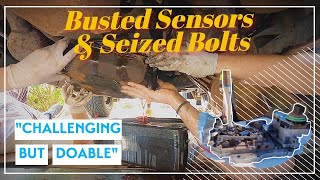
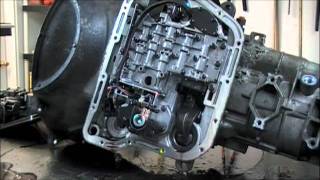
Typical fix: Replace the entire solenoid pack assembly. 🎬 Watch: This walkthrough shows how to replace the 42RLE solenoid pack. This requires dropping the transmission pan, replacing the filter and gasket, and refilling with approximately 4-5 quarts of Mopar ATF+4 fluid.
Est. part cost: $150-$350 - Faulty Governor Pressure Solenoid/Sensor (1997-2002 with 32RH) 🟡 Medium Probability On the earlier 32RH and related Chrysler transmissions (A500/42RE family), the governor pressure solenoid and sensor are common failure points that regulate line pressure for shifting. Debris can contaminate the solenoid, causing it to stick.
How to confirm: Scan the TCM for pressure-related codes. A mechanic can monitor governor pressure readings with a scan tool during a test drive to see if it matches the desired pressure.
Typical fix: Replace the governor pressure solenoid and sensor, which are located inside the transmission pan. They are often sold as a kit. 🎬 See how to replace the governor pressure solenoid and sensor.
Est. part cost: $100-$200 - Low or Dirty Transmission Fluid 🟡 Medium Probability → Shop Transmission Assembly Off-road use can lead to leaks from pan damage, and extended fluid change intervals cause fluid breakdown. Burnt or low fluid affects hydraulic pressure, causing shifting issues and solenoid wear.
How to confirm: Check the transmission fluid level and condition using the dipstick (engine running, in neutral, on a level surface). Fluid should be bright red and not smell burnt.
Typical fix: Top off with Mopar ATF+4 fluid if low. If dirty or burnt, perform a transmission fluid and filter change. This is required for any internal repairs anyway.
Est. part cost: $50-$150 - Faulty Input/Output Speed Sensors ⚪ Low Probability
How to confirm: Scan the TCM for specific speed sensor codes (e.g., P0721). A discrepancy between input and output speed sensor readings can trigger limp mode. Sometimes, aftermarket speedometer correction devices can interfere with these signals.
Typical fix: Replace the faulty sensor. These are typically mounted externally on the transmission case, making for a relatively easy replacement.
Est. part cost: $20-$60 per sensor
Rare But Worth Checking
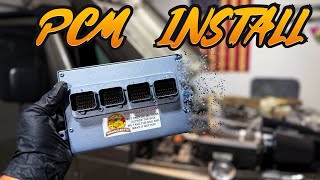
- Faulty Powertrain Control Module (PCM) / Transmission Control Module (TCM): → Shop Engine Control Module (ECM) On 2005-2006 models, the TCM is integrated into the PCM, and these units are a known failure point, causing intermittent shifting issues, stalling, and various codes including P0700. For 2003-2004 models, the separate TCM can also fail. This should be considered after solenoids and wiring are ruled out. Companies like WranglerFix.com specialize in repairing these modules.
- Damaged Wiring Harness or Connectors: Given the Wrangler's off-road nature, wiring to the transmission can get damaged by debris, heat from the exhaust, or corrosion from water/mud. A common issue is the harness melting on the exhaust manifold or chafing where it routes over the transmission. A thorough visual inspection of the harness from the PCM/TCM to the transmission is crucial.
- Sticking Solenoid Switch Valve in Valve Body: → Shop Transmission Valve Body Separate from the solenoid pack itself, a solenoid switch valve within the valve body can become sticky or clogged with debris. This was noted in TSB 21-001-13 for a P1776 code, which can accompany a P0700. This requires removing and servicing the valve body itself, which is more complex than a solenoid pack swap.
Diagnosis Steps
- Check and correct the transmission fluid level and condition. Ensure the fluid is Mopar ATF+4.
- Use an advanced scan tool capable of communicating with the Jeep's Transmission Control Module (TCM).
- Read and record all DTCs from the TCM. Do not just read the PCM codes.
- Analyze the specific transmission codes. Codes in the P0750-P0770 range point to solenoid issues. P0888 points to a power supply problem. P1776 points to a valve body issue.
- For solenoid codes on a 42RLE (2003-2006), the solenoid pack is the primary suspect.
- For pressure codes on a 32RH (1997-2002), the governor pressure solenoid and sensor are the primary suspects.
- Inspect the transmission wiring harness and connectors for any signs of damage, corrosion, or loose connections. Pay close attention to the area behind the engine near the exhaust manifold and the main connector at the transmission.
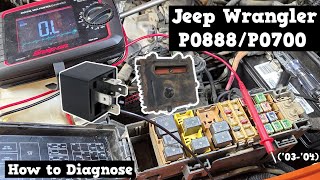
- If P0888 is present, test the transmission control relay and check for power and ground at the relay socket 🎬 Watch: A pro diagnostic guide for P0888 and P0700 codes. and the TCM connector.
- If a 2005-2006 model has persistent, intermittent issues with no clear sensor/solenoid fault, investigate the PCM/TCM itself. A common diagnostic step is to monitor power and ground signals to the module during a drive to check for dropouts.
Parts You'll Likely Need
- Transmission Solenoid Pack (for 2003-2006 42RLE)
(OEM #5143155AA (Superseded by 68376696AA))— This is the most common failure point on the 42RLE transmission that triggers a P0700
Related Codes That Often Appear With This One
- P0750-P0770 — These codes point to specific issues with the shift solenoids (e.g., P0750 for Low/Reverse, P0765 for Shift Solenoid D). Seeing one of these alongside P0700 on a 42RLE transmission makes the solenoid pack the primary suspect.
- P0888 — This code indicates an issue with the power supply to the TCM (Transmission Relay Output Always Off). It often appears with P0700 and points towards a faulty transmission control relay, a wiring issue between the relay and the TCM/PCM, or a faulty control module itself.
- P1776 — This code means the 'Solenoid Switch Valve Latched in LR Position'. It often points to a sticky valve in the valve body, not necessarily the solenoid pack. TSB 21-001-13 was issued for this problem on 2003-2004 Wranglers with the 42RLE.
Technical Service Bulletins (TSBs) & Recalls
- TSB 21-001-13 (Supersedes 21-008-04): Addresses DTC P1776 (Solenoid Switch Valve Latched in LR Position) for 2003-2004 Wranglers with the 42RLE. It guides technicians to check shifter cable adjustment or inspect the valve body for a sticky solenoid switch valve, which is separate from the main solenoid pack.
Platform-Specific Known Issues
- 2005-2006 Integrated PCM/TCM Failure: The 2005 and 2006 TJ/LJ models have the TCM integrated into the PCM. These modules are located on the firewall and are prone to failure from heat and vibration over time. Symptoms are often intermittent and can mimic a bad solenoid pack, including hard shifts (especially 1-2), stalling, and throwing codes like P0700, P1603, and P1604. A popular and effective fix is replacing the unit with a remanufactured one from a specialist like WranglerFix.
- DIY Solenoid Pack Replacement on 42RLE: → Shop Transmission Valve Body Many owners have successfully replaced the 42RLE solenoid pack at home. A YouTube video by 'Some Guy Outside' provides a detailed walkthrough on a Jeep, highlighting challenges like removing the corroded shift linkage clamp and the messiness of the job. The repair fixed limp mode and stalling at low speeds. Another video by 'Bang4Buck' on a 2010 Wrangler shows the process and mentions the need for a 'quick learn' procedure with a capable scan tool after installation.
- Diagnosing P0700 and P0888 with a Multimeter: A YouTube video by 'SAPS Az' on a 2003 Wrangler with P0700 and P0888 demonstrates a step-by-step electrical diagnosis. The technician tests the transmission control relay, then checks for continuity on the wiring between the relay socket and the TCM connector pins. After confirming the relay and wiring were good, the final diagnosis was a defective TCM, which was replaced with a used unit, solving the problem.
Mechanic-Grade Diagnostic Values
- 42RLE Shift Solenoid Resistance — expected: 1.5 - 2.5 ohms (when tested through the harness). Failure: A reading of infinite ohms indicates an open circuit in the solenoid coil. A reading near zero ohms indicates a short circuit.
- Transmission Control Relay Coil Resistance (for P0888 diagnosis) — expected: ~75 ohms. Failure: A significantly higher or lower reading suggests a faulty relay coil.
- TCM Power Supply (2005-2006 models) — expected: Stable battery voltage at Pin 29 (fused B+) and solid ground at Pin 18 of the C4 (black) connector at the PCM.. Failure: Voltage that drops out or flickers during a test drive (monitored with a test light or oscilloscope) indicates an intermittent power/ground issue to the module or an internal PCM fault.
Scan Tool Commands That Help
- DRB III or equivalent (Autel, Snap-on): Quick Learn Procedure — This function should be used after replacing the solenoid/pressure switch assembly, valve body, or the entire transmission. It allows the TCM to relearn adaptive values and pressure characteristics for the new components, preventing harsh or erratic shifts.
Wiring & Ground Locations
- Main Engine/PCM Ground — A primary ground point is located on the engine block, near the oil dipstick tube. Another key ground strap runs from the back of the cylinder head to the firewall.. A poor ground at these locations can cause a host of intermittent electrical problems, including erratic TCM/PCM behavior, incorrect sensor readings, and false codes.
- Transmission Harness Chafe Point 1 — The wiring harness that runs over the top of the transmission bellhousing.. Vibration and heat can cause the plastic loom to disintegrate, allowing wires to chafe against the transmission case, leading to shorts that can trigger P0700 and other transmission codes.
- Transmission Harness Chafe Point 2 — Behind the engine block, where the harness can make contact with the hot exhaust manifold.. The exhaust heat can melt the wire insulation, causing shorts between circuits for the solenoids, sensors, or the TCM power supply, leading to limp mode and codes like P0700 and P0888.
- PCM Connector C4 (Black) - 2005-2006 models — The black connector on the Powertrain Control Module, located on the firewall.. Pin 29 is the fused battery positive feed and Pin 18 is the ground for the internal TCM logic. Testing for stable power and ground at these pins is a key step in diagnosing a suspected faulty PCM.
Documented NHTSA Reports
- NHTSA ODI #11376167: An owner reported that occasionally the transmission ceased in first gear. Diagnostic codes retrieved included P0700 (TCM) and P0734 (incorrect gear ratio).
- NHTSA ODI #11268694: A report describes a vehicle where RPMs were raising high before shifting. After the check engine light appeared, codes P0700, P0562, and P0750 were found. The owner attempted repairs by changing the battery, throttle body, and transmission fluid and filters.
- NHTSA ODI #11308068: An owner experienced a check engine light incident with codes U0404 and P0700. In this instance, a mechanic suggested driving the vehicle for a while to see if the failure codes would clear on their own.
- NHTSA ODI #10984300: A report mentions that the P0700 transmission control system malfunction is a known issue discussed on multiple forums, describing it as malfunctioning in an unsafe manner.
- NHTSA ODI #10992967: A report indicates a diagnosed P0700 code associated with shifting problems, specifically slipping or "free wheeling."
Real Owner Repair Stories
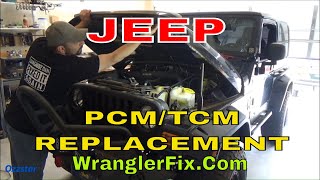
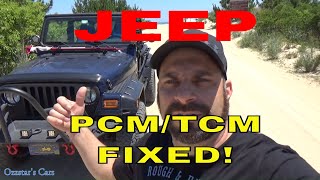
- Ozzstar YouTube Channel (2006 Jeep Wrangler TJ with automatic transmission) — Harsh clunk when shifting from 1st to 2nd, Check Engine Light on with codes P1603, P1604, and P0700.
❌ Tried (didn't work) Owner had tried multiple rebuilt PCMs that did not work correctly (caused no-start or incorrect fuel gauge readings).
✅ What actually fixed it Replacing the factory PCM with a specialized remanufactured unit from WranglerFix.com resolved the shifting issues and codes. The diagnosis confirmed stable power and ground to the PCM, proving the fault was internal to the module. - JLwranglerforums.com user report (Jeep Wrangler (newer model, but illustrates a common TJ issue)) — Transmission going into limp mode, multiple codes.
❌ Tried (didn't work) Initial diagnosis was inconclusive.
✅ What actually fixed it A technician found the transmission wiring harness was resting on the exhaust, melting the insulation and causing a short circuit. The plastic clip meant to secure the harness had failed. Repairing the wiring and securing it away from the exhaust fixed the problem. - YouTube channel "Problem Solver Garage" (Jeep with 42RLE transmission) — Limp mode, codes P1775 and P1776.
❌ Tried (didn't work) Replacing the solenoid pack would not have fixed this issue.
✅ What actually fixed it The problem was a mechanically stuck Solenoid Switch Valve inside the valve body itself, caused by debris. The fix required removing the valve body, disassembling it, and cleaning the bore for the switch valve to allow it to move freely again.
OEM Part Supersession History
5143155AA→68376696AA (which is further superseded by 68371508AB)— Standard part revision and improvement by the manufacturer.
Heads up: While many aftermarket solenoid packs are available, forums frequently warn of high failure rates. Using a genuine Mopar part or a reputable aftermarket brand like Rostra is often recommended to avoid premature failure.
Model Year Variations Within This Range
- 2003-2004: These years use a separate Transmission Control Module (TCM) located under the dashboard near the steering column. A P0700 could be caused by a failure of this separate module.
- 2005-2006: The TCM is integrated into the main Powertrain Control Module (PCM) on the firewall. These integrated modules are a very common failure point, causing P0700 and other intermittent transmission and engine issues, often when hot.
Diagnostic Flowchart
Real Owner Stories
Aggregated from forums and TSBs cited above. Mileages and costs reflect what owners reported in those sources.
2005 Jeep Wrangler TJ 4.0L
Symptoms: Vehicle went into limp mode and threw codes P0700 and P0765 (Shift Solenoid D Malfunction).
What fixed it: Replaced the PCM with a remanufactured unit from WranglerFix.com after checking the wiring harness behind the engine block for melting.
Source hint: Reddit - 05 jeep tj automatic 4.0..help! P0700 & P0765
2004 Jeep Wrangler TJ
Symptoms: Triggered a P0700 code and became stuck in limp mode.
What fixed it: Replaced the 42RLE transmission solenoid pack.
Source hint: WranglerTJForum - P0700 Limp Mode - Solenoid Pack?
2003 Jeep Wrangler
Symptoms: Check engine light illuminated with codes P0700 and P0888.
What fixed it: Replaced a defective TCM with a used unit. This was done after using a multimeter to confirm the transmission control relay and wiring continuity between the relay socket and TCM connector were good.
Source hint: YouTube video by 'SAPS Az' (Diagnosing P0700 and P0888 with a Multimeter)
Jeep Wrangler (42RLE Transmission)
Symptoms: Transmission entered limp mode and the vehicle was stalling at low speeds.
What fixed it: Performed a DIY replacement of the 42RLE solenoid pack at home, which involved removing a corroded shift linkage clamp.
Source hint: YouTube video by 'Some Guy Outside' (DIY Solenoid Pack Replacement on 42RLE)
Related OBD-II Codes
Frequently Asked Questions
Does TSB 21-001-13 apply to my Jeep Wrangler for code P0700?
I have a 2005-2006 Wrangler with P0700 and hard shifting. Is it definitely the solenoid pack?
What transmission fluid should I use when replacing the solenoid pack on my 42RLE?
My 1997-2002 Wrangler with the 32RH transmission has P0700. What are the most common causes?
I'm getting P0700 and P0888 on my Jeep. Do I need a new transmission?
Where should I check for wiring damage on my 4.0L Wrangler if I have P0700?
Helpful Videos
We Have This Part in Stock

The information in this article is provided for general reference and educational purposes only. Vehicle specifications, procedures, and part compatibility can vary by production date, trim level, and region. Always consult your vehicle's factory service manual and verify part numbers before purchasing or performing repairs. Safety-critical components such as airbags, seat belts, and braking systems should be installed by a qualified professional.
- Jeep Wrangler:
- 🧭 Diagnostic Flowchart
- 🎬 Helpful Videos
- 🛍️ Shop This Part
- What's Unique About the 1997-2006 Jeep Wrangler
- Symptoms You May Notice
- Most Likely Causes
- Rare But Worth Checking
- Diagnosis Steps
- Parts You'll Likely Need
- Related Codes That Often Appear With This One
- Technical Service Bulletins (TSBs) & Recalls
- Platform-Specific Known Issues
- Mechanic-Grade Diagnostic Values
- Scan Tool Commands That Help
- Wiring & Ground Locations
- Documented NHTSA Reports
- Real Owner Repair Stories
- OEM Part Supersession History
- Model Year Variations Within This Range
- Real Owner Stories
- 2005 Jeep Wrangler TJ 4.0L
- 2004 Jeep Wrangler TJ
- 2003 Jeep Wrangler
- Jeep Wrangler (42RLE Transmission)
- Related OBD-II Codes
- Frequently Asked Questions
- 🎟️ Get 5% Off