

P0700 on 2001-2008 Mazda Tribute: Transmission Control System Malfunction Causes and Fixes
On a 2001-2008 Mazda Tribute, P0700 is a general alert that the transmission has a problem. It doesn't specify the fault, but the most common underlying issues are a failed Transmission Range Sensor or a bad shift solenoid. You must scan the Transmission Control Module (TCM) for more specific codes to find the real problem. This vehicle is a mechanical clone of the Ford Escape, so repair information is shared between them.
- P0700 is a general warning light for the transmission; it is not a specific diagnosis.
- You MUST use a scanner that can read codes from the Transmission Control Module (TCM) to find the actual fault.
- For the 2001-2008 Tribute, the most likely culprits are a bad Transmission Range Sensor (neutral safety switch) or a faulty shift solenoid.
- Always check the transmission fluid level and condition first, as low or dirty fluid can cause numerous shifting problems.
- Do not drive the vehicle extensively with this code, as it can lead to severe, expensive transmission damage.
What's Unique About the 2001-2008 Mazda Tribute
The 2001-2008 Mazda Tribute is a rebadged version of the Ford Escape and shares its entire powertrain, including the CD4E automatic transmission (also known by the Mazda designation LA4A-EL). Because of this, common transmission problems, technical service bulletins (TSBs), and repair strategies for the Ford Escape of the same vintage are directly applicable to the Tribute. The P0700 code on this platform is frequently a precursor to more specific codes related to known weak points like the transmission range sensor and shift solenoids, which are common failures on the CD4E transmission.
Generation note: This range covers the first generation (2001-2006) and the beginning of the second generation (2008) of the Mazda Tribute. Both generations within this timeframe used the Ford-built CD4E automatic transmission, so the meaning of the P0700 code and its common causes are largely consistent between them. The second generation started in 2008 with a significant redesign, but powertrain components remained similar for that initial year.
Symptoms You May Notice
- Check Engine Light is on
- Flashing O/D (Overdrive) light on the gear shifter.
- Harsh, erratic, or delayed shifting.
- Vehicle gets stuck in one gear (limp mode).
- Inability to shift into or out of a specific gear
- Vehicle may not start (if the faulty part is the neutral safety switch/range sensor).
- Reduced fuel economy.
- Sensation of reduced power, especially when climbing hills.
- Replacing the Powertrain Control Module (PCM) without confirming it's the faulty component.
- Clearing the P0700 code without scanning the TCM for the underlying specific codes, leading to the problem quickly returning.
- Replacing the transmission without first diagnosing simpler external components like the Transmission Range Sensor or wiring.
Most Likely Causes
- Faulty Transmission Range (TR) Sensor 🔴 High Probability → Shop Transmission Assembly The TR sensor (also known as the neutral safety switch or PRNDL switch) is a very common failure point on the CD4E transmission. It is mounted on the exterior of the transmission case, making it highly susceptible to moisture, road salt, and corrosion, which leads to incorrect gear position signals being sent to the TCM.
How to confirm: Scan the TCM for codes like P0705, P0706, P0707, P0708, or P1705. Use a scan tool to monitor the transmission live data PID for gear position and confirm the reading matches the shifter's actual position as you move it. Any discrepancy points to a faulty sensor. A visual inspection may reveal corrosion on the sensor or its connector. The sensor can also be tested for resistance across its terminals for each gear position, though specific values are not consistently published.
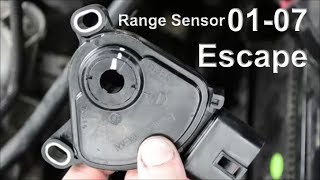
Typical fix: Replace the Transmission Range Sensor. This involves removing the connector, unbolting the sensor from the transmission shaft, and installing the new one. 🎬 See this walkthrough for replacing the range sensor and symptoms. The new sensor must be properly aligned in the neutral position before tightening the bolts; there are score marks on the inner and outer body of the sensor that must be lined up perfectly.
Est. part cost: $40-$100 - Failed Shift Solenoid or Solenoid Pack 🟡 Medium Probability → Shop Transmission Valve Body The CD4E solenoid pack is a known weak point. Solenoids can fail electrically (open or short circuit) or become clogged with debris from old or burnt transmission fluid, leading to hydraulic pressure control issues and shifting problems. The entire pack is often replaced as a single unit.
How to confirm: Scan the TCM for specific solenoid codes (e.g., P0750, P0755, P0760). The solenoids can be tested for resistance with a multimeter after draining the fluid and removing the transmission oil pan. Check for continuity between the solenoid pins and ground; continuity indicates a short. Resistance values for Shift Solenoids 1 & 2 should be 12.0 - 22.0 ohms.
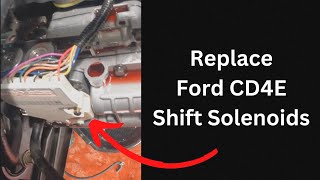
Typical fix: Replace the entire shift solenoid pack. This requires draining the fluid and removing the transmission pan to access the valve body where the solenoid pack is mounted. 🎬 Watch: Step-by-step guide to replacing the CD4E shift solenoids.
Est. part cost: $100-$250 for an aftermarket pack, $250-$400 for an OEM Motorcraft/BorgWarner unit. - Low or Dirty Transmission Fluid 🟡 Medium Probability → Shop Transmission Assembly The CD4E transmission is sensitive to fluid condition and level. Neglected maintenance leads to fluid breakdown, causing overheating, varnish buildup, and sludge that can clog the filter and solenoid passages, leading to pressure issues and component failure. There was also confusion in early models where the dipstick was mislabeled 'Mercon V' when the transmission required 'Mercon' (Dexron III compatible) fluid, potentially leading to incorrect fluid use. Ford later issued a TSB stating that Mercon V is an acceptable replacement for Mercon.
How to confirm: Check the transmission fluid level and condition using the dipstick with the engine warm and running. The fluid should be bright red and not smell burnt. If it is dark brown/black or has a burnt smell, it is degraded. If you find metal particles, suspect more severe internal damage.
Typical fix: Perform a transmission fluid and filter change. If the fluid is extremely dirty, a full transmission flush is an option but can sometimes dislodge debris and cause new problems on high-mileage units. Ensure the correct fluid type is used; Mercon V is now the recommended service fluid.
Est. part cost: $50-$150 for fluid and filter - Damaged Wiring Harness or Connectors ⚪ Low Probability The wiring harness leading to the transmission can be damaged by road debris, heat from the exhaust, or fluid leaks, causing short or open circuits. The main connector on the transmission is a common spot for corrosion or loose pins.
How to confirm: Visually inspect the wiring harness going to the transmission for any signs of chafing, melting, or corrosion, especially at the main connector and the connector for the Transmission Range Sensor. Check for continuity on suspect wires using a multimeter.
Typical fix: Repair the damaged section of wiring or clean/replace the affected connector.
Est. part cost: $10-$100 for repair materials
Rare But Worth Checking
- Internal Transmission Mechanical Failure: → Shop Transmission Assembly The CD4E can suffer from worn bands, a failed double drum clutch basket, or torque converter issues. A common symptom of a clogged internal filter is a temporary loss of drive that returns after letting the vehicle sit, as fluid seeps back through the blockage. Significant metal debris in the transmission pan is a strong indicator of mechanical failure requiring a rebuild or replacement.
- Faulty Transmission Control Module (TCM): → Shop Transmission Assembly While rare, the TCM itself can fail. This should only be considered after all other possibilities (sensors, solenoids, wiring, and fluid) have been thoroughly ruled out. Sometimes a weak battery or poor alternator output can cause voltage issues that mimic a TCM failure.
Diagnosis Steps
- Check the transmission fluid level and condition. Ensure the correct fluid type is being used. Top off or change if necessary.
- Use an advanced scan tool to read the specific trouble codes from the Transmission Control Module (TCM). Do not proceed without these companion codes.
- Based on the TCM codes, begin diagnosing the specific component. For a TR sensor code (P0705), inspect the sensor, its connector, and wiring. Test its output signals by monitoring live data while shifting through gears.
- For a shift solenoid code (e.g., P0755), inspect the wiring to the transmission. If wiring is good, drain the fluid, remove the pan, and test the resistance of the specified solenoid or replace the solenoid pack.
- For speed sensor codes (P0715, P0720), locate the sensor and test its resistance and check for a signal while rotating the wheels. Be aware that the input and output speed sensor connectors are identical and can be accidentally swapped.
- If no other codes are present or if communication with the TCM is not possible, inspect the power and ground connections to the TCM and check for stable voltage from the charging system.
- If fluid is full of metal shavings, suspect internal mechanical failure, which may require a transmission rebuild or replacement.
Parts You'll Likely Need
- Transmission Range Sensor / Neutral Safety Switch
(OEM #YL8Z7F293AA)— This is the most common failure point causing P0700 and related codes on this platform due to its exposure to the elements. - Transmission Solenoid Pack
(OEM #F6RZ-7G391-A)— The second most common cause, these solenoids are a known weak point in the CD4E transmission and are often replaced as a complete assembly. - Transmission Fluid and Filter Kit — Low or degraded fluid is a frequent contributor to transmission problems, and a fluid/filter change is required when replacing internal components like the solenoid pack.
Related Codes That Often Appear With This One
- P0705 — Indicates a fault in the Transmission Range Sensor circuit, a very common cause for P0700 on this vehicle.
- P0750 - P0770 — This range of codes points to faults with the various shift solenoids (A, B, C, etc.) that control gear changes.
- P0715 — Indicates a fault with the Input/Turbine Speed Sensor, which is critical for the TCM to monitor transmission operation.
- P0720 — Indicates a fault with the Output Speed Sensor, which tells the TCM how fast the vehicle is moving.
Technical Service Bulletins (TSBs) & Recalls
- NHTSA Campaign Number: 14V165000 - While not for the P0700 code itself, this is a critical safety recall for 2001-2004 models regarding severe subframe rust in salt-belt states, which could cause a loss of steering control. This highlights a major platform weakness.
Platform-Specific Known Issues
- Recall 1904D was issued for 2001-2003 V6 models for a PCM re-calibration to prevent engine stalling during deceleration, which could be related to powertrain control issues.
- The underlying Ford Escape platform with the CD4E transmission had known issues with internal wear on the torque converter and failure of the intermediate and overdrive bands, which could cause major shifting problems or total loss of movement.
Mechanic-Grade Diagnostic Values
- Shift Solenoid 1 (SSA) & 2 (SSB) Resistance — expected: 12.0 - 22.0 Ohms. Failure: A reading outside this range (open or short) indicates a failed solenoid.
- Torque Converter Clutch (TCC) Solenoid Resistance (Black Connector) — expected: 1.0 - 2.0 Ohms. Failure: A reading outside this range indicates a failed TCC solenoid on earlier models.
- Torque Converter Clutch (TCC) Solenoid Resistance (Natural/Beige Connector) — expected: 12.5 - 19.0 Ohms. Failure: A reading outside this range indicates a failed TCC solenoid on later models.
- Electronic Pressure Control (EPC) Solenoid Resistance — expected: 3.75 - 5.92 Ohms. Failure: A reading outside this range indicates a failed EPC solenoid.
Scan Tool Commands That Help
- Ford IDS (Integrated Diagnostic System): Powertrain -> Transmission -> Self-Test -> Retrieve CM DTCs — This is the primary function to read the specific, stored transmission codes that are causing the generic P0700 code to be set in the ECM.
- Ford IDS (Integrated Diagnostic System): Datalogger -> Transmission — To monitor live data PIDs (Parameter IDs) such as TR_DC (Transmission Range Duty Cycle), OSS (Output Shaft Speed), TSS (Turbine Shaft Speed), and solenoid command states to diagnose component function in real-time.
- Ford IDS (Integrated Diagnostic System): Active Commands / Bi-Directional Controls — To command individual solenoids on and off to test their mechanical function and to control transmission pressures for advanced diagnostics, confirming if a solenoid is mechanically stuck or electrically failed.
Real Owner Repair Stories
- Mazda Forum user (1995 Mazda 626 (with CD4E transmission)) — Overdrive light blinking, hard shift from 1st to 2nd gear.
❌ Tried (didn't work) A repair shop replaced the Mass Air Flow sensor, which did not fix the problem.
✅ What actually fixed it Temporarily fixed by unhooking the battery cables for a minute and reconnecting them. This reset the transmission computer, stopping the flashing light and hard shifts until the fault was detected again. This points to an intermittent electronic fault rather than a constant mechanical one. - Reddit user on r/Ford (2006 Ford Escape) — Check engine light on, O/D OFF light flashing, code P0750 (Shift Solenoid A Malfunction), rough shifting, and sometimes no reverse.
❌ Tried (didn't work) Visual inspection of solenoid pack and wiring showed no obvious issues.
✅ What actually fixed it The user diagnosed a bad solenoid pack after finding the transmission fluid was in very poor condition. The fix involved dropping the transmission pan and side cover/valve body to replace the entire solenoid pack assembly.
OEM Part Supersession History
YL8Z-7F293-AA→6L8Z-7F293-AA— Part number update/revision by Ford.
Heads up: The new part number (6L8Z-7F293-AA) is the correct service replacement for the original and is fully compatible with all 2001-2008 models.F6RZ-7G391-A→XS7P-7G391-AA (and others)— Part number update/revision by Ford for the solenoid pack.
Heads up: While multiple part numbers exist for the solenoid pack, most aftermarket and remanufactured units are sold as compatible with all 1994-2008 CD4E applications.
Model Year Variations Within This Range
- 2001-2006 (approx.): These earlier models originally specified Mercon automatic transmission fluid. Ford issued a TSB stating that using Mercon V was not recommended.
- 2007-2008 (and as a service replacement for earlier years): Ford discontinued licensing for Mercon fluid and later issued a new TSB stating that Mercon V is the appropriate and backward-compatible service fluid for all CD4E transmissions that previously required Mercon.
Diagnostic Flowchart
Other Known Issues on This Vehicle
Issues unrelated to this code that are worth knowing about as an owner of this generation:
- Front Subframe Rust/Corrosion Failure 🔴 High — Very common on 2001-2004 models used in salt-belt regions. Can lead to separation of the lower control arm and complete loss of steering. (Ref: Ford Recall 14S02 / NHTSA Campaign 14V165000.)
- Sticking Throttle Cable 🔴 High — Common on 2001-2008 V6 models with cruise control. The cruise control cable could get caught on the plastic engine cover, causing unintended acceleration. (Ref: Mazda recall affecting 217,500 Tributes.)
- Premature Alternator Failure 🟠 Medium — Many owners report repeated alternator failures. Symptoms include dimming/flickering lights, battery warning light, strange noises, and stalling.
- Ignition Coil and Intake Gasket Failure (V6) 🟠 Medium — Coil-on-plug ignition coils are a frequent failure item, causing misfires (P030x codes). Leaking intake manifold gaskets can cause lean conditions and also contribute to coil failure.
- DPFE Sensor Failure (V6) 🟡 Low — The Differential Pressure Feedback EGR (DPFE) sensor often fails, leading to EGR flow codes like P0401 and driveability issues such as pinging or surging.
Used vs. New Parts: Buying Guide for This Vehicle
When a used part is the smart pick: For a complex electronic part like a solenoid pack, a used part is a gamble but can be a cost-effective option if sourced from a low-mileage, reputable salvage yard with a warranty. Given the high failure rate, a new or remanufactured part is generally safer. A used Transmission Range Sensor is also a viable option if its condition can be verified.
Donor-vehicle mileage cap: roughly under 80000 miles for the part to have meaningful remaining life.
What to inspect on the donor part:
- Check for a vehicle that was wrecked due to collision, not scrapped for powertrain failure.
- Inspect the transmission fluid from the donor car if possible; bright red fluid is a good sign, while dark or burnt fluid is a major red flag.
- For sensors and connectors, look for clean pins with no signs of corrosion, water intrusion, or heat damage.
OEM-only on this vehicle (don't cheap out):
- While not strictly 'OEM-only', using a Motorcraft (Ford OEM) or a well-regarded remanufactured OEM solenoid pack is highly recommended over no-name aftermarket units to ensure longevity and correct electronic performance.
Aftermarket brands forum-validated for this vehicle:
- Rostra is a known manufacturer of aftermarket transmission solenoids and components, often seen as a viable alternative to OEM.
Brands owners have reported issues with on this vehicle:
- Be cautious of unbranded, generic solenoid packs from online marketplaces, as their quality control and longevity can be highly inconsistent.
Real Owner Stories
Aggregated from forums and TSBs cited above. Mileages and costs reflect what owners reported in those sources.
2001 Ford Escape V6 (CD4E Platform Mate)
Symptoms: Flashing OD light and reduced power sensation.
What fixed it: Full transmission rebuild.
Cost: $3500-$3500
Source hint: https://www.ford-trucks.com/forums/303999-cd4e-transmission-problem.html - A 2004 thread on Ford Truck Enthusiasts
2005 Mazda Tribute
Symptoms: Blinking O/D OFF light while driving on the highway; the light resets after turning the car off and back on.
What fixed it: Intermittent electronic fault diagnosis (TCM scanning required).
Source hint: https://www.mazdaforum.com/forum/mazda-tribute-5/blinking-o-d-off-light-2005-mazda-tribute-27488/
2001 Mazda Tribute
Symptoms: Owner seeking guidance on removing the solenoid pack to address shifting issues.
What fixed it: Replacement of the solenoid pack (DIY attempt).
Source hint: https://www.mazdaforum.com/forum/mazda-tribute-5/replacing-solenoid-pack-29367/
Related OBD-II Codes
Frequently Asked Questions
My 2001 Mazda Tribute V6 keeps stalling when I slow down; is there a fix for this?
The dipstick on my early Tribute says 'Mercon V' but I heard that's wrong. What fluid should I use?
My O/D light is flashing on the shifter of my 2005 Tribute. Does this mean the transmission is failing?
Is there a safety recall I should know about for my 2001-2004 Mazda Tribute besides transmission issues?
Why is my Tribute stuck in one gear and won't shift?
Can I replace the solenoid pack on my Tribute myself?
Helpful Videos

We Have This Part in Stock

The information in this article is provided for general reference and educational purposes only. Vehicle specifications, procedures, and part compatibility can vary by production date, trim level, and region. Always consult your vehicle's factory service manual and verify part numbers before purchasing or performing repairs. Safety-critical components such as airbags, seat belts, and braking systems should be installed by a qualified professional.
- Mazda Tribute:
- 🧭 Diagnostic Flowchart
- 🎬 Helpful Videos
- 🛍️ Shop This Part
- What's Unique About the 2001-2008 Mazda Tribute
- Symptoms You May Notice
- Most Likely Causes
- Rare But Worth Checking
- Diagnosis Steps
- Parts You'll Likely Need
- Related Codes That Often Appear With This One
- Technical Service Bulletins (TSBs) & Recalls
- Platform-Specific Known Issues
- Mechanic-Grade Diagnostic Values
- Scan Tool Commands That Help
- Real Owner Repair Stories
- OEM Part Supersession History
- Model Year Variations Within This Range
- Other Known Issues on This Vehicle
- Used vs. New Parts: Buying Guide for This Vehicle
- Real Owner Stories
- 2001 Ford Escape V6 (CD4E Platform Mate)
- 2005 Mazda Tribute
- 2001 Mazda Tribute
- Related OBD-II Codes
- Frequently Asked Questions
- 🎟️ Get 5% Off