

P0700 on 2013-2019 Subaru Crosstrek: Transmission Control System Fault Guide
P0700 is a general code indicating a fault has been detected in the transmission. On the Crosstrek, this is most often caused by a failing CVT valve body, specifically the torque converter lock-up solenoid. This can cause a flashing 'AT OIL TEMP' light, erratic shifting, and stalling when stopping. A valve body replacement with an OEM part is the most common and recommended fix.
- P0700 is a general alert from the transmission; you MUST scan the Transmission Control Module (TCM) for more specific codes.
- The most likely cause on a 2013-2019 Crosstrek is a failed solenoid inside the CVT valve body, which will usually store a P2764 or P2762 code in the TCM.
- Before paying for a repair, check if your vehicle is covered under Subaru's CVT warranty extension (10 years / 100,000 miles for 2013-2015 models).
- This repair is not recommended for DIYers due to the complexity of the CVT and the need for a post-repair relearn procedure.
- Always use genuine Subaru High Torque CVT fluid.
What's Unique About the 2013-2019 Subaru Crosstrek
The 2013-2019 Subaru Crosstrek uses a Lineartronic TR580 Continuously Variable Transmission (CVT). A very common point of failure on this CVT is the valve body, which contains solenoids that control fluid pressure. The torque converter lock-up duty solenoid is the most frequent culprit. When this solenoid fails, it often triggers a specific code in the TCM (like P2764) and the general P0700 code in the ECM. Due to the prevalence of this issue, Subaru extended the CVT warranty for many vehicles, including the 2013-2015 Crosstrek, to 10 years or 100,000 miles.
Generation note: This range covers the first generation (2013-2017) and the beginning of the second generation (2018-2019) Crosstrek. Both generations use a TR580 CVT and are known to experience similar valve body issues that can trigger a P0700 code. However, part numbers and specific procedures may differ, so always verify parts for your specific model year. The warranty extension specifically covered models up to 2015.
Symptoms You May Notice
- Check Engine Light is on
- Flashing 'AT OIL TEMP' light on the dashboard
- Cruise control is disabled
- Vehicle may feel sluggish or hesitate on acceleration
- Erratic shifting or engine revving without acceleration
- Stalling or shuddering when coming to a complete stop, similar to a manual car without the clutch depressed
- Vehicle may enter 'limp mode' with reduced power
- Replacing only the external transmission sensors without checking for internal codes.
- Clearing the P0700 code without reading the underlying TCM codes. The light will almost certainly return until the root cause is fixed.
- Mistaking a burnt-out tail light bulb for a transmission issue, as Subaru is known to illuminate multiple dash lights for a simple bulb failure.
Most Likely Causes
- Faulty CVT Valve Body / Lock-Up Solenoid 🔴 High Probability → Shop Transmission Valve Body The lock-up duty solenoid within the valve body is a well-documented, high-failure-rate item on this generation of Subaru TR580 CVTs. It is one of the most active solenoids, leading to eventual burnout. TSBs for other models, like 16-90-13R, describe failures of the lock-up system that are mechanically similar.
How to confirm: Scan the TCM for codes like P2764 ('Torque Converter Clutch Pressure Control Solenoid Circuit Low') or P2762, which point directly to the solenoid circuit. A mechanic can also perform a resistance test on the solenoid's electrical connector. A reading near 0-2.5 ohms indicates a shorted, failed solenoid, whereas a healthy one should read around 10-13.5 ohms.
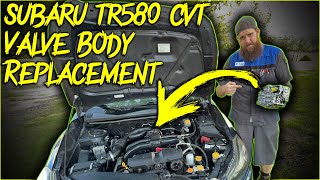
Typical fix: Replace the entire CVT valve body assembly with a new OEM part. While the solenoid is the point of failure, Subaru does not sell it separately, and aftermarket solenoids or rebuilt valve bodies are known to fail prematurely. A transmission fluid drain/fill and a relearn procedure are required after replacement. 🎬 Watch: A complete DIY guide to replacing the TR580 valve body.
Est. part cost: $700-$900 - Low or Degraded CVT Fluid 🟡 Medium Probability CVTs are highly sensitive to fluid level and condition. Overheating or contamination can affect the hydraulic pressure needed for operation, triggering fault codes. Some owners have reported codes disappearing after topping off low fluid. In some cases, as noted in NHTSA ODI #11723189 for other Subaru models, a pressure sensor leaking oil can lead to multiple transmission-related codes including P0700 and P0841.
How to confirm: Check the CVT fluid level and condition. The fluid should be translucent and not smell burnt. Note that these Subarus do not have a traditional transmission dipstick, requiring a specific procedure to check the level from a fill plug, often best left to a professional.
Typical fix: Perform a CVT fluid drain and fill using the correct Subaru High Torque CVT fluid (or the appropriate fluid for the specific year). Do not use standard ATF fluid.
Est. part cost: $100-$200 - Damaged Wiring Harness or Connectors ⚪ Low Probability
How to confirm: Visually inspect the wiring harness leading to the transmission for any signs of damage, corrosion, or loose connections. Test for continuity on the relevant solenoid or sensor circuits using a multimeter.
Typical fix: Repair the damaged section of the wire or replace the faulty connector.
Est. part cost: $20-$100
Rare But Worth Checking
- Faulty Transmission Control Module (TCM): → Shop Transmission Assembly TCM failure is uncommon. Before replacing the TCM, all other possibilities, especially the valve body and wiring, should be thoroughly ruled out. Manufacturer TSB Bulletin #06-93-25 notes that ECM updates have been developed to address P0700 and P0890 (TCM Power Relay Sense Circuit Low).
- Internal Mechanical CVT Failure: In some cases, metal shavings from internal wear (chain slip, bearing failure) can clog passages in the valve body or indicate a more severe failure requiring a full transmission replacement. This is usually a last resort after other diagnostics have failed and is often accompanied by grinding noises or large metal chunks on the drain plug magnet. NHTSA ODI #11265402 describes a situation where a dealership recommended a whole new transmission after P0700 and P2764 codes appeared.
- Torque Converter Failure: → Shop Automatic Transmission Torque Converter Separate from the solenoid, the torque converter's internal lock-up clutch can mechanically fail, causing the engine to stall when stopping. This was the subject of Subaru TSB 16-102-16 for several models, including the Crosstrek. This repair requires removing the transmission to replace the torque converter.
Diagnosis Steps
- Connect an OBD-II scanner capable of reading transmission codes to the vehicle's diagnostic port.
- Read the codes from the Transmission Control Module (TCM). The P0700 code in the ECM is just a pointer; the real codes are in the TCM.
- If codes like P2764 or P2762 are present, the valve body's lock-up solenoid is the primary suspect.
- To confirm a failed solenoid, a technician can perform a resistance test on the solenoid circuit at the transmission connector. A reading of approximately 0-2.5 ohms confirms a shorted solenoid, while a good solenoid should read ~10-13.5 ohms.
- If no other codes are present, or if fluid-related codes appear, inspect the CVT fluid level and condition. Ensure the correct Subaru CVT fluid is used.
- If the primary symptom is stalling when stopping, investigate the torque converter lock-up clutch function, referencing TSB 16-102-16.
- Inspect the transmission wiring harness and connectors for any visible damage, corrosion, or loose pins.
- If the valve body, fluid, and wiring are good, further diagnosis of the TCM or internal transmission components may be necessary.
Parts You'll Likely Need
- CVT Valve Body Assembly
(OEM #31825AA055 (current, supersedes 31825AA050, 31825AA051, 31825AA052, 31825AA053, 31825AA054))— This assembly contains the lock-up solenoid, which is the most frequent point of failure leading to a P0700 code on the Crosstrek. Must be purchased as a complete OEM assembly.
Trusted brands: Subaru (OEM)
OEM price range: $750-$950
Aftermarket price range: Not Recommended - High failure rate reported by mechanics. - Subaru High Torque CVT Fluid (HT-CVTF)
(OEM #SOA427V1660 (Orange Bottle) or SOA748V0200 (older Blue))— This specific fluid is required for any service involving the CVT. Using incorrect fluid can cause severe damage. Always verify the correct fluid type for your specific model year.
Trusted brands: Subaru (OEM)
OEM price range: $20-$25 per quart
Aftermarket price range: Not Recommended - Valve Body Cover Gasket
(OEM #31338AA020)— Required when replacing the valve body, as the top cover must be removed.
Trusted brands: Subaru (OEM)
OEM price range: $15-$25
Aftermarket price range: N/A
Related Codes That Often Appear With This One
- P2764 — This code specifically indicates a problem with the Torque Converter Clutch Pressure Control Solenoid circuit ('low' or 'open'), which is the most common root cause of P0700 on these vehicles.
- P2762 — Similar to P2764, this code points to a performance/stuck off issue in the Lock-Up Duty Solenoid circuit, which is part of the valve body assembly.
- P2757 — This code relates to the Torque Converter Clutch Pressure Control Solenoid being 'stuck on' and can also be associated with valve body issues.
Technical Service Bulletins (TSBs) & Recalls
- 16-107-17R: Announces the CVT warranty extension for certain models, including the 2013-2015 Crosstrek, to 10 years/100,000 miles.
- 16-90-13R: While for older Legacy/Outback models, this TSB details a fix for a torque converter lock-up clutch issue that causes stalling when stopping—a symptom also seen in Crosstreks with P0700.
- 16-102-16: Addresses issues with the torque converter lock-up clutch failing to release, causing the engine to stall at a stop. Affects 2013-2015 Crosstreks.
- Bulletin #06-93-25: Outlines ECM software updates developed to address Diagnostic Trouble Codes P0700 and P0890.
Platform-Specific Known Issues
- Subaru issued a warranty extension for the CVT on 2013-2015 Crosstreks (among other models) to 10 years / 100,000 miles due to concerns about CVT performance and durability. This may cover repairs related to the P0700 code if the vehicle falls within the age and mileage limits.
- The TR580 CVT in the Crosstrek has the valve body located on top of the transmission case, making it accessible from the engine bay after removing the intake and throttle body, unlike many transmissions that require dropping a pan from below.
Mechanic-Grade Diagnostic Values
- Lock-Up Duty Solenoid Resistance — expected: 10.0 - 13.5 Ohms at ~68°F (20°C). Failure: A reading near 0-2.5 Ohms indicates a short circuit. A much higher reading (e.g., 27 Ohms) or an open circuit also indicates failure.
- Primary Up/Down Solenoid Resistance — expected: 10.0 - 13.5 Ohms. Failure: Readings significantly outside the expected range.
- All-Wheel Drive (AWD) Solenoid Resistance — expected: 2.0 - 4.5 Ohms. Failure: Readings significantly outside the expected range.
- Secondary Line Pressure Control Solenoid Resistance — expected: 5.0 - 7.0 Ohms. Failure: Readings significantly outside the expected range.
- Forward/Reverse Linear Solenoid Resistance — expected: 4.0 - 6.0 Ohms. Failure: Readings significantly outside the expected range.
- ATF Temperature for Relearn Procedure — expected: 40 - 65°C (104 - 149°F). Failure: Procedure may not initiate or complete correctly if the fluid is too hot or too cold.
Scan Tool Commands That Help
- Subaru Select Monitor (SSM) or equivalent professional scanner: Compulsory learning mode (AT learning) — This procedure should be performed after replacing the CVT valve body or clearing the AT learning value. It recalibrates the transmission control module to the new components. While some mechanics report success without it, others note a significant improvement in drivability after performing the relearn.
Wiring & Ground Locations
- T4 / B11 Connector — The main external electrical connector on the top of the transmission case, leading into the valve body area.. This is the primary access point for testing the resistance of the internal transmission solenoids without disassembling the transmission. A technician can test the lock-up solenoid circuit (and others) between the specific pin and a chassis ground to confirm an electrical failure before ordering parts.
Real Owner Repair Stories
- Reddit user Apart_Link5973 (2013 Subaru Crosstrek, 198,000 miles) — P0700 and P2764 codes.
✅ What actually fixed it Owner performed a DIY replacement of the CVT valve body with a new OEM part ($750). They also purchased a high-end Autel scanner ($600) to perform the transmission relearn procedure. This completely solved the codes and the CVT ran perfectly afterward. - Reddit user SnooDoughnuts231 (2018 Subaru Crosstrek Base, 150,000 miles) — Check Engine Light, flashing AT Temp light, and flashing cruise control indicator. Codes P0700 and P0841 were present.
✅ What actually fixed it A Subaru dealership confirmed the valve body had failed. The dealer replaced the valve body assembly for a total cost of $2,200 (including diagnosis). This was the final fix. - NHTSA ODI #11723218 — An owner reported that their vehicle was locked in limp mode and could barely climb a small ramp. Diagnostic codes P0841, P0700, and C1431 were stored, and a technician confirmed the valve body had likely failed.
- NHTSA ODI #11505856 — An owner reported experiencing a CVT failure at 150,000 miles with symptoms including Check Engine Lights and an AT Oil Temp Warning. Diagnostic codes P0700 and P2764 (Torque Converter Clutch Pressure Control Solenoid Control Circuit Low) were identified.
OEM Part Supersession History
31825AA050, 31825AA051, 31825AA052, 31825AA053, 31825AA054→31825AA055— Subaru has made successive updates to the valve body to improve reliability and address known failure points like the lock-up solenoid.
Heads up: While an older revision may physically fit, it is strongly recommended to use the latest part number (31825AA055) to benefit from all design improvements.
Model Year Variations Within This Range
- 2013-2017 (First Generation): These models are the first generation Crosstrek. The CVT warranty extension to 10 years/100,000 miles for this issue specifically covers model years 2013-2015.
- 2018-2019 (Second Generation): The 2018 model year introduced the Subaru Global Platform, featuring a redesigned chassis, a revised engine with direct injection (152 hp vs 148 hp), and updated interior/infotainment. While the core TR580 transmission and valve body part number remained the same, these models were not covered by the initial CVT warranty extension.
Diagnostic Flowchart
Used vs. New Parts: Buying Guide for This Vehicle
When a used part is the smart pick: For this specific P0700 fault path, sourcing a used part is generally not recommended. The primary cause is a high-failure-rate solenoid within the valve body. A used valve body from a donor vehicle is highly likely to have a solenoid that is near the end of its life, leading to a repeat failure.
Donor-vehicle mileage cap: roughly under 50000 miles for the part to have meaningful remaining life.
What to inspect on the donor part:
- If considering a used valve body despite the risk, source it from a vehicle with the lowest possible mileage.
- Obtain vehicle history to ensure the donor car was not involved in a severe front-end collision.
- Ask for a warranty from the salvage yard, even if it's only 30-90 days.
OEM-only on this vehicle (don't cheap out):
- CVT Valve Body Assembly (Part No. 31825AA055)
- Subaru High Torque CVT Fluid (HT-CVTF)
Brands owners have reported issues with on this vehicle:
- Unbranded/generic individual solenoids or complete valve bodies from eBay/Amazon have a high risk of premature failure.
- While Dorman offers an individual solenoid, reports from owners and mechanics are mixed, with some experiencing failures shortly after installation, requiring the job to be done a second time.
Real Owner Stories
Aggregated from forums and TSBs cited above. Mileages and costs reflect what owners reported in those sources.
2013 Crosstrek — 198000 miles
Symptoms: Got the dreaded P0700 and P2764 codes.
What fixed it: Replaced the valve body with a new OEM part ($750) and used a high-end Autel scanner ($600) to run the transmission relearn program.
Cost: $1350
Source hint: Reddit r/Crosstrek thread titled 'Advice. 2013 Crosstrek. 180k miles. Got the dreaded P0700 and P2764 codes.'
2013 Subaru Crosstrek — 104000 miles
Symptoms: Displayed P0700 and P2764 codes.
What fixed it: Required a valve body replacement, with quotes from a dealer ($1300) and an independent shop ($1700).
Cost: $1300-$1700
Source hint: Reddit r/subaru thread titled 'SUBARU CROSSTREK VALVE BODY'
Related OBD-II Codes
Frequently Asked Questions
My 2014 Crosstrek has a P0700 code. Is this covered by the CVT warranty extension?
The mechanic found code P2764 and says I need a new valve body. Can't I just replace the faulty lock-up solenoid?
My Crosstrek is stalling when I come to a stop. Is this related to the P0700 code?
What kind of transmission fluid should I use for a fluid change on my Crosstrek?
How can a mechanic confirm the lock-up solenoid has failed?
Is replacing the valve body a DIY-friendly job on this Crosstrek?
Helpful Videos

The information in this article is provided for general reference and educational purposes only. Vehicle specifications, procedures, and part compatibility can vary by production date, trim level, and region. Always consult your vehicle's factory service manual and verify part numbers before purchasing or performing repairs. Safety-critical components such as airbags, seat belts, and braking systems should be installed by a qualified professional.
- Subaru Crosstrek:
- 🧭 Diagnostic Flowchart
- 🎬 Helpful Videos
- What's Unique About the 2013-2019 Subaru Crosstrek
- Symptoms You May Notice
- Most Likely Causes
- Rare But Worth Checking
- Diagnosis Steps
- Parts You'll Likely Need
- Related Codes That Often Appear With This One
- Technical Service Bulletins (TSBs) & Recalls
- Platform-Specific Known Issues
- Mechanic-Grade Diagnostic Values
- Scan Tool Commands That Help
- Wiring & Ground Locations
- Real Owner Repair Stories
- OEM Part Supersession History
- Model Year Variations Within This Range
- Used vs. New Parts: Buying Guide for This Vehicle
- Real Owner Stories
- 2013 Crosstrek — 198000 miles
- 2013 Subaru Crosstrek — 104000 miles
- Related OBD-II Codes
- Frequently Asked Questions
- 🎟️ Get 5% Off