

P0705 on 2018-2024 Toyota Camry: Transmission Range Sensor Circuit Malfunction Causes and Fixes
This code means the transmission range sensor (neutral safety switch) is failing or its circuit is compromised. The most common fix is to replace the sensor, which is located on the outside of the transmission. Expect to pay $150-$250 for an OEM sensor. In some cases, especially after a front-end collision, the cause can be a damaged wiring harness leading to the sensor.
- P0705 on a 2018-2024 Camry indicates a problem with the circuit that tells the car which gear it's in.
- The most likely culprit is a faulty Transmission Range Sensor, followed by damaged wiring or a bad connector.
- Symptoms can be severe, including a no-start condition or getting stuck in one gear, so it should be addressed promptly.
What's Unique About the 2018-2024 Toyota Camry
For the 2018-2024 (XV70 generation) Camry, the P0705 code almost always points to an issue with the externally-mounted transmission range sensor or its wiring. Unlike some vehicles where the sensor is internal, the Camry's sensor is accessible on top of the transmission, usually after removing the battery and battery tray. While the issue is common across many automatic vehicles, the diagnostic process on the Camry is straightforward. A key area to inspect, especially if the vehicle has been in a front-end accident, is the wiring harness and connector block near the fuse box, which can be damaged and cause this code.
Symptoms You May Notice
- Check Engine Light is on
- Vehicle will not start, or only starts in Neutral.
- Gear indicator on the dashboard (PRNDL) is blank, does not match the shifter position, or flashes.
- Transmission is stuck in one gear (limp mode).
- Harsh or erratic shifting between gears, sometimes with a noticeable jerk when shifting into Drive or Reverse.
- Reverse lights do not turn on when in Reverse.
- Backup camera does not activate when in Reverse.
- Replacing the Transmission Range Sensor without first inspecting the wiring harness and connector. A simple broken wire or corroded pin can mimic the symptoms of a failed sensor. 🎬 See why you shouldn't replace parts before checking the harness.
Most Likely Causes
- Faulty Transmission Range Sensor (Neutral Safety Switch) 🔴 High Probability → Shop Transmission Assembly The sensor is an electro-mechanical part with internal contacts that can wear out or corrode over time from exposure to heat, moisture, and road debris, as it is mounted externally on the transmission.
How to confirm: After confirming the wiring is intact, test the sensor's circuit at the connector. For this generation Camry, the sensor communicates via CAN bus, so testing involves checking for power, ground, and CAN signal voltages with a multimeter. An OBD-II scanner with live data can also show if the computer is receiving conflicting or no gear position signals.
Typical fix: Replace the transmission range sensor. The sensor must be properly aligned during installation, typically by aligning marks in the Neutral position. 🎬 Watch: How to replace and align the sensor without special tools.
Est. part cost: $140-$220 - Damaged Wiring or Corroded Connector 🟡 Medium Probability The wiring harness leading to the sensor can be damaged by engine heat, vibration, or impact, especially if the vehicle was in a front-end accident. The connector pins can also corrode from moisture, causing a poor signal. In one documented case on a 2019 Camry, damage to the connector block near the fuse box from a prior accident was the root cause.
How to confirm: Visually inspect the entire wiring harness from the sensor to the control module for any signs of fraying, melting, or breaks. Unplug the connector at the sensor and the corresponding connector block (often near the under-hood fuse box) and check for corrosion (green or white powder) or bent/broken pins.
Typical fix: Repair the damaged section of wire or clean/replace the electrical connector. In the case of the 2019 Camry, the connector itself was replaced and the wires were repinned.
Est. part cost: $10-$100 - Misadjusted Sensor or Shift Linkage ⚪ Low Probability While less common, the sensor's alignment can be knocked out of place, or the mechanical linkage from the shifter can become loose, causing a mismatch between the lever position and the sensor's reading.
How to confirm: Check that the shift linkage is secure and not worn. Verify the alignment of the range sensor; there are typically alignment marks or a procedure to follow to ensure it's set correctly in the Neutral position.
Typical fix: Adjust the sensor's position or repair/adjust the shift linkage.
Est. part cost: $0-$20
Rare But Worth Checking
- Faulty Powertrain or Transmission Control Module (PCM/TCM): → Shop Transmission Assembly This is very rare and should only be considered after the sensor and wiring have been definitively ruled out as the cause. The module's internal circuits for reading the sensor can fail. Other fault codes would likely be present if the PCM/TCM were failing.
- Blown Fuse: In some cases, a related fuse that powers the circuit can be blown, causing a loss of signal from the sensor. This is uncommon but easy to check.
Diagnosis Steps
- Connect an OBD-II scanner to confirm the P0705 code and check for any other related trouble codes. Record the freeze frame data, which can show what the vehicle was doing when the code was set.
- Perform a thorough visual inspection of the Transmission Range Sensor, its electrical connector, and the wiring harness. Look for any signs of damage, corrosion, or loose connections. Pay special attention to the harness area if the vehicle has a history of a front-end collision.
- The sensor is located on top of the transmission, under the air filter housing, battery, and battery tray. You will need to remove these components for access.
- Check the adjustment of the shift linkage to ensure it is not loose or damaged.
- Using a digital multimeter and the vehicle's wiring diagram, test the sensor's circuit at the connector. Check for proper voltage, ground, and CAN bus signals (if applicable). A 2019 Camry repair video shows checking for 12V ignition power, ground, and CAN Lo/Hi signals at the connector pins. 🎬 Watch: A professional diagnostic walkthrough using wiring diagrams and multimeters.
- Test the sensor's output signal for each gear position (P, R, N, D). If the signals are incorrect or absent, the sensor is likely faulty.
- If the sensor and wiring test good, the issue may be with the Transmission Control Module (TCM), though this is very uncommon.
Parts You'll Likely Need
- Transmission Range Sensor / Neutral Safety Switch
(OEM #84540-06020, superseded by 84540-06021)— This sensor is the most common point of failure for the P0705 code due to internal wear and tear from its external mounting location.
Trusted brands: Toyota (OEM), Aisin
OEM price range: $140-$220
Aftermarket price range: $70-$150
Platform-Specific Known Issues
- Front-End Accident Damage: A documented case on a 2019 Camry showed that a previous front-end collision damaged the wiring harness connector near the fuse box, causing a P0705 code and a no-start condition. The sensor itself was fine; the fix was to repair the connector and wiring.
- Cold Weather Onset: A 2019 Corolla owner reported P0705 symptoms (harsh shifting, no backup camera) began immediately following a week of severe cold weather, suggesting that temperature extremes can potentially trigger a failure in a marginal sensor or its connections.
- Shifter Resistance (Cross-Manufacturer Reference): While reported on a different model, NHTSA ODI #11195754 notes that a P0705 code can coincide with a shifter that requires significant strength to move through positions such as Reverse, Drive, 3, 2, and 1.
Mechanic-Grade Diagnostic Values
- Transmission Range Sensor Connector (A74) - Pin 7 (Ignition Power) to Ground — expected: ~12V with ignition ON. Failure: 0V or significantly low voltage indicates a power supply issue from the ECM or a break in the wire.
- Transmission Range Sensor Connector (A74) - Pin 3 (Ground) to Chassis Ground — expected: Less than 1 ohm. Failure: High resistance indicates a poor ground connection, which can cause incorrect sensor readings.
- Transmission Range Sensor Connector (A74) - Pin 2 (CAN High) to Ground — expected: ~2.6V - 2.7V with ignition ON. Failure: Voltage that is 0V, 5V, 12V, or does not match the CAN Low voltage pattern indicates a CAN bus communication fault.
- Transmission Range Sensor Connector (A74) - Pin 1 (CAN Low) to Ground — expected: ~2.3V - 2.4V with ignition ON. Failure: Voltage that is 0V, 5V, 12V, or does not mirror the CAN High voltage indicates a CAN bus communication fault.
Scan Tool Commands That Help
- Toyota Techstream: Data List > Power Train > Transmission > Shift Lever Position — This is the primary way to confirm the fault. While an assistant moves the physical gear shifter through P, R, N, and D, the technician watches this data parameter on the scan tool. If the displayed value is blank, erratic, or does not match the actual shifter position, it confirms a fault in the range sensor circuit.
Wiring & Ground Locations
- A74 Connector — The electrical connector located directly on the Transmission Range Sensor, on top of the transmission case.. This is the primary point for testing the sensor and its direct power, ground, and CAN bus signals.
- A5 Connector — A large, multi-wire junction connector located in the engine bay, near the under-hood fuse box.. This connector is an intermediate point between the range sensor and the ECM. It is a known failure point, especially after a front-end collision, where damaged pins can cause an open circuit and trigger P0705 even if the sensor itself is good.
- Engine/Chassis Grounds (EA, EB) — Bolted to the engine block, cylinder head, or on the strut tower in the engine compartment.. The ECM and its sensors rely on clean ground connections. A loose or corroded main ground point can cause floating voltages and erratic behavior in multiple systems, including the transmission range sensor circuit.
Real Owner Repair Stories
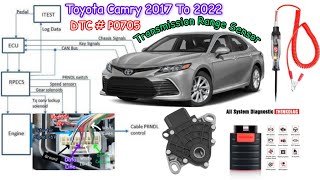
- YouTube channel 'Mughal Auto Electrician' (2019 Toyota Camry) — No crank, no start. No gear position (PRNDL) displayed on the instrument cluster. P0705 code stored.
❌ Tried (didn't work) The technician immediately suspected a wiring issue due to a known history of a front-end collision.
✅ What actually fixed it The technician found damaged and pushed-out pins inside the A5 junction connector near the fuse box. Repairing the pins and reseating the connector restored communication from the range sensor and fixed the no-start condition. The sensor itself was not faulty. - Reddit user on r/COROLLA (2019 Toyota Corolla (Similar powertrain logic)) — After a week of extreme cold (-30 to -40 degrees), the car started shifting harshly, and the backup camera stopped working. Check Engine and Traction Control lights came on with code P0705.
✅ What actually fixed it The dealership replaced the neutral safety switch (Transmission Range Sensor), which resolved all symptoms. This suggests extreme temperatures can cause a marginal sensor to fail completely.
OEM Part Supersession History
84540-06020→84540-06021— Standard part revision by the manufacturer. Often indicates a minor improvement in materials or design, or a change in supplier.
Heads up: None. The parts are fully interchangeable.
Model Year Variations Within This Range
- 2018-2024: No significant variations are noted for the P0705 code within this generation for non-hybrid models equipped with the 8-speed automatic transmission. The sensor, its location, and the diagnostic procedure remain consistent.
Diagnostic Flowchart
Other Known Issues on This Vehicle
Issues unrelated to this code that are worth knowing about as an owner of this generation:
- Harsh/Jerky 8-Speed Automatic Transmission 🟠 Medium → Shop Transmission Assembly — Most common on 2018-2020 models. Can manifest as hesitation, lurching at low speeds, or harsh shifts. A software update (TSB) was issued to address some of these complaints. (Ref: TSB exists for software reflash.)
- Faulty Low-Pressure Fuel Pump 🔴 High — Widespread issue affecting 2018-2020 models, leading to a major recall. The fuel pump can fail, causing the engine to stall while driving. (Ref: Recalls 20V-012 and 20V682000)
- Faulty Brake Booster Vacuum Pump 🔴 High — Affected some 2018 models. The pump can fail, leading to a sudden loss of power braking assist. (Ref: Recall J0K/JLD)
- Premature Water Pump Failure 🟠 Medium — Noted as a potential issue across the generation, can lead to engine overheating.
- Oversized Pistons (2.5L Engine) 🔴 High — A small number of 2018 models were produced with out-of-spec pistons, which could cause the engine to stall. (Ref: Recall J1M/J0M)
- Infotainment System Glitches 🟡 Low — Owners report issues with Bluetooth connectivity, system freezing, or unresponsiveness. A software update can sometimes resolve these problems.
Used vs. New Parts: Buying Guide for This Vehicle
When a used part is the smart pick: A used Transmission Range Sensor is a reasonable choice for this repair. It is an external, bolt-on electronic component, not a critical internal wear item. Sourcing a used OEM part from a low-mileage wrecked vehicle can provide OEM quality for significantly less than a new part.
Donor-vehicle mileage cap: roughly under 60000 miles for the part to have meaningful remaining life.
What to inspect on the donor part:
- Verify the mileage of the donor vehicle.
- Inspect the sensor housing for any cracks or physical damage.
- Check the electrical connector pins to ensure they are straight, clean, and free of corrosion.
- If possible, get the VIN of the donor car to check its history for major accidents near the transmission.
Aftermarket brands forum-validated for this vehicle:
- Aisin: Aisin is a well-regarded OEM supplier for Toyota, and their branded parts are considered equivalent to genuine Toyota parts.
Brands owners have reported issues with on this vehicle:
- Unbranded 'white-box' sensors from online marketplaces should be avoided. They often have higher failure rates and may not provide accurate signals, leading to the code returning.
Real Owner Stories
Aggregated from forums and TSBs cited above. Mileages and costs reflect what owners reported in those sources.
2019 Toyota Camry
Symptoms: The vehicle would not start. A P0705 code was present, indicating a Transmission Range Sensor Circuit 'A' Open fault.
What fixed it: The technician found a damaged wiring harness connector near the fuse box resulting from a previous accident. The connector was replaced and the wires were repinned.
Source hint: YouTube: #P0705 #Toyota #Camry #Transmission #RangeSensor Circuit"A"Open Diagnose Fault Repair With #Diagram
2019 Toyota Corolla
Symptoms: Symptoms included jerky shifting and the backup camera failing to activate. These issues appeared immediately after a week of severe cold weather.
What fixed it: The owner identified the issue as a P0705 error code following temperature extremes.
Source hint: Reddit: 2019 Corolla Error code P0705
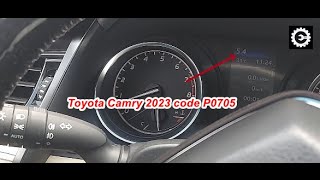
2023 Toyota Camry
Symptoms: The vehicle triggered a P0705 DTC, pointing to a fault in the Park/Neutral Position Switch or its associated circuit.
What fixed it: Diagnostic confirmation of the Park/Neutral Position Switch (Transmission Range Sensor) circuit failure.
Source hint: YouTube: 2023 TOYOTA CAMRY DTC P0705 SOLVED
Toyota Owner Report (NHTSA ODI #11195754)
Symptoms: An owner reported that moving the shifter through positions like Reverse and Drive required significant strength. Additionally, the check engine light with code P0705 began coming and going on the dashboard display.
What fixed it: While the owner reported multiple failed dealership diagnostic attempts, this record highlights how physical shifter resistance can accompany the electronic P0705 fault code.
Source hint: NHTSA ODI #11195754
Related OBD-II Codes
Frequently Asked Questions
Where is the Transmission Range Sensor located on my 2018-2024 Camry?
My 2019 Camry won't start and has a P0705 code after a front-end accident; could it be something other than the sensor?
Can extreme cold weather cause P0705 symptoms on my Toyota?
What part number is used for the Transmission Range Sensor in this generation of Camry?
Does the P0705 code on my Camry mean I need a new Transmission Control Module (TCM)?
Is there a TSB for the harsh shifting I'm experiencing alongside the P0705 code?
Helpful Videos
We Have This Part in Stock


The information in this article is provided for general reference and educational purposes only. Vehicle specifications, procedures, and part compatibility can vary by production date, trim level, and region. Always consult your vehicle's factory service manual and verify part numbers before purchasing or performing repairs. Safety-critical components such as airbags, seat belts, and braking systems should be installed by a qualified professional.
- Toyota Camry:
- 🧭 Diagnostic Flowchart
- 🎬 Helpful Videos
- 🛍️ Shop This Part
- What's Unique About the 2018-2024 Toyota Camry
- Symptoms You May Notice
- Most Likely Causes
- Rare But Worth Checking
- Diagnosis Steps
- Parts You'll Likely Need
- Platform-Specific Known Issues
- Mechanic-Grade Diagnostic Values
- Scan Tool Commands That Help
- Wiring & Ground Locations
- Real Owner Repair Stories
- OEM Part Supersession History
- Model Year Variations Within This Range
- Other Known Issues on This Vehicle
- Used vs. New Parts: Buying Guide for This Vehicle
- Real Owner Stories
- 2019 Toyota Camry
- 2019 Toyota Corolla
- 2023 Toyota Camry
- Toyota Owner Report (NHTSA ODI #11195754)
- Related OBD-II Codes
- Frequently Asked Questions
- 🎟️ Get 5% Off