

P0706 on 2011-2016 Ford Fiesta: Transmission Range Sensor and TCM Faults Explained
On a 2011-2016 Ford Fiesta with the DPS6 PowerShift, code P0706 is most often caused by a failing Transmission Control Module (TCM), a known issue with an extended warranty. It can also be a faulty Transmission Range Sensor. Diagnosis is critical, as TCM replacement is expensive if not covered by Ford's Customer Satisfaction Program 14M02.
- P0706 on a Ford Fiesta with a PowerShift transmission is very often a symptom of a failing Transmission Control Module (TCM), not just a simple sensor.
- Before any repair, check with a Ford dealer for warranty coverage. The TCM warranty was extended to 10 years/150,000 miles under program 14M02.
- This is not a simple DIY fix. Replacing either the range sensor or the TCM requires a special 'relearn' procedure with a professional-grade scan tool.
- Always test the vehicle's battery first, as low voltage can mimic TCM failure symptoms.
What's Unique About the 2011-2016 Ford Fiesta
The 2011-2016 Fiesta uses the DPS6 'PowerShift' transmission, which is not a traditional automatic but a dual-clutch automated manual. This transmission is infamous for a wide range of issues, leading to class-action lawsuits and multiple warranty extensions from Ford. For code P0706, the Transmission Control Module (TCM) is a very common point of failure, often more so than the range sensor itself. Ford extended the TCM warranty under program 14M02 to 10 years or 150,000 miles, and later updated the program to offer one-time replacements through June 30, 2025, for vehicles outside the original limits, so it's crucial to check for coverage before paying for repairs.
Symptoms You May Notice
- Check Engine Light is on
- "Transmission Malfunction Service Now" message on the instrument cluster
- Delayed, harsh, or erratic shifting
- Shuddering or jerking on acceleration
- Inability to shift out of Park
- Vehicle enters 'limp mode' with reduced power
- Gear selector indicator on the dash (PRNDL) may flash or show all gears selected at once.
- Engine cranks but will not start, as the computer cannot confirm the transmission is in Park or Neutral.
- Complete loss of forward or reverse engagement.
- Replacing the entire transmission when only the external TCM or range sensor is faulty.
- Replacing the range sensor when the actual problem is a bad TCM, which is the more common failure point on this platform.
Most Likely Causes
- Failing Transmission Control Module (TCM) 🔴 High Probability → Shop Transmission Assembly The DPS6 transmission's TCM is a well-documented, widespread failure point due to internal circuit board issues. Ford issued customer satisfaction program 14M02, extending the warranty on this specific part to 10 years / 150,000 miles due to the high failure rate.
How to confirm: After confirming the battery, wiring, and range sensor are good, the TCM is the most likely cause. A professional diagnosis with a Ford-specific scan tool is needed to confirm communication faults (like U0101) or internal processor faults (P0606) which are frequently stored alongside P0706.
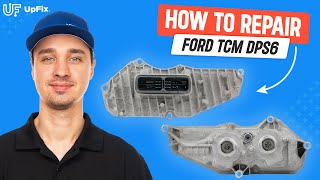
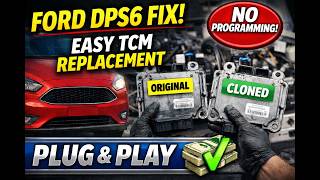
Typical fix: Replace the Transmission Control Module. The new module must be programmed to the vehicle's VIN 🎬 See how to clone a TCM without programming. and undergo a clutch adaptive relearn procedure.
Est. part cost: $500-$900 - Faulty Transmission Range Sensor (TRS) 🟡 Medium Probability → Shop Transmission Assembly The sensor is mounted externally on the transmission, exposing it to heat and vibration which can lead to internal failure over time, causing it to send incorrect voltage signals.
How to confirm: Using a multimeter, a technician can test for 5V power on the correct wire at the sensor connector. If power is present but the signal is incorrect or absent, the sensor is bad. A scan tool can also monitor the sensor's output PID while moving the shifter; it should show a clean transition between gear positions.
Typical fix: Replace the Transmission Range Sensor. A relearn procedure is often required after installation.
Est. part cost: $50-$150 - Damaged Wiring or Connectors ⚪ Low Probability The wiring harness running to the transmission can chafe against the chassis or other components. The connectors for the TCM and TRS can also suffer from corrosion or loose pins, interrupting the signal.
How to confirm: Visually inspect the wiring harness leading to the Transmission Range Sensor and the main connector for the TCM. Check for chafed wires, corrosion in the connectors, or loose pins. Perform a continuity test on the signal, power, and ground wires between the sensor and the TCM.
Typical fix: Repair the damaged section of the wiring harness and secure it away from sharp edges. Clean or replace corroded connectors.
Est. part cost: $10-$100
Rare But Worth Checking
- Weak or Failing Battery: Low system voltage can cause a variety of random electronic faults in modern cars, including communication errors with the TCM. A weak battery can sometimes set a P0606 (TCM Internal Failure) code. Always test the battery and charging system first before diagnosing transmission components.
Diagnosis Steps
- Check the battery and charging system. Ensure voltage is stable and above 12.4V with the engine off.
- Scan the TCM for any other trouble codes. Note any communication codes like U0101, U0100 or internal fault codes like P0606, as these strongly point to the TCM.
- Visually inspect the wiring harness and connectors going to the Transmission Range Sensor (TRS) and the Transmission Control Module (TCM). Look for any signs of damage, corrosion, or chafing.
- With a capable scan tool, monitor the live data for the Transmission Range Sensor PID while moving the gear selector. Check if the reading corresponds correctly to each gear position (P, R, N, D, S).
- If scan tool data is erratic, perform a direct electrical test. Disconnect the TRS and check for 5V power on the white wire with a green tracer. If no power, the TCM is likely at fault.
- If 5V power is present at the sensor connector, but the sensor's signal output is incorrect when tested with a multimeter, the TRS itself has failed.
- If the TRS sensor tests good and the wiring is intact, the suspicion falls heavily on the TCM.
- Before replacing the TCM, check with a Ford dealer using your VIN to see if your vehicle is covered under the extended warranty program 14M02 (10 years/150,000 miles or subsequent extensions).
- After replacing any component (TCM or TRS), perform the mandatory transmission adaptive learning procedures using a Ford IDS or equivalent professional scan tool.
Parts You'll Likely Need
- Transmission Control Module (TCM)
(OEM #AE8Z-7Z369-F)— This is the most common failure point on the DPS6 transmission that causes code P0706. It is subject to an extended warranty from Ford (14M02). The 'F' revision supersedes earlier versions like AE8Z-7Z369-B and AE8Z-7Z369-D.
Trusted brands: Motorcraft
OEM price range: $700-$900
Aftermarket price range: $400-$700 - Transmission Range Sensor
(OEM #AE8Z-7F293-A)— The sensor itself can fail, sending incorrect gear position data to the TCM. It's a less common failure than the TCM but is a primary cause for this specific code.
Trusted brands: Motorcraft
OEM price range: $100-$150
Aftermarket price range: $50-$90
Related Codes That Often Appear With This One
- P0705 — This code indicates a malfunction in the same Transmission Range Sensor circuit, pointing directly to the sensor or its wiring.
- P0606 — This code means 'ECM/PCM Processor Fault' but on this vehicle, it often points to an internal failure of the Transmission Control Module (TCM). Seeing it with P0706 strongly suggests a bad TCM, and is specifically mentioned in TSB 16-0129.
- U0101 — This code indicates 'Lost Communication with TCM'. It's another strong indicator that the TCM itself has failed or has a severe connection issue, and is also covered under TSB 16-0129.
- U0100 — Indicates 'Lost Communication With ECM/PCM'. This can be set in other modules when the TCM stops communicating on the vehicle's network, further pointing to a failed TCM.
Technical Service Bulletins (TSBs) & Recalls
- TSB 16-0129: Details diagnostic procedures for no-start, loss of power, or engagement issues accompanied by DTCs U0100, U0101, U1013, and/or P0606, instructing technicians to replace the TCM if these conditions are met.
- Customer Satisfaction Program 14M02: Extended warranty coverage for the Transmission Control Module (TCM) to 10 years / 150,000 miles. Multiple supplements have been issued, extending or modifying terms.
Platform-Specific Known Issues
- The DPS6 PowerShift transmission is subject to multiple recalls and customer satisfaction programs. Ford extended the warranty for the clutch assembly (Program 14M01) and the Transmission Control Module (TCM) due to widespread failures. For the TCM, program 14M02 extends coverage to 10 years or 150,000 miles, and was later supplemented to offer a one-time replacement until mid-2025 for certain vehicles. Always check with a dealer for warranty coverage before authorizing repairs.
Documented NHTSA Reports
- A manufacturer service bulletin notes that erratic or harsh shifting while on the highway can be accompanied by P0706, P0707, and P0606 (NHTSA ODI #11715240).
- An owner reported that the shift indicator light would flash and go off, accompanied by a wrench light and codes P0706 and P0707, eventually requiring a range sensor (NHTSA ODI #11458070).
- NHTSA ODI #11681756 describes a situation where the dash loses track of what gear the vehicle is in, with codes P0706 and P0707 appearing randomly.
- An owner reported a wrench icon appearing on the dashboard during a downshift, leading to a diagnosis of P0706 and a recommendation to replace the molded lead frame and main control (NHTSA ODI #11650215).
- NHTSA ODI #11725706 records a vehicle becoming unsafe and unstable to drive due to transmission range sensor codes P0706 and P0707.
Hidden / Shadow Codes Worth Checking
- U1013: Invalid Internal Control Module Monitoring Data Received. This code is often stored in other modules when the TCM begins to fail internally and sends corrupt data over the CAN bus. It is mentioned in TSB 16-0129 as a companion code that points toward TCM replacement. (see via Ford IDS or other professional-grade scan tools capable of reading manufacturer-specific codes from all vehicle modules.)
Scan Tool Commands That Help
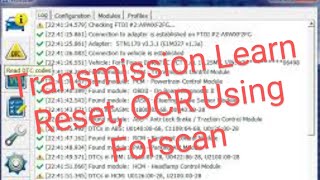
- Ford IDS / FORScan: TCM Adaptive Learning — This is a mandatory procedure after replacing the TCM or the Transmission Range Sensor. It includes several sub-routines: TR Sensor Adaptive Learning, Shift Drum Learning, and Clutch Adaptive Learning. Failure to perform this will result in incorrect shifting and may cause damage.
- Ford IDS / FORScan: Module Programming / PMI (Programmable Module Installation) — When installing a brand new TCM, this function is used to load the vehicle's specific VIN and 'As-Built' data into the module. It ensures the TCM has the correct software and calibration for that specific car.
- Ford IDS / FORScan: Clear Transmission Adaptive Tables — This function is part of the initial adaptive learning process. It erases old learned values from the previous module, providing a clean slate for the new TCM to learn the clutch touch-points and shift drum positions.
Wiring & Ground Locations
- G102 — Located on the left front transmission support.. A poor ground at this location can cause a host of transmission-related electrical issues, including erratic signals from sensors and communication problems with the TCM. It is a primary ground point for transmission components.
- G104 — Located at the left front of the engine compartment.. This is a major chassis ground point. A loose or corroded connection here can introduce electrical noise and voltage drops affecting the Powertrain Control Module (PCM) and by extension, its communication with the TCM.
- C175T — This is the 50-pin main connector for the Powertrain Control Module (PCM), often mounted to the battery box in the engine compartment.. The PCM communicates with the TCM via this connector. Any pin corrosion or wiring issues at C175T can cause communication loss codes (U-codes) and symptoms related to P0706. It's a critical point for checking CAN bus communication integrity.
- TCM Connectors — Two large multi-pin connectors that plug directly into the TCM, which is mounted on the front of the transmission case.. These are the direct interface for the TCM. The pins for the Transmission Range Sensor signal, power, and ground are located here. Corrosion or loose pins in these main connectors are a common cause of intermittent signal faults.
Real Owner Repair Stories
- Reddit user on r/FordFocus (2013 Ford Focus (shares DPS6 transmission and TCM with Fiesta)) — Car would not engage any gear, would not start.
❌ Tried (didn't work) Initial diagnosis pointed to a general transmission failure.
✅ What actually fixed it The owner diagnosed it as a bad TCM. Since new parts were on backorder, they temporarily swapped in a used TCM from their 2012 Focus. The car immediately started and was able to be moved, confirming the TCM was the sole point of failure.
OEM Part Supersession History
AE8Z-7Z369-B, AE8Z-7Z369-D→AE8Z-7Z369-F— The original TCMs were prone to internal circuit failures. The updated 'F' revision and subsequent remanufactured versions often feature soldered connections instead of compliant pins for better durability and to prevent intermittent failures.
Heads up: While TCMs from 2012-2018 are physically interchangeable, models from 2015-2018 have a different software calibration. Using a later TCM on an earlier car (e.g., a 2016 TCM on a 2013 Fiesta) without reprogramming it with the correct 'As-Built' data can result in harsh shifting or other drivability issues.
Model Year Variations Within This Range
- 2015-2016: TCMs installed in Fiestas and Focuses from 2015 onward received a different factory software calibration compared to the 2011-2014 models. While physically identical, swapping modules between these year groups without reprogramming is not recommended as it can cause shift quality problems.
Diagnostic Flowchart
Other Known Issues on This Vehicle
Issues unrelated to this code that are worth knowing about as an owner of this generation:
- Faulty Door Latches 🔴 High — Widespread across 2011-2014 models, leading to multiple recalls. The latch pawl spring tab can break, preventing the door from latching or causing it to unlatch while driving. (Ref: Recalls 15S16, 16S30, 20S30.)
- Failing HVAC Blend Door Actuator 🟡 Low — Very common across all model years. The plastic gears inside the actuator strip, causing a repetitive clicking or ticking sound from behind the dashboard, especially when changing temperature or airflow direction.
- Suspension and Steering Rack Wear 🟠 Medium — Common on higher-mileage vehicles. Owners report clunking noises over bumps due to worn sway bar links, struts, and bushings. Premature steering rack wear is also noted.
- 1.0L EcoBoost Coolant Hose Failure 🔴 High — Affects models with the 1.0L EcoBoost engine, primarily from 2012-2016. A design flaw in a coolant hose can lead to sudden coolant loss, overheating, and potential engine failure. (Ref: Recalls were issued in the UK and other markets; check for regional service actions.)
- Parasitic Battery Drain 🟠 Medium — Reported by numerous owners. Can be caused by faulty alternators or software bugs in various modules that prevent them from going to sleep, leading to a dead battery overnight.
Used vs. New Parts: Buying Guide for This Vehicle
When a used part is the smart pick: A used TCM can be a viable, cost-effective option, especially if new OEM parts are on backorder, which is a common issue. It can serve as a good diagnostic tool to confirm a bad TCM before investing in a new one. However, it comes with risks and additional steps.
Donor-vehicle mileage cap: roughly under 80000 miles for the part to have meaningful remaining life.
What to inspect on the donor part:
- Match the part number as closely as possible, prioritizing donors from the same year range (e.g., 2011-2014 or 2015-2016) to get a compatible software calibration.
- Visually inspect the connectors for any signs of corrosion, bent pins, or physical damage to the casing.
- Ask the seller if the donor vehicle had any transmission-related trouble codes before it was dismantled.
OEM-only on this vehicle (don't cheap out):
- Transmission Control Module (TCM)
Aftermarket brands forum-validated for this vehicle:
- Motorcraft (OEM)
- Dorman (Remanufactured - note: Dorman's remanufactured units often have reinforced internal connections)
Brands owners have reported issues with on this vehicle:
- Unnamed, no-brand units from online marketplaces should be avoided due to high failure rates and lack of support.
Real Owner Stories
Aggregated from forums and TSBs cited above. Mileages and costs reflect what owners reported in those sources.
2014 Ford Fiesta
Symptoms: Harsh shifting and no-start conditions linked to the transmission.
What fixed it: Replacement of the Transmission Control Module (TCM).
Source hint: reddit.com/r/FordFiesta thread titled '2014 Ford Fiesta - Transmission Issues - P0706'
2011-2016 Ford Fiesta
Symptoms: General shifting issues and P0706 code.
What fixed it: TCM replacement performed under Ford's extended warranty program.
Source hint: fiestafaction.com thread titled 'Transmission Control Module' URL: https://www.fiestafaction.com/threads/transmission-control-module.66857/
Related OBD-II Codes
Frequently Asked Questions
Is my 2011-2016 Ford Fiesta covered under a warranty extension for the P0706 code?
My Fiesta won't start and the gear indicator is flashing; could this be related to P0706?
Does TSB 16-0129 apply to my Fiesta's shifting issues?
Can I just replace the Transmission Range Sensor (TRS) myself to fix P0706?
What is the 'clutch adaptive relearn' I keep hearing about?
Is the P0706 code related to the clutch warranty extension (14M01)?
Helpful Videos
We Have This Part in Stock


The information in this article is provided for general reference and educational purposes only. Vehicle specifications, procedures, and part compatibility can vary by production date, trim level, and region. Always consult your vehicle's factory service manual and verify part numbers before purchasing or performing repairs. Safety-critical components such as airbags, seat belts, and braking systems should be installed by a qualified professional.
- Ford Fiesta:
- 🧭 Diagnostic Flowchart
- 🎬 Helpful Videos
- 🛍️ Shop This Part
- What's Unique About the 2011-2016 Ford Fiesta
- Symptoms You May Notice
- Most Likely Causes
- Rare But Worth Checking
- Diagnosis Steps
- Parts You'll Likely Need
- Related Codes That Often Appear With This One
- Technical Service Bulletins (TSBs) & Recalls
- Platform-Specific Known Issues
- Documented NHTSA Reports
- Hidden / Shadow Codes Worth Checking
- Scan Tool Commands That Help
- Wiring & Ground Locations
- Real Owner Repair Stories
- OEM Part Supersession History
- Model Year Variations Within This Range
- Other Known Issues on This Vehicle
- Used vs. New Parts: Buying Guide for This Vehicle
- Real Owner Stories
- 2014 Ford Fiesta
- 2011-2016 Ford Fiesta
- Related OBD-II Codes
- Frequently Asked Questions
- 🎟️ Get 5% Off