

P0715 on 2009-2013 Volkswagen Golf: Input Speed Sensor Causes and Fixes
On a 2009-2013 VW Golf, P0715 is often caused by a failed mechatronic unit if you have a DSG transmission, or a brittle internal wiring harness on a conventional automatic. Both are complex repairs requiring professional service, with costs ranging from several hundred to over a thousand dollars.
- P0715 on a 2009-2013 Golf indicates a serious transmission issue that requires prompt attention.
- The most likely cause depends entirely on your transmission type: a faulty mechatronic unit for DSG or a bad internal wiring harness for a conventional automatic.
- This is not a simple DIY fix. Due to the complexity and location of the parts, professional service is strongly recommended.
- Symptoms typically include harsh shifting and the transmission going into a protective 'limp mode'.
- When getting a repair, ensure the shop is experienced with Volkswagen transmissions, especially the DSG mechatronic unit.
What's Unique About the 2009-2013 Volkswagen Golf
For the Mk6 Golf, the root cause of P0715 heavily depends on which automatic transmission is in the car. Models equipped with the Direct-Shift Gearbox (DSG), such as the 6-speed DQ250, have the input speed sensor (G182) integrated into the complex and expensive mechatronic unit. On these cars, P0715 often signals an internal failure within the mechatronic unit itself, not just a simple sensor swap. In contrast, models with the conventional Tiptronic automatic (the Aisin-Warner TF-60SN, also known as the 09G) commonly suffer from a brittle internal wiring harness that cracks from heat and fluid exposure, causing the circuit fault.
Symptoms You May Notice
- Harsh, erratic, or failed gear shifts.
- Vehicle enters 'limp mode' or 'fail-safe' mode, often stuck in one gear.
- Flashing 'PRNDS' light on the instrument cluster.
- Check Engine Light is illuminated.
- Delayed or harsh engagement when shifting from Park to Drive or Reverse.
- Reduced fuel efficiency.
- Tachometer needle fluctuating erratically during long drives (reported on DSG models).
- Replacing only the input speed sensor (G182) on a conventional 09G automatic when the brittle internal wiring harness was the actual root cause. The labor to access the sensor is significant, so replacing both is best practice.
- Condemning the entire transmission for a complete rebuild when the issue is an electrical fault with the sensor, wiring, or mechatronic unit.
Most Likely Causes
- Failed Internal Transmission Wiring Harness (Conventional Automatic) 🔴 High Probability → Shop Transmission Assembly On the 09G Tiptronic transmission, the internal wiring harness becomes brittle from constant heat cycles and exposure to transmission fluid, leading to cracked insulation and short circuits. This is a widely documented failure point for this Aisin-built transmission.
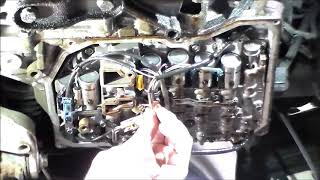
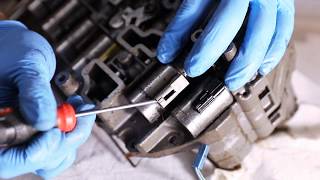
How to confirm: After ruling out external wiring, the transmission oil pan must be removed to visually inspect the harness for signs of cracking, flaking, or damage. The wires will feel stiff and the insulation may crumble when handled. 🎬 Watch: How to safely unplug 09G valve body connectors
Typical fix: Replacement of the internal wiring harness. The input speed sensor (G182) and transmission fluid/filter are typically replaced at the same time. This requires removing the valve body.
Est. part cost: $70-$150 - Failed Mechatronic Unit (DSG Models) 🔴 High Probability → Shop Transmission Valve Body On DSG transmissions (like the 6-speed wet-clutch DQ250), the input speed sensor is an integral part of the mechatronic unit. An internal failure in the unit's circuitry or the sensor itself is a common cause for this code.
How to confirm: A professional diagnosis with a VW-specific scan tool (like VCDS) is needed to confirm communication faults with the mechatronic unit and analyze sensor data streams. The unit must be removed for physical inspection or testing.
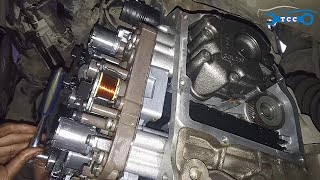
Typical fix: Repair or replacement of the mechatronic unit. This is a very complex job that requires programming the new unit to the vehicle. 🎬 Watch: Step-by-step DSG mechatronic unit replacement walkthrough
Est. part cost: $800-$2000+ - Failed Input Speed Sensor (G182) 🟡 Medium Probability The sensor itself can fail electronically. On 09G models, its magnetic tip can also become contaminated with metallic debris from normal wear, disrupting its signal. However, it is less common for the sensor to fail than the harness that connects to it.
How to confirm: On conventional 09G automatics, the sensor's resistance can be tested with a multimeter, but this requires removing the transmission pan and valve body for access. A service manual states a resistance of 5.0M Ohms at room temperature is expected.
Typical fix: Replacement of the sensor. On conventional automatics, this is almost always done with the internal harness. On DSG models, it's part of the mechatronic unit service.
Est. part cost: $40-$100 - Damaged External Wiring or Connector ⚪ Low Probability The wiring harness leading to the transmission can be damaged by road debris, heat from the exhaust, or corrosion at the main connector. A user on the Ross-Tech forums reported finding a broken wire inside the connector boot, which was only discovered by gently pulling on each wire.
How to confirm: Visually inspect the wiring harness from the TCM to the transmission case. Check for continuity and shorts using a multimeter. Pay close attention to the main connector, tugging gently on each wire to check for internal breaks.
Typical fix: Repair the damaged section of the wire or replace the corroded connector pigtail.
Est. part cost: $20-$80
Rare But Worth Checking
- Faulty Transmission Control Module (TCM): → Shop Transmission Assembly While rare, the TCM itself can fail to process the sensor's signal correctly. This should only be considered after all sensors and wiring have been proven to be good.
Diagnosis Steps
- Scan the TCM for codes using an OBD-II scanner. Confirm P0715 is present and note any other transmission-related codes like P0716 or P0720 (Output Speed Sensor).
- Use a scanner's live data function to monitor the Input Speed Sensor RPM. Check for dropouts or erratic readings while driving (if possible) or by raising the drive wheels and running the car in gear.
- Inspect the transmission fluid level and condition. Low, burnt, or debris-filled fluid can indicate larger problems and affect sensor operation.
- Visually inspect the external wiring harness and the main connector at the transmission for any signs of damage, corrosion, or loose connections. As per a real-world forum diagnosis, gently pull on each wire at the back of the connector to check for hidden breaks.
- If external components are okay, the next step depends on the transmission type:
- - Conventional Automatic (09G): Drain the fluid, remove the transmission oil pan, and inspect the internal wiring harness for brittleness and cracks. Accessing the G182 sensor or harness requires removing the valve body.
- - DSG Transmission (DQ250): This step typically requires a professional. The mechatronic unit must be diagnosed using advanced tools. Removal may be necessary for inspection or replacement.
- Based on findings, replace the faulty component (mechatronic unit, internal harness, or sensor).
- Refill with the correct specification VW transmission fluid, clear the codes, and perform a test drive to ensure the repair was successful.
Parts You'll Likely Need
- Automatic Transmission Internal Wiring Harness (Tiptronic)
(OEM #09G927363B)— This harness becomes brittle and is the most common cause of P0715 on the conventional 09G automatic transmission.
Trusted brands: Volkswagen OE, Febi Bilstein, VEMO, Rostra
OEM price range: $150-$250
Aftermarket price range: $70-$150 - Mechatronic Repair Kit or Replacement Unit (DSG) — For DSG models, the sensor is internal to this unit, which is the most common point of failure for a P0715 code.
Trusted brands: Volkswagen OE
OEM price range: $1200-$2500
Aftermarket price range: $800-$1500 (rebuilt) - Transmission Input Speed Sensor (G182)
(OEM #09M927321B)— The sensor itself can fail. It's often replaced along with the internal harness on conventional automatics as a best practice.
Trusted brands: Aisin, Bosch, Volkswagen OE
OEM price range: $80-$150
Aftermarket price range: $40-$90
Related Codes That Often Appear With This One
- P0716 — This code for 'Input/Turbine Speed Sensor 'A' Circuit Range/Performance' is very similar and often points to the same root causes, like a failing sensor or wiring that provides an erratic signal before failing completely.
- P0700 — This is a general 'Transmission Control System Malfunction' code. It's an informational code indicating that the TCM has stored a more specific fault, like P0715.
Technical Service Bulletins (TSBs) & Recalls
- TSB TT 01-15-06 (for Jetta with 09G transmission) - Notes failure of the internal transmission wiring harness, a highly relevant issue for Golf models with the same transmission.
Platform-Specific Known Issues
- A known issue on similar VW platforms with the 09G automatic transmission is the failure of the internal wiring harness due to heat and fluid exposure.
- DSG Mechatronic units are a known failure point across the VW/Audi lineup, leading to various shifting problems and fault codes, including P0715.
Mechanic-Grade Diagnostic Values
- Input Speed Sensor (G182) Resistance (09G Tiptronic) — expected: 5.0M Ohms at room temperature.. Failure: A significantly different reading, or an open/short circuit, indicates a failed sensor.
- Wiring continuity from G182 sensor connector to TCM connector (09G Tiptronic) — expected: Max 1.5 Ohms.. Failure: Higher resistance indicates a problem in the wiring harness (corrosion, partial break). Infinite resistance indicates an open circuit.
Scan Tool Commands That Help
- VCDS (VAG-COM) or ODIS: Mechatronic Cloning / Immobilizer Adaptation — Required when replacing the DQ250 Mechatronic unit. The new or used unit must be programmed to the vehicle's VIN and immobilizer system, otherwise the car will not shift or move.
- VCDS (VAG-COM) or ODIS: Basic Settings — After replacing a DQ250 mechatronic unit or 09G valve body, a basic settings procedure must be performed to recalibrate shift points and clutch engagement.
Wiring & Ground Locations
- Ground connection on transmission — A main ground strap connects the transmission case to the vehicle body or chassis, typically on the left side of the engine compartment.. A poor ground connection can cause a floating ground, leading to erratic sensor readings and communication faults for all transmission sensors, including the G182.
- Ground connection in plenum chamber, left — Located in the plenum chamber (the area at the base of the windshield), designated as point 607.. This is a key grounding point for various engine bay electronics. Corrosion or looseness here can cause intermittent and hard-to-diagnose electrical issues for the engine and transmission control systems.
- Main Transmission Case Connector (09G) — An 8-pin or 14-pin round connector on the exterior of the transmission case, where the external harness connects to the internal components.. This is the primary point for testing the G182 sensor circuit without dropping the transmission pan. Checking for voltage, ground, and signal at these pins is a critical diagnostic step.
Real Owner Repair Stories
- VW Polo owner (shared platform) (VW Polo with 09G (AQ 250 6F) transmission) — Check Engine Light on, P0715 and other transmission codes stored. Transmission oil was milky grey with metal filings.
❌ Tried (didn't work) Initial diagnosis pointed to multiple sensor failures.
✅ What actually fixed it The root cause was severe fluid contamination from lack of service. Upon stripping the valve body, the internal wiring harness was found to be so brittle it "disintegrated into crumbs" when unplugged. Replacing the harness and solenoids, along with a full fluid service, was the fix.
OEM Part Supersession History
09G927321, 9G927321, 09M927321→09M927321B— Part revision and consolidation across multiple vehicle platforms.
Heads up: While 09M927321B is the latest revision, always verify fitment with the vehicle's VIN as minor differences can exist.09G927363→09G927363B— Likely improvements to wire insulation material to combat brittleness.
Heads up: The 'B' revision is the standard replacement for the 09G internal harness. Aftermarket versions from brands like VEMO are also widely available.
Diagnostic Flowchart
Other Known Issues on This Vehicle
Issues unrelated to this code that are worth knowing about as an owner of this generation:
- 2.0T TSI Timing Chain Tensioner Failure 🔴 High — Common on earlier EA888 engines (approx. 2008-2012). Failure can be catastrophic, often happening at startup without warning. (Ref: Covered under a class-action lawsuit settlement and extended warranty in some cases.)
- Water Pump / Thermostat Housing Leak (TSI engines) 🟠 Medium — Very common failure. The plastic housing is prone to cracking or leaking, often due to age or oil contamination from other leaks. (Ref: VW extended the warranty on this component for many vehicles due to high failure rates.)
- Intake Manifold Runner Flap Failure (TSI engines) 🟠 Medium — Commonly occurs between 60,000-100,000 miles, causing rough idle, poor acceleration, and fault code P2015. (Ref: An extended warranty was issued by VW for this component on many affected vehicles.)
- DSG Mechatronic Unit and Clutch Pack Wear 🔴 High → Shop Transmission Valve Body — Can occur on both 6-speed (DQ250) and 7-speed (DQ200) DSG gearboxes. Symptoms include jerky shifts, hesitation, and flashing PRNDS light. (Ref: Various recalls and service campaigns have been issued globally, particularly for the 7-speed dry clutch DQ200.)
- Ignition Coil Failure 🟡 Low — Coil packs can fail intermittently, causing engine misfires. This is a relatively common and easy-to-diagnose issue.
Used vs. New Parts: Buying Guide for This Vehicle
When a used part is the smart pick: For the 09G Tiptronic, a complete used transmission from a low-mileage donor can be economically viable if the cost of a valve body/harness repair approaches the value of the used unit. For the DSG, a used Mechatronic unit is a potential option ONLY if you have access to a specialist who can perform the required immobilizer cloning and programming.
Donor-vehicle mileage cap: roughly under 80000 miles for the part to have meaningful remaining life.
What to inspect on the donor part:
- Verify the donor vehicle's VIN to ensure compatibility of the transmission code (e.g., '09G 300 033 G').
- Ask for service history, specifically looking for regular fluid changes (every 40k miles for DSG, 60k for 09G).
- Inspect the fluid from the donor transmission if possible. It should be reddish and translucent (09G) or clear/light amber (DSG), not black, burnt, or milky.
- Check all electrical connectors for damage, corrosion, or bent pins.
OEM-only on this vehicle (don't cheap out):
- Mechatronic Unit (DSG): While rebuilt units exist, a new or dealer-rebuilt OEM unit is the safest bet due to the complexity and critical nature of programming.
- Transmission Fluid: Use only the exact VW-specified fluid. The wrong fluid can cause shifting problems and damage to internal components.
Aftermarket brands forum-validated for this vehicle:
- Internal Wiring Harness (09G): VEMO, Febi, Rostra are commonly cited as reliable aftermarket alternatives to the OEM harness.
Brands owners have reported issues with on this vehicle:
- Unbranded, no-name Mechatronic units or solenoids from online marketplaces should be avoided, as they often use lower-grade components that fail prematurely.
Real Owner Stories
Aggregated from forums and TSBs cited above. Mileages and costs reflect what owners reported in those sources.
2009-2013 Volkswagen Golf
Symptoms: A user reported finding a P0715 code and discovered a broken wire inside the connector boot after a detailed inspection.
What fixed it: The repair involved identifying the broken wire by gently pulling on each wire at the back of the connector and repairing the connection.
Source hint: https://forums.ross-tech.com/index.php?threads/10697/
2009-2013 Volkswagen Golf DSG
Symptoms: Vehicle experienced jerky shifts, hesitation, and the 'PRNDS' light flashing on the instrument cluster.
What fixed it: Replacement or repair of the DSG Mechatronic Unit.
Source hint: vehicle_specific_issues
Related OBD-II Codes
Frequently Asked Questions
Does TSB TT 01-15-06 apply to my Volkswagen Golf if I have the 09G transmission?
I have a DSG-equipped Golf; is the P0715 code fixed by just replacing a sensor?
Why is my Golf's 'PRNDS' light flashing on the dashboard?
Can I just replace the G182 sensor on my 09G Tiptronic transmission to clear P0715?
Is there a specific resistance value I should look for when testing the G182 sensor?
Could a simple wiring issue outside the transmission cause P0715 on my Golf?
Helpful Videos
We Have This Part in Stock

The information in this article is provided for general reference and educational purposes only. Vehicle specifications, procedures, and part compatibility can vary by production date, trim level, and region. Always consult your vehicle's factory service manual and verify part numbers before purchasing or performing repairs. Safety-critical components such as airbags, seat belts, and braking systems should be installed by a qualified professional.
- Volkswagen Golf:
- 🧭 Diagnostic Flowchart
- 🎬 Helpful Videos
- 🛍️ Shop This Part
- What's Unique About the 2009-2013 Volkswagen Golf
- Symptoms You May Notice
- Most Likely Causes
- Rare But Worth Checking
- Diagnosis Steps
- Parts You'll Likely Need
- Related Codes That Often Appear With This One
- Technical Service Bulletins (TSBs) & Recalls
- Platform-Specific Known Issues
- Mechanic-Grade Diagnostic Values
- Scan Tool Commands That Help
- Wiring & Ground Locations
- Real Owner Repair Stories
- OEM Part Supersession History
- Other Known Issues on This Vehicle
- Used vs. New Parts: Buying Guide for This Vehicle
- Real Owner Stories
- 2009-2013 Volkswagen Golf
- 2009-2013 Volkswagen Golf DSG
- Related OBD-II Codes
- Frequently Asked Questions
- 🎟️ Get 5% Off