

P0720 on 2000-2006 BMW X5 4.4L: Output Speed Sensor Causes and Fixes
P0720 on a 2000-2006 BMW X5 4.4L almost always means the transmission output speed sensor has failed, causing a 'Trans Failsafe Prog' warning and limp mode. The fix involves replacing the sensor inside the transmission pan, which costs about $50-$70 for the part and 2-3 hours of labor. It's a very common issue for the ZF 5HP24 transmission in these vehicles.
- P0720 on your X5 will almost certainly put the car into 'Trans Failsafe Prog' limp mode.
- The most likely cause is a failed output speed sensor, a relatively cheap part.
- The repair is moderately difficult for a DIYer as it requires removing the transmission pan.
- Always use a BMW-capable scanner to check for codes in the ABS module, as a wheel speed sensor fault can sometimes trigger P0720.
- Since you have to drain the fluid and drop the pan, it is highly recommended to replace the transmission filter and both the input and output speed sensors at the same time.
What's Unique About the 2000-2006 BMW X5
The 2000-2003 BMW X5 (E53) with the 4.4L M62 V8 uses a ZF 5HP24 automatic transmission. For this gearbox, the P0720 code is a very common issue as these vehicles age. The output speed sensor is located inside the transmission, making replacement more involved than on cars with externally mounted sensors. While the sensor itself is the most frequent culprit, it's important to know that the transmission control module also compares the output speed sensor signal with wheel speed signals from the ABS system; a fault in the ABS system or even a significant difference in tire pressures can sometimes trigger a P0720 code as a secondary issue.
Symptoms You May Notice
- "TRANS FAILSAFE PROG" mess 🎬 Watch this troubleshooting guide for Trans Failsafe Modeage on the instrument cluster.
- Check Engine Light or transmission warning light is on.
- Transmission is stuck in one gear (limp mode), usually 4th gear.
- Harsh, erratic, or delayed shifting.
- Vehicle has very poor acceleration from a stop.
- Speedometer may behave erratically or not work at all (though this is less common as it often defaults to using ABS wheel speed data).
- Replacing only the output speed sensor when the fault is in the wiring harness.
- Assuming the transmission has failed and needs a full replacement, when only a relatively inexpensive sensor is needed.
- Confusing the transmission output speed sensor (P0720) with a wheel speed sensor (ABS fault). However, a faulty ABS/wheel speed sensor can sometimes cause a secondary P0720 code, so it's important to scan all modules for codes.
Most Likely Causes
- Failed Output Speed Sensor 🔴 High Probability The electronic components of the sensor, located inside the hot transmission environment, can fail over time due to heat cycles and age. This is a widely documented failure on the ZF 5HP24.
How to confirm: After dropping the transmission pan, the sensor can be tested with a multimeter. Its resistance should be between 285 and 365 ohms. A reading outside this range confirms a failed sensor. A definitive test uses an oscilloscope to check for a clean signal wave.
Typical fix: Replace the output speed sensor. Since the input and output sensors are identical and require the same labor to access, it is common practice to replace both at the same time.
Est. part cost: $50-$75 - Damaged Wiring or Connector 🟡 Medium Probability The internal transmission wiring harness can become brittle from heat and age. The main external connector at the transmission case can also get contaminated with fluid or road debris, causing a poor connection.
How to confirm: Visually inspect the internal wiring harness for brittle or broken wires when the pan is removed. Check the large round external connector for corrosion, bent pins, or fluid contamination.
Typical fix: Replace the internal wiring harness if damage is found. Clean the external connector with electrical contact cleaner and ensure it is fully seated.
Est. part cost: $50-$100 for a new internal harness - Low or Contaminated Transmission Fluid ⚪ Low Probability → Shop Transmission Assembly BMW marketed this transmission as having 'lifetime' fluid, leading many owners to neglect fluid services. Over time, the fluid degrades and the level can drop due to minor leaks, causing erratic hydraulic pressure and potentially affecting sensor readings.
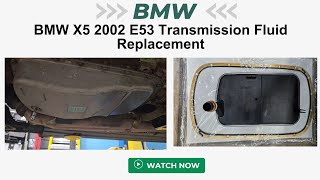
How to confirm: Check the transmission fluid level and condition. 🎬 See how to replace the transmission fluid and filter This is difficult as there is no dipstick; it must be checked via the fill plug with the vehicle running and at a specific temperature. Dark, burnt-smelling fluid indicates a problem.
Typical fix: Perform a transmission fluid and filter service. If the fluid is heavily contaminated, a full flush may be needed, but this should be done with caution on high-mileage transmissions.
Est. part cost: $150-$250 for a fluid and filter kit
Rare But Worth Checking
- Internal Transmission Seal Leakage: → Shop Transmission Assembly In some cases, a P0720 code is not the root cause, but a symptom. Internal clutch pack seals can harden and leak, causing slippage, especially when the transmission is hot. The TCM detects this discrepancy between input and output speed and may log a speed sensor fault. If replacing the sensor doesn't fix the issue and the problem is worse when hot, this could be the underlying problem, requiring a transmission rebuild. One owner on Xoutpost.com described this exact scenario.
- Faulty Transmission Control Module (TCM/EGS): → Shop Transmission Assembly While rare, the TCM itself can fail, causing it to misinterpret the sensor signal. This is usually the last part to suspect after all sensors and wiring have been confirmed to be good.
Diagnosis Steps
- Scan all vehicle modules (Engine, Transmission, ABS) with a BMW-capable scan tool to check for any related codes.
- If only P0720 is present, the primary suspect is the output speed sensor.
- Check the transmission fluid level and condition. This requires the vehicle to be level, running, and the transmission fluid to be at a specific temperature (usually 30-50°C).
- If fluid is okay, the next step is to gain access to the sensor. Safely raise and support the vehicle.
- Drain the transmission fluid and remove the transmission pan.
- Visually inspect the fluid and pan for excessive metal debris, which would indicate a more severe internal failure.
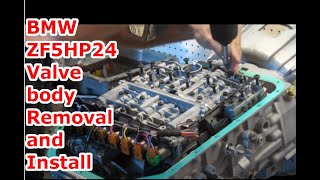
- Locate the output speed sensor on the valve body. 🎬 Watch this walkthrough of the valve body installation It is held in by a single Torx T27 screw and a small bracket. Inspect its wiring and connector for any visible damage.
- Test the sensor's resistance with a multimeter. It should be between 285-365 Ohms. If it's out of spec, it needs replacement.
- If the sensor tests good, carefully inspect the internal wiring harness for breaks or brittle insulation.
- If no issues are found inside the transmission, inspect the main external connector and the wiring leading to the TCM for damage.
Parts You'll Likely Need
- Transmission Speed Sensor (Input/Output)
(OEM #ZF Part: 0501-310-401, BMW Part: 24341218551)— This is the most common failure part for a P0720 code on the ZF 5HP24 transmission. The input and output sensors are the same part.
Trusted brands: ZF (OEM), Bosch
OEM price range: $60-$80
Aftermarket price range: $40-$60 - Transmission Filter and Pan Gasket Kit — This is required for the job, as the transmission pan must be removed to access the sensor. The filter should always be replaced at the same time.
Trusted brands: ZF, Febi, Vaico, Filtran
OEM price range: $50-$80
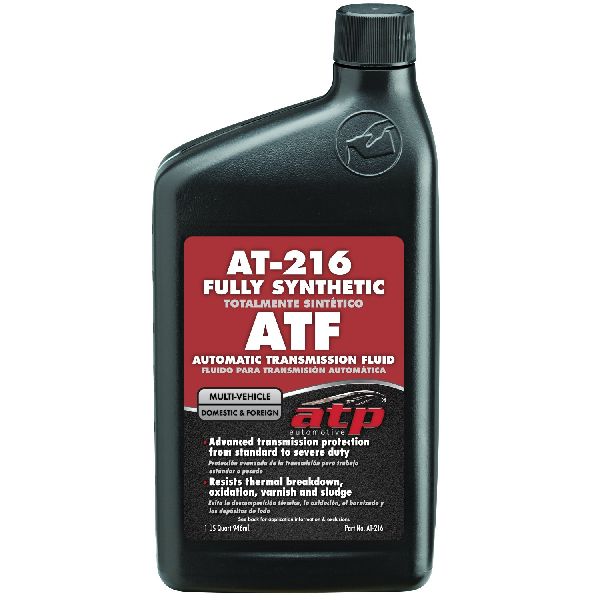
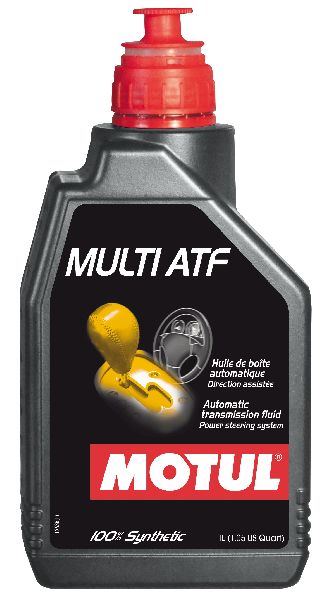
Aftermarket price range: $30-$60 - ZF Lifeguard 5 Transmission Fluid
(OEM #BMW Part: 83229407807)— This is the specified fluid for the ZF 5HP24 transmission. A partial drain and refill will require approximately 4-6 liters.
Trusted brands: ZF, Pentosin ATF 1, Mobil Esso LT 71141
OEM price range: $20-$25 per liter
Aftermarket price range: $15-$20 per liter
Related Codes That Often Appear With This One
- P0715 — P0715 is for the Input Speed Sensor circuit. Since the input and output sensors are identical parts living in the same harsh environment, it's not uncommon for them to fail around the same time. Many owners and technicians replace them as a pair during the service.
- ABS/DSC codes (e.g., 5F-EGS) — The TCM communicates with the ABS/DSC module. A fault in the ABS system or a bad wheel speed sensor can cause a conflict in the speed data the TCM receives, sometimes leading it to incorrectly flag the transmission's output sensor. In one documented case on a Range Rover with the same transmission, an underinflated tire created enough of a speed differential to trigger a P0720.
Mechanic-Grade Diagnostic Values
- Output Speed Sensor Resistance — expected: 285 - 365 Ohms. Failure: A reading of 0, infinity (OL), or outside the specified range indicates a failed sensor.
- Output Speed Sensor Resistance at Main Case Connector — expected: 285 - 365 Ohms between pins 12 and 15. Failure: A reading outside this range points to a failure in the sensor or the internal harness. If the reading here is bad but good at the sensor itself, the internal harness is faulty.
Hidden / Shadow Codes Worth Checking
- 59 (Decimal): This is the BMW-specific transmission control module (EGS) fault code for 'Output Speed Sensor (n-ab)'. It is the direct equivalent of the generic OBD-II code P0720. (see via BMW-specific diagnostic software such as INPA or ISTA.)
- Shadow/Latent Faults: While no specific shadow code is consistently linked to P0720, a technician would scan for other non-critical faults related to voltage supply or communication on the CAN bus. These codes do not trigger a warning light but can indicate an underlying electrical issue that might cause the P0720, such as a failing alternator or a bad ground intermittently affecting the TCM. (see via Advanced BMW diagnostic tools like ISTA. Basic OBD-II readers will not show these.)
Scan Tool Commands That Help
- ISTA or INPA: Clear adaptations (EGS) — This service function should be performed after replacing the speed sensor(s) or valve body. It resets the transmission control module's learned values for shift timing and clutch pressures, allowing it to re-learn with the new components for optimal shift quality.
Wiring & Ground Locations
- Transmission Case Connector — Large, round, 16-pin connector on the right-hand (passenger) side of the ZF 5HP24 transmission case.. This is the main electrical interface for all internal transmission components. The output speed sensor signal passes through pins 12 and 15. Fluid can leak into this connector, causing corrosion and signal loss. It's a key external test point before removing the transmission pan.
- Transmission Ground Strap — A braided metal strap connecting the transmission body to the vehicle chassis, typically near the transmission mounts.. A corroded or broken ground strap can cause a floating ground for the entire transmission, leading to erratic behavior from all electronic sensors and solenoids, including the speed sensor. This can trigger various transmission codes, including P0720.
OEM Part Supersession History
24341215603, 24341421193→24341218551— Part number consolidation and potential minor revisions by BMW over the years.
Heads up: For the E53 X5 with the ZF 5HP24 transmission, 24341218551 is the correct and current part number. Using older stock is not advised. The ZF OEM part number is 0501-310-401.
Model Year Variations Within This Range
- 2000-2003 (Pre-Facelift): The 4.4i models in this range used the M62 V8 engine mated to the ZF 5HP24 five-speed automatic transmission. The P0720 fault, parts, and repair procedures described here are highly specific and common to this combination.
- 2004-2006 (Post-Facelift): The 4.4i models in this range received the newer N62 V8 engine and were typically paired with a ZF 6HP26 six-speed automatic transmission. While a P0720 code can occur on this transmission, the speed sensors are different parts and may be in different locations, making this guide less applicable.
Diagnostic Flowchart
Other Known Issues on This Vehicle
Issues unrelated to this code that are worth knowing about as an owner of this generation:
- Timing Chain Guide Failure 🔴 High — Very common on M62 engines over 100,000-150,000 miles. Heat cycles make the plastic guides brittle. A rattling noise on a cold start is the classic symptom.
- Valley Pan Gasket Coolant Leak 🟠 Medium — Common as the vehicle ages. Gaskets under the intake manifold fail, causing a slow coolant leak that drips down the back of the engine onto the transmission bellhousing.
- Valve Stem Seal Failure 🟠 Medium — A well-known issue on the M62 V8, causing oil consumption and blue smoke from the exhaust, particularly on startup or after idling.
- Cooling System Component Failure 🔴 High — Plastic components like the radiator, expansion tank, and various hoses become brittle with age and can fail without warning. Water pumps and thermostats are also common failure points.
- Final Stage Unit (FSU) / Blower Motor Resistor Failure 🟡 Low — Extremely common. Causes the HVAC fan to work erratically (fluctuating speeds) or not at all. It's a relatively easy and inexpensive DIY fix.
- Front Suspension Control Arm Bushing Wear 🟠 Medium — The front thrust arm bushings are a frequent wear item, leading to clunking noises over bumps and a shimmy in the steering wheel, especially under braking.
Used vs. New Parts: Buying Guide for This Vehicle
When a used part is the smart pick: For a P0720 code, using a used part is almost never a smart choice. The primary failure part is a relatively inexpensive electronic sensor, but the labor to access it is significant. The risk of a used sensor failing shortly after installation outweighs the small cost savings. A used part would only make sense if you are replacing the entire transmission due to a catastrophic failure that happens to include a P0720 code.
Donor-vehicle mileage cap: roughly under 100000 miles for the part to have meaningful remaining life.
What to inspect on the donor part:
- For a full transmission assembly: Ask for service history if available.
- If possible, check the donor vehicle's mileage.
- Inspect the transmission fluid on the dipstick (if applicable) or by cracking a line; it should not be black or smell burnt.
- Check the main electrical connector for signs of fluid leaks or pin damage.
OEM-only on this vehicle (don't cheap out):
- Transmission Speed Sensor: Given the high labor cost for replacement, using the OEM ZF or Genuine BMW sensor is strongly recommended to ensure longevity and prevent a repeat failure.
Aftermarket brands forum-validated for this vehicle:
- Filter/Gasket Kit: ZF (OEM), Filtran, Febi, Vaico.
- Transmission Fluid: ZF Lifeguard 5 (OEM), Pentosin ATF 1, Mobil Esso LT 71141.
Brands owners have reported issues with on this vehicle:
- Unbranded, 'white-box' speed sensors from online marketplaces. The quality control is unknown, and failure rates are reportedly high according to forum consensus.
Real Owner Stories
Aggregated from forums and TSBs cited above. Mileages and costs reflect what owners reported in those sources.
2001 BMW X5 4.4L V8
Symptoms: The car was shaking and the engine was dying especially under load and coming down to lower RPMs. Shifting down was not smooth.
What fixed it: The owner was investigating the intake and MAF, but the context points to P0720 output speed sensor errors being the underlying transmission fault.
Source hint: Xoutpost.com thread titled 'p0720-output-speed-sensor-error.html'
2003 Range Rover (L322) 4.4L V8
Symptoms: Vehicle triggered a P0720 fault code despite sharing the same M62 engine and ZF transmission architecture as the X5.
What fixed it: In this specific documented case, the fault was caused by an underinflated tire.
Source hint: Context reference regarding platform mates
Related OBD-II Codes
Frequently Asked Questions
My 2002 X5 4.4L is stuck in 4th gear and showing 'TRANS FAILSAFE PROG'. Is this related to P0720?
Can I test the output speed sensor on my X5 without replacing it immediately?
Is it true that the BMW X5 4.4L transmission fluid never needs to be changed?
I'm replacing the output speed sensor; should I replace the input sensor as well?
Could a tire issue really cause a P0720 transmission code on my X5?
What size tool do I need to remove the speed sensor from the valve body?
Helpful Videos
We Have This Part in Stock




The information in this article is provided for general reference and educational purposes only. Vehicle specifications, procedures, and part compatibility can vary by production date, trim level, and region. Always consult your vehicle's factory service manual and verify part numbers before purchasing or performing repairs. Safety-critical components such as airbags, seat belts, and braking systems should be installed by a qualified professional.
- BMW X5:
- 🧭 Diagnostic Flowchart
- 🎬 Helpful Videos
- 🛍️ Shop This Part
- What's Unique About the 2000-2006 BMW X5
- Symptoms You May Notice
- Most Likely Causes
- Rare But Worth Checking
- Diagnosis Steps
- Parts You'll Likely Need
- Related Codes That Often Appear With This One
- Mechanic-Grade Diagnostic Values
- Hidden / Shadow Codes Worth Checking
- Scan Tool Commands That Help
- Wiring & Ground Locations
- OEM Part Supersession History
- Model Year Variations Within This Range
- Other Known Issues on This Vehicle
- Used vs. New Parts: Buying Guide for This Vehicle
- Real Owner Stories
- 2001 BMW X5 4.4L V8
- 2003 Range Rover (L322) 4.4L V8
- Related OBD-II Codes
- Frequently Asked Questions
- 🎟️ Get 5% Off