

P0720 on 2009-2022 Kia Forte: Output Speed Sensor Circuit Causes and Fixes
On 2009-2018 Fortes with the 6-speed automatic, P0720 is almost always a failed internal Output Speed Sensor. The sensor is inside the transmission, making replacement a labor-intensive job. For 2019+ models with the IVT/CVT, this code is less common, and transmission issues often point to other problems.
- P0720 on a Kia Forte points to a problem with the Output Speed Sensor, which is crucial for proper shifting.
- For 2009-2018 models with a 6-speed automatic, the sensor is inside the transmission, making this a difficult DIY repair. The input and output sensors are often replaced together.
- For 2019+ models with the IVT/CVT, transmission issues are common but usually trigger different codes and may be covered by a service campaign.
- Symptoms include harsh shifting, a non-working speedometer, and the vehicle may enter a 'limp mode'.
- Driving with this code is not recommended due to unpredictable shifting, which can be a safety hazard.
What's Unique About the 2009-2022 Kia Forte
The key difference for the Kia Forte lies in the transmission type. Models from 2009-2018 typically use a 6-speed automatic transmission (A6GF1 family) where the input and output speed sensors are located inside the transmission, mounted to the valve body. This makes replacement much more complex than for externally mounted sensors. Later models from 2019 onwards often feature an Intelligent Variable Transmission (IVT), which is a type of CVT. While P0720 can occur, these IVT units have known issues covered by service bulletin TRA102 for different codes (like P0730, P0741) that often require a software update or complete unit replacement due to symptoms like slipping, shuddering, or total failure at low mileage.
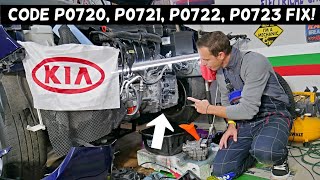
🎬 Watch: A mechanic's warning about these specific Kia transmission models.Generation note: The vehicle range covers three generations, with a major transmission change: - First Gen (TD, 2009-2013) & Second Gen (YD, 2014-2018): Typically equipped with a 6-speed A6GF1 automatic transmission. P0720 on these models most often points to the internal speed sensor harness failing due to heat and fluid exposure. The switch from a 4-speed to the 6-speed A6GF1 around 2011 is the key change; the 4-speed used an easier-to-access external sensor, while the 6-speed moved it inside the transmission. - Third Gen (BD, 2019-2022): Primarily uses an IVT (CVT). Transmission problems on these models are common but usually manifest with other codes (P0730, P0731, P0741, P0867) and are addressed by specific TSBs like TRA102 for software updates or IVT replacement due to internal slippage.
Symptoms You May Notice
- Check Engine Light is on
- Harsh, erratic, or delayed shifting
- Transmission getting stuck in one gear (limp mode)
- Speedometer reads 0 mph or behaves erratically
- Cruise control does not work
- Engine may stall when coming to a stop
- Decreased fuel efficiency
- RPMs jumping with jerking or shuddering, especially on IVT models.
- Replacing the external Vehicle Speed Sensor (VSS) located on the wheel hub (ABS sensor). While this sensor also measures speed, P0720 specifically refers to the transmission's *output* shaft speed sensor.
- Replacing only one of the internal sensors (input or output) when the entire harness assembly is the actual point of failure.
Most Likely Causes
- Faulty Internal Output Speed Sensor (OSS) / Wiring Harness 🔴 High Probability On 6-speed automatic models (2009-2018), the sensors and their wiring are integrated into a single plastic harness located inside the transmission. This harness is constantly submerged in hot transmission fluid, which makes the plastic brittle over time, leading to cracks and circuit failures.
How to confirm: A diagnostic scan tool can monitor the OSS data stream. If the reading is zero or erratic while the vehicle is moving, the sensor or its circuit is bad. Resistance can also be checked with a multimeter if the sensor is accessed, comparing it to manufacturer specs. However, since the failure is often the harness itself, a visual inspection after removing the valve body is the most definitive confirmation.
Typical fix: Replace the entire input/output speed sensor wiring harness assembly. Since it contains the input sensor, output sensor, and transmission temperature sensor, it is common practice and highly recommended to replace the entire harness as a unit. 🎬 See this walkthrough on diagnosing output speed sensor codes. This requires draining the transmission fluid, removing the oil pan, and removing the valve body to access the harness.
Est. part cost: $40-$100 - Damaged Internal Wiring Harness 🟡 Medium Probability → Shop Transmission Wiring Harness The wiring harness that holds the input and output speed sensors is plastic and lives inside the hot transmission fluid, which can make it brittle and prone to failure over time. This is the primary failure mode for P0720 on the A6GF1 transmission.
How to confirm: A visual inspection after removing the valve body may reveal cracked or damaged wiring. A continuity test on the harness wires can confirm an open or short circuit.
Typical fix: Replace the entire input/output speed sensor wiring harness assembly. This part often includes both sensors and the temperature sensor.
Est. part cost: $50-$100 - Low or Contaminated Transmission Fluid ⚪ Low Probability → Shop Transmission Assembly While not a direct cause of a circuit code, very low or dirty fluid can cause erratic shifting, high temperatures, and transmission slippage, which can stress electrical components within the transmission and potentially trigger various codes.
How to confirm: Check the transmission fluid level and condition (if a dipstick is available). On sealed transmissions, this must be checked by a professional. The fluid should be red and clear, not brown, black, or smelling burnt.
Typical fix: Perform a transmission fluid drain and fill, or a full fluid exchange, using the correct specification fluid (e.g., Kia SP-IV).
Est. part cost: $80-$200 for fluid
Rare But Worth Checking
- Faulty Transmission Control Module (TCM) or Powertrain Control Module (PCM): → Shop Engine Control Module (ECM) This is very uncommon. Before condemning the control module, all other possibilities, including the sensor, wiring, and fluid, must be exhaustively ruled out.
Diagnosis Steps
- Connect an OBD-II scanner to confirm the P0720 code and check for any other related transmission codes, especially P0715 and P0711.
- Use the scanner's live data function to monitor the Output Speed Sensor (OSS) signal while driving. A reading of 0 MPH or an erratic reading while the car is moving points to a problem with the sensor or its circuit.
- Check the transmission fluid level and condition. Low or burnt fluid can indicate larger transmission problems.
- If the OSS signal is faulty, the next step for 2009-2018 models is to access the internal sensor harness. This requires draining the fluid and removing the transmission oil pan and valve body.
- Visually inspect the sensor and its wiring harness for any signs of damage, like cracks, brittle plastic, or burnt spots.
- Test the sensor's resistance with a multimeter and compare it to the manufacturer's specifications. Test the wiring harness for continuity.
- If the sensor or harness is faulty, replace the entire harness assembly. It is highly recommended to replace the input and output sensors together as they are on the same harness.
- Reassemble the transmission, refill with the correct type and amount of new transmission fluid (e.g., Kia SP-IV), and clear the trouble codes.
- Perform a test drive to ensure the transmission is shifting correctly and the P0720 code does not return.
Parts You'll Likely Need
- Transmission Input/Output Speed Sensor Harness
(OEM #42620-26001 (Verify for A6GF1))— This is the most common failure point for P0720 on 6-speed automatic models (A6GF1). The harness typically includes both the input and output sensors and the temperature sensor, and is replaced as a single unit.
Trusted brands: Kia/Hyundai (Genuine OEM), Dorman, Standard Motor Products (SMP)
OEM price range: $70-$120
Aftermarket price range: $40-$80 - Automatic Transmission Fluid — The transmission fluid must be drained to access the sensor and must be replaced with new fluid of the correct specification (e.g., Kia SP-IV).
Trusted brands: Kia (Genuine OEM), Idemitsu, Valvoline
OEM price range: $15-$25 per quart
Aftermarket price range: $10-$18 per quart - Transmission Pan Gasket — The old gasket should be replaced when the transmission pan is removed to prevent leaks.
Trusted brands: Kia (Genuine OEM), Fel-Pro, Mahle
OEM price range: $20-$40
Aftermarket price range: $10-$25
Related Codes That Often Appear With This One
- P0715 — Input Speed Sensor Circuit Malfunction. On many Kia models with the A6GF1 transmission, the input and output sensors are on the same internal harness and often fail or are replaced together.
- P0711 — Transmission Fluid Temperature Sensor Circuit Range/Performance. This sensor is also part of the same internal wiring harness that fails, so it is very common to see this code alongside P0715 and P0720.
- P0721, P0722, P0723 — These are related codes indicating specific faults with the output speed sensor signal, such as range/performance issues, no signal, or intermittent signal.
Technical Service Bulletins (TSBs) & Recalls
- TSB TRA102: IVT Software Logic Improvement and/or IVT Replacement for 2019-2021 Forte, Soul, and Seltos models.
- TSB CHA121: Addresses intermittent noise when turning the steering wheel on 2019-2024 Forte models by replacing the front strut bearing and upper spring pad.
Platform-Specific Known Issues
- For 2019-2021 Forte models with the IVT, there is a service bulletin (TRA102 / SA424) for issues including hesitation and various transmission codes (P0730, P0731, P0741, P0867). The fix involves a TCM software update and, in some cases, a complete IVT replacement.
- Owner Experience: Replacing Parts Without Fixing the Problem: A common story on owner forums involves replacing the individual input and output sensors without success. One owner of a platform-mate Hyundai Elantra reported replacing both sensors and flushing the fl
Mechanic-Grade Diagnostic Values
- Output Speed Sensor (OSS) internal resistance — expected: Approx. 5.8 MΩ (Megaohms). Failure: A reading that is significantly different, open (OL), or shorted (near 0 Ω).
- Input Speed Sensor (ISS) internal resistance — expected: Approx. 3.8 MΩ (Megaohms). Failure: A reading that is significantly different, open (OL), or shorted (near 0 Ω). Tested as it's on the same harness.
- Sensor reference voltage at harness connector — expected: 5.0V ± 0.5V. Failure: No voltage or voltage outside this range points to a wiring or TCM issue, not a sensor failure.
Scan Tool Commands That Help
- Kia GDS (Global Diagnostic System) or equivalent professional scanner: Resetting Auto T/A Values / Init Of TCU Learning — This procedure is required after replacing the transmission, valve body, or the speed sensor harness. It clears the old learned shift adaptations from the TCM. Failure to perform this reset can result in continued poor shifting even with new parts. After the reset, a specific 'relearn' drive cycle must be performed to teach the TCM the characteristics of the new components.
Wiring & Ground Locations
- Transmission Case Ground — A ground cable that connects the transmission case directly to the chassis.. A poor ground connection for the transmission can introduce electrical noise and voltage drops, potentially causing erratic signals from sensors housed within it. For 2014-2016 models, a specific ground cable is listed as OEM part 91860-A7220. Checking the integrity of this ground is a key diagnostic step before condemning internal components.
- TCM/PCM Connector Pins — At the main connector for the Transmission or Powertrain Control Module.. To definitively rule out a wiring issue between the transmission and the control module, a continuity test is required. This involves identifying the specific pins for the OSS signal at the transmission's main external connector and the corresponding pins at the TCM. While a public, model-year-specific pinout is difficult to find, a technician would use service data to locate these pins and check for resistance (should be <1 Ω) and for shorts to ground or power.
Real Owner Repair Stories
- Go-Parts article citing a Reddit user (2016 Hyundai Elantra (platform-mate with identical A6GF1 transmission)) — P0722 code (No Output Speed Signal), which is functionally similar to P0720.
❌ Tried (didn't work) Replacing the internal speed sensor three times., Replacing the entire transmission with a used unit.
✅ What actually fixed it The code immediately returned after the transmission replacement. The strong implication is that the actual fault was in the vehicle's external wiring harness between the transmission and the TCM, a step that was overlooked, leading to an expensive and unnecessary transmission replacement.
OEM Part Supersession History
42620-26000→42620-26001— Typically indicates a minor revision, material improvement, or change in supplier. The updated part is considered more reliable.
Heads up: The parts are interchangeable, but 42620-26001 should always be used if available.
Model Year Variations Within This Range
- Approx. 2009-2010: Some early first-generation Fortes may have been equipped with a 4-speed automatic transmission. On these models, the output speed sensor is typically an external, individual sensor that is much easier and cheaper to replace.
- Approx. 2011-2018: Models equipped with the 6-speed A6GF1 automatic have the infamous internal sensor harness. P0720 on these vehicles almost always points to this internal component, requiring valve body removal.
Diagnostic Flowchart
Other Known Issues on This Vehicle
Issues unrelated to this code that are worth knowing about as an owner of this generation:
- Theta II / Nu / Gamma Engine Failure 🔴 High — Widespread across many 2010-2021 models. Can occur at various mileages, often noted around 80k-100k miles. Characterized by engine knocking, excessive oil consumption, stalling, and potential for fire. (Ref: Multiple recalls (e.g., SC147) and class-action lawsuit settlements have been issued, extending warranties and providing reimbursements for repairs.)
- Intelligent Variable Transmission (IVT) Failure 🔴 High → Shop Transmission Assembly — Common on 2019-2021 models. Can occur at very low mileage (<20,000 miles). Symptoms include hesitation, shuddering, slipping, and sudden loss of power. (Ref: TSB TRA102 / SA424 provides a software update and, if necessary, a full IVT replacement. Subject of class-action investigation.)
- Steering Column / Strut Noise 🟡 Low — Intermittent clicking or popping noise when turning the steering wheel at low speeds or when stationary. Common on 2019+ models. (Ref: TSB CHA121 addresses this by replacing the front strut bearing and upper spring pad on both sides.)
- Brake Module Electrical Short 🔴 High — Affects a range of 2010-2019 models. Fluid leaks in the brake module can cause an electrical short, increasing fire risk. (Ref: A large recall was issued advising owners to park outdoors until a fuse replacement could be performed.)
- Faulty Ignition Coils 🟠 Medium — Particularly noted on 2017 models, often occurring between 20,000 to 40,000 miles. Can cause stalling, misfiring, and engine hesitation.
Used vs. New Parts: Buying Guide for This Vehicle
When a used part is the smart pick: For this specific repair, obtaining a used part is almost never a smart choice. The primary failure mode of the sensor harness is degradation of the plastic and wiring from prolonged exposure to heat and transmission fluid. A used part from a junkyard vehicle will have experienced similar or worse conditions and is likely to fail in a short amount of time, forcing you to repeat the highly labor-intensive repair.
Donor-vehicle mileage cap: roughly under 10000 miles for the part to have meaningful remaining life.
What to inspect on the donor part:
- Not applicable. Avoid used harnesses regardless of visual condition or mileage.
OEM-only on this vehicle (don't cheap out):
- While not strictly OEM-only, using the Genuine Kia/Hyundai OEM harness (part 42620-26001) is the safest bet for ensuring longevity and correct electrical values. The cost difference between OEM and aftermarket is often minimal compared to the cost of labor for this job.
Aftermarket brands forum-validated for this vehicle:
- Dorman offers a replacement (e.g., 917-607), and they are a well-known aftermarket supplier.
- Standard Motor Products (SMP) is another reputable brand for electronic components.
Brands owners have reported issues with on this vehicle:
- Avoid unbranded, no-name parts from online marketplaces. The risk of incorrect resistance values or poor-quality plastic leading to premature failure is very high, and the labor to replace it again is significant.
Real Owner Stories
Aggregated from forums and TSBs cited above. Mileages and costs reflect what owners reported in those sources.
2019 Kia Forte IVT — ~15000 miles
Symptoms: Hesitation, shuddering, slipping, and sudden loss of power.
What fixed it: TCM software update and/or full IVT replacement per TSB TRA102 / SA424.
Source hint: TSB TRA102 / SA424 and Reddit r/kia '2019 kia forte recall for transmission issues'
2011-2016 Hyundai Elantra (Platform Mate)
Symptoms: Owner replaced individual input and output sensors but the problem persisted.
What fixed it: Replacing the entire internal transmission wiring harness assembly, as the failure is often in the harness plastic/circuits rather than the sensors themselves.
Source hint: Vehicle Specific Issues: Owner Experience: Replacing Parts Without Fixing the Problem
Related OBD-II Codes
Frequently Asked Questions
My 2020 Kia Forte is hesitating and showing transmission codes; is there a specific TSB for this?
I have a 2015 Forte with P0720. Should I just replace the Output Speed Sensor?
What specific transmission fluid should I use for my Kia Forte after replacing the sensor harness?
Can a faulty speed sensor cause my speedometer to stop working?
Is the P0720 code related to the engine knocking issues common in these years?
Does the IVT software update apply to the 2022 Forte as well?
Helpful Videos


The information in this article is provided for general reference and educational purposes only. Vehicle specifications, procedures, and part compatibility can vary by production date, trim level, and region. Always consult your vehicle's factory service manual and verify part numbers before purchasing or performing repairs. Safety-critical components such as airbags, seat belts, and braking systems should be installed by a qualified professional.
- Kia Forte:
- 🧭 Diagnostic Flowchart
- 🎬 Helpful Videos
- What's Unique About the 2009-2022 Kia Forte
- Symptoms You May Notice
- Most Likely Causes
- Rare But Worth Checking
- Diagnosis Steps
- Parts You'll Likely Need
- Related Codes That Often Appear With This One
- Technical Service Bulletins (TSBs) & Recalls
- Platform-Specific Known Issues
- Mechanic-Grade Diagnostic Values
- Scan Tool Commands That Help
- Wiring & Ground Locations
- Real Owner Repair Stories
- OEM Part Supersession History
- Model Year Variations Within This Range
- Other Known Issues on This Vehicle
- Used vs. New Parts: Buying Guide for This Vehicle
- Real Owner Stories
- 2019 Kia Forte IVT — ~15000 miles
- 2011-2016 Hyundai Elantra (Platform Mate)
- Related OBD-II Codes
- Frequently Asked Questions
- 🎟️ Get 5% Off