

P0722 on 2012-2018 Ford Focus: Output Speed Sensor and TCM Fault Guide
On a 2012-2018 Ford Focus, P0722 most often points to a failing Transmission Control Module (TCM), a very common issue with the PowerShift (DPS6) transmission. While the code technically means 'Output Speed Sensor No Signal,' the sensor itself is less likely to be the root cause. Expect a costly repair for a new TCM if not covered by Ford's extended warranty program (14M02), which covers the TCM for 10 years or 150,000 miles.
- P0722 on a 2012-2018 Focus is a serious code that should be addressed immediately to prevent further transmission damage.
- The most probable cause is a faulty Transmission Control Module (TCM), a notorious issue for this vehicle.
- Do not be surprised if replacing the cheaper Output Speed Sensor does not fix the problem; proper diagnosis of the sensor and wiring is crucial.
- Before paying for repairs, check with a Ford dealer to see if your vehicle's VIN is covered under Customer Satisfaction Program 14M02 for the TCM.
- Due to the complexity of the diagnosis and the need for programming, this repair is best left to a professional service center.
What's Unique About the 2012-2018 Ford Focus
The 2012-2018 Ford Focus is equipped with the DPS6 PowerShift dual-clutch automatic transmission, which is widely known for significant reliability problems. While P0722 universally points to the output speed sensor circuit, on this specific vehicle, the fault is very frequently traced back to an internal failure of the Transmission Control Module (TCM). The original TCMs used compliant pin connections for critical components that could loosen over time, causing malfunctions. Upgraded or remanufactured modules often feature soldered connections for better durability. The TCM is so problematic that Ford has issued extended warranty programs for it, most notably Customer Satisfaction Program 14M02. Owners often find that replacing the less expensive speed sensor does not resolve the issue, ultimately leading to a TCM replacement.
Symptoms You May Notice
- Check Engine Light is on
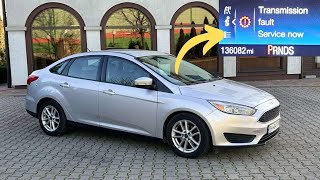
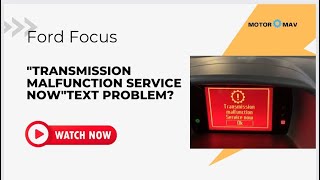
- "Transmission Fault, Service Now" message on the instrument cluster
- Harsh, erratic, or delayed gear shifts
- Transmission getting stuck in one gear (limp mode)
- Transmission slipping (engine RPMs rise without an increase in speed)
- Vehicle stalling, especially when coming to a stop
- Incorrect or non-functional speedometer
- Reduced fuel economy
- Complete loss of power or failure to move
- Replacing the Output Speed Sensor when the true fault lies within the Transmission Control Module (TCM). Many owners and shops replace the sensor first due to its lower cost, only for the P0722 code to return. It is critical to test the sensor and wiring before assuming the sensor itself is the problem.
Most Likely Causes
- Faulty Transmission Control Module (TCM) 🔴 High Probability → Shop Transmission Assembly The TCM on the DPS6 transmission is a well-documented, high-failure-rate component. Internal circuit failures, often due to poor pin connections on the original units, cause a loss of communication with sensors, triggering codes like P0722.
How to confirm: After confirming the sensor and wiring are good (via multimeter and oscilloscope tests), the diagnosis points to the TCM. A professional shop with Ford-specific diagnostic tools can confirm a TCM failure. Often, other TCM-related codes like U0100, U0101, U1013, or P0606 may be present.
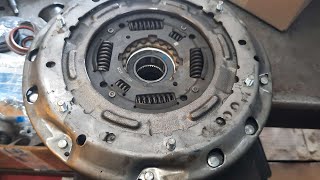
Typical fix: Replace the Transmission Control Module and program the new unit to the vehicle. 🎬 See how to replace the TCM yourself. An adaptive learning sequence must be performed with a scan tool after installation. 🎬 Watch how to perform the clutch adaptive learn using FORScan.
Est. part cost: $600-$1000+ - Defective Output Speed Sensor (OSS) 🟡 Medium Probability Like any electronic sensor, the OSS is subject to failure from heat cycles and age, typically between 80,000 and 120,000 miles. Metallic debris from normal wear can also accumulate on the magnetic tip and disrupt the signal.
How to confirm: Test the sensor's resistance and voltage output with a multimeter. A visual inspection for damage is also necessary. A scan tool can monitor the sensor's data stream (or lack thereof) in real-time; the PID value will remain at 0 RPM while the vehicle is moving. An oscilloscope can definitively confirm the absence of a signal waveform.
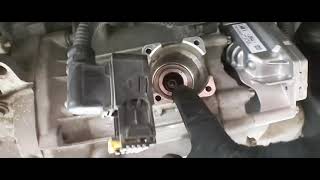
Typical fix: Replace the output speed sensor. The sensor is located on the passenger side of the transaxle, where the axle shaft exits. 🎬 Watch this step-by-step guide to replacing the output speed sensor.
Est. part cost: $50-$150 - Damaged Wiring or Connectors ⚪ Low Probability The wiring harness is located under the vehicle and is exposed to heat, moisture, and road debris, which can lead to corrosion, chafing, or broken wires over time.
How to confirm: Visually inspect the wiring harness between the OSS and the TCM for any signs of damage, corrosion, or loose connections. Perform a continuity test with a multimeter to check for breaks or shorts in the circuit; resistance should be close to zero ohms on a healthy wire. A 'wiggle test' on the harness while monitoring live data can also help identify intermittent connection issues.
Typical fix: Repair or replace the damaged section of the wiring harness or the connector.
Est. part cost: $20-$200
Rare But Worth Checking
- Internal Transmission Failure: → Shop Transmission Assembly While rare compared to TCM failure, severe mechanical issues within the transmission (like a damaged reluctor ring) could potentially cause this code. This would typically be accompanied by significant mechanical noise or complete failure to engage gears. As noted in a cross-manufacturer report (NHTSA ODI #11721793), metal shavings found in the transmission drain filler plug can be associated with a P0722 diagnosis.
- Contaminated Transmission Fluid: → Shop Transmission Assembly Extremely dirty or contaminated fluid can interfere with sensor readings or cause issues in the valve body that may trigger various transmission codes.
Diagnosis Steps
- Read all trouble codes from the TCM/PCM using an OBD-II scanner with live data capability.
- Check for any Technical Service Bulletins (TSBs) or warranty extensions for your specific VIN. Specifically, check for Customer Satisfaction Program 14M02, which extends the TCM warranty to 10 years/150,000 miles.
- Using the scan tool, monitor the live data for the Output Speed Sensor PID. If it reads 0 RPM while the vehicle is moving, the fault is confirmed.
- Visually inspect the wiring harness and connector for the Output Speed Sensor. Look for any signs of damage, corrosion, melted insulation, or loose pins.
- Test the sensor's circuit. Disconnect the sensor and use a multimeter to check for the correct reference voltage (typically 5V) and a good ground at the connector.
- If the circuit has power and ground, test the Output Speed Sensor itself. This can involve checking its internal resistance with a multimeter or, for a definitive test, using an oscilloscope to check for a square wave signal while rotating the wheels. A manufacturer technician in NHTSA ODI #11578725 noted that reprogramming the PCM and OSS may be attempted during the diagnostic process.
- If the sensor and wiring both test good, the suspicion falls heavily on the Transmission Control Module (TCM). Diagnosis is often by exclusion, but a professional can use advanced tools to check TCM communication and internal data.
- If the TCM is deemed faulty, it must be replaced and programmed to the vehicle, followed by an adaptive learning procedure.
Parts You'll Likely Need
- Transmission Control Module (TCM)
(OEM #AE8Z-7Z369-F (supersedes previous versions like -B, -D, -E))— This is the most frequent point of failure on the 2012-2018 Focus for transmission-related codes, including P0722.
Trusted brands: Motorcraft, Dorman
OEM price range: $700-$1000
Aftermarket price range: $500-$800 - Transmission Output Speed Sensor (OSS)
(OEM #AE8Z-7H103-A)— This is the component directly named by the code definition and is the second most likely part to have failed.
Trusted brands: Motorcraft, Standard Motor Products (SMP), NTK
OEM price range: $80-$150
Aftermarket price range: $40-$90
Related Codes That Often Appear With This One
- P0720 — P0720 indicates an erratic signal from the Output Speed Sensor, while P0722 indicates no signal at all. These codes often appear together or sequentially as a sensor or TCM fails completely. NHTSA ODI #11696479 describes a sudden limp mode where the vehicle is stuck in specific gears at highway speeds when both P0720 and P0722 are present.
- P0700 — This is a generic code indicating that the Transmission Control Module has requested the Malfunction Indicator Lamp (Check Engine Light) to be turned on. It signals that a specific transmission fault, like P0722, has been stored.
- U0100 — This code indicates a loss of communication with the ECM/PCM. Since the TCM is the primary failure point, communication codes like this are often seen alongside sensor circuit codes when the TCM itself is failing.
Technical Service Bulletins (TSBs) & Recalls
- TSB 16-0109: Addresses excessive transmission clutch shudder and/or fluid leaks from the clutch housing. While not directly for P0722, it is related to the overall health and diagnosis of the DPS6 transmission and may require PCM/TCM reprogramming as part of the fix.
Platform-Specific Known Issues
- The DPS6 PowerShift transmission's Transmission Control Module (TCM) is a known high-failure item. Ford has faced class-action lawsuits and issued extended warranty programs to address these issues. Customer Satisfaction Program 14M02 specifically extends the warranty on the TCM to 10 years or 150,000 miles from the vehicle's warranty start date, covering symptoms like loss of engagement, no-start, or lack of power. Owners should always check with a Ford dealer using their VIN to see if this coverage applies before paying for repairs.
Documented NHTSA Reports
- An owner reported in NHTSA ODI #11716692 that their vehicle experienced no 1st or 2nd gear until it was shut off and restarted, which was eventually diagnosed as a P0722 pinpoint OSS sensor failure.
- NHTSA ODI #11640475 describes a situation where a PCM update failed to resolve P0721 and P0722 codes, ultimately requiring the installation of a new lead frame to fix the issue.
Mechanic-Grade Diagnostic Values
- Reference voltage at OSS connector — expected: Approximately 5V with ignition on, engine off.. Failure: Missing or significantly lower voltage points to a wiring or TCM fault, not the sensor.
- Ground circuit resistance at OSS connector — expected: Less than 5 Ω to chassis ground.. Failure: High resistance indicates a bad ground connection, which can prevent the sensor from working.
- Continuity of signal and power wires — expected: Close to 0 Ω resistance from the sensor connector to the corresponding pins at the TCM connector.. Failure: High resistance or an open circuit (OL) indicates a broken wire in the harness.
Scan Tool Commands That Help
- FORScan: TCM Adaptive Learning — This procedure is mandatory after replacing the Transmission Control Module (TCM). It allows the new module to learn the clutch touchpoints and shift drum positions. Failure to perform this can result in harsh shifting or no engagement.
- Ford IDS: Module Programming — Required when installing a new, unprogrammed TCM. The module must be flashed with the correct calibration file for the vehicle's specific VIN.
- FORScan: Module Firmware Update — Can be used to load a specific calibration file onto a replacement TCM. This is particularly useful if swapping a module from a different year vehicle that requires a different calibration version.
Wiring & Ground Locations
- Output Speed Sensor (OSS) — Located on the exterior of the transmission, underneath the vehicle, near where the driver's side axle shaft exits the transaxle. The connector is often wrapped in a foil-like heat shield.. This is the sensor the P0722 code directly refers to. Its location makes it and its wiring susceptible to road debris, heat, and moisture damage.
- TCM Power/Ground Pins — At the main TCM connector. On a 2012 Focus, power is on pins 1 & 10, and grounds are on pins 4 & 5.. A complete loss of power or ground to the TCM can cause a P0722 code along with total communication loss codes (U0100, U0101), mimicking a dead TCM module.
- Transmission Harness Chafe Point — The wiring harness near the speed sensors, particularly where it runs near the battery tray area, is known to chafe and cause shorts or open circuits.. A chafed wire can cause an intermittent or complete loss of signal from the OSS, directly triggering P0722.
Real Owner Repair Stories
- Reddit user on r/FordFocus (2012 Ford Focus (DPS6)) — No-start condition after refueling. Engine cranks, but PRNDL lights are off on the shifter. Scan tool cannot communicate with the TCM.
❌ Tried (didn't work) Verified 12V power on TCM pins 1 & 10., Verified solid grounds on TCM pins 4 & 5., Checked fuse 20 and relay R14., Attempted to jump the relay.
✅ What actually fixed it The user concluded the TCM was internally dead, as all power and ground inputs were confirmed good, but the module remained unresponsive. The presence of U0101 (Lost Communication with TCM) and U0100 from other modules confirmed the TCM was offline. The plan was to replace the TCM with a used unit.
OEM Part Supersession History
AE8Z-7Z369-D→AE8Z-7Z369-F— The original TCM design used compliant pin connections internally that were prone to failure. The updated 'F' version and quality remanufactured units use soldered connections for critical components to improve durability and prevent common failures.
Model Year Variations Within This Range
- 2012-2014 vs 2015-2018: The TCM calibration is different between these two groups. While a TCM from any year (2012-2018) can physically be used, it must be programmed with the correct calibration for the vehicle's year range to avoid shifting problems, such as firm shifts into fourth gear. For a plug-and-play (plus adaptive learn) experience without full reprogramming, it is best to source a replacement TCM from the same year group as the vehicle.
Diagnostic Flowchart
Other Known Issues on This Vehicle
Issues unrelated to this code that are worth knowing about as an owner of this generation:
- DPS6 Transmission Shudder/Jerking 🔴 High → Shop Transmission Assembly — Extremely common, especially in early model years (2012-2014). Can occur at low mileage. (Ref: TSB 16-0109)
- Faulty Door Latches 🔴 High — Widespread, affecting millions of Ford vehicles including the 2012-2015 Focus. Can result in doors not latching or opening while driving. (Ref: Recall 16S30, 20S30)
- Sticking Canister Purge Valve (CPV) 🟠 Medium — Common across 2012-2018 models. Can cause stalling, rough running, inaccurate fuel gauge, and potential fuel tank deformation. (Ref: Recall 18S32 / NHTSA 18V735000; Customer Program 24N07)
- Electronic Power Steering Failure 🔴 High — Particularly noted on the 2012 model year, but can affect others. Can result in a sudden loss of power steering assist.
- Failing Engine Mounts 🟠 Medium — The passenger-side hydraulic engine mount is prone to leaking and collapsing, causing excessive engine vibration to be felt in the cabin.
Used vs. New Parts: Buying Guide for This Vehicle
When a used part is the smart pick: For the Output Speed Sensor (OSS), a used part is a reasonable, low-cost option. For the Transmission Control Module (TCM), a used part is a significant gamble due to the high failure rate of the original design and should generally be avoided unless it's a very temporary fix.
Donor-vehicle mileage cap: roughly under 80000 miles for the part to have meaningful remaining life.
What to inspect on the donor part:
- For a used TCM, try to source one from the same year range (2012-14 or 2015-18) to have a better chance of compatible calibration.
- Inspect connectors on any used electronic part for corrosion, bent pins, or fluid intrusion.
- Avoid parts from vehicles with obvious signs of flood or heavy impact damage.
OEM-only on this vehicle (don't cheap out):
- Transmission Control Module (TCM) - While aftermarket remanufactured units exist, a new OEM part (AE8Z-7Z369-F) is the most reliable, albeit expensive, option. Avoid used junkyard TCMs as they are likely to have the same original design flaw.
Aftermarket brands forum-validated for this vehicle:
- Dorman (for remanufactured TCMs)
- Standard Motor Products (SMP), NTK (for speed sensors)
Brands owners have reported issues with on this vehicle:
- Unknown, no-name sellers on platforms like eBay or Amazon for the TCM, as quality and programming support are highly questionable.
Real Owner Stories
Aggregated from forums and TSBs cited above. Mileages and costs reflect what owners reported in those sources.
2014 Ford Focus — 48000 miles
Symptoms: Violent shuddering and shifting issues; owner noted that most problems were electronic/program issues rather than mechanical.
What fixed it: The dealer replaced and reprogrammed the Transmission Control Module (TCM) under warranty.
Source hint: r/FordFocus on Reddit: A thread titled 'Most DPS6 transmission problems are NOT mechanical. They are strictly electronic/program issues!'
Related OBD-II Codes
Frequently Asked Questions
Is there an extended warranty that covers the TCM failure causing my P0722 code?
My 2014 Focus is shuddering and has a P0722 code; does TSB 16-0109 apply to me?
Can I use a used TCM from a junkyard to fix my P0722 error?
Where is the Output Speed Sensor located on my 2012-2018 Focus?
Does the Ford Fiesta share this same P0722 and TCM issue?
What is the specific part number for the reliable replacement TCM?
Helpful Videos


We Have This Part in Stock



The information in this article is provided for general reference and educational purposes only. Vehicle specifications, procedures, and part compatibility can vary by production date, trim level, and region. Always consult your vehicle's factory service manual and verify part numbers before purchasing or performing repairs. Safety-critical components such as airbags, seat belts, and braking systems should be installed by a qualified professional.
- Ford Focus:
- 🧭 Diagnostic Flowchart
- 🎬 Helpful Videos
- 🛍️ Shop This Part
- What's Unique About the 2012-2018 Ford Focus
- Symptoms You May Notice
- Most Likely Causes
- Rare But Worth Checking
- Diagnosis Steps
- Parts You'll Likely Need
- Related Codes That Often Appear With This One
- Technical Service Bulletins (TSBs) & Recalls
- Platform-Specific Known Issues
- Documented NHTSA Reports
- Mechanic-Grade Diagnostic Values
- Scan Tool Commands That Help
- Wiring & Ground Locations
- Real Owner Repair Stories
- OEM Part Supersession History
- Model Year Variations Within This Range
- Other Known Issues on This Vehicle
- Used vs. New Parts: Buying Guide for This Vehicle
- Real Owner Stories
- 2014 Ford Focus — 48000 miles
- Related OBD-II Codes
- Frequently Asked Questions
- 🎟️ Get 5% Off