

P0722 on 2011-2014 Hyundai Sonata: Output Speed Sensor 'No Signal' Causes and Fixes
On a 2011-2014 Sonata, P0722 is almost always caused by a failed internal transmission wiring harness that contains the output speed sensor. The fix requires dropping the transmission pan and valve body to replace this harness (part #46307-3B650). Expect to pay $40-$150 for the part and $250-$500 for labor.
- P0722 on a 2011-2014 Sonata is almost certainly a failed internal transmission wiring harness (P/N 46307-3B650).
- The repair is complex, requiring removal of the transmission valve body.
- Do not let a shop replace the entire transmission for this code without first replacing the harness.
- Codes P0717 and P0711 frequently appear alongside P0722 and point to the same root cause.
What's Unique About the 2011-2014 Hyundai Sonata
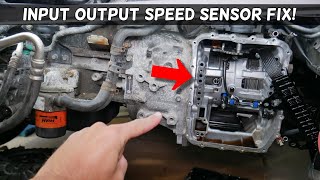
For the 2011-2014 Sonata (YF generation) with the 6-speed A6MF1/A6MF2 automatic transmission, the input and output speed sensors are not simple external bolt-on parts. They are integrated into a single wiring harness located inside the transmission, attached to the valve body. This internal harness is a very common failure point. Hyundai has issued multiple Technical Service Bulletins (like TSB 14-AT-013 and its successors) specifically advising technicians *not* to replace the entire transmission for this code, but to replace the internal harness instead, acknowledging it as a known issue.
Symptoms You May Notice
- Transmission is stuck in 3rd gear (fail-safe or 'limp mode')
- Check Engine Light is on
- Harsh or jerky engagement when shifting from Park to Drive or Reverse
- Poor acceleration from a stop
- Vehicle will not shift gears while driving
- Speedometer usually works correctly, as it often relies on wheel speed sensors
- Replacing the entire transmission. Hyundai TSBs specifically warn against this, as the problem is almost always the inexpensive internal harness.
Most Likely Causes
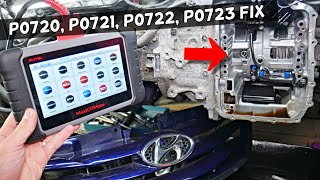
- Failed Internal Transmission Wiring Harness 🔴 High Probability → Shop Transmission Assembly The 2011-2014 Sonata's 6-speed automatic transmission (A6MF series) has a well-documented, high failure rate for the internal harness that contains the input, output, and fluid temperature sensors. Constant exposure to heat and transmission fluid causes the plastic and wiring to degrade, leading to an open or short circuit within the sensor assembly.
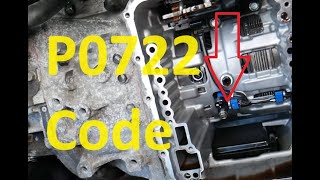
How to confirm: Confirming requires testing for a signal at the TCM connector. However, given the extremely high probability of this failure on this specific vehicle, and the presence of codes like P0722, P0717, or P0721, technicians often proceed directly with replacement based on the TSBs. The part is located inside the transmission oil pan, on the valve body.
Typical fix: Replace the internal transmission wiring harness assembly. 🎬 Watch: Step-by-step internal harness replacement walkthrough This requires draining the fluid, dropping the pan, and removing the valve body to access the harness.
Est. part cost: $40-$150 - Damaged External Wiring or Connector ⚪ Low Probability
How to confirm: Visually inspect the main transmission wiring harness from the transaxle to the TCM for any signs of chafing, corrosion, or damage. Test for continuity and voltage at the main connector per the service manual.
Typical fix: Repair or replace the damaged section of the wiring harness.
Est. part cost: $10-$100
Rare But Worth Checking
- Faulty Powertrain Control Module (PCM) or Transmission Control Module (TCM): → Shop Engine Control Module (ECM) This is very rare. The official Hyundai TSB instructs technicians to replace the PCM only if the code returns after replacing the sensor harness and verifying the external wiring.
- Internal Transmission Failure: → Shop Transmission Assembly While possible, this is unlikely to be the cause if P0722 is the primary code. Usually, a major internal failure would be accompanied by other gear ratio error codes, noises, or severe drivability issues beyond being stuck in one gear.
Diagnosis Steps
- Scan the vehicle's computer for all stored trouble codes. Note if P0717 or P0711 are also present, which strongly indicates the internal harness has failed.
- Check the transmission fluid level and condition. The level must be checked at a specific temperature 🎬 Watch: Understanding P0722 causes and fixes (122-140°F or 50-60°C). While unlikely to be the root cause, low or burnt fluid indicates other problems.
- Visually inspect the external transmission wiring harness for any obvious damage, though this is not the most likely cause.
- Given the known issues with this platform and multiple TSBs, the next step is typically to assume the internal harness has failed. This involves a significant repair.
- Drain the transmission fluid and remove the oil pan.
- Carefully remove the transmission valve body.
- Unplug and unbolt the old sensor harness from the valve body and transmission case.
- Install the new internal wiring harness (Part #46307-3B650).
- Reinstall the valve body, new oil pan gasket (or sealant), and oil pan, torquing all bolts to factory specifications.
- Refill the transmission with the correct type and amount of Hyundai SP-IV fluid.
- Clear all trouble codes and perform a test drive to confirm the repair.
Parts You'll Likely Need
- Internal Transmission Wire Harness
(OEM #46307-3B650)— This is the primary failure point for code P0722 on this vehicle. It contains the input, output, and temperature sensors integrated into one assembly. This part number supersedes older versions 46307-3B610 and 46307-3B620.
Trusted brands: Hyundai (OEM), Dorman, Transend
OEM price range: $140-$200
Aftermarket price range: $40-$150 - Hyundai SP-IV Automatic Transmission Fluid
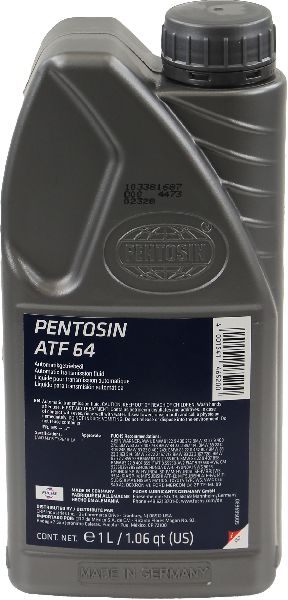
(OEM #00232-19045)— The transmission fluid must be drained to perform the repair. It is critical to use the manufacturer-specified fluid. You will need 5-6 quarts for a drain and fill.
Trusted brands: Hyundai (OEM), Idemitsu TLS-LV, Valvoline MaxLife ATF (meets SP-IV spec)
OEM price range: $15-$25 per quart
Aftermarket price range: $8-$15 per quart - Transmission Oil Pan Gasket
(OEM #45283-3B810 (Verify with VIN))— A new gasket or RTV sealant is required when reinstalling the oil pan to prevent leaks. Some models may use a reusable gasket, but replacement is recommended.
Trusted brands: Hyundai (OEM), Fel-Pro
OEM price range: $20-$40
Aftermarket price range: $10-$25
Related Codes That Often Appear With This One
- P0717 — P0717 is 'Input Speed Sensor Circuit No Signal'. Since both the input and output sensors are part of the same internal harness on this vehicle, it is very common for them to fail together and set both codes.
- P0721 — P0721 is 'Output Speed Sensor Circuit Range/Performance'. This indicates an erratic or intermittent signal rather than a complete loss of signal. It is caused by the same failing internal harness.
- P0711 — P0711 is 'Transmission Fluid Temperature Sensor 'A' Circuit Range/Performance'. The temperature sensor is also integrated into the same internal harness, and its failure often accompanies or precedes the speed sensor failures.
Technical Service Bulletins (TSBs) & Recalls
- TSB 14-AT-013: Instructs technicians to replace the internal sensor/harness for codes P0717, P0721, and P0722, and explicitly states not to replace the entire transmission. 🎬 See how to fix these common speed sensor codes
- TSB 16-AT-003: Supersedes the previous TSB, adding more models and reinforcing the same repair procedure.
- TSB 20-AT-011H: Supersedes 16-AT-003, adding even more models and clarifying the repair for the Generation 1 valve body used in these vehicles.
Platform-Specific Known Issues
- The 6-speed automatic transmission (A6MF1/2) used in the 2011-2014 Sonata has a well-documented issue with the internal wiring harness failing, leading to codes P0722 and P0717. This is the most common cause of transmission shifting problems on this platform.
Mechanic-Grade Diagnostic Values
- Output Speed Sensor (OSS) Resistance — expected: 560 to 680 Ω at 20°C (68°F). Failure: A reading outside this range, especially an open circuit (infinite resistance) or short circuit (near zero resistance).
- OSS Circuit to Ground — expected: 10 kΩ or higher. Failure: A low resistance reading indicates a short to ground in the wiring harness.
- Oscilloscope Waveform at ECM/PCM — expected: A clean AC sine wave that increases in frequency as vehicle speed increases.. Failure: A flat line (no signal) or a very noisy/erratic waveform indicates a problem with the sensor or its wiring.
Scan Tool Commands That Help
- Hyundai GDS (Global Diagnostic System) or equivalent professional scan tool: Resetting Auto T/A Values (Transmission Adaptive Values) — This procedure is mandatory after replacing the internal wiring harness or the transmission itself. It erases the old learned shift parameters stored in the TCM. Failure to perform this reset can result in poor shift quality, harsh shifts, or flares even after the repair is complete.
- Hyundai GDS (Global Diagnostic System) or equivalent professional scan tool: Relearn Adaptive Values (Drive Cycle) — Immediately after resetting the adaptive values, a specific drive cycle must be performed to allow the TCM to learn the characteristics of the new components. This typically involves accelerating gently through all gears multiple times to allow the TCM to build new adaptive tables for smooth shifting.
Wiring & Ground Locations
- Transmission Ground Wire — Typically bolted to the transmission case, near the starter motor. The other end of the cable connects to the chassis frame rail, often located under the battery tray.. A loose or corroded ground connection at either the transmission or the chassis can cause an intermittent or complete loss of signal from the speed sensors, mimicking a harness failure. One known issue is the ground bolt being attached to a painted surface from the factory, which can be fixed by grinding the paint to ensure a bare metal connection.
- ECM Connector D3 (for testing) — At the main Engine Control Module (ECM/PCM), which is located in the engine bay.. Pins D3-35 (SP2+) and D3-27 (SP2-) are the specific terminals for the output speed sensor. A technician can test for resistance and signal directly at these pins to verify the integrity of the entire circuit from the sensor to the computer without having to access the transmission itself.
"I Checked Everything" — The Actual Cause
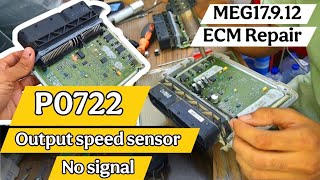
- In a case involving a similar Hyundai with a P0722 code, the output speed sensor was replaced, but the problem persisted. Electrical testing at the sensor connector revealed incorrect voltage on the signal wire (1.3V when ~11V was expected). The root cause was not the sensor or wiring, but a faulty Engine Control Module (ECM). Leaking capacitors inside the ECM had damaged the circuit board, preventing it from supplying the correct voltage to the sensor. The fix was to repair or replace the ECM.
OEM Part Supersession History
46307-3B610, 46307-3B620→46307-3B650— Revisions by the manufacturer to improve durability and address the known failure mode of the internal sensors and wiring.
Heads up: None. The newest part number (46307-3B650) is the correct and backward-compatible replacement for all 2011-2014 Sonatas with the 6-speed automatic.
Model Year Variations Within This Range
- 2011-2014: The 6-speed automatic transmissions in this vehicle range are equipped with a 'Generation 1' valve body that utilizes 8 solenoids. This is a key distinction from later Hyundai 6-speeds that use a 'Generation 2' valve body with only 7 solenoids. While the P0722 harness fix is the same, this detail is critical if any valve body work or solenoid replacement is being considered.
Diagnostic Flowchart
Other Known Issues on This Vehicle
Issues unrelated to this code that are worth knowing about as an owner of this generation:
- Theta II Engine Failure (Rod Bearing Wear) 🔴 High — Extremely common, especially on 2.4L GDI engines. Can occur at any mileage but often seen between 60k-120k miles. Subject of a massive class-action lawsuit and recall campaign. (Ref: Multiple Recalls (e.g., NHTSA 20V-746) and lifetime warranty extension for affected vehicles that have had the Knock Sensor Detection System (KSDS) software update.)
- Steering Coupler Failure 🟠 Medium — Very common. A small rubber coupler in the electronic power steering column disintegrates over time, causing a noticeable 'clunk' or clicking noise in the steering wheel when turning. Typically occurs after 50,000 miles. (Ref: No recall, but it is a widely recognized problem. The replacement part is inexpensive, but labor can be several hundred dollars.)
- Engine Seizure and Fire Risk 🔴 High — A direct consequence of the Theta II engine bearing failure. Debris from the failing bearings can clog oil passages, leading to seizure. In some cases, a connecting rod can fracture and puncture the engine block, causing an oil leak onto hot exhaust components, resulting in a fire. (Ref: Covered by the same engine recalls and settlement as the primary bearing failure issue.)
- Excessive Oil Consumption 🟠 Medium — Common on the 2.4L GDI engine, often related to piston ring and cylinder wall issues. Owners report needing to add oil between changes. Can be a precursor to more serious engine problems. (Ref: Covered under some engine-related settlements and warranty extensions if it leads to failure.)
- Peeling Paint (Especially on White models) 🟡 Low — A widespread cosmetic issue where the top layer of paint, particularly on white-colored Sonatas, begins to peel off in large sheets. Hyundai extended the warranty for this issue for some owners. (Ref: Not a formal recall, but warranty extensions and goodwill programs have been offered in response to customer complaints.)
Used vs. New Parts: Buying Guide for This Vehicle
When a used part is the smart pick: For this specific repair, using a used part is strongly discouraged. The primary failure part, the internal wiring harness, fails due to prolonged exposure to heat and transmission fluid, which degrades the plastic and electronics. A used harness from a junkyard vehicle has undergone the same stress and has a very high probability of failing shortly after installation, forcing you to pay for the complex labor all over again.
What to inspect on the donor part:
- Not applicable, as used harnesses should be avoided for this repair.
OEM-only on this vehicle (don't cheap out):
- Internal Transmission Wire Harness (46307-3B650): While reputable aftermarket versions exist, the cost of labor to access this part is very high. Using the genuine Hyundai OEM part is the safest investment to ensure you only have to do the job once.
Aftermarket brands forum-validated for this vehicle:
- Dorman is a commonly available aftermarket brand for this harness, but user reviews can be mixed. OEM is the most recommended option.
Brands owners have reported issues with on this vehicle:
- Avoid unbranded, no-name harnesses from online marketplaces. The quality control is unknown, and the risk of premature failure is extremely high given the difficult installation.
Real Owner Stories
Aggregated from forums and TSBs cited above. Mileages and costs reflect what owners reported in those sources.
2013 Kia Optima (Platform Mate)
Symptoms: The vehicle was throwing code P0722. The owner required a detailed guide on removing the valve body to access the sensor harness.
What fixed it: Replacement of the internal transmission sensor harness following a step-by-step valve body removal process.
Source hint: 2CarPros forum post 'Code p0722 - 2013 kia optima'
2011-2014 Hyundai Sonata
Symptoms: Owners reported the car entering 'limp mode' (stuck in 3rd gear) and experiencing significant shifting problems.
What fixed it: Replacement of the internal transmission wiring harness assembly.
Source hint: hyundai-forums.com threads regarding P0722/P0717 issue
Documented NHTSA Reports
An owner of a similar Hyundai platform reported that their vehicle would not go into drive at all before the check engine light illuminated with code P0722 (NHTSA ODI #11427357). In another instance, a technician noted a P0722 code for an open or short in the output speed sensor alongside poor transmission fluid condition (NHTSA ODI #10143151). Additionally, a report describes a vehicle that required manual shifting for 1st and 2nd gears while reverse remained functional, eventually scanning for the P0722 error code (NHTSA ODI #11696914).
Related OBD-II Codes
Frequently Asked Questions
My 2012 Sonata is stuck in 3rd gear and won't shift. Which TSB covers this issue?
What is the specific part number for the internal wiring harness on a 2011-2014 Sonata?
Can I just replace the speed sensor, or do I need the whole internal harness?
Is the P0722 code related to the Theta II engine recall on my Sonata?
Why is my car jerking when I shift into Drive, but the speedometer still works?
How much should I expect to pay for the parts to fix P0722?
Helpful Videos
We Have This Part in Stock



The information in this article is provided for general reference and educational purposes only. Vehicle specifications, procedures, and part compatibility can vary by production date, trim level, and region. Always consult your vehicle's factory service manual and verify part numbers before purchasing or performing repairs. Safety-critical components such as airbags, seat belts, and braking systems should be installed by a qualified professional.
- Hyundai Sonata:
- 🧭 Diagnostic Flowchart
- 🎬 Helpful Videos
- 🛍️ Shop This Part
- What's Unique About the 2011-2014 Hyundai Sonata
- Symptoms You May Notice
- Most Likely Causes
- Rare But Worth Checking
- Diagnosis Steps
- Parts You'll Likely Need
- Related Codes That Often Appear With This One
- Technical Service Bulletins (TSBs) & Recalls
- Platform-Specific Known Issues
- Mechanic-Grade Diagnostic Values
- Scan Tool Commands That Help
- Wiring & Ground Locations
- "I Checked Everything" — The Actual Cause
- OEM Part Supersession History
- Model Year Variations Within This Range
- Other Known Issues on This Vehicle
- Used vs. New Parts: Buying Guide for This Vehicle
- Real Owner Stories
- 2013 Kia Optima (Platform Mate)
- 2011-2014 Hyundai Sonata
- Documented NHTSA Reports
- Related OBD-II Codes
- Frequently Asked Questions
- 🎟️ Get 5% Off