

P0730 on 2004-2008 Chrysler Pacifica: Incorrect Gear Ratio Causes and Fixes
On a 2004-2008 Pacifica, P0730 most often points to low or burnt-out ATF+4 transmission fluid or a failing solenoid pack in the 41TE transmission. Start by checking the fluid. If that's okay, the solenoid pack is the next likely culprit, costing around $100-$200 for the part. The OEM Mopar part number for the solenoid pack is 5140429AA.
- P0730 means your transmission is slipping. Do not ignore this code, as it can lead to severe damage.
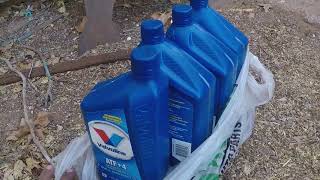
- The first and most important step is to check the transmission fluid level and condition. Use only Mopar ATF+4 fluid.
- If the fluid is fine, the most likely culprit on a 2004-2008 Pacifica is the transmission solenoid pack.
- While some diagnosis can be done at home, replacing the solenoid pack or diagnosing further often requires a professional mechanic.
- Check if your vehicle was part of the NHTSA recall 06V432000 for a PCM software update, especially if you have a 2005-2006 model.
What's Unique About the 2004-2008 Chrysler Pacifica
The 2004-2008 Chrysler Pacifica uses the 4-speed 41TE (also known as the A604) automatic transmission, a unit with a long and well-documented history. While P0730 is a generic code, on this specific platform, it's frequently linked to either low/degraded ATF+4 fluid or the transmission's solenoid pack, which is a widely-known weak point on this family of transmissions since its introduction in 1989. Unlike many newer vehicles, these models have a transmission dipstick, making the crucial first step of checking the fluid level and condition relatively straightforward for a DIYer.
Symptoms You May Notice
- Check Engine Light is on
- Transmission slipping (engine revs but speed doesn't increase)
- Harsh, jerky, or delayed shifts
- Vehicle gets stuck in one gear (limp-home mode)
- Loss of power, especially during shifts
- Reduced fuel economy
- Stalling when coming to a stop after highway driving
- Replacing the input/output speed sensors when the actual problem is low/dirty fluid or a failing solenoid pack.
- Assuming the entire transmission is bad without first checking the fluid level and condition, which is the simplest and most common fix.
- Replacing the PCM/TCM when the issue is a simple wiring or connector problem.
Most Likely Causes
- Low or Dirty Transmission Fluid (ATF+4) 🔴 High Probability → Shop Transmission Assembly Leaks or lack of regular service can lead to low levels or fluid degradation, which reduces hydraulic pressure needed for proper gear engagement. The 41TE is sensitive to fluid condition.
How to confirm: Check the transmission fluid dipstick with the engine running in Park after it's warmed up. The fluid should be at the 'FULL' mark, red in color, and not smell burnt. Dark, brownish, or burnt-smelling fluid indicates a problem.
Typical fix: If low, top off with Mopar ATF+4 fluid (Part# 68218057AC for quarts, 68218058AC for gallons). If dirty or burnt, perform a transmission fluid and filter change. 🎬 Watch: Step-by-step transmission fluid and filter change
Est. part cost: $50-$120 - Failing Transmission Solenoid Pack 🔴 High Probability → Shop Transmission Assembly The A604/41TE transmission is infamous for solenoid pack failures. These electronic solenoids control fluid flow to engage clutches; when they fail electronically or mechanically, the transmission cannot shift correctly, directly causing P0730.
How to confirm: A professional scan tool can command individual solenoids to check for response. Resistance can also be checked at the solenoid pack connector. This is the most common cause after fluid level/condition is confirmed to be correct.
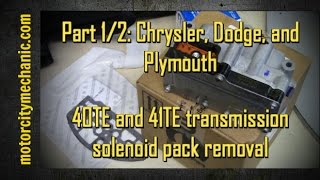
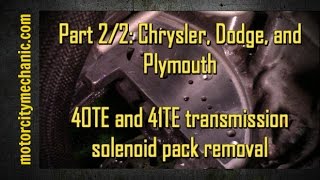
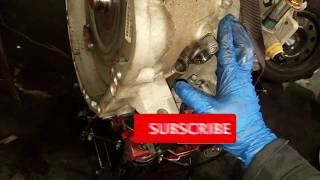
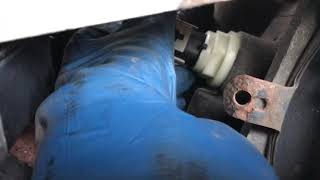
Typical fix: Replace the entire solenoid pack. 🎬 See how to replace the 41TE solenoid pack This is located on the front of the transmission, behind a pan. The OEM Mopar part is 5140429AA.
Est. part cost: $100-$250 - Faulty Input or Output Speed Sensors 🟡 Medium Probability These sensors can fail due to heat and vibration. If one sensor sends an incorrect signal, the TCM will calculate an incorrect gear ratio. The input and output sensors are often physically identical and it is common practice to replace both at the same time.
How to confirm: A scan tool can monitor the live data from both sensors while driving. An erratic or absent signal from one sensor indicates failure. They can also be tested for resistance. The OEM part number is 4800879.
Typical fix: Replace the faulty sensor(s). 🎬 Watch: How to replace input and output speed sensors They are located on the outside of the transmission case and are generally accessible, making replacement relatively simple.
Est. part cost: $30-$80 per sensor - Internal Mechanical Failure ⚪ Low Probability If driven for an extended period with low fluid or slipping, internal components like clutch packs or the torque converter can suffer permanent damage. While less common than electronic failures, it's the worst-case scenario.
How to confirm: If fluid, solenoids, and sensors are all confirmed to be good, the issue is internal. A transmission specialist will need to perform pressure tests and inspect the internals, likely finding debris in the pan.
Typical fix: Requires a complete transmission rebuild or replacement.
Est. part cost: $1800-$3500+
Rare But Worth Checking
- Faulty Powertrain Control Module (PCM/TCM): A recall (NHTSA 06V432000) was issued for some 2005-2006 models for a software update to prevent engine stalling. While not directly for P0730, faulty control module software can cause a variety of transmission-related issues. It's worth checking if this recall was performed on your vehicle.
- Clogged Transmission Filter: → Shop Transmission Assembly A clogged filter can restrict fluid flow, leading to low pressure and slipping. This is usually replaced during a fluid service and is a key part of addressing dirty fluid issues.
- Damaged Wiring Harness: The wiring harness to the solenoid pack or speed sensors can become damaged from heat, oil, or road debris. A repair kit for the main solenoid harness is available. This should be inspected before replacing components.
Diagnosis Steps
- Check the transmission fluid level and condition using the dipstick. Ensure the fluid is Mopar ATF+4 and is not low, dark, or burnt-smelling.
- Use an OBD-II scanner to check for other transmission-related codes, such as P0700 or specific gear ratio codes (P0731-P0734).
- Inspect the wiring harness and connectors going to the transmission, including the solenoid pack and speed sensors, for any visible damage, corrosion, or looseness.
- If possible, use a scan tool to monitor live data from the input and output speed sensors while driving to check for dropouts or erratic readings.
- If fluid and sensors are good, the next logical step is to suspect the solenoid pack. This is the most common point of failure on the 41TE transmission.
- If all of the above check out, the problem is likely an internal mechanical issue (e.g., worn clutches, faulty valve body), which requires diagnosis by a transmission specialist.
Parts You'll Likely Need
- Transmission Solenoid Pack
(OEM #5140429AA (replaces 4800879, 5015646AC))— This is a very common failure point on the 41TE transmission that directly causes shifting errors and the P0730 code. It is often sold as a block and is the primary electronic controller for shifting.
Trusted brands: Mopar, Rostra, Dorman, Borg-Warner
OEM price range: $200-$300
Aftermarket price range: $100-$200 - Transmission Fluid and Filter Kit
(OEM #Fluid: 68218057AC (Quart), 68218058AC (Gallon))— Low or contaminated fluid is the most common and easiest-to-fix cause. A fluid and filter service is the first diagnostic step. Only ATF+4 fluid should be used.
Trusted brands: Mopar (ATF+4 Fluid), Wix (Filter), ATP (Filter)
OEM price range: $80-$150
Aftermarket price range: $50-$100 - Input/Output Speed Sensor
(OEM #4800879)— A faulty sensor provides bad data to the TCM, causing it to miscalculate the gear ratio and trigger a P0730 code. Both sensors are often replaced together.
Trusted brands: Mopar, Standard Motor Products (SMP), NTK, Dorman
OEM price range: $50-$90
Aftermarket price range: $30-$60
Related Codes That Often Appear With This One
- P0700 — P0700 is a generic code that simply means the Transmission Control Module (TCM) has stored a fault code. It will almost always be present alongside a more specific code like P0730.
- P0731, P0732, P0733, P0734 — These codes indicate incorrect gear ratios for specific gears (1st, 2nd, 3rd, 4th). They often appear with P0730 and can help pinpoint which gear circuit has the primary fault.
- P1776 — This code ('Solenoid Switch Valve Latched in LR Position') can be caused by a sticky valve in the valve body or a misadjusted shifter cable. While a different issue, it can cause limp mode and shifting problems similar to P0730. TSB 21-001-13 addresses its diagnosis.
Technical Service Bulletins (TSBs) & Recalls
- TSB 21-001-13: Addresses a P1776 code (Solenoid Switch Valve Latched in LR Position) which can cause similar limp-mode symptoms. It guides technicians to check shifter cable adjustment or inspect
- TSB Bulletin #21-005-13: Notes that customers may indicate MIL illumination for P0730 (Incorrect Gear Ratio) and involves updating the Transmission Control Module (TCM) software.
- TSB Bulletin #21-033-14 (also referenced as #2103314): Involves selectively erasing and reprogramming the Transmission Control Module (TCM) with new software to address MIL illumination for P0730 and provide transmission shift enhancements.
Platform-Specific Known Issues
- The 41TE (A604) transmission used in this vehicle is widely known for issues with its solenoid pack, making it a primary suspect for code P0730.
- Some 2005-2006 models were subject to a PCM software recall (NHTSA ID: 06V432000) to address engine stalling, which could be related to overall powertrain control.
- The AWD models use a variant of the transmission called the 41AE, which shares the same core components and failure points.
Mechanic-Grade Diagnostic Values
- Input/Output Speed Sensor Resistance — expected: 650 - 750 Ohms. Failure: Readings that are open (infinite resistance), shorted (zero resistance), or unstable and fluctuating wildly indicate a failed sensor.
- Solenoid Coil Resistance (within Solenoid Pack) — expected: 1.0 - 4.0 Ohms. Failure: A reading outside of this range for any of the individual solenoid coils within the pack points to an internal failure of the pack.
Scan Tool Commands That Help
- Chrysler DRB III / StarSCAN / Witech: Transmission Quick Learn — This procedure must be performed after replacing the transmission, valve body, or solenoid pack. It allows the TCM to learn the new clutch volume indexes (CVI) and adapt shift pressures. Failure to perform the Quick Learn can result in harsh shifts, persistent codes, and premature transmission failure.
- Professional Scan Tool (e.g., Snap-on, Autel): Solenoid Actuation Test — To individually command each shift solenoid on and off to verify its electrical and mechanical operation. This can help isolate a faulty solenoid within the pack before replacement, though replacing the entire pack is standard practice.
Wiring & Ground Locations
- G104 — At the left front of the engine compartment, roughly behind the driver's side headlight and below the battery tray.. This is a major grounding point for many engine and transmission control systems. A corroded or loose connection at G104 can cause erratic behavior from the PCM/TCM and various sensors, leading to incorrect calculations and codes like P0730.
- Transmission Solenoid Pack Connector — On the front of the 41TE transmission, accessible after removing a small cover.. This is the main electrical connection to the solenoid pack. It's a common point for inspection for corrosion, pin damage, or wiring harness strain before condemning the solenoid pack itself. A harness repair kit is available if the connector or pigtail is damaged.
Real Owner Repair Stories
- BobIsTheOilGuy forum user (Chrysler with 41TE/A604 transmission) — Poor shifting performance.
✅ What actually fixed it Replacing the transmission solenoid pack with a new part. The user noted that shifting improved, but cautioned that it is extremely difficult to prevent dirt from falling into the open transmission passages during the swap, which can cause other issues. - NHTSA ODI #11405676 — An owner reported a flare between gears followed by the vehicle getting stuck in 3rd gear or limp mode with a check engine light. Diagnostic scans showed codes P0730 through P0735.
OEM Part Supersession History
Multiple, including 4504570, 5015646AB, 5015646AC→5140429AA— Design update and consolidation.
Heads up: Early A604/41TE transmissions used a solenoid pack with a steel separator plate and two gaskets. The updated design (5140429AA) eliminates the steel plate and uses only a single gasket. When replacing an old-style pack with the new one, the steel plate and extra gasket must be discarded. Using the old plate with the new pack will cause incorrect installation and likely lead to leaks or malfunction.
Diagnostic Flowchart
Other Known Issues on This Vehicle
Issues unrelated to this code that are worth knowing about as an owner of this generation:
- Engine Cradle / Subframe Rust and Corrosion 🔴 High — Very common, especially in 'salt belt' states. Can become structurally unsafe, leading to the engine shifting or, in extreme cases, detaching. A class-action lawsuit was filed regarding this issue for 2004-2008 models. (Ref: Chrysler issued TSBs and limited warranty extensions for certain 2004-2005 models, but many vehicles fall outside the narrow manufacturing window.)
- Broken Engine Rocker Arm Retaining Pin (Engine Ticking) 🟠 Medium — Frequently reported around 104,000 miles on 3.5L, 3.8L, and 4.0L engines. Causes a distinct ticking noise from the engine's front side that gets progressively louder.
- Failed Engine Mounts 🟠 Medium — Common issue causing excessive vibration at idle, and clunking or thudding noises during acceleration or shifting. Often misdiagnosed as a transmission problem.
- Carbon Buildup on Intake Valves 🟡 Low — Affects 3.5L and 4.0L V6 engines, typically after 60,000-130,000 miles. Can cause the check engine light to illuminate with misfire codes.
- Faulty TIPM (Totally Integrated Power Module) 🔴 High — A widespread issue on many Chrysler vehicles of this era. Can cause a vast array of difficult-to-diagnose electrical problems, including issues with the fuel pump, starter, and other vehicle electronics.
Used vs. New Parts: Buying Guide for This Vehicle
When a used part is the smart pick: For a complete transmission assembly, a low-mileage used unit from a reputable salvage yard can be a cost-effective alternative to a full rebuild, especially if the failure is major internal mechanical damage.
Donor-vehicle mileage cap: roughly under 100000 miles for the part to have meaningful remaining life.
What to inspect on the donor part:
- Check the fluid condition on the donor vehicle's dipstick if possible. It should be reddish and not smell burnt.
- Ask for the VIN of the donor vehicle to verify its year and mileage.
- Inspect the transmission case for any cracks, damage, or signs of heavy leaks.
- Ensure all electrical connectors are intact and not damaged during removal.
OEM-only on this vehicle (don't cheap out):
- Transmission Fluid (ATF+4): The 41TE is notoriously sensitive to fluid type. Using anything other than a licensed ATF+4 fluid is a major risk and can cause shift problems and long-term damage.
- Transmission Solenoid Pack: While many aftermarket brands exist, owner and technician reports frequently suggest that remanufactured or cheap aftermarket solenoid packs have a high failure rate. A new Mopar OEM pack is the most reliable choice.
Aftermarket brands forum-validated for this vehicle:
- Borg-Warner (Solenoid Pack): Often considered a high-quality alternative to OEM Mopar.
- Rostra (Solenoid Pack): Another well-regarded brand in the transmission parts industry.
Brands owners have reported issues with on this vehicle:
- Dorman (Remanufactured Solenoid Pack): Customer reviews for the Dorman remanufactured solenoid pack for this application are mixed, with some users reporting receiving multiple defective units.
Real Owner Stories
Aggregated from forums and TSBs cited above. Mileages and costs reflect what owners reported in those sources.
2005 Chrysler Pacifica
Symptoms: Vehicle entered limp mode with multiple codes including P0700, P0730, P0846, and P0871. The owner confirmed the fluid was full and clean.
What fixed it: The consensus from forum members pointed to a failed solenoid pack, which the owner planned to replace as the next step.
Source hint: chryslerminivan.net thread titled '2005 Pacifica P0700, P0730, P0846, P0871...'
2006 Chrysler Pacifica
Symptoms: Owner experienced a P0730 code and the vehicle was stuck in limp mode.
What fixed it: The owner replaced the solenoid pack and both speed sensors, which resolved the issue completely.
Source hint: pacificaforums.com thread titled 'P0730 Incorrect Gear Ratio - 2006 Pacifica'
2005 Chrysler Town & Country (41TE Transmission)
Symptoms: Vehicle triggered a P0730 code indicating an incorrect gear ratio.
What fixed it: The repair shop replaced the solenoid pack, which fixed the problem.
Source hint: allpar.com thread titled 'Transmission problem P0730'
Related OBD-II Codes
Frequently Asked Questions
Is there a recall for my 2005-2006 Pacifica that could be related to transmission or engine stalling issues?
My Pacifica is stuck in 'limp-home' mode with code P0730. What is the most likely part I need to replace?
What specific transmission fluid should I use for my 2004-2008 Pacifica?
Does TSB 21-001-13 apply to the shifting issues I'm seeing with P0730?
Can I replace the speed sensors myself to fix an incorrect gear ratio code?
I hear a ticking noise from the front of my 3.5L Pacifica engine along with transmission codes; are they related?
Helpful Videos

We Have This Part in Stock

The information in this article is provided for general reference and educational purposes only. Vehicle specifications, procedures, and part compatibility can vary by production date, trim level, and region. Always consult your vehicle's factory service manual and verify part numbers before purchasing or performing repairs. Safety-critical components such as airbags, seat belts, and braking systems should be installed by a qualified professional.
- Chrysler Pacifica:
- 🧭 Diagnostic Flowchart
- 🎬 Helpful Videos
- 🛍️ Shop This Part
- What's Unique About the 2004-2008 Chrysler Pacifica
- Symptoms You May Notice
- Most Likely Causes
- Rare But Worth Checking
- Diagnosis Steps
- Parts You'll Likely Need
- Related Codes That Often Appear With This One
- Technical Service Bulletins (TSBs) & Recalls
- Platform-Specific Known Issues
- Mechanic-Grade Diagnostic Values
- Scan Tool Commands That Help
- Wiring & Ground Locations
- Real Owner Repair Stories
- OEM Part Supersession History
- Other Known Issues on This Vehicle
- Used vs. New Parts: Buying Guide for This Vehicle
- Real Owner Stories
- 2005 Chrysler Pacifica
- 2006 Chrysler Pacifica
- 2005 Chrysler Town & Country (41TE Transmission)
- Related OBD-II Codes
- Frequently Asked Questions
- 🎟️ Get 5% Off