

P0733 on 2001-2005 GMC Sierra 4L60E: Gear 3 Incorrect Ratio Causes and Fixes
On a 2001-2005 Sierra with the 4L60E, code P0733 almost always means the 3-4 clutch pack has failed. This is a major internal transmission problem requiring a rebuild or replacement, typically costing $2,000-$5,200. Continued driving is not advised as it can cause more extensive damage.
- P0733 on a 2001-2005 GMC Sierra almost guarantees the 3-4 clutch pack in the 4L60E transmission has failed.
- Do not continue to drive the vehicle. Tow it to a repair shop to prevent further, more expensive damage.
- A simple fluid change or solenoid replacement will not fix this problem. The only reliable solutions are a complete transmission rebuild or replacement.
- When rebuilding, it is critical to use an upgraded 3-4 clutch pack to prevent the issue from recurring.
- This is a complex and expensive repair that is not suitable for a DIY mechanic without significant transmission-building experience.
What's Unique About the 2001-2005 GMC Sierra
The 4L60E transmission used in this generation of GMC Sierra (GMT800 platform) is notoriously prone to 3-4 clutch pack failure. This specific clutch pack is a well-documented weak point that wears out, causing loss of third and often fourth gear. The failure is often accelerated by design flaws, including wear in the input drum, hardening of piston seals over time, and hydraulic pressure loss from worn valve body bores. While other issues like solenoids can cause shifting problems, P0733 on this truck is overwhelmingly linked to this specific, catastrophic mechanical failure inside the transmission.
Symptoms You May Notice
- Check Engine Light is on
- Engine RPMs flare up when shifting into 3rd gear, as if it's in neutral
- Transmission slipping in 3rd gear
- Delayed or no engagement into 3rd gear
- Loss of 4th gear (as it uses the same clutch pack)
- Vehicle may enter "limp mode," getting stuck in a lower gear (usually 2nd)
- Harsh or jerky shifts into or out of 3rd gear.
- Replacing only the shift solenoid when the fluid is burnt and full of debris. The new solenoid will not fix the mechanical slip and will likely fail from the same contamination.
- Performing a transmission fluid flush. A flush can sometimes dislodge debris and worsen the problem or, at best, temporarily mask the symptoms without fixing the underlying mechanical failure.
Most Likely Causes
- Worn or Burnt 3-4 Clutch Pack 🔴 High Probability The 3-4 clutch pack is a well-known, documented weak point in the 4L60E design. Failure is often due to a combination of factors including hardening of the apply piston seals, wear on the input drum splines, and insufficient hydraulic pressure caused by leaks in the valve body (particularly the TCC regulator valve bore).
How to confirm: Drop the transmission pan and inspect for excessive black, flaky clutch material or metallic debris in the fluid and on the pan magnet. Burnt, dark fluid is a key indicator. A transmission pressure test will show a significant pressure drop when 3rd gear is commanded. Final confirmation requires transmission disassembly, where burnt clutches will be visually obvious.
Typical fix: A complete transmission rebuild, including an upgraded 3-4 clutch pack, or replacement with a remanufactured transmission. During a rebuild, it is critical to address related weak points like the sun shell and valve body bores to prevent a repeat failure.
Est. part cost: $200-$3500 - Low or Burnt Transmission Fluid 🟡 Medium Probability → Shop Transmission Assembly
How to confirm: Check the transmission fluid level and condition with the engine warm and running in Park. The fluid should be pink/red and not smell burnt. Dark, burnt-smelling fluid with debris is a strong indicator of internal clutch failure.
Typical fix: If the fluid is just low, top it off and check for leaks. If the fluid is burnt, it's a symptom of a larger problem (like clutch failure), and a simple fluid change will not fix the issue and may only temporarily mask the slip.
Est. part cost: $50-$150 - Failed Shift Solenoid ⚪ Low Probability → Shop Transmission Valve Body
How to confirm: Test the solenoid's resistance with a multimeter after removing the transmission pan (should be 20-40 ohms for the 1-2 and 2-3 solenoids). A professional scan tool can also be used to command the solenoid and check its response. However, a failed solenoid is often a symptom of debris from a failing clutch pack, not the root cause.
Typical fix: Replace the faulty 2-3 shift solenoid. This requires removing the transmission pan. Given the low cost of the part, some owners attempt this first, but it rarely solves P0733 on this platform if slipping is present.
Est. part cost: $40-$100
Rare But Worth Checking
- Valve Body Issues: → Shop Transmission Valve Body Debris from failing clutches can clog passages or cause valves to stick in the valve body, leading to pressure loss and shifting errors. A common failure point is the TCC Regulator Valve Bore, which wears out, causing fluid to overheat and accelerating clutch failure, often setting code P1870 alongside P0733.
- Faulty Powertrain Control Module (PCM): It is extremely rare for the PCM to be the cause of this specific code. All other mechanical and hydraulic possibilities should be exhausted before considering PCM replacement.
Diagnosis Steps
- Check the transmission fluid level and condition. If it is low, top it off and re-test. If it is dark, burnt, or contains debris, internal failure is almost certain.
- Use an OBD-II scanner to check for other transmission-related codes that may provide more context (e.g., P0734, P0894, P1870).
- If the fluid appears clean, drop the transmission pan to inspect for clutch material (looks like black flakes) or metal shavings on the magnet.
- While the pan is off, test the resistance of the 1-2 and 2-3 shift solenoids with a multimeter (should be 20-30 ohms).
- If solenoids test good but symptoms persist, perform a transmission line pressure test. A significant pressure drop when 3rd gear is commanded confirms an internal hydraulic leak, most likely in the 3-4 clutch circuit.
- At this point, the transmission must be removed and disassembled for inspection and rebuild.
Parts You'll Likely Need
- Remanufactured Transmission — For most owners, this is the fastest and most reliable fix. It replaces the entire unit, including known weak points, and often comes with a warranty. The RPO code for the 4L60E is M30.
Trusted brands: ACDelco, Jasper, Monster Transmission
OEM price range: $2500-$4000
Aftermarket price range: $1800-$3000 - Transmission Rebuild Kit — This is required for a professional rebuild. It contains the necessary clutches, steels, seals, and gaskets to overhaul the transmission. A comprehensive kit should be chosen.
Trusted brands: Raybestos, Sonnax (e.g., HP-4L60E-01 Performance Pack), Alto
OEM price range: $300-$600
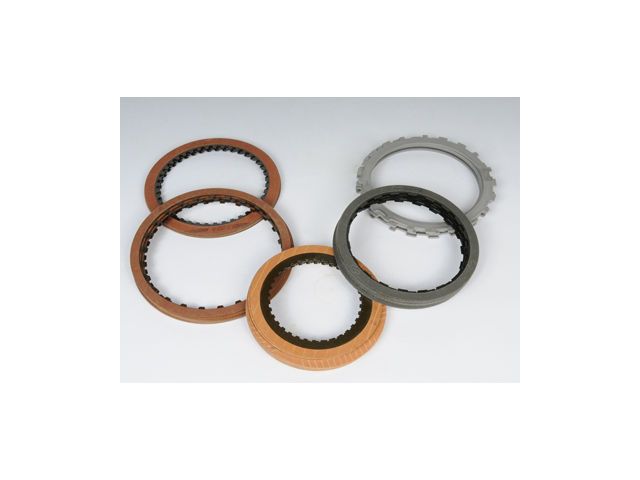
Aftermarket price range: $150-$400 - Upgraded 3-4 Clutch Pack
(OEM #Raybestos: RZP-001)— This is the specific component that fails. Upgraded kits like the Raybestos Z-Pak use more durable friction material (GPZ) and a unique single-sided clutch design to increase durability and torque capacity, preventing repeat failures.
Trusted brands: Raybestos Z-Pak (RZP-001), Sonnax, Alto Red Eagle
OEM price range: $80-$150
Aftermarket price range: $70-$250
Related Codes That Often Appear With This One
- P0734 — Stands for 'Gear 4 Incorrect Ratio'. The 3-4 clutch pack is used for both 3rd and 4th gears in the 4L60E, so it is very common for both codes to appear when this pack fails.
- P0894 — Stands for 'Transmission Component Slipping'. This is a more general code that confirms the TCM is detecting slip and frequently accompanies a specific gear ratio code like P0733.
- P1870 — Stands for 'Transmission Component Slipping'. On GM vehicles, this often points to wear in the valve body's TCC (Torque Converter Clutch) valve bore, which causes fluid overheat and accelerates the failure of other components like the 3-4 clutches.
Technical Service Bulletins (TSBs) & Recalls
- 01-07-30-038A: Addresses loss of 3rd/4th gear due to 3-4 clutch failure.
- PIP4379K: Mentions P0733 in a list of codes related to internal transmission engagement issues. Manufacturer Bulletin #PIP4379K notes that technicians may find P0733 alongside symptoms like delayed engagement into drive or no engagement into reverse.
Platform-Specific Known Issues
- GM Technical Service Bulletin (TSB) 01-07-30-038A directly addresses the loss of 3rd and 4th gear and associated codes, pointing to a worn 3-4 clutch pack as the cause.
- TSB PIP4379K also lists P0733 in a group of codes related to delayed or no gear engagement, pointing to internal transmission issues.
- A common owner experience shared on forums is noticing the engine revving higher than usual during the 2-3 shift before the code appears, which is the first sign of the 3-4 clutches beginning to slip.
Mechanic-Grade Diagnostic Values
- 1-2 and 2-3 Shift Solenoid Resistance — expected: 20-40 Ohms. Failure: Reading outside this range indicates a faulty solenoid.
- Pressure Control (PC) Solenoid Resistance — expected: 3.5-8.0 Ohms. Failure: Reading outside this range indicates a faulty PC solenoid.
- Torque Converter Clutch (TCC) Solenoid Resistance — expected: 20-40 Ohms. Failure: Reading outside this range indicates a faulty TCC solenoid.
- 3-2 Control Solenoid Resistance — expected: 9-14 Ohms. Failure: Reading outside this range indicates a faulty solenoid.
- Line Pressure at Idle (in Park or Drive) — expected: 55-65 PSI (min) to 170-190 PSI (max). Failure: Significantly lower pressure, especially when commanding 3rd gear, points to an internal hydraulic leak (e.g., 3-4 clutch circuit).
- Line Pressure at Idle (in Reverse) — expected: 64-75 PSI (min) to 300-325 PSI (max). Failure: Low pressure can indicate a weak pump or major internal leaks.
Scan Tool Commands That Help
- Tech 1 / Tech 2 or equivalent: PC Solenoid Amp Control Test — This bidirectional test allows a technician to command the Pressure Control (PC) solenoid through its amperage range (0.0 to 1.1 amps) while monitoring line pressure with a mechanical gauge. It verifies if the PC solenoid is responding correctly to commands and if the transmission can build and hold pressure. A failure to build pressure as amps are decreased points to a hydraulic issue, not an electrical one.
Wiring & Ground Locations
- Transmission Case Connector — On the passenger side of the transmission case, above the pan rail.. This is the main connection point for all internal electronics. Testing solenoid resistance can be done from this connector without dropping the pan, helping to quickly rule out or confirm electrical faults. Corrosion or damage here can cause a variety of transmission codes.
- G103 / G104 — Typically located on the rear of the driver's side cylinder head or on the engine block near the bellhousing.. These are the primary engine-to-chassis ground points. A poor ground here can cause erratic behavior in the PCM and TCM, leading to incorrect sensor readings and false codes. While not a direct cause of mechanical slip, verifying these grounds is a crucial step in any electronic diagnosis.
Real Owner Repair Stories
- LS1TECH Forum Member (Vehicle with 4L60E transmission) — No 3rd or 4th gear available.
❌ Tried (didn't work) Initial speculation about accumulator issues or shifter linkage alignment.
✅ What actually fixed it The definitive cause was confirmed to be a completely worn-out 3-4 clutch pack. The fix was a full transmission rebuild, including new clutches and friction plates, a Trans-Go shift kit, and an external transmission cooler to prevent future overheating issues.
Model Year Variations Within This Range
- 2001+: Starting in 2001, GM introduced the 4L65E (RPO M32) for higher-torque applications like the Sierra Denali with the 6.0L engine. The 4L65E is an upgraded 4L60E featuring 5-pinion front and rear planetaries (instead of 4-pinion) and an additional 3-4 clutch, increasing the clutch count from six to seven. While externally identical, these internal upgrades make it more durable. When rebuilding a standard 4L60E, using 4L65E 5-pinion planetaries is a common and highly recommended strength upgrade.
- 2000+: For V8 applications, the bellhousing was deepened to accommodate a larger 300mm torque converter, and the input shaft was changed accordingly. This makes transmissions from 1999 and earlier incompatible with 2000+ models without swapping multiple components.
- 2005+: In 2005, the transmission case connector color changed from green to black to signify an internal wiring harness change for an input shaft speed sensor that was being added to some models. By 2006-2008 this sensor was fully implemented.
Diagnostic Flowchart
Other Known Issues on This Vehicle
Issues unrelated to this code that are worth knowing about as an owner of this generation:
- Instrument Cluster Stepper Motor Failure 🟠 Medium — Extremely common, especially on 2003-2006 models. Gauges (speedometer, tachometer, fuel, etc.) become erratic, get stuck, or stop working entirely. (Ref: GM issued several TSBs, and a class-action lawsuit led to a special coverage adjustment for repairs.)
- Intermediate Steering Shaft Clunk 🟡 Low — Very common across all years. A clunking or popping noise is felt through the steering wheel, especially at low speeds or over bumps. Caused by a lack of lubrication in the collapsible shaft design. (Ref: GM released updated part designs and TSBs outlining a re-greasing procedure or shaft replacement.)
- Rusted Brake Lines 🔴 High — Common on vehicles in the rust belt. The factory steel brake lines corrode, particularly in the sections running along the frame rail, leading to potential brake fluid leaks and sudden loss of braking.
- HVAC Blend Door Actuator Failure 🟡 Low — Common. A clicking or tapping sound from behind the dashboard, often accompanied by an inability to change temperature or airflow direction.
- Fuel Level Sensor Failure 🟡 Low — Common. The fuel gauge becomes inaccurate or reads empty, even with a full tank. Requires dropping the fuel tank to replace the sending unit, which is part of the fuel pump module.
- Cab Corner and Rocker Panel Rust 🟠 Medium — Extremely common, especially in northern climates. The rocker panels and the cab corners behind the rear doors are notorious for rusting from the inside out.
Used vs. New Parts: Buying Guide for This Vehicle
When a used part is the smart pick: A used transmission from a junkyard is a high-risk, budget-oriented choice. It makes the most sense as a short-term solution to get a vehicle running while planning for a proper rebuild, or if the donor vehicle has documented low mileage and proof of running condition (e.g., from a rear-end collision). Given the known failure rate of the 3-4 clutch pack, any used, un-rebuilt 4L60E is a gamble.
Donor-vehicle mileage cap: roughly under 100000 miles for the part to have meaningful remaining life.
What to inspect on the donor part:
- Check the fluid on the dipstick. If it's dark, smells burnt, or has a glittery/metallic appearance, walk away. The transmission is already failing internally.
- Avoid units where the seller has recently changed the fluid to be bright red. This can be a tactic to hide evidence of burning.
- Look for a donor vehicle that was taken off the road due to a collision, not engine or transmission failure. This increases the odds the transmission was functional at the time of the accident.
- If possible, pull the pan. A small amount of fine gray material on the magnet is normal, but chunks of metal or piles of black clutch material mean it's junk.
- Inspect the transmission case for cracks, especially around the bellhousing and mounting points.
OEM-only on this vehicle (don't cheap out):
- Transmission Harness: While aftermarket harnesses exist, the OEM ACDelco harness is recommended to avoid potential electrical gremlins and ensure proper fitment.
Aftermarket brands forum-validated for this vehicle:
- Rebuild Kits: Sonnax (especially their Performance Packs and Sure Cure kits), Raybestos (their Z-Pak for the 3-4 clutch is a popular upgrade), Alto (Red Eagle clutches), TransGo (for shift kits and valve body upgrades).
- Hard Parts: Sonnax is highly regarded for problem-solving parts like improved sun shells, boost valves, and valve body components.
- Remanufactured Units: Jasper, Monster Transmission are commonly cited options, though quality and warranty should be carefully evaluated.
Brands owners have reported issues with on this vehicle:
- Unbranded 'performance' rebuild kits from online marketplaces. Many forum users advise buying name-brand components separately or from a reputable transmission parts supplier to ensure you get quality parts like BorgWarner or Raybestos clutches and a TransGo separator plate.
Real Owner Stories
Aggregated from forums and TSBs cited above. Mileages and costs reflect what owners reported in those sources.
2001 GMC Sierra
Symptoms: Losing 3rd and 4th gear entirely.
What fixed it: A transmission rebuild or replacement with a GM remanufactured unit.
Source hint: PerformanceTrucks.net Forums thread titled 'Gmc Sierra transmission problems...help needed!'
2001-2005 GMC Sierra 4L60E
Symptoms: Engine revving higher than usual during the 2-3 shift (flare) before the P0733 code appeared.
What fixed it: Complete transmission rebuild, including an upgraded 3-4 clutch pack and addressing valve body bores.
Source hint: vehicle_specific_issues
Related OBD-II Codes
Frequently Asked Questions
Does GM Technical Service Bulletin 01-07-30-038A apply to my Sierra's loss of 3rd and 4th gear?
My 2001 Sierra is revving high during the 2-3 shift; is this related to P0733?
Can I just replace the 2-3 shift solenoid to fix the slipping in my GMC Sierra?
Is P0733 covered under the same TSB as delayed gear engagement?
What should I look for in the transmission pan of my Sierra to confirm a 3-4 clutch failure?
Are there other common issues on the 2001-2005 Sierra I should check while fixing the transmission?
We Have This Part in Stock


The information in this article is provided for general reference and educational purposes only. Vehicle specifications, procedures, and part compatibility can vary by production date, trim level, and region. Always consult your vehicle's factory service manual and verify part numbers before purchasing or performing repairs. Safety-critical components such as airbags, seat belts, and braking systems should be installed by a qualified professional.
- GMC Sierra:
- 🧭 Diagnostic Flowchart
- 🛍️ Shop This Part
- What's Unique About the 2001-2005 GMC Sierra
- Symptoms You May Notice
- Most Likely Causes
- Rare But Worth Checking
- Diagnosis Steps
- Parts You'll Likely Need
- Related Codes That Often Appear With This One
- Technical Service Bulletins (TSBs) & Recalls
- Platform-Specific Known Issues
- Mechanic-Grade Diagnostic Values
- Scan Tool Commands That Help
- Wiring & Ground Locations
- Real Owner Repair Stories
- Model Year Variations Within This Range
- Other Known Issues on This Vehicle
- Used vs. New Parts: Buying Guide for This Vehicle
- Real Owner Stories
- 2001 GMC Sierra
- 2001-2005 GMC Sierra 4L60E
- Related OBD-II Codes
- Frequently Asked Questions
- 🎟️ Get 5% Off