

P0733 on 2018-2023 Lincoln Navigator: 10R80 Gear 3 Incorrect Ratio Causes & Fixes
P0733 on a 2018-2023 Lincoln Navigator almost always indicates a serious internal failure of the 10R80 transmission, most commonly a faulty CDF clutch drum, especially on models built on or before August 15, 2022. This is a complex, non-DIY repair requiring a partial transmission rebuild with an updated part. Repair costs range from $2,500 to over $7,000, with some dealer replacement quotes exceeding $11,000.
- P0733 on a 2018-2023 Navigator is a critical code that almost always points to a major internal transmission failure, not a simple sensor issue.
- The most likely cause is a well-documented design flaw in the 10R80 transmission's CDF clutch drum, which requires a partial transmission rebuild to fix with an updated part.
- Do not continue to drive the vehicle. This can cause catastrophic transmission failure and turn a targeted, expensive repair into a much more expensive full replacement.
- This is not a DIY repair. It requires a professional transmission specialist with experience on the Ford 10R80.
- When speaking with a repair shop or dealer, reference Ford TSB 24-2254, as it directly addresses the most common cause of this code.
What's Unique About the 2018-2023 Lincoln Navigator
The 2018-2023 Lincoln Navigator uses the Ford-GM co-developed 10R80 10-speed automatic transmission. While P0733 is a generic code, on this specific platform, it is strongly linked to a well-documented design flaw in the transmission's 'CDF' clutch drum assembly. This issue, where an internal sleeve 'walks' out of position causing a major hydraulic leak, is so prevalent on vehicles built before mid-August 2022 that it has been the subject of multiple Technical Service Bulletins (TSBs) and is a frequent topic of complaint on owner forums.
Symptoms You May Notice
- Check Engine Light or Wrench Light is on
- Harsh, jerky, or delayed shifting, sometimes described as a 'bang' or 'clunk'
- Vehicle hesitates or lunges when accelerating
- Slipping in and out of gear
- Transmission gets stuck in one gear or enters 'limp mode'
- Loud clunking or banging noises from the transmission
- Noticeable flare in RPMs between shifts, especially the 3-4 or 3-5 shift
- Delayed engagement when shifting from Park to Drive or Reverse
- Replacing transmission speed sensors. While sensors can fail, for this code on the 10R80, it is almost always a symptom of a deeper mechanical or hydraulic issue, not the root cause. The computer is correctly reporting a slip; the sensor is not the problem.
- Performing only a fluid change. A simple fluid and filter change will not fix the underlying mechanical failure of the CDF drum or a faulty valve body. It may temporarily improve symptoms but the code and drivability issues will return quickly as the new fluid is contaminated.
- Clearing adaptive learning tables. While resetting the transmission's learned shift strategy can sometimes resolve minor shift quality complaints, it cannot fix a massive internal hydraulic leak caused by the CDF drum failure. It may mask the issue for a very short time before harsh engagement returns.
Most Likely Causes
- CDF Clutch Cylinder Sleeve Failure 🔴 High Probability → Shop Automatic Transmission Coast Clutch Hub This is a well-documented design flaw in 10R80 transmissions built on or before August 15, 2022. An internal sleeve inside the CDF clutch drum can 'walk' or move out of position because the original drum lacks a retaining lip. This movement uncovers hydraulic passages, causing a catastrophic pressure loss to the C, D, and F clutch packs, which are needed for multiple gears including 3rd.
How to confirm: A technician must perform specific hydraulic pressure tests using a pressure transducer kit as outlined in Ford TSBs 24-2254 or 23-2250. Visual confirmation requires transmission disassembly to inspect the drum. The presence of glittery, metallic debris in the transmission fluid is also a strong indicator of this internal failure.
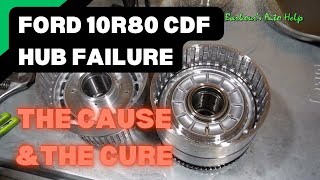
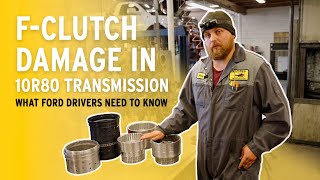
Typical fix: The transmission must be removed and disassembled to replace the faulty CDF clutch cylinder with an updated part (OEM # JL3Z-7H351-B). 🎬 Watch: How the updated CDF hub cures this design flaw This new part has a machined lip that acts as a hard stop to prevent the sleeve from moving. This is effectively a partial transmission rebuild. Some technicians recommend replacing the valve body at the same time due to potential contamination from debris.
Est. part cost: $150-$400 for the drum itself. - Main Control Valve Body Malfunction 🟡 Medium Probability → Shop Transmission Valve Body Debris from a failing clutch can travel through the fluid and score or contaminate the valve body, causing valves to stick. Sticking valves in the main control are a known issue on the 10R80 and are cited in TSBs as a primary cause for harsh shifts and various DTCs, including P0733. This can also occur as a primary failure, even without the CDF drum issue.
How to confirm: This is typically diagnosed after ruling out the more common CDF drum failure, or if shifting problems persist after the drum has been replaced. A technician may use a scan tool to monitor solenoid commands and pressures, and inspect the valve body for scoring upon disassembly.
Typical fix: Overhaul or replacement of the main control valve body, followed by a mandatory adaptive learning drive cycle. In many cases, this repair is performed alongside the CDF drum replacement.
Est. part cost: $800-$1500 - Low or Contaminated Transmission Fluid ⚪ Low Probability → Shop Transmission Assembly This is almost always a symptom, not the root cause, on this platform. Low fluid can cause a lack of hydraulic pressure, but the fluid had to go somewhere. Contaminated fluid (dark, burnt, or full of metal 'glitter') is a direct result of the CDF drum or other clutches failing and shedding material.
How to confirm: Check the transmission fluid level and condition. The 10R80 requires a specific, multi-step workshop procedure as it does not have a traditional dipstick. The fluid should be red and clear (Motorcraft MERCON ULV). Dark, burnt-smelling, or glittery fluid confirms a serious internal failure.
Typical fix: If fluid is just low, top it off with Motorcraft MERCON ULV and check for external leaks. If it's dirty, a fluid and filter change is necessary, but this will not fix the mechanical problem and the new fluid will be quickly contaminated. It is not a solution for P0733.
Est. part cost: $150-$300
Diagnosis Steps
- Verify the code with a professional-grade scan tool.
- Check for any related Technical Service Bulletins (TSBs) for the vehicle's VIN. Specifically, reference TSB 24-2254, which supersedes earlier versions like 23-2250.
- Check the transmission fluid level and condition following the correct workshop procedure. Note any signs of burning or metallic debris ('glitter'), which strongly indicates internal failure.
- If the vehicle was built on or before August 15, 2022, and exhibits P0733, the CDF drum is the primary suspect.
- Perform hydraulic pressure tests as outlined in TSB 24-2254 to confirm or rule out the CDF clutch drum leak. This requires specialized equipment (Rotunda 164-R9833 Pressure Vacuum Transducer Kit). 🎬 See this step-by-step diagnostic process for harsh shifting
- If the CDF drum leak is confirmed, the transmission must be removed and disassembled for repair with the updated part (JL3Z-7H351-B).
- During the repair, carefully inspect the valve body for scoring or contamination from debris and replace if necessary.
- After reassembly, perform the adaptive learning drive cycle as specified by Ford to ensure proper shift quality.
Parts You'll Likely Need
- CDF Clutch Cylinder / Hub Assembly
(OEM #JL3Z-7H351-B)— This is the updated part from Ford that corrects the design flaw of the original. It features a machined lip to prevent the internal sleeve from moving and causing hydraulic leaks. It supersedes HL3Z-7H351-A and JL3Z-7H351-A.
Trusted brands: Motorcraft
OEM price range: $150-$300
Aftermarket price range: $100-$250 - Main Control Valve Body — If debris from the initial failure has damaged the valve body or if it has sticking valves, it will need to be replaced to restore proper hydraulic function. TSBs often recommend inspection and replacement if necessary during the CDF drum repair.
Trusted brands: Motorcraft
OEM price range: $1000-$1500
Aftermarket price range: $800-$1200 - Automatic Transmission Fluid
(OEM #XT-12-QULV)— The transmission will require a full fluid replacement with the correct type (Motorcraft MERCON ULV) after any internal repair.
Trusted brands: Motorcraft MERCON ULV
OEM price range: $150-$250
Aftermarket price range: $100-$200 - Transmission Gasket and Seal Kit — A complete overhaul or partial rebuild requires replacement of all relevant gaskets, seals, and O-rings to ensure proper sealing upon reassembly.
Trusted brands: Motorcraft, Mahle
OEM price range: $200-$400
Aftermarket price range: $150-$300
Related Codes That Often Appear With This One
- P0731, P0732, P0734, P0735, P0736 — These are incorrect gear ratio codes for other gears. When multiple gear ratio codes appear together, it strongly suggests a systemic hydraulic problem, like the failing CDF drum, which affects the C, D, and F clutches used for multiple gear combinations.
- P2700-P2708 — These are clutch application time-related codes. Their presence alongside P0733 reinforces the diagnosis of a major internal hydraulic leak or valve body fault, as the TCM is detecting that clutches are taking too long to apply. TSB 24-2254 explicitly lists these codes as being related to the CDF drum sleeve issue.
Technical Service Bulletins (TSBs) & Recalls
- TSB 24-2254: Supersedes previous TSBs. Links a long list of DTCs (including P0733) to the CDF clutch cylinder sleeve issue. It provides a specific diagnostic procedure using a pressure transducer kit to verify hydraulic leaks before authorizing the replacement of the drum.
- TSB 23-2250: Addressed harsh/delayed shifts and DTCs including P0733 due to axial movement of the CDF clutch cylinder sleeve. This TSB has been superseded by 24-2254.
- TSB 23-2123: An earlier TSB that also addressed harsh/delayed shifts and a list of DTCs including P0733, pointing to overhauling the main control valve body as a potential solution. This has also been superseded.
Platform-Specific Known Issues
- A well-documented design flaw in the 10R80 transmission's CDF clutch drum is the primary cause of P0733. An internal sleeve 'walks' out of position, causing a major hydraulic leak that starves clutches of pressure. This issue primarily affects vehicles built on or before August 15, 2022.
Mechanic-Grade Diagnostic Values
- Shift Solenoids (A-F), TCC Solenoid, and Line Pressure Control (LPC) Solenoid Resistance — expected: 5.0 - 5.4 Ohms at 68°F (20°C). Failure: A resistance reading outside this range indicates a faulty solenoid coil, which could be part of a valve body failure.
- Transmission Fluid Temperature (TFT) Sensor Resistance — expected: 37k-16k Ohms at 69-104°F (21-40°C); 5k-2.7k Ohms at 159-194°F (70-90°C). Failure: Resistance values that do not correlate with the known fluid temperature suggest a faulty sensor. This is rarely the cause of P0733 but is a key input for the TCM.
- CDF Clutch Circuit Leak Test (per TSB 24-2254) — expected: Pressure decay should be within a specified limit when the circuit is pressurized to 1900-2000kPa (275-290 PSI) using a specialized transducer kit.. Failure: A rapid drop in pressure confirms a significant hydraulic leak within the CDF clutch circuit, definitively pointing to the failed drum sleeve.
Scan Tool Commands That Help
- Ford IDS (or equivalent high-level scanner like FORScan): Transmission Characterization / Solenoid Body Strategy — This is mandatory after replacing the main control (valve body) assembly. The tech must input the 13-digit strategy number from the tag on the new valve body to ensure the TCM uses the correct calibration. Failure to do so will cause severe shifting problems.
- Ford IDS (or equivalent high-level scanner): Clear Transmission Adaptive Tables — This function must be performed after any major transmission repair, especially replacing the CDF drum or valve body. It erases the TCM's learned shift adjustments, forcing it to start a new learning process with the corrected mechanical and hydraulic components.
- Ford IDS (or equivalent high-level scanner): Reset TCM KAM (Keep Alive Memory) — This is a deeper reset than clearing adaptive tables and is often required as part of the complete post-repair procedure to ensure the adaptive learning process is fully effective.
Real Owner Repair Stories
- Ford F150 Forum user (2018 F-150 Lariat 3.5L EcoBoost, 88,000 miles) — Transmission skipping 2nd and 4th gears, with very hard shifts into 3rd and 5th. Eventually set a P07F7 code and locked out 10th gear.
❌ Tried (didn't work) Resetting the PCM and TCM had no effect.
✅ What actually fixed it A transmission rebuild costing $4,400. The mechanic confirmed the internal CDF drum sleeve had moved, partially covering fluid passages and destroying a seal. The faulty drum was replaced with the updated Ford part. - Reddit user r/f150 (2019 F-150 Lariat 2.7L) — Initial harsh upshifts/downshifts, followed by a 2-3 second delay when shifting from Park to Drive/Reverse.
❌ Tried (didn't work) A previous dealer visit for a reflash and 'some parts swapped per TSB' did not provide a permanent fix.
✅ What actually fixed it The CDF drum was replaced under warranty, which fixed the delayed engagement. However, 900km later, the truck developed very hard shifts into 3rd gear. The dealer then replaced the main control valve body assembly, which resolved the remaining issue after a short adaptive learning period. - Ford F150 Forum user (2017 F-150 3.5L, 101,000 miles) — Symptoms consistent with CDF drum failure.
❌ Tried (didn't work) The owner opted against a remanufactured transmission, fearing it could have the same pre-update design flaw.
✅ What actually fixed it A full transmission rebuild from an independent transmission shop, which included the updated CDF drum. The total cost was $7,000, and the truck was reported as flawless 4,000 miles after the repair.
OEM Part Supersession History
HL3Z-7H351-A, JL3Z-7H351-A→JL3Z-7H351-B— The original design allowed an internal sleeve to 'walk' out of position. The updated JL3Z-7H351-B part has a machined lip that acts as a hard stop, preventing the sleeve from moving and causing the hydraulic leak.
Model Year Variations Within This Range
- 2018 - mid-2022: Vehicles built on or before August 15, 2022, were equipped with the original, flawed CDF clutch drum (e.g., HL3Z-7H351-A) and are highly susceptible to this failure. Vehicles built after this date have the updated part (JL3Z-7H351-B) from the factory and are not prone to this specific issue.
Diagnostic Flowchart
Other Known Issues on This Vehicle
Issues unrelated to this code that are worth knowing about as an owner of this generation:
- 3.5L EcoBoost Cam Phaser Rattle on Cold Start 🟠 Medium — Common on 2017-2020 models. A rattling noise lasting a few seconds after a cold start. Can progress to a hot idle knock. (Ref: Customer Satisfaction Program 21N03 provided an extended warranty for this repair after a PCM reflash under FSA 21B10.)
- Air Suspension Leaks or Malfunctions 🟠 Medium — A minority of owners report issues with the air suspension, including leaks causing the vehicle to sag or sensor malfunctions. Repair can be costly.
- Infotainment System Glitches 🟡 Low — Some owners report minor electrical issues such as the infotainment screen freezing, going black, or being unresponsive. Often resolved with a software update or system reset.
- Hesitation or Jerky Low-Speed Shifting 🟠 Medium — Even on transmissions without a hard fault code, many owners complain about the 10R80's busy shift logic, leading to harsh or clunky behavior at low speeds. Adaptive learning resets are a common, but often temporary, dealer fix. (Ref: Multiple TSBs exist for software updates to improve shift quality.)
Used vs. New Parts: Buying Guide for This Vehicle
When a used part is the smart pick: For this specific P0733 failure, buying a used CDF drum or a complete used transmission from a 2018-2022 model year donor is NOT recommended. The CDF drum failure is a known design flaw, and a used part will have the same defect or be on the verge of failing. A used complete transmission assembly only makes sense if it can be verified to be from a donor vehicle built AFTER August 15, 2022, ensuring it has the updated internal components.
Donor-vehicle mileage cap: roughly under 40000 miles for the part to have meaningful remaining life.
What to inspect on the donor part:
- Verify the donor vehicle's VIN to confirm a build date after August 2022.
- If possible, inspect the transmission fluid for clarity and color; avoid any unit with dark, burnt, or glittery fluid.
- Check the main electrical connector for any signs of damage or corrosion.
- Obtain any available service history for the donor vehicle.
OEM-only on this vehicle (don't cheap out):
- CDF Clutch Cylinder / Hub Assembly: You MUST use the updated OEM part (JL3Z-7H351-B) or a reputable aftermarket kit that specifically addresses the sleeve-walking issue. Do not use an old-stock or used original-design drum.
- Main Control Valve Body: Due to the complexity and need for precise calibration (solenoid strategy), a new or remanufactured OEM/Motorcraft unit is strongly recommended to avoid compatibility and performance issues.
Aftermarket brands forum-validated for this vehicle:
- Sonnax: Offers a 'CDF Drum Saver Kit' (129910-01K) designed to repair a failed drum by installing an improved sleeve with a locking set screw, which can prevent the need to buy a whole new drum assembly. This is a technician-grade repair, not a simple drop-in part.
Brands owners have reported issues with on this vehicle:
- Unbranded or no-name 'rebuild kits' from online marketplaces. The quality of the internal seals, clutches, and especially the CDF drum solution is critical, and using low-quality components will likely lead to a repeat failure.
Real Owner Stories
Aggregated from forums and TSBs cited above. Mileages and costs reflect what owners reported in those sources.
2018 Ford F-150 (Platform Mate) — 47000 miles
Symptoms: Diagnosed with P0733; internal CDF clutch cylinder sleeve failure.
What fixed it: The dealer recommended a full transmission replacement.
Cost: $11,040.95-$11,040.95
Source hint: https://www.f150forum.com/f118/10-speed-transmission-10r80-559389/
2017-2023 Ford F-150 (Platform Mate)
Symptoms: Check C clutch for slipping; transmission removed to inspect CDF drum for worn clutches and slipped seals.
What fixed it: Confirmed CDF drum failure requiring removal and inspection.
Source hint: https://www.f150forum.com/f118/10r80-transmission-failure-replacement-522689/index3/
2017-2023 Ford F-150 (Platform Mate)
Symptoms: Engagement delays followed by very hard shifts into third gear 900km after a drum replacement.
What fixed it: Replacement of the valve body assembly to resolve collateral damage/debris issues.
Source hint: https://www.reddit.com/r/f150/comments/yfv902/10r80_cdf_drum/
2017-2023 Ford F-150 (Platform Mate)
Symptoms: Hesitation when accelerating and presence of codes P0732 and P0733.
What fixed it: Diagnostic advice pointed toward common 10R80 internal failures.
Source hint: https://www.reddit.com/r/mechanic/comments/18y8j4v/help_with_fix/
Related OBD-II Codes
Frequently Asked Questions
My 2019 Navigator was built in early 2022; does TSB 24-2254 apply to my transmission issues?
What is the specific part number for the updated CDF clutch drum for the Lincoln Navigator?
Can I just change the Mercon ULV fluid to fix the P0733 gear 3 incorrect ratio code?
Why does my Navigator 'bang' into gear or flare in RPMs between the 3rd and 4th shift?
Is there a specific tool my mechanic needs to diagnose the CDF drum failure before tearing down the transmission?
If I replace the CDF drum, should I also replace the valve body?
Helpful Videos
We Have This Part in Stock


The information in this article is provided for general reference and educational purposes only. Vehicle specifications, procedures, and part compatibility can vary by production date, trim level, and region. Always consult your vehicle's factory service manual and verify part numbers before purchasing or performing repairs. Safety-critical components such as airbags, seat belts, and braking systems should be installed by a qualified professional.
- Lincoln Navigator:
- 🧭 Diagnostic Flowchart
- 🎬 Helpful Videos
- 🛍️ Shop This Part
- What's Unique About the 2018-2023 Lincoln Navigator
- Symptoms You May Notice
- Most Likely Causes
- Diagnosis Steps
- Parts You'll Likely Need
- Related Codes That Often Appear With This One
- Technical Service Bulletins (TSBs) & Recalls
- Platform-Specific Known Issues
- Mechanic-Grade Diagnostic Values
- Scan Tool Commands That Help
- Real Owner Repair Stories
- OEM Part Supersession History
- Model Year Variations Within This Range
- Other Known Issues on This Vehicle
- Used vs. New Parts: Buying Guide for This Vehicle
- Real Owner Stories
- 2018 Ford F-150 (Platform Mate) — 47000 miles
- 2017-2023 Ford F-150 (Platform Mate)
- 2017-2023 Ford F-150 (Platform Mate)
- 2017-2023 Ford F-150 (Platform Mate)
- Related OBD-II Codes
- Frequently Asked Questions
- 🎟️ Get 5% Off