

P0734 on 2003-2007 Honda Accord: Gear 4 Incorrect Ratio Causes and Fixes
On a 2003-2007 Honda Accord, code P0734 often points to low or dirty transmission fluid, or failing transmission pressure switches. Start by checking the fluid and performing a '3x drain and fill' with Honda Genuine ATF. If that's not the issue, suspect the 4th gear clutch pressure switch, which is a very common and relatively inexpensive part to replace on these models.
- P0734 on a 2003-2007 Accord means the transmission is slipping or not engaging 4th gear correctly.
- Always check the transmission fluid level and condition first. Use only Genuine Honda ATF-DW1 fluid.
- The most likely part to fail is the 4th gear clutch pressure switch, which is relatively easy and inexpensive to replace.
- Do not ignore this code. Driving with a slipping transmission can quickly lead to catastrophic failure requiring a full rebuild.
- If fluid and pressure switches don't solve the issue, the problem may be a shift solenoid or, in worst-case scenarios, internal clutch pack wear.
What's Unique About the 2003-2007 Honda Accord
The 5-speed automatic transmissions (codename BAYA for V6 models) in this generation of Honda Accord are known for having issues with pressure switches and being extremely sensitive to fluid condition and level. While early models in this generation (2003-2004) were particularly prone to premature transmission failure, many P0734 issues on these specific cars can be traced back to faulty external sensors (pressure switches) or hydraulic pressure problems that can often be resolved without a full transmission rebuild. Replacing the 3rd and 4th gear pressure switches is a common preventative and corrective measure among owners.
Symptoms You May Notice
- Check Engine Light is on.
- Transmission fails to shift into 4th gear, engine RPMs are unusually high at highway speeds.
- Delayed or harsh, jerky shifting into 4th gear.
- Transmission slipping (engine RPMs flare up without a corresponding increase in speed).
- Reduced fuel economy due to inefficient gear operation.
- Vehicle may enter 'limp mode,' getting stuck in 2nd or 3rd gear with limited speed.
- Flashing 'D' (Drive) indicator light on the dashboard.
- Immediately assuming the transmission needs to be rebuilt without first checking fluid level/condition and replacing the inexpensive 3rd and 4th gear pressure switches.
- Replacing a shift solenoid when the actual problem is a faulty pressure switch, low fluid, or a clogged solenoid screen.
- Confusing a failing engine coolant temperature sensor with a transmission issue, as it can sometimes cause erratic shifting behavior.
Most Likely Causes
- Low or Dirty Automatic Transmission Fluid (ATF) 🔴 High Probability → Shop Transmission Assembly These transmissions are notoriously sensitive to fluid type, level, and condition. Degraded fluid loses its hydraulic properties and friction modifiers, leading to pressure issues, overheating, and poor shifting.
How to confirm: Check the transmission fluid level and condition using the dipstick with the engine warm and off, on a level surface. The fluid should be at the correct level, reddish in color, and not smell burnt. Dark, black, or burnt-smelling fluid indicates a problem and likely internal wear.
Typical fix: Perform a series of drain-and-fills, often called a '3x drain and fill.' This involves draining the 3-4 quarts from the pan, refilling, driving a short distance to circulate the new fluid, and repeating the process two more times. This replaces a majority of the old fluid. Only use Honda Genuine ATF-DW1 (or the previously specified Z1).
Est. part cost: $40-$120 - Faulty 4th Gear Clutch Pressure Switch 🔴 High Probability These pressure switches are a very common failure point on this generation of Honda/Acura automatic transmissions. They can fail electronically or get clogged with debris, sending incorrect pressure readings to the TCM and causing harsh or incorrect shifting.
How to confirm: The switch can be tested with a multimeter for continuity. However, given their high failure rate and low cost, many owners and mechanics replace the 3rd and 4th gear switches as a primary diagnostic step after checking the fluid.
Typical fix: Replace the 4th gear clutch pressure switch. It is externally mounted on the transmission case. On V6 models, it is often located behind the driver's side front wheel splash shield. On 4-cylinder models, it may be under the airbox.
Est. part cost: $40-$80 - Failing Shift Solenoid or Linear Solenoid Pack 🟡 Medium Probability → Shop Transmission Valve Body
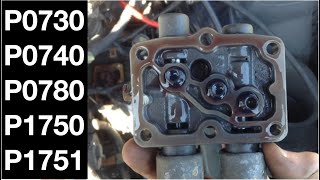
How to confirm: Test the resistance of the solenoids with a multimeter to see if they are within the specifications listed in the factory service manual. A professional scan tool can also command the solenoids to activate to check their function. The screens on the solenoids can also be inspected for clogging. 🎬 Watch: How to clean your transmission solenoid screen filters.
Typical fix: Remove and clean the solenoid screens or replace the faulty shift solenoid/solenoid pack. These are typically mounted on the exterior of the transmission, sometimes under the air filter housing.
Est. part cost: $100-$300 - Internal Mechanical Failure ⚪ Low Probability Early V6 models (2003-2004) were known for premature transmission failure. High mileage or a history of poor maintenance can lead to worn-out internal components, specifically the 3rd and 4th gear clutch packs, which burn up and lose their friction material.
How to confirm: This is a diagnosis of exclusion. If fluid, pressure switches, and solenoids are all confirmed to be good, the problem is likely internal. A transmission pressure test performed by a professional can confirm low pressure in the 4th gear clutch circuit. Dropping the transmission pan and finding significant metal shavings or clutch material is a definitive sign.
Typical fix: Requires a complete transmission rebuild or replacement with a remanufactured unit.
Est. part cost: $2000-$4500
Rare But Worth Checking
- Faulty Transmission Control Module (TCM): → Shop Transmission Assembly This is very rare. The TCM should only be considered as the cause after all other possibilities (fluid, sensors, solenoids, and internal mechanics) have been exhaustively ruled out.
- Blocked Hydraulic Passages: If the transmission fluid has broken down significantly, it can create sludge that blocks small passages within the valve body, preventing proper hydraulic pressure from reaching the 4th gear clutch pack.
Diagnosis Steps
- Check the automatic transmission fluid (ATF) level and condition. The engine should be off and warm, and the vehicle on a level surface.
- If the fluid is low, top it off with Honda ATF-DW1 and check for leaks. If the fluid is dark, burnt, or contains debris, perform a 3x drain and fill.
- Scan for other transmission-related codes. Multiple gear ratio codes may point to a different root cause.
- Locate and inspect the wiring and connectors for the 3rd and 4th gear pressure switches for any damage or corrosion.
- Test or replace the 3rd and 4th gear clutch pressure switches. Given their high failure rate and low cost, this is a common and highly recommended step. The 4th gear switch is often located behind the driver-side wheel well.
- Inspect and test the shift solenoids. Check their resistance with a multimeter against factory specifications and inspect their filter screens for blockage.
- If all external components and fluid are good, a professional should perform a transmission line pressure test to check for low pressure in the 4th gear circuit.
- If line pressure is low, inspect the transmission drain plug magnet and fluid pan (if removed) for excessive metal shavings, which would confirm an internal mechanical failure requiring a rebuild or replacement.
Parts You'll Likely Need
- 4th Gear Clutch Pressure Switch
(OEM #28610-RAY-003 or 28610-RKE-004 (V6 models); 28600-P7Z-003 or 28600-P7Z-013 (4-Cyl models))— This is a very common failure point on this platform that directly causes P0734 and related shifting issues. Part numbers have been superseded over time.
Trusted brands: Genuine Honda, Standard Motor Products (Intermotor), Rostra
OEM price range: $60-$90
Aftermarket price range: $30-$60 - Honda Genuine Automatic Transmission Fluid (ATF-DW1)
(OEM #08200-9008)— Honda transmissions are extremely sensitive to fluid type. Using the correct OEM fluid is critical for proper operation and longevity. A 3x drain and fill requires about 9-12 quarts.
Trusted brands: Genuine Honda
OEM price range: $10-$15 per quart
Aftermarket price range: N/A - 3rd Gear Clutch Pressure Switch
(OEM #28600-RAY-003 or 28600-RKE-004 (V6 models))— Often replaced along with the 4th gear switch as a preventative measure, as it is also a common failure point and is often sold in a kit with the 4th gear switch.
Related Codes That Often Appear With This One
- P0730 — Incorrect Gear Ratio (General). This is a generic code that often appears with more specific gear ratio codes like P0734, indicating a broader transmission issue.
- P0731, P0732, P0733, P0735 — These are incorrect ratio codes for other gears. If multiple gear ratio codes are present, it points towards a more systemic issue like low fluid, a failing torque converter, or a clogged filter, rather than a problem specific to just 4th gear.
- P0780 — Shift Malfunction. This code often accompanies gear ratio codes and points to a problem in the hydraulic control system (solenoids, valve body).
Technical Service Bulletins (TSBs) & Recalls
- TSB 04-037: While not directly for P0734, this TSB addresses an issue on 2003-2004 Accord V6 models where a faulty 2nd gear clutch pack could cause issues. It highlights the known weaknesses in these early transmissions. A related TSB involved installing an oil jet kit to improve lubrication to the second gear, indicating Honda's awareness of design flaws.
Platform-Specific Known Issues
- Owner Experience: Pressure Switch Replacement Fix: A user on DriveAccord.net with a 2003 Accord V6 experiencing P0734 and harsh shifting reported that replacing both the 3rd and 4th gear pressure switches completely solved the problem. They noted the parts were relatively inexpensive and the job was manageable for a DIYer, taking about an hour after removing the driver's side wheel.
- Owner Experience: 3x Drain and Fill Success: On the Honda-Tech forums, a 2005 Accord owner with a P0734 code and slipping symptoms was advised to perform a 3x drain and fill with Honda ATF-DW1 before attempting any mechanical repairs. The owner later reported that the fluid change alone resolved the shifting issues and the code did not return.
- Real-World Diagnosis on YouTube: Multiple YouTube videos for 2003-2007 Accords and the similar Acura TL show mechanics and owners diagnosing P0734. A common theme is starting with a fluid check, followed by replacing the 3rd and 4th gear pressure switches located behind the driver's side wheel well, which often resolves the code without further work.
Mechanic-Grade Diagnostic Values
- Shift Solenoid Resistance — expected: 12 - 25 Ohms (Ω). Failure: A reading outside this range (e.g., infinite for an open circuit, or zero for a short) indicates a faulty solenoid coil.
- Shift Solenoid Activation Test — expected: An audible 'click' when 12V is briefly applied to the solenoid's terminals.. Failure: No click indicates the solenoid is mechanically stuck or electrically burned out.
Scan Tool Commands That Help
- Honda Diagnostic System (HDS): Miscellaneous Test Menu > Shift Solenoid A, B, C, and D Test — This bidirectional control allows a technician to command each shift solenoid on individually. Listening for an audible 'click' from the transmission case confirms the solenoid is mechanically actuating, helping to distinguish an electrical fault from a mechanical one without removing parts.
Wiring & Ground Locations
- G101 — On V6 models, this critical ground is located on the driver's side of the engine, typically bolted to the thermostat housing or the intake manifold plenum.. G101 is the main power and logic ground for the Engine Control Module (ECM/PCM). A poor connection here due to corrosion or looseness can cause a wide range of erratic electronic behaviors, including incorrect sensor readings and faulty commands to the transmission, potentially leading to shifting problems and codes like P0734.
Real Owner Repair Stories
- Composite of multiple owner reports on DriveAccord.net and Acurazine.com (2004 Honda Accord V6, ~145,000 miles) — Check Engine Light on with code P0734, flashing 'D' light on the dashboard, harsh shifting around 3rd-4th gear, and occasional RPM flare when trying to accelerate at highway speeds.
❌ Tried (didn't work) A single drain and fill of the transmission fluid. The old fluid was dark but didn't smell excessively burnt and had minimal material on the magnetic drain plug. The symptoms persisted.
✅ What actually fixed it Replacing both the 3rd and 4th gear clutch pressure switches. After replacement and clearing the codes, the shifting behavior returned to normal and the P0734 code did not return.
OEM Part Supersession History
28610-RAY-003, 28610-RAY-013, 28600-P7Z-003, 28600-P7Z-013→28610-RKE-004— Part consolidation and potential design improvements over time. Honda often uses the same switch for multiple clutch packs.
Heads up: The part 28610-RKE-004 is the current, widely compatible OEM replacement for many 3rd and 4th gear pressure switch applications on this platform. Always verify with VIN, but this part number covers a broad range of the affected vehicles.
Model Year Variations Within This Range
- 2003-2004 (V6 Models): These early models were subject to Honda's voluntary recall (NHTSA Campaign ID: 04V176000) for a design flaw that caused insufficient lubrication and overheating of the second gear set. The fix involved installing an 'oil jet kit' to improve fluid flow. Transmissions in these years are more prone to premature internal failure, which can generate debris that clogs passages, screens, and pressure switches, leading to codes like P0734 for other gears.
Diagnostic Flowchart
Other Known Issues on This Vehicle
Issues unrelated to this code that are worth knowing about as an owner of this generation:
- Automatic Transmission Failure (2003-2004 V6) 🔴 High → Shop Transmission Assembly — Very common on early 7th-gen V6 models, often failing before 100,000 miles. Less common on 4-cylinder and later V6 models. (Ref: Honda issued an extended warranty and TSBs for early models, sometimes involving the installation of an oil jet kit to improve lubrication.)
- Failing Radio/HVAC Display Backlight 🟡 Low — Extremely common, especially on 2003-2004 models. The circuit board for the backlight fails, causing the display to go dark.
- Power Steering Hose Leak / Whine 🟠 Medium — Common across all years. A high-pressure power steering hose can leak, and failing O-rings in the system can introduce air, causing a distinct whining noise when turning the wheel. (Ref: A recall was issued for the power steering feed hose on V6 models due to potential deterioration.)
- Excessive Oil Consumption (4-Cylinder K24 Engine) 🟠 Medium — Mentioned frequently by owners, though less severe than on later 8th-gen models. Can be caused by sticking piston rings.
- Premature Rear Brake Wear 🟡 Low — Some owners report faster-than-expected wear on rear brake pads.
- Navigation System Clock Error (2022 Onward) 🟡 Low — A GPS rollover event on January 1, 2022, caused the clocks in many older Honda/Acura navigation systems to display the incorrect time. (Ref: TSB #A21120A)
Used vs. New Parts: Buying Guide for This Vehicle
When a used part is the smart pick: Used external parts like shift solenoid packs and clutch pressure switches can be a cost-effective option if sourced from a low-mileage donor vehicle and tested for correct resistance before installation. A complete used transmission is only a viable option if it comes from a later model year (2005-2007) with documented low mileage and a clean fluid history.
Donor-vehicle mileage cap: roughly under 100000 miles for the part to have meaningful remaining life.
What to inspect on the donor part:
- For a complete transmission, insist on seeing the donor vehicle to verify mileage and check for accident damage.
- Pull the dipstick on the donor transmission; if the fluid is dark black, burnt-smelling, or has visible metal flake, reject the part.
- For sensors/solenoids, inspect connectors for corrosion, cracked plastic, or damaged wiring.
OEM-only on this vehicle (don't cheap out):
- Automatic Transmission Fluid (ATF-DW1). Using non-OEM fluid is a major cause of shifting problems and premature failure in these transmissions.
- In-line Transmission Filter. While aftermarket versions exist, the cost difference is minimal and the OEM part ensures correct fitment and filtration media.
Aftermarket brands forum-validated for this vehicle:
- Standard Motor Products (Intermotor) for clutch pressure switches.
- Rostra for clutch pressure switches and solenoids.
Brands owners have reported issues with on this vehicle:
- Avoid unbranded, 'white-box' electronic parts like sensors and solenoids from online marketplaces, as their internal components and calibration often do not meet OEM specifications, leading to repeat failures.
Real Owner Stories
Aggregated from forums and TSBs cited above. Mileages and costs reflect what owners reported in those sources.
2003 Accord V6
Symptoms: P0734 and harsh shifting
What fixed it: Replacing both the 3rd and 4th gear pressure switches completely solved the problem.
Source hint: Owner Experience: Pressure Switch Replacement Fix
2005 Accord
Symptoms: A P0734 code and slipping symptoms
What fixed it: The owner reported that a 3x drain and fill with Honda ATF-DW1 alone resolved the shifting issues and the code did not return.
Source hint: Owner Experience: 3x Drain and Fill Success
2003-2007 Accord
Symptoms: P0734 code
What fixed it: Mechanics and owners diagnosed the issue by starting with a fluid check, followed by replacing the 3rd and 4th gear pressure switches, which often resolved the code without further work.
Source hint: Real-World Diagnosis on YouTube
2003 Accord V6
Symptoms: P0734 and P0780 codes
What fixed it: Forum consensus points to checking fluid first, then replacing the 3rd and 4th gear pressure switches as the primary fixes.
Source hint: DriveAccord.net - Numerous threads discuss P0734, with the consensus being to check fluid first, then replace the 3rd and 4th gear pressure switches.
Related OBD-II Codes
Frequently Asked Questions
What is the correct transmission fluid for my 2003-2007 Accord, and why is it so important?
I have a P0734 code. Should I replace the transmission right away?
Where is the 4th gear pressure switch located on my Accord?
My Accord is a 2003 V6. Is it true these have known transmission problems?
What is a '3x drain and fill' and why is it recommended for this car?
My 'D' (Drive) indicator light is flashing. Is this related to the P0734 code?
Helpful Videos
We Have This Part in Stock

The information in this article is provided for general reference and educational purposes only. Vehicle specifications, procedures, and part compatibility can vary by production date, trim level, and region. Always consult your vehicle's factory service manual and verify part numbers before purchasing or performing repairs. Safety-critical components such as airbags, seat belts, and braking systems should be installed by a qualified professional.
- Honda Accord:
- 🧭 Diagnostic Flowchart
- 🎬 Helpful Videos
- 🛍️ Shop This Part
- What's Unique About the 2003-2007 Honda Accord
- Symptoms You May Notice
- Most Likely Causes
- Rare But Worth Checking
- Diagnosis Steps
- Parts You'll Likely Need
- Related Codes That Often Appear With This One
- Technical Service Bulletins (TSBs) & Recalls
- Platform-Specific Known Issues
- Mechanic-Grade Diagnostic Values
- Scan Tool Commands That Help
- Wiring & Ground Locations
- Real Owner Repair Stories
- OEM Part Supersession History
- Model Year Variations Within This Range
- Other Known Issues on This Vehicle
- Used vs. New Parts: Buying Guide for This Vehicle
- Real Owner Stories
- 2003 Accord V6
- 2005 Accord
- 2003-2007 Accord
- 2003 Accord V6
- Related OBD-II Codes
- Frequently Asked Questions
- 🎟️ Get 5% Off