

P0740 on 1999-2004 Honda Odyssey: TCC Solenoid and Transmission Failure Guide
On a 1999-2004 Honda Odyssey, P0740 almost always points to a transmission problem. The easiest first step is checking for low or dirty fluid. More likely causes are a failed torque converter clutch (TCC) solenoid or, unfortunately, a failing torque converter and transmission requiring a rebuild or replacement. This code is often called the 'kiss of death' for this specific transmission.
- P0740 on a 1999-2004 Odyssey is a serious code that often signals an impending transmission failure.
- Always check the transmission fluid level and condition first. Use only Honda Genuine ATF-DW1 fluid.
- The most common parts to fail are the TCC/Lock-up solenoids, but replacing them may not fix the problem if the torque converter is shedding material.
- Due to the high rate of transmission failure on this model, be prepared for the possibility that a full rebuild or replacement is the only permanent solution.
- Do not use a high-pressure 'flush' machine on this transmission; perform a series of drain-and-fills instead.
What's Unique About the 1999-2004 Honda Odyssey
The second-generation Honda Odyssey (1999-2004) is infamous for automatic transmission failures, and P0740 is a very common code associated with this issue. While the code points to an electrical circuit, it is frequently triggered by a cascading mechanical and hydraulic problem within the transmission itself. The core issue often begins with the torque converter's lock-up clutch friction material delaminating and breaking down. This abrasive debris contaminates the transmission fluid, turning it dark and gritty. This contaminated fluid then circulates throughout the transmission, clogging the fine mesh screens on the TCC and other solenoids, as well as blocking narrow hydraulic passages in the valve body. This blockage is what ultimately triggers the P0740 code and leads to starvation of fluid, overheating, and catastrophic failure of clutches and gears. Because of this well-documented failure path, P0740 on this specific vehicle should be treated with more seriousness than on many other cars.
Generation note: This covers the entire second generation (RL1) of the Honda Odyssey. Models from 1999-2001 used a 4-speed automatic (B7XA), while 2002-2004 models used a 5-speed (BYBA/BGYA). Both transmissions are highly susceptible to the failures that cause code P0740, though the issue is particularly notorious on the 5-speed units.
Symptoms You May Notice
- Check Engine Light is on
- Flashing 'D' or 'D5' light on the dashboard
- Harsh or delayed shifting, particularly a clunky shift between 1st and 2nd gear
- Vehicle shudders or vibrates at highway speeds, often described as driving over a 'rumble strip' as the TCC attempts to engage/disengage
- Engine RPMs are higher than usual at highway speeds because the transmission won't shift into overdrive or the torque converter won't lock up
- Noticeable decrease in fuel economy
- Stalling when coming to a stop or when shifting into gear
- Transmission slipping or feeling like it's in neutral between shifts
- Replacing only the TCC solenoid without addressing the root cause. If the transmission fluid is full of debris from a failing torque converter, a new solenoid will likely fail again in a short time or won't fix the issue because the hydraulic passages are clogged.
Most Likely Causes
- Low or Dirty Transmission Fluid 🔴 High Probability → Shop Transmission Assembly These transmissions are very sensitive to fluid condition. As the torque converter clutch wears, its friction material contaminates the fluid, clogging passages and solenoid screens. This is the primary failure mode.
How to confirm: Check the transmission fluid dipstick. The fluid should be at the correct level, pink/red in color, and not smell burnt. Dark, brown, or black fluid with a burnt smell or visible metallic/clutch material is a definitive sign of a serious internal problem.
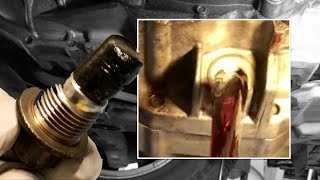
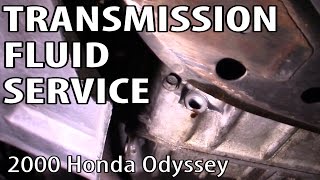
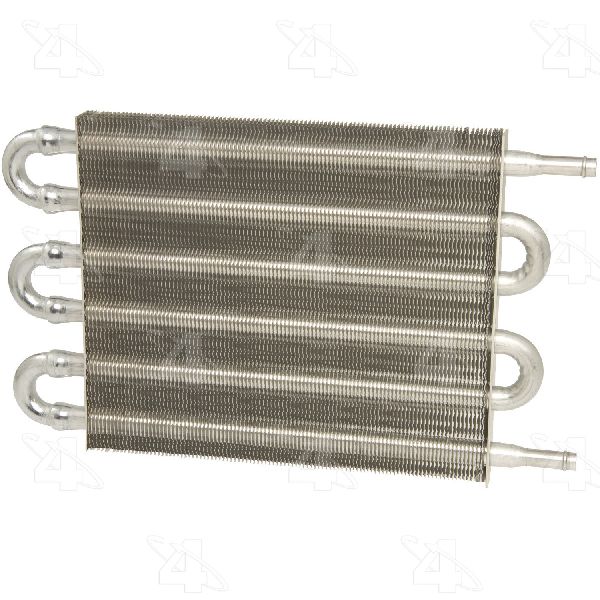
Typical fix: Perform multiple (3-4) drain-and-fill procedures (NOT a power flush) using only Honda Genuine ATF-DW1 🎬 See this step-by-step guide for changing your transmission fluid. (or its predecessor ATF-Z1). This replaces a majority of the contaminated fluid. Some owners also install an inline magnetic filter on the cooler line to catch further debris. This is often a temporary fix if internal damage is already severe.
Est. part cost: $40-$120 - Failed Torque Converter Clutch (TCC) Solenoid or Linear Solenoid Assembly 🔴 High Probability → Shop Automatic Transmission Torque Converter Debris in the fluid is the number one killer of these solenoids. It clogs the fine mesh screens underneath them or causes the solenoids themselves to stick or fail electrically.
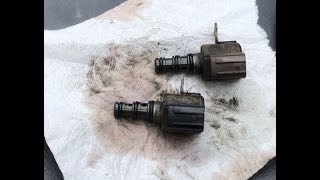
How to confirm: The solenoid(s) can be removed and tested for resistance with a multimeter. The spec is typically 12-25 Ohms. You can also apply 12V to check for an audible click. Most importantly, remove the solenoids and inspect the screens underneath them for black, gritty clutch material.
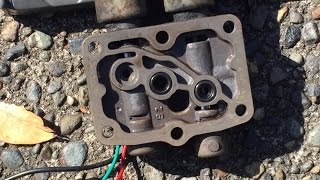
Typical fix: Replace the faulty TCC/Lock-Up solenoid or the entire linear solenoid assembly. 🎬 Watch: How to replace the linear solenoid assembly yourself. It is critical to also clean the mounting surface and any screens. Many owners attempt to just clean the screens, but if the transmission is shedding material, the problem will return.
Est. part cost: $100-$300 - Internal Transmission Failure (Torque Converter or Valve Body) 🔴 High Probability → Shop Transmission Assembly This is the well-documented weak point of this Odyssey generation, leading to a class-action lawsuit and a warranty extension (now expired). The torque converter fails internally, or the valve body passages become blocked with clutch material, starving components of lubrication and pressure.
How to confirm: This is often a diagnosis of exclusion. If multiple fluid changes and solenoid cleaning/replacement do not resolve the code, the problem is internal. A transmission pressure test can confirm a hydraulic fault. Finding significant metal debris in the transmission pan is a definitive sign of failure. An owner report in NHTSA ODI #10425779 noted that even after replacing the torque converter, the P0740 code returned, indicating the next step was a full transmission replacement.
Typical fix: Requires a complete transmission rebuild or replacement with a remanufactured unit. Rebuilds must include updates to address the original design flaws.
Est. part cost: $2000-$4000+ - Damaged Wiring or Connectors ⚪ Low Probability
How to confirm: Visually inspect the wiring harness going to the transmission solenoids for any signs of damage, corrosion, or loose connections. Use a multimeter to check for continuity and proper voltage at the solenoid connector per the factory service manual.
Typical fix: Repair or replace the damaged section of the wiring harness.
Est. part cost: $20-$150
Rare But Worth Checking
- Faulty Powertrain Control Module (PCM): → Shop Engine Control Module (ECM) This is extremely rare. The PCM should only be considered a potential cause after all other possibilities—fluid, solenoids, wiring, and the transmission itself—have been thoroughly ruled out. Honda did issue some service bulletins related to PCM replacement for shifting issues. In NHTSA ODI #10248080, an owner reported that a dealership first suggested replacing the ignition switch for a related code before addressing the P0740 transmission fault.
Diagnosis Steps
- Check the transmission fluid level and condition. If it is low, top it off with Honda ATF-DW1 and re-evaluate. If it is dark, burnt, or contains debris, a transmission failure is highly likely.
- Scan for any other transmission-related trouble codes. Address other codes first if they are present.
- Inspect the wiring harness and connectors leading to the transmission TCC solenoid for any visible damage, corrosion, or loose pins.
- Test the TCC solenoid's resistance using a multimeter. Compare the reading to the manufacturer's specification of 12-25 Ohms. A reading outside this range indicates a failed solenoid.
- If possible, command the TCC solenoid 'on' with a capable scan tool to check for an audible click and a change in engine RPM.
- Remove the TCC solenoid and the linear solenoid block. Carefully inspect their filter screens for metal shavings or black, gritty clutch material. Clogged screens are the 'smoking gun' for internal transmission wear.
- If fluid is clean and solenoids/wiring test good, the next step is to perform a transmission line pressure test to check for hydraulic issues. Low pressure points to internal blockages or a failing pump.
- If line pressure is low or erratic, and all external components are verified as good, the fault is internal to the transmission (likely the torque converter, valve body, or internal filter), requiring a rebuild or replacement.
Parts You'll Likely Need
- Torque Converter Clutch (TCC) / Lock-Up Solenoid Assembly
(OEM #28250-P6H-024)— This solenoid assembly is a frequent failure point, either electrically or by becoming clogged with debris from a deteriorating transmission. This part is often sold as a dual linear solenoid assembly.
Trusted brands: Honda (OEM), Standard Motor Products (SMP), Rostra
OEM price range: $200-$350
Aftermarket price range: $80-$200 - Honda Genuine Automatic Transmission Fluid (ATF-DW1)
(OEM #08200-9008)— Honda transmissions are notoriously sensitive to fluid type. Using the correct OEM fluid is critical. ATF-DW1 is the modern replacement for the older ATF-Z1 and is fully backward compatible.
Related Codes That Often Appear With This One
- P0730 — Incorrect Gear Ratio. This code often appears alongside P0740 when internal clutch pack slippage or hydraulic blockages are severe, indicating the transmission is failing mechanically. NHTSA ODI #10299659 describes a vehicle displaying P0740, P0730, and P1750 simultaneously at 166,000 miles.
- P0741 — Torque Converter Clutch Circuit Performance or Stuck Off. This is a more specific version of P0740, indicating the computer sees the lock-up clutch is not engaging when commanded. It's often used interchangeably as a symptom of the same underlying failure.
- P0780 — Shift Malfunction. This code points to a general shifting problem and frequently accompanies P0740 and P0730 when the transmission is in an advanced state of failure.
Technical Service Bulletins (TSBs) & Recalls
- Honda TSB 04-021: While not directly for P0740, this was a safety recall concerning heat buildup and potential gear failure in 2002-2004 Odyssey and 2003-2004 Pilot transmissions, highlighting the known durability issues of the era.
Platform-Specific Known Issues
- History of Transmission Failures and Lawsuits: → Shop Transmission Assembly The transmissions in this generation of Odyssey, Pilot, and Acura MDX were the subject of a class-action lawsuit due to their high rate of premature failure. Honda acknowledged the issue by extending the warranty to 7 years or 100,000 miles (and later 109,000 miles), but this has long since expired. The P0740 code is the most common indicator of this well-known failure in progress.
- 4-speed (1999-2001) vs. 5-speed (2002-2004) Transmissions: → Shop Transmission Assembly Both the 4-speed (B7XA) and 5-speed (BYBA/BGYA) automatics are affected. The failure mechanism is identical: torque converter clutch material degrades, contaminates the fluid, and clogs hydraulic circuits and solenoid screens. While both are problematic, the 5-speed units are particularly infamous for this issue.
- The 'Drain and Fill' vs. 'Flush' Debate: Nearly all experts and experienced owners strongly advise against using a pressurized or chemical transmission flush machine on these vehicles. The fear is that a flush can dislodge large chunks of debris, causing them to block critical passages instantly. The recommended procedure is a series of 3-4 simple 'drain and fills' with short drives in between to slowly dilute and replace the old fluid.
Mechanic-Grade Diagnostic Values
- Resistance of TCC / Lock-up Solenoid and Shift Solenoid A — expected: 12 - 25 Ohms. Failure: A reading outside this range, or an open/short circuit.
- Resistance of the Dual Linear Solenoid Assembly (28250-P6H-024) — expected: ~5.6 Ohms across the pins for each solenoid in the assembly.. Failure: A significantly different reading, or an open/short circuit.
- TCC Solenoid Valve Current (Live Scan Tool Data) — expected: Current should be active when lock-up is commanded.. Failure: Current is below 200mA for 5 or more seconds when lock-up should be engaged. This indicates a circuit or solenoid fault and will trigger the P0740 code.
Scan Tool Commands That Help
- Honda HDS (or equivalent professional scanner): TCC Solenoid On/Off Test — Use this bidirectional command to manually activate the TCC solenoid while monitoring engine RPM. A slight drop in RPM should occur when the solenoid is commanded ON, indicating it is mechanically functioning. Lack of RPM change suggests a stuck solenoid or a hydraulic blockage.
- Honda HDS (or equivalent professional scanner): Data Monitor — Before performing a diagnostic drive cycle, use the data monitor to ensure the transmission fluid temperature ('FLUID TEMP') is above 10°C (50°F) as required by the Honda diagnostic procedure.
Wiring & Ground Locations
- G101 — On the intake manifold support bracket.. This is a primary ground point for the Powertrain Control Module (PCM). A poor connection at G101 can cause erratic PCM behavior and trigger false circuit codes, including P0740.
- G1 — On the transmission housing.. This is the main ground for the transmission case itself. Corrosion or a loose connection here can affect the electrical return path for all transmission solenoids, leading to circuit malfunction codes.
Real Owner Repair Stories
- YouTube user 'Fix Odyssey P0740... Part 2' (1999 Honda Odyssey) — P0740 code returned after 1.5 years, accompanied by a new, serious hard shift from 1st to 2nd gear.
❌ Tried (didn't work) An earlier fix of cleaning the top-mounted solenoids and adding an inline filter worked temporarily but the problem came back., Cleaning the ATF filter again provided only brief relief.
✅ What actually fixed it Replacing the two shift solenoids (A and B) located underneath the starter motor immediately and completely resolved the hard shifting and the associated P0740 code. - YouTube user 'Bundy's Garage' (Honda/Acura V6 with P0740 (used a solenoid from a '01 Odyssey)) — Violent, jolting shift from 1st to 2nd and 2nd to 3rd that would chirp the tires. Code P0740 was present.
❌ Tried (didn't work) Testing the old solenoid by applying 12V power. The solenoid still produced an audible 'click', incorrectly suggesting it was functional.
✅ What actually fixed it Replacing the entire dual linear solenoid assembly (part no. 28250-P6H-024) completely fixed the hard shifting problem. The key takeaway was that a solenoid can pass a simple click test and still be bad. - Reddit user 'Dirty_Old_Town' (former Honda dealer tech) (2000 Honda Odyssey) — P0740 code returned less than 10k miles after a transmission flush, with intermittent rough 1-2 shifts.
❌ Tried (didn't work) A transmission drain/flush and cleaning of a solenoid filter provided only a temporary fix.
✅ What actually fixed it This is a story of diagnosis, not a final fix by the owner. The tech explained the common failure path: the TCC friction material breaks down and clogs hydraulic passages. The official diagnostic path after confirming fluid level and pressure is to replace the TCC solenoid valve, then re-test. If the code returns, the torque converter and/or transmission must be replaced. - NHTSA ODI #10499235 — An owner reported that after the P0740 code appeared, the transmission continued to malfunction with flares between shifts from gears 2-3 and 3-4, and occasionally failing to shift entirely.
- NHTSA ODI #10465677 — A driver experienced the check engine light and a flashing TCS light; the P0740 diagnosis indicated a torque converter lockup malfunction where the vehicle would not shift into the highest gear at freeway speeds and would shudder.
"I Checked Everything" — The Actual Cause
- A common diagnostic trap for this P0740 code is relying on a simple electrical test of the solenoid. In one documented case, the original linear solenoid assembly passed the test of applying 12V power, producing an audible 'click' which would lead many to believe it was working correctly. However, the solenoid was internally faulty and was not functioning correctly under actual load and fluid pressure. Replacing the 'clicking' solenoid assembly was the repair that ultimately fixed the severe shifting issues.
OEM Part Supersession History
28250-P6H-004→28250-P6H-024— Updated design for the Dual Linear Solenoid Assembly.Honda ATF-Z1→Honda ATF-DW1 (08200-9008)— ATF-DW1 is a newer, lower viscosity, full-synthetic fluid developed for improved performance, especially in cold temperatures, and better fuel economy.
Heads up: ATF-DW1 is fully backward-compatible and can be mixed with ATF-Z1. However, mixing dilutes the performance advantages of the newer DW1 fluid. It is recommended to perform several drain-and-fills to replace as much of the old fluid as possible.
Model Year Variations Within This Range
- 1999-2004: While the primary linear solenoid (28250-P6H-024) is used across many V6 models, some owners report slight physical differences in the solenoid's housing or base. It is a best practice to visually compare the new part to the original part before installation to ensure an exact match.
- 1999-2001 vs 2002-2004: As noted in Pass 2, 1999-2001 models use a 4-speed automatic (B7XA), while 2002-2004 models use a 5-speed (BYBA/BGYA). While both are prone to this failure, the underlying cause (torque converter clutch material shedding) and the primary external solenoids involved in the P0740 code are very similar.
Diagnostic Flowchart
Real Owner Stories
Aggregated from forums and TSBs cited above. Mileages and costs reflect what owners reported in those sources.
Honda Odyssey
Symptoms: Received a P0740 TCS Transmission Problem code.
What fixed it: Attempted a DIY fix by cleaning the solenoid filters, installing an external inline ATF magnetic filter, and performing a triple fluid change.
Source hint: Odyclub.com - 'Fix Odyssey P0740 TCS Transmission Problem' (YouTube)
Acura TL — ~150000 miles
Symptoms: Triggered the P0740 code, which owners noted almost always signals the beginning of the end for the transmission.
What fixed it: Identified that clutch material was clogging the TCC solenoid screen; consensus was that transmission replacement is ultimately required.
Source hint: Acurazine.com - 'P0740 code... death of transmission?'
1999 Honda Odyssey
Symptoms: Check engine light came on with the dreaded P0740 code.
What fixed it: Recommended cleaning the solenoids as a last-ditch effort before committing to a full transmission replacement.
Source hint: Reddit.com/r/MechanicAdvice - 'Just got a check engine light... P0740 (1999 Honda Odyssey)'
1999-2001 Honda Odyssey (4-speed)
Symptoms: Received a P0740 Torque Converter Clutch Circuit Malfunction code.
What fixed it: Determined that the non-serviceable internal filter was plugged with clutch material, leading to eventual failure requiring a rebuild.
Source hint: Honda-Tech.com - 'P0740 Torque Converter Clutch Circuit Malfunction'
Related OBD-II Codes
Frequently Asked Questions
Is the P0740 code covered under the Honda transmission warranty extension for my 1999-2004 Odyssey?
Should I get a transmission flush to fix the P0740 code on my Odyssey?
Does Honda TSB 04-021 apply to my P0740 code?
What transmission fluid should I use when doing a drain-and-fill on my 2002 Odyssey?
I have a 1999 Odyssey with a 4-speed transmission. Is it less prone to P0740 than the 5-speed?
Can I just clean the TCC solenoid screens to permanently fix P0740?
Helpful Videos
We Have This Part in Stock

The information in this article is provided for general reference and educational purposes only. Vehicle specifications, procedures, and part compatibility can vary by production date, trim level, and region. Always consult your vehicle's factory service manual and verify part numbers before purchasing or performing repairs. Safety-critical components such as airbags, seat belts, and braking systems should be installed by a qualified professional.
- Honda Odyssey:
- 🧭 Diagnostic Flowchart
- 🎬 Helpful Videos
- 🛍️ Shop This Part
- What's Unique About the 1999-2004 Honda Odyssey
- Symptoms You May Notice
- Most Likely Causes
- Rare But Worth Checking
- Diagnosis Steps
- Parts You'll Likely Need
- Related Codes That Often Appear With This One
- Technical Service Bulletins (TSBs) & Recalls
- Platform-Specific Known Issues
- Mechanic-Grade Diagnostic Values
- Scan Tool Commands That Help
- Wiring & Ground Locations
- Real Owner Repair Stories
- "I Checked Everything" — The Actual Cause
- OEM Part Supersession History
- Model Year Variations Within This Range
- Real Owner Stories
- Honda Odyssey
- Acura TL — ~150000 miles
- 1999 Honda Odyssey
- 1999-2001 Honda Odyssey (4-speed)
- Related OBD-II Codes
- Frequently Asked Questions
- 🎟️ Get 5% Off