

P0740 on 2005-2010 Pontiac G6: Torque Converter Clutch Circuit Malfunction Causes and Fixes
This code means an electrical fault in the torque converter clutch (TCC) circuit. The most likely cause is a failed TCC solenoid inside the transmission. On many G6 models with the 4-speed automatic (4T45-E), this is a very difficult repair requiring removal and partial disassembly of the transmission. Before condemning internal parts, check for the common GM issue of a faulty ignition switch, especially if other transmission codes are present.
- P0740 is an electrical fault code for the Torque Converter Clutch circuit, most often caused by a failed TCC solenoid.
- Before suspecting internal parts, always check the transmission fluid level and condition, and inspect for external wiring damage.
- If you have multiple transmission solenoid codes (e.g., P0753, P0758) along with P0740, the problem may be a faulty ignition switch, not the transmission itself.
- On the common 4-speed automatic G6 models, replacing the TCC solenoid is a major repair that requires removing the transmission.
- Due to the complexity and potential for causing more damage, professional diagnosis and repair are strongly recommended for this code.
What's Unique About the 2005-2010 Pontiac G6
The Pontiac G6 was equipped with several automatic transmissions, most commonly the 4-speed 4T45-E or the 6-speed 6T40/6T45. On the very common 4-speed 4T45-E, the Torque Converter Clutch (TCC) solenoid is located on the valve body, which is accessed through a side cover, not the bottom pan. Replacing it is a labor-intensive job that often requires lowering the subframe and removing the driver's side wheel and axle shaft to get enough clearance. This makes the repair significantly more complex and expensive than on many other vehicles where solenoids are accessible by simply removing the transmission pan. 🎬 Watch: This walkthrough shows the complex side cover removal process. Because of this, a thorough diagnosis of external wiring, fluid condition, and especially the ignition switch is critical before condemning the solenoid.
Symptoms You May Notice
- Check Engine Light is on
- Reduced fuel economy
- Vehicle shudders or vibrates at highway speeds, like driving over rumble strips
- Engine RPMs fluctuate or are higher than normal while cruising at a steady speed
- Harsh or delayed gear shifts
- Stalling when coming to a stop
- Transmission may feel like it's slipping or not locking into top gear
- A very important note for GM vehicles of this era: If P0740 appears alongside other transmission solenoid codes (P0753, P0758, P0785) and especially P1860, the root cause is often a faulty ignition switch, not an internal transmission problem. The ignition switch provides power to the transmission solenoids via a specific circuit, and a failure can cut power intermittently, triggering multiple codes simultaneously. Owners report that other electrical issues, like inoperative gauges, may also be present.
Most Likely Causes
- Faulty Torque Converter Clutch (TCC) Solenoid 🔴 High Probability → Shop Automatic Transmission Torque Converter The solenoid is an electro-hydraulic valve located inside the hot transmission that operates constantly, making it a common failure point over time.
How to confirm: A technician can command the solenoid on/off with a high-end scan tool to check its operation. It can also be tested for correct electrical resistance with a multimeter (typically 10-11 ohms for this type of solenoid), but this requires accessing the transmission connector or the solenoid itself.
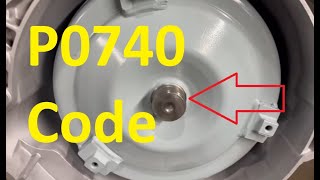
Typical fix: Replace the TCC solenoid. 🎬 Watch: A mechanic explains how to fix the P0740 code. On 4-speed 4T45-E models, this requires accessing the valve body through the side cover of the transmission. On 6-speed models, it may also be in the valve body, accessible via the side cover.
Est. part cost: $40-$100 - Low or Degraded Transmission Fluid 🟡 Medium Probability → Shop Transmission Assembly Many G6 models do not have a traditional transmission dipstick, making it difficult for owners to check the fluid level and condition regularly. Old, burnt, or low fluid can cause solenoids to stick or operate poorly and can lead to overheating.
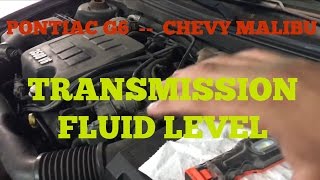
How to confirm: The fluid level must be checked via a plug on the side of the transmission case while the vehicle is running, level, and at a specific temperature (typically 180-200°F or at least 104°F). 🎬 See how to check fluid levels on the 2.4L engine. The fluid should be bright red and not smell burnt. Dark or metallic-flecked fluid indicates a more serious internal problem.
Typical fix: Perform a transmission fluid drain and fill, or a full fluid exchange, using the correct specification fluid (DEXRON-VI).
Est. part cost: $60-$150 - Damaged Wiring or Connectors ⚪ Low Probability The wiring harness to the transmission is exposed to road debris, moisture, and engine/exhaust heat, which can cause wires to break, chafe, or connectors to corrode over time.
How to confirm: Visually inspect the wiring harness leading to the transmission for any signs of damage. Test for continuity and shorts in the TCC solenoid circuit between the TCM connector and the transmission connector using a multimeter and the vehicle's wiring diagram.
Typical fix: Repair or replace the damaged section of the wiring harness or the main transmission connector.
Est. part cost: $20-$200
Rare But Worth Checking
- Failing Torque Converter: → Shop Automatic Transmission Torque Converter Although P0740 is an electrical circuit code, a mechanical failure inside the torque converter can shed debris that clogs passages or damages the solenoid, causing the electrical fault. In some cases, even with a circuit code, the root cause is a bad torque converter.
- Faulty Transmission Control Module (TCM) or Powertrain Control Module (PCM): → Shop Engine Control Module (ECM) It is rare for the control module to fail, but the internal driver circuit for the TCC solenoid can burn out. This should be the last item to consider after all other possibilities have been exhausted.
Diagnosis Steps
- Check the transmission fluid level and condition. This is a critical first step. Note that the G6 may not have a dipstick and requires a specific procedure using a fill plug.
- Scan for other trouble codes. If multiple solenoid codes (P0753, P0758, etc.) are present with P1860, investigate the ignition switch circuit as a primary suspect before inspecting the transmission.
- Inspect the main transmission wiring harness and connector for any visible damage, corrosion, or loose pins.
- Using a professional scan tool, monitor the TCC command status (On/Off or Duty Cycle %) and TCC slip RPM to see if the computer is attempting to lock the converter. A healthy system should show slip RPM drop to below 50 RPM when lockup is commanded.
- Using a wiring diagram and a digital multimeter, check for proper voltage and ground at the transmission connector for the TCC circuit.
- Test the resistance of the TCC solenoid through the connector to see if it is within the manufacturer's specified range (typically 10-11 ohms at room temperature). An open (infinite resistance) or shorted (near zero resistance) reading indicates a failed solenoid or internal wiring.
- If all external wiring, the ignition switch, and signals are good, the problem is internal to the transmission, most likely the TCC solenoid itself or the internal harness.
Parts You'll Likely Need
- Torque Converter Clutch (TCC) Solenoid
(OEM #ACDelco 24227792 (check specific application))— This solenoid is the most common component to fail within the TCC circuit, triggering the P0740 code.
Trusted brands: ACDelco, Delphi, Rostra
OEM price range: $60-$120
Aftermarket price range: $40-$80 - Ignition Switch
(OEM #ACDelco D1462G (check specific application))— A known weak point on this GM platform that can cut power to the transmission solenoids and mimic an internal transmission fault.
Trusted brands: ACDelco, Standard Motor Products
OEM price range: $30-$50
Aftermarket price range: $20-$40 - Transmission Fluid
(OEM #ACDelco 10-9395 (DEXRON-VI))— Fluid must be replaced when servicing internal transmission components, and fresh fluid can sometimes resolve issues caused by degradation.
Trusted brands: ACDelco DEXRON-VI
OEM price range: $10-$15 per quart
Aftermarket price range: $8-$12 per quart - Transmission Side Cover Gasket — Required when replacing the TCC solenoid on the 4T45-E transmission, as the side cover must be removed.
Trusted brands: ACDelco, Fel-Pro
OEM price range: $25-$40
Aftermarket price range: $15-$30
Related Codes That Often Appear With This One
- P0741 — P0741 indicates 'TCC System Stuck Off'. While P0740 is an electrical circuit fault, P0741 is a performance fault. They can appear together if the circuit issue prevents the clutch from engaging.
- P1860 — This is a GM-specific code for 'TCC PWM Solenoid Circuit Electrical'. If seen with P0740 and other solenoid codes, it strongly points towards a shared power or ground issue, such as a faulty ignition switch.
- P0700 — This is a generic code indicating the Transmission Control Module (TCM) has requested the check engine light be turned on. It will always be present with a more specific transmission code like P0740.
Technical Service Bulletins (TSBs) & Recalls
- GM TSB 01-07-30-038F: This bulletin addresses multiple transmission codes, including P0740, and points to a faulty ignition switch as a possible cause when multiple solenoid codes are set simultaneously. It also discusses checking for terminal issues at the transmission connector.
- GM TSB 08-07-30-023B: Discusses diagnostic aids for P0740 and other TCC-related codes on various GM transmissions, emphasizing checking for proper fluid level and condition before proceeding to component replacement.
Platform-Specific Known Issues
- A recall (14V252000) was issued for the transmission shift cable on 2008-2010 G6 models with a 4-speed transmission. While not directly related to P0740, it highlights a known issue with transmission components on this platform.
Mechanic-Grade Diagnostic Values
- TCC PWM Solenoid Resistance (4T45-E) — expected: 10 - 11 ohms at 20°C (68°F). Failure: A reading significantly outside this range, or showing open (infinite) or shorted (near zero), indicates a failed solenoid.
- TCC Slip Speed (Scan Tool Data) — expected: Should drop to below 50 RPM when TCC lockup is commanded and functioning correctly.. Failure: The PCM may set code P0740 if it sees a slip of more than 200 RPM between the torque converter and the input shaft when lockup is commanded. Consistently high slip RPM during commanded lockup points to a hydraulic or mechanical issue.
Scan Tool Commands That Help
- Tech2 / GDS2 or equivalent professional scanner: TCC Solenoid Command / TCC System Test — This bidirectional control allows a technician to manually command the TCC solenoid on, off, or modulate its duty cycle while monitoring live data like TCC Slip RPM. If the solenoid can be commanded on and the slip RPM drops accordingly, it suggests the solenoid and hydraulic circuit are likely functional, pointing the diagnosis toward a wiring or TCM control issue.
Wiring & Ground Locations
- TCM Location — On most G6 models, the Transmission Control Module (TCM) is located in the engine compartment, to the left of the engine, near the driver's side strut tower.. This is the starting point for testing the TCC solenoid circuit. Technicians need to access the TCM connector to test for voltage, ground, and continuity of the wires going to the transmission.
- G105 / G106 — These are key ground points. G105 is on a left rear engine-to-transmission stud. G106 is on a front transmission stud for 3.5L/3.6L engines. A poor ground at these locations can cause numerous electrical and transmission issues.. A faulty ground can cause erratic voltage in control circuits, leading the TCM to incorrectly flag a circuit malfunction for the TCC solenoid.
- Splice #107 (Pink Wire) — In the wiring harness conduit located directly above the transmission oil cooler lines. The splice is about 13 inches forward from where the harness breaks out to the transmission.. This splice provides power to the transmission solenoids. The conduit can hold water, causing the splice to corrode and become non-conductive, which cuts power to the solenoids and can trigger P0740 and other codes.
- 20-Pin Transmission Connector (4T45-E) — The main round connector on the transmission case.. The TCC Solenoid is controlled via pins on this connector. Specifically, Pin E is often the ignition voltage feed (Pink wire), and Pin U is the TCC solenoid control wire (Tan/Black wire) from the TCM. Testing for voltage, ground, and resistance is done at these pins.
Real Owner Repair Stories
- GM-Tech forum user (2000 GMC Savana with 4L60E (similar GM electrical strategy)) — Check Engine Light with code P0740. Van seemed to run and shift fine otherwise.
❌ Tried (didn't work) A transmission shop verified the code but could not find the problem after initial diagnosis.
✅ What actually fixed it The owner had recently replaced the Vehicle Control Module (VCM/PCM). The pin for the TCC solenoid wire had been pushed back out of the main connector when it was plugged in, causing an open circuit. Reseating the pin properly in the VCM connector resolved the P0740 code. - YouTube Commenter (Unknown GM vehicle) — P0700 and P0740 codes appearing after a transmission and torque converter replacement.
❌ Tried (didn't work) Replacing transmission and torque converter., Checking fluid levels.
✅ What actually fixed it The problem was ultimately resolved by replacing the ECU (Engine Control Unit, likely the PCM/TCM).
OEM Part Supersession History
24212690→24227792— Standard part evolution, likely for improved durability or material changes.
Heads up: The new part number (24227792) is the correct service replacement for the old one.
Model Year Variations Within This Range
- 2005-2010: The G6 used multiple transmissions. Base and GT models with the 2.4L and 3.5L V6 typically used the 4-speed 4T45-E. Higher-trim (GTP/GXP) and later-year models could have a 6-speed automatic (6T40 or 6T70, especially with the 3.6L V6). The 3.9L V6 used the 4T65-E. The difficult side-cover access for solenoid replacement is characteristic of the 4T45-E. Diagnosis and repair procedures can vary significantly between these transmissions.
- 2009-2010: A mid-cycle refresh for '2009.5' models included revised styling and dashboard electronics, including updated radios. While not directly affecting the P0740 cause, be aware of potential wiring or module differences in these later cars when diagnosing.
Diagnostic Flowchart
Used vs. New Parts: Buying Guide for This Vehicle
When a used part is the smart pick: A used wiring harness from a low-mileage donor car can be a cost-effective fix if your original harness has physical damage or corrosion. A complete used valve body assembly with solenoids can also be an option, but it carries the risk of having the same wear issues (like worn bores) as your original.
Donor-vehicle mileage cap: roughly under 80000 miles for the part to have meaningful remaining life.
What to inspect on the donor part:
- For a wiring harness, inspect for any cuts, melted sections, or corrosion on the connector pins.
- For a valve body, ask the seller if the solenoids were tested. Look for signs of heavy sludge or burnt fluid residue.
- Check the donor vehicle's history if possible to ensure it wasn't involved in a front-end collision that could have damaged the transmission or wiring.
OEM-only on this vehicle (don't cheap out):
- Transmission Control Module (TCM): While aftermarket options exist, a new or remanufactured OEM module programmed with the correct VIN is the most reliable way to avoid software compatibility issues.
Aftermarket brands forum-validated for this vehicle:
- Solenoids: ACDelco (OEM), Standard Motor Products (SMP), Rostra, ATP are reputable.
- Valve Body Repair: Sonnax is the industry standard for kits that fix common valve body wear issues like worn TCC apply valve bores.
Brands owners have reported issues with on this vehicle:
- Unbranded, no-name solenoid 'kits' from online marketplaces can have high failure rates. Given the high labor cost for replacement, it's not worth the risk.
Real Owner Stories
Aggregated from forums and TSBs cited above. Mileages and costs reflect what owners reported in those sources.
2006 Pontiac G6 GTP 3.9L — 186000 miles
Symptoms: The transmission was in limp mode with code P0700, and after a short time, it began slipping, especially when cold. It then started making noise and would fail to engage drive or reverse until the car was shut off and restarted.
What fixed it: A transmission mechanic diagnosed the issue as a likely failure of the torque converter and transmission pump.
Source hint: GM Forum
2008 Pontiac G6
Symptoms: The Check Engine Light came on, and a scan revealed code P0740.
What fixed it: The issue was identified as a faulty TCC solenoid, which is difficult to access on the side of the transmission.
Cost: $800-$1000
Source hint: G6OwnersClub.com - P0740 TCC Solenoid Issue
Pontiac G6 (platform-wide issue)
Symptoms: The vehicle displayed code P0740 along with a group of other solenoid codes, such as P0753, P0758, P0785, and P1860.
What fixed it: The problem was traced back to the ignition switch cutting power to the transmission, not an internal transmission failure. Replacing the ignition switch resolved all codes.
Source hint: GM-Trucks.com - P0740, P0753, P0758, P0785 and P1860 discussion
Related OBD-II Codes
Frequently Asked Questions
My G6 has code P0740 and a bunch of other transmission codes like P0753 and P1860. What's the first thing I should check?
How do I check the transmission fluid on my 2005-2010 Pontiac G6? I can't find a dipstick.
Is replacing the TCC solenoid for a P0740 code an easy DIY job on my G6?
What is the expected repair cost for a P0740 on a Pontiac G6?
Is there a transmission-related recall for my 2009 G6?
What is the correct electrical resistance for the TCC solenoid on a G6?
Helpful Videos



We Have This Part in Stock

The information in this article is provided for general reference and educational purposes only. Vehicle specifications, procedures, and part compatibility can vary by production date, trim level, and region. Always consult your vehicle's factory service manual and verify part numbers before purchasing or performing repairs. Safety-critical components such as airbags, seat belts, and braking systems should be installed by a qualified professional.
- Pontiac G6:
- 🧭 Diagnostic Flowchart
- 🎬 Helpful Videos
- 🛍️ Shop This Part
- What's Unique About the 2005-2010 Pontiac G6
- Symptoms You May Notice
- Most Likely Causes
- Rare But Worth Checking
- Diagnosis Steps
- Parts You'll Likely Need
- Related Codes That Often Appear With This One
- Technical Service Bulletins (TSBs) & Recalls
- Platform-Specific Known Issues
- Mechanic-Grade Diagnostic Values
- Scan Tool Commands That Help
- Wiring & Ground Locations
- Real Owner Repair Stories
- OEM Part Supersession History
- Model Year Variations Within This Range
- Used vs. New Parts: Buying Guide for This Vehicle
- Real Owner Stories
- 2006 Pontiac G6 GTP 3.9L — 186000 miles
- 2008 Pontiac G6
- Pontiac G6 (platform-wide issue)
- Related OBD-II Codes
- Frequently Asked Questions
- 🎟️ Get 5% Off