

P0741 on 2009-2012 Toyota RAV4 2.5L: Torque Converter Clutch Failure Causes and Fixes
On a 2009-2012 RAV4 2.5L with the U760E transmission, code P0741 is a serious issue often pointing to an internal transmission problem. A specific Toyota TSB (T-SB-0007-11) suggests the cause is likely a failed torque converter or the entire transmission, a repair costing thousands. Less common causes include a bad TCC solenoid (SLU/DSL) or old fluid.
- P0741 on a 2009-2012 RAV4 2.5L is a serious code that should be diagnosed promptly.
- There is a Toyota Service Bulletin (T-SB-0007-11) that points directly to a faulty torque converter or transmission as the most likely cause, not just a simple solenoid.
- Diagnosis requires professional-level tools and may involve removing the transmission for inspection.
- Driving with this code can lead to transmission overheating and catastrophic failure.
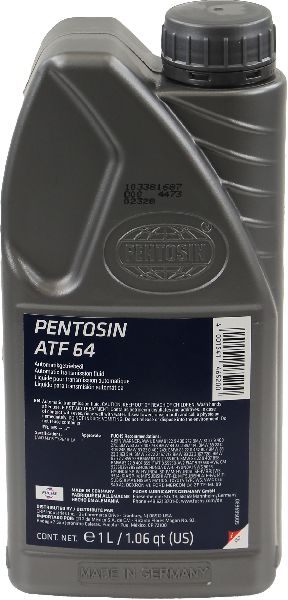
- Always use Toyota ATF WS fluid for any service on this transmission.
What's Unique About the 2006-2012 Toyota RAV4
For the 2009-2011 RAV4 with the 2.5L 2AR-FE engine and U760E automatic transmission, Toyota issued a Technical Service Bulletin (T-SB-0007-11) specifically for code P0741. This bulletin indicates a known issue where the ECM detects excessive slip. The diagnostic procedure requires removing the transmission to inspect an oil seal on the stator shaft. If the seal is damaged, only the torque converter is replaced. If the seal is intact, the TSB instructs technicians to replace the entire remanufactured transaxle and torque converter assembly, making this code particularly serious and potentially expensive for this vehicle.
Generation note: The specified year range 2006-2012 covers the entire third generation (XA30) RAV4. However, the 2AR-FE 2.5L engine and U760E transmission were only available from the 2009-2012 model years. This guide specifically applies to those 2009-2012 models. The TSB T-SB-0007-11 specifically covers model years 2009-2011.
Symptoms You May Notice
- Check Engine Light is on (VSC and traction control lights may also illuminate)
- Reduced fuel efficiency
- Engine RPM is higher than usual at highway speeds
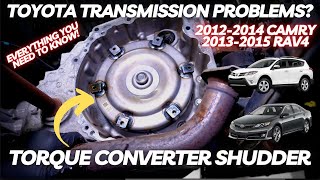
- Vehicle shudders or vibrates at cruising speeds, similar to driving over rumble strips 🎬 Watch: Understanding torque converter shudder and how to identify it.
- Transmission may feel like it's slipping or shifting incorrectly
- In some cases, the vehicle may stall after driving at highway speeds
- Inability to shift into the highest gear at highway speeds
- Difficulty shifting from first to second gear or lagging when accelerating out of a turn
- Replacing only the TCC solenoid without considering the high probability of a failed torque converter as per TSB-0007-11. While the solenoid can be the cause, ignoring the TSB can lead to a repeat repair, especially if the fluid is clean and the solenoid tests within spec.
Most Likely Causes
- Failed Torque Converter or Internal Seal 🔴 High Probability → Shop Automatic Transmission Torque Converter A known issue documented in Toyota Technical Service Bulletin T-SB-0007-11 for 2009-2011 RAV4s with the 2AR-FE engine. This is the most likely cause if the fluid is in good condition.
How to confirm: Following the TSB, a technician must remove the transmission and inspect the torque converter clutch oil seal on the stator shaft for damage (cuts or tears). If the seal is damaged, the torque converter is the confirmed fault. If the seal is okay, the TSB directs replacement of the entire transmission assembly as the fault is presumed to be internal to the transaxle.
Typical fix: Replace the torque converter assembly. In cases where the seal is not damaged, as directed by the TSB, the entire transmission must be replaced with a remanufactured unit.
Est. part cost: $900-$1400 for an OEM torque converter, $2000-$4000 for a remanufactured transmission. - Low or Dirty Transmission Fluid 🟡 Medium Probability → Shop Transmission Assembly Fluid breaks down over time, losing its hydraulic properties and causing components like solenoids and valves to stick. Debris can clog fine passages in the valve body or solenoids, preventing proper TCC operation.
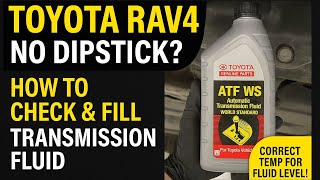
How to confirm: Check the transmission fluid level and condition. The fluid should be at the correct level, pink/red in color, and not smell burnt. This vehicle does not have a dipstick, so the check must be performed via the fill and overflow plugs on the transmission case while the vehicle is running at a specific temperature. 🎬 See this guide for checking fluid on no-dipstick transmissions.
Typical fix: Perform a transmission fluid drain-and-fill using the correct fluid (Toyota ATF WS). A full flush is generally not recommended on higher-mileage vehicles where service history is unknown, as it can dislodge debris and cause more issues.
Est. part cost: $60-$120 for fluid. - Faulty Torque Converter Clutch (TCC) Solenoid 🟡 Medium Probability → Shop Automatic Transmission Torque Converter
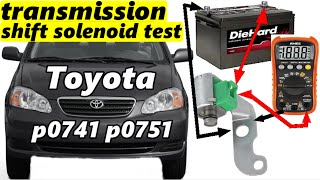
How to confirm: The solenoid, called 'Shift Solenoid Valve DSL' or 'SLU' by Toyota, can be tested with a multimeter for proper resistance (approx. 11-13 Ohms at 68°F). 🎬 Watch: Official Toyota procedure for testing the TCC solenoid. A professional can also command it on/off using a scan tool to see if it functions and makes an audible click.
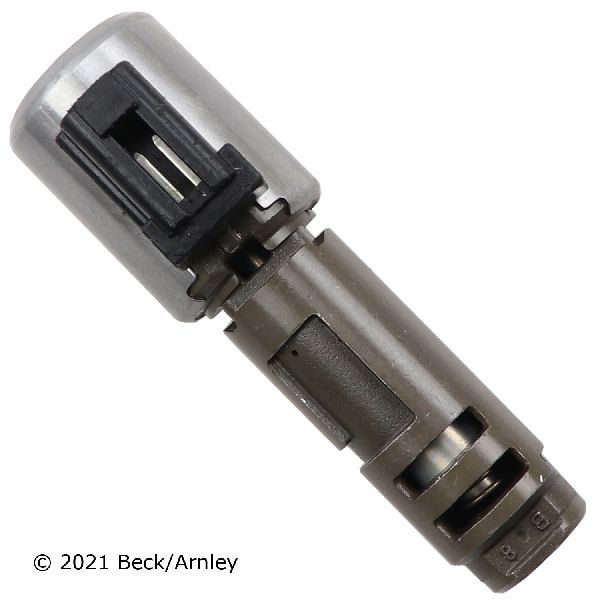
Typical fix: Replace the TCC/DSL/SLU solenoid. This requires draining the fluid, removing the transmission oil pan, and accessing the valve body where the solenoid is located. This is often attempted first due to lower cost, but may not solve the issue if the root cause is the torque converter itself.
Est. part cost: $50-$150 for the solenoid. - Damaged Wiring or Electrical Connector ⚪ Low Probability
How to confirm: Visually inspect the wiring harness going to the transmission for any signs of damage, corrosion, or loose connections. A mechanic can perform a continuity test from the ECM connector to the transmission connector.
Typical fix: Repair or replace the damaged section of the wiring harness or the connector.
Est. part cost: $20-$200 depending on the extent of damage.
Rare But Worth Checking
- Failing Transmission Valve Body: → Shop Transmission Valve Body Internal passages can get clogged with debris from old fluid, or a valve can stick, preventing the hydraulic pressure needed to engage the TCC. This is less common than a single solenoid failure but can happen on high-mileage vehicles.
Diagnosis Steps
- Check and verify the transmission fluid level and condition. The fluid must be clean, at the proper level (checked via overflow plug at operating temperature), and of the correct type (Toyota ATF WS).
- Use a professional scan tool like Toyota Techstream to check for any other related trouble codes and review freeze frame data. As noted in NHTSA ODI #11579413, P0741 often appears alongside codes like P2714 and P2757.
- Perform an 'Active Test' with the scan tool to command the TCC solenoid (DSL/SLU) on and off while driving at highway speed (over 36 mph / 60 km/h). Observe if the engine RPM drops slightly when commanded ON, indicating a successful lock-up. The ECM is looking for a slip of less than 35 RPM when locked.
- If the active test fails or the code returns, inspect the transmission wiring harness for damage. Test the resistance of the TCC/DSL/SLU solenoid at the connector. It should be within 11-13 ohms.
- If the solenoid and wiring test good, the issue is likely internal. At this point, the procedure in TSB-0007-11 should be followed, which involves removing the transmission for inspection of the torque converter and its seal.
Parts You'll Likely Need
- Torque Converter Assembly
(OEM #32000-42070)— This is the most likely point of failure according to Toyota's own service bulletin (T-SB-0007-11) for this specific vehicle and code.
Trusted brands: Toyota (OEM), Aisin
OEM price range: $900-$1400
Aftermarket price range: $200-$400 - Automatic Transmission Fluid WS
(OEM #00289-ATFWS)— Required for any repair involving draining the transmission, such as replacing the solenoid, torque converter, or the entire unit.
Trusted brands: Toyota (OEM), Aisin, Idemitsu, Valvoline MaxLife
OEM price range: $12-$20 per quart
Aftermarket price range: $8-$15 per quart - Torque Converter Clutch (TCC) Solenoid / Shift Solenoid SLU
(OEM #35280-06020)— A common cause for P0741 across many vehicles. It's an electro-hydraulic valve that controls fluid flow for the lock-up clutch and can fail electrically or mechanically.
Trusted brands: Toyota (OEM), Rostra, Aisin
OEM price range: $100-$200
Aftermarket price range: $40-$90
Related Codes That Often Appear With This One
- P2757 — This code for 'Torque Converter Clutch Pressure Control Solenoid Control Circuit Performance' often appears with P0741, as they both relate to the hydraulic control of the lock-up system. NHTSA ODI #11723306 confirms that these codes frequently appear together when there is a torque converter-related failure.
Technical Service Bulletins (TSBs) & Recalls
- T-SB-0007-11: Addresses a MIL ON condition with DTC P0741 for 2009-2011 RAV4s. The repair procedure involves inspecting the torque converter seal and potentially replacing the torque converter or the entire transaxle assembly.
Platform-Specific Known Issues
- Toyota TSB T-SB-0007-11 was issued for 2009-2011 RAV4 models with the 2AR-FE engine due to a pattern of P0741 codes caused by internal torque converter or transmission failures.
Mechanic-Grade Diagnostic Values
- Shift Solenoid Valve (DSL/SLU) Resistance — expected: 11 to 13 Ohms at 20°C (68°F). Failure: A reading outside this range, or an open/short circuit, indicates a faulty solenoid coil.
- TCC Slip RPM (Live Data) — expected: Near 0 RPM difference between engine speed (NE) and input turbine speed (NT) when lock-up is commanded ON.. Failure: A difference of more than 100 RPM when lock-up is commanded ON will trigger the DTC. A difference of less than 35 RPM when lock-up is commanded OFF can also trigger the code, indicating it's stuck on.
- Stall Speed Test — expected: Approximately 2,550 RPM. Failure: A significantly higher or lower RPM can indicate internal transmission or torque converter issues.
Hidden / Shadow Codes Worth Checking
- Check Mode: This is a scan-tool-driven function that puts the ECM/TCM into a high-sensitivity mode. Faults that might normally take two or more drive cycles to set a code will set immediately upon detection. This is useful for verifying a fix or confirming an intermittent fault. (see via Accessible via Toyota Techstream software. Activating it erases previously stored codes and freeze-frame data.)
Scan Tool Commands That Help
- Toyota Techstream: Active Test: 'Control the Lock-Up' — This test is critical for diagnosing P0741. It allows a technician to manually command the TCC solenoid (DSL) ON and OFF while driving over ~36 mph. By observing live data (Engine RPM vs. Turbine Speed NT), the technician can confirm if the solenoid is electrically functional and if the hydraulic circuit/clutch is capable of engaging. A lack of RPM drop when commanded ON points directly to a mechanical or hydraulic failure, rather than an electrical one.
Wiring & Ground Locations
- B30 ECM Connector — Located at the Engine Control Module in the engine bay.. This is a primary connector for testing the wiring harness continuity between the ECM and the transmission solenoid.
- B32 Electronically Controlled Transmission Solenoid Connector — The main electrical connector on the transmission case that houses the circuits for all internal solenoids.. This is the external point for testing the resistance of the internal TCC (DSL/SLU) solenoid without removing the transmission pan.
- E1 / E4 Ground Points — E1 is typically located in the left kick panel area; E4 is in the right kick panel area.. These are major body ground points. While not directly for the transmission, poor grounds in these locations can cause a variety of electrical issues and module communication problems that could potentially affect transmission operation.
Real Owner Repair Stories
- Reddit user on r/Toyota (2012 Toyota Camry 2.5L (U760E transmission)) — Jerky 2-3 shift. After resetting transmission adaptive values, the shifting became smooth but Check Engine Light came on with codes P0741 and P2757.
❌ Tried (didn't work) Resetting transmission adaptive values (this fixed the shift feel but revealed the underlying TCC codes).
✅ What actually fixed it The user was advised that the issue was likely caused by old, degraded transmission fluid that was preventing the TCC solenoid from functioning correctly after the adaptive memory was cleared. The recommended fix, starting with the least invasive step, was a transmission fluid and filter change. - NHTSA ODI #11128737 — An owner reported that the vehicle struggled when shifting from first to second and lagged when turning and accelerating simultaneously. The transmission felt like it was "pushing the max" to reach highway speeds before the P0741 code appeared.
- NHTSA ODI #11384226 — One owner noted that after the P0741 code appeared, they were told by a service advisor that if the car wasn't "broken," they shouldn't fix it, highlighting the confusion some owners face when this code appears without catastrophic failure.
OEM Part Supersession History
35280-48030→35280-06020— Standard part revision and consolidation by the manufacturer.
Heads up: The new part number 35280-06020 is the correct service replacement. Some sources also show 35280-06010 as a prior number. Always verify with VIN.
Model Year Variations Within This Range
- 2009-2011 vs 2012: The specific Technical Service Bulletin (T-SB-0007-11) from Toyota for the P0741 code only lists the 2009-2011 model years. While the 2012 model uses the same 2AR-FE engine and U760E transmission and is known to suffer from the same issues, it is not officially covered by this specific TSB. The underlying problem and repair are generally considered identical.
Diagnostic Flowchart
Other Known Issues on This Vehicle
Issues unrelated to this code that are worth knowing about as an owner of this generation:
- Excessive Oil Consumption 🟠 Medium — More prevalent on the earlier 2AZ-FE (2.4L) engine, but the 2AR-FE (2.5L) can also consume oil, especially with high mileage or extended oil change intervals. Caused by low-tension piston rings getting stuck. (Ref: A warranty enhancement program (ZE7) was issued for the 2AZ-FE, but not formally for the 2AR-FE.)
- Intermediate Steering Shaft Clunk/Noise 🟡 Low — A very common issue where a clunking or popping noise is heard and felt in the steering wheel when turning. Typically occurs at lower speeds. (Ref: T-SB-0318-08 was issued for 2006-2008 models, but the issue is known to affect later years as well. The fix is to replace the intermediate steering shaft.)
- Water Pump Failure 🟠 Medium — The water pump can be prone to leaking coolant, often noticeable by pink residue around the pump area or a sweet smell after driving. Failure can occur anywhere from 60,000 miles onward.
- Rear Suspension Arm Corrosion 🔴 High — Affects vehicles in regions with road salt. The rear tie rods/suspension arms can corrode, leading to alignment issues and a risk of failure. (Ref: Subject of multiple safety recalls. Owners should verify that the recall service has been performed.)
Used vs. New Parts: Buying Guide for This Vehicle
When a used part is the smart pick: Due to the U760E's known history of torque converter and internal failures, buying a used transmission or torque converter is a significant gamble. It only makes sense if the donor vehicle is known to be a low-mileage, well-maintained car that was wrecked for non-drivetrain reasons. A used part is a very short-term, budget-only option where the understanding is it may fail again.
Donor-vehicle mileage cap: roughly under 80000 miles for the part to have meaningful remaining life.
What to inspect on the donor part:
- Verify the donor vehicle's VIN to confirm it wasn't subject to repeated transmission complaints.
- Inspect the transmission fluid from the donor unit if possible. It should be bright red/pink and not smell burnt.
- Look for a clear warranty from the salvage yard (e.g., 90 days) to protect against an immediate failure.
- Ask for the maintenance history of the donor vehicle if available.
OEM-only on this vehicle (don't cheap out):
- Torque Converter
- Transmission Assembly
Aftermarket brands forum-validated for this vehicle:
- Aisin (often the OEM supplier for Toyota)
- Certified Transmission (remanufacturer, addresses known factory flaws)
- ETE Reman (remanufacturer, offers 3-year unlimited mile warranty)
- Drivetrain Direct (distributor of remanufactured units with upgraded torque converters)
Brands owners have reported issues with on this vehicle:
- Unbranded, no-name rebuilt units from small, unknown shops without a comprehensive, nationwide warranty.
- Any 'rebuilt' unit that only replaces failed parts, rather than a fully 'remanufactured' one that replaces all wear items and incorporates updates.
Real Owner Stories
Aggregated from forums and TSBs cited above. Mileages and costs reflect what owners reported in those sources.
2009 Toyota RAV4 2.5L
Symptoms: The user experienced a P0741 code and sought advice on replacing the Torque Converter Clutch Solenoid for the U140 transmission. They received a high quote for a full transmission replacement.
What fixed it: The discussion highlighted that the torque converter itself is the likely failure point rather than just the solenoid, echoing the TSB findings.
Source hint: RAV4World - '2009 RAV4 Torque Converter Clutch Solenoid Replacement'
2007 Toyota RAV4 2.4L AWD
Symptoms: DTC P0741 was present; the diagnostic process involved using a scan tool to monitor slip RPM and manually commanding the TCC solenoid to check for operation.
What fixed it: The professional technician emphasized that proper diagnosis using a scan tool to monitor slip is required to avoid the common mistake of simply replacing parts.
Source hint: ScannerDanner - '2007 Toyota RAV4 2.4L Engine AWD DTC P0741'
Documented NHTSA Reports
NHTSA ODI #11596407 describes a persistent P0741 fault code indicating the torque converter clutch circuit is underperforming or stuck off. In another case, NHTSA ODI #11723306 notes that a vehicle was towed to a mechanic where P0741 was retrieved alongside several other codes including P2757, all related to the torque converter.
Related OBD-II Codes
Frequently Asked Questions
Does TSB T-SB-0007-11 apply to my 2012 RAV4 with the 2.5L engine?
Can I just replace the TCC solenoid (DSL/SLU) to fix P0741 on my RAV4?
How do I check the transmission fluid on my 2006-2012 RAV4 to see if it's causing the code?
What is the 'Active Test' mentioned for diagnosing P0741 in the 2AR-FE?
If the torque converter seal is damaged on my 2010 RAV4, what is the recommended repair?
What happens if the torque converter seal is NOT damaged but I still have P0741?
Helpful Videos

We Have This Part in Stock

The information in this article is provided for general reference and educational purposes only. Vehicle specifications, procedures, and part compatibility can vary by production date, trim level, and region. Always consult your vehicle's factory service manual and verify part numbers before purchasing or performing repairs. Safety-critical components such as airbags, seat belts, and braking systems should be installed by a qualified professional.
- Toyota RAV4:
- 🧭 Diagnostic Flowchart
- 🎬 Helpful Videos
- 🛍️ Shop This Part
- What's Unique About the 2006-2012 Toyota RAV4
- Symptoms You May Notice
- Most Likely Causes
- Rare But Worth Checking
- Diagnosis Steps
- Parts You'll Likely Need
- Related Codes That Often Appear With This One
- Technical Service Bulletins (TSBs) & Recalls
- Platform-Specific Known Issues
- Mechanic-Grade Diagnostic Values
- Hidden / Shadow Codes Worth Checking
- Scan Tool Commands That Help
- Wiring & Ground Locations
- Real Owner Repair Stories
- OEM Part Supersession History
- Model Year Variations Within This Range
- Other Known Issues on This Vehicle
- Used vs. New Parts: Buying Guide for This Vehicle
- Real Owner Stories
- 2009 Toyota RAV4 2.5L
- 2007 Toyota RAV4 2.4L AWD
- Documented NHTSA Reports
- Related OBD-II Codes
- Frequently Asked Questions
- 🎟️ Get 5% Off