

P0746 on 2015-2020 Honda Fit: CVT Pressure Solenoid 'A' Performance Causes and Fixes
P0746 on a 2015-2020 Honda Fit usually points to a problem with the CVT's hydraulic pressure, often caused by old, low, or dirty CVT fluid. The first step is always to check and change the fluid and filters. If that doesn't work, the issue is likely a faulty pressure control solenoid or a clogged valve body, which is a more complex repair. In many cases on this platform, the root cause is debris clogging passages, not just a failed solenoid.
- P0746 is a serious transmission code on your Honda Fit that should be addressed immediately to prevent catastrophic CVT failure.
- The most common and simplest first step is to check and replace the CVT fluid with genuine Honda HCF-2 fluid.
- Due to the sensitivity of CVTs and the common issue of clogged valve bodies on this platform, professional diagnosis is strongly recommended if a fluid change doesn't solve the problem.
- Do not drive the vehicle with this code, as you risk turning a potentially manageable repair into one that requires a full transmission replacement.
What's Unique About the 2015-2020 Honda Fit
The 2015-2020 Honda Fit is part of the third generation (GK series) and uses a CVT. While the P0746 code can point to a failed solenoid on any vehicle, on modern Hondas with CVTs, the issue is frequently caused by clogged fluid passages within the transmission valve body. This means that simply replacing the solenoid might not fix the problem if the underlying cause is debris or sludge from degraded fluid restricting flow. Therefore, fluid condition and maintenance history are especially critical on this platform, and a valve body cleaning or replacement is a more common repair than on other vehicles.
Symptoms You May Notice
- Check Engine Light is illuminated
- Flashing 'D' (Drive) indicator on the dashboard
- Harsh, erratic, or delayed shifting
- Transmission slipping (engine RPMs increase but vehicle speed does not)
- Vehicle enters 'limp mode' (may feel stuck in one gear)
- Poor or sluggish acceleration
- Increased fuel consumption
- Transmission may overheat, potentially triggering a temperature warning light
- Replacing the solenoid without addressing fluid quality. If dirty fluid caused the original solenoid to fail or get stuck, it will likely cause the new one to fail as well.
- Assuming the entire transmission has failed. While this code is serious, the fault is often limited to the hydraulic control system (fluid, solenoids, valve body) and may not require a full transmission replacement if caught early.
- Replacing only the solenoid when the valve body passages are clogged. On this platform, the clog is often the root cause, and a new solenoid won't fix the pressure restriction.
Most Likely Causes
- Low, Degraded, or Incorrect CVT Fluid 🔴 High Probability CVTs are extremely sensitive to fluid condition. Old fluid loses its properties and can lead to sludge and varnish, clogging the very small passages in the valve body and solenoids.
How to confirm: Check the CVT fluid level and condition. The fluid should be at the correct level, translucent, and not smell burnt or contain visible debris. Honda specifies its own CVT fluid (HCF-2), and using anything else can cause issues.
Typical fix: Perform a CVT fluid drain and fill using only Honda HCF-2 fluid. It is often recommended to do this process multiple times (drain-and-fill three times) to exchange a higher percentage of the old fluid. Replace the external CVT filter as well.
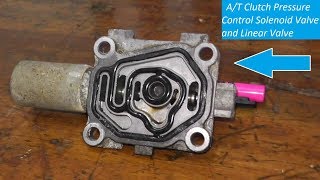
Est. part cost: $50-$150 for fluid and filter - Faulty Pressure Control Solenoid 'A' 🟡 Medium Probability → Shop Transmission Valve Body The solenoid is an electro-mechanical part that can fail over time due to an internal electrical fault (bad coil) or a mechanical issue (plunger stuck from debris).
How to confirm: A technician can test the solenoid's resistance with a multimeter and compare it to the manufacturer's specification (typically 3-10 ohms). A bi-directional scan tool can also command the solenoid on and off to check for an audible click. This requires accessing the solenoid on the valve body.
Typical fix: Replace the faulty solenoid. The solenoids are located on the transmission valve body, requiring removal of the transmission pan and sometimes the valve body itself to access.
Est. part cost: $100-$300 for the solenoid - Clogged Hydraulic Passages or Faulty Valve Body 🟡 Medium Probability → Shop Transmission Valve Body As noted, debris from normal wear or degraded fluid can clog the very small and complex passages within the valve body, restricting pressure even if the solenoid is functional. This is a known issue on Honda CVTs of this era.
How to confirm: This is difficult to confirm without ruling out other causes first. If new fluid and a new solenoid do not fix the issue, the valve body is the next logical suspect. Inspection may reveal sludge or scoring on the bores.
Typical fix: The valve body may be removed for a thorough cleaning by a specialist, or more commonly, replaced as an assembly.
Est. part cost: $500-$1200 for a valve body assembly
Rare But Worth Checking
- Wiring or Connector Issues: The wiring harness to the transmission can become damaged, or connectors can corrode, leading to a loss of signal to the solenoid. A visual inspection of the harness is always a worthwhile step.
- Faulty Transmission Control Module (TCM): → Shop Transmission Assembly While rare, the TCM itself can fail, sending incorrect signals or no signal at all. This is typically diagnosed only after all other possibilities have been exhausted and wiring has been confirmed to be good.
- Clogged Internal CVT Strainer/Filter: Besides the external filter, there is an internal strainer (filter) located inside the transmission pan, attached to the valve body. If this becomes clogged with debris, it can starve the entire system of fluid pressure. It should be replaced if the pan is dropped. The part number is 25420-5T0-003.
Diagnosis Steps
- Check and document any other stored trouble codes.
- Check the CVT fluid level and condition. If it is low, dark, burnt-smelling, or contains debris, this is a critical finding. Note: The 2015-2020 Fit requires Honda HCF-2 fluid.
- If the fluid is suspect, perform a drain and fill (or multiple, if necessary) with HCF-2 fluid and replace the external paper cartridge filter. Clear the codes and test drive to see if the code returns.
- If the code returns, inspect the wiring and connector at the transmission for any visible damage, corrosion, or loose connections.
- If wiring is intact, the transmission pan must be removed to access the valve body and solenoids.
- Inspect the pan for excessive metal shavings or clutch material, which would indicate a severe internal failure requiring a rebuild or replacement.
- While the pan is off, replace the internal transmission strainer (Part No. 25420-5T0-003).
- Test the resistance of Pressure Control Solenoid 'A' and compare it to the manufacturer's specifications (typically 3-10 Ohms).
- If possible, use a bi-directional scanner to command the solenoid and check for an audible click or change in state. 🎬 Watch: How to test and replace the pressure control solenoid
- If the solenoid is confirmed to be faulty, replace it. If the solenoid tests good, the issue is likely a blockage in the valve body or a larger internal problem, requiring professional diagnosis or valve body replacement.
Parts You'll Likely Need
- CVT Fluid (HCF-2)
(OEM #08200-HCF2)— Correct and clean fluid is the most critical component for CVT health and the first step in addressing this code.
Trusted brands: Honda Genuine
OEM price range: $15-$25 per quart
Aftermarket price range: N/A (OEM is strongly recommended) - CVT Internal Strainer Assembly
(OEM #25420-5T0-003)— This internal filter can become clogged with debris, causing pressure issues. It is best practice to replace it whenever the transmission pan is removed for service.
Trusted brands: Honda Genuine
OEM price range: $130-$180
Aftermarket price range: N/A - CVT Pressure Control Solenoid / Valve Body Assembly
(OEM #28250-5T0-003 (Solenoid A))— If the fluid change does not resolve the issue, the solenoid or the entire valve body assembly it's attached to is the most likely hardware failure.
Trusted brands: Honda Genuine
OEM price range: $450-$700 for solenoid, $800-$1200 for valve body
Aftermarket price range: $300-$800
Related Codes That Often Appear With This One
- P0747 — This code is for 'Pressure Control Solenoid 'A' Stuck On,' the opposite of P0746. Seeing them together or intermittently could indicate an erratic solenoid or a significant hydraulic blockage causing unpredictable behavior.
- P0776 — This code relates to 'Pressure Control Solenoid 'B' Stuck Off.' Seeing multiple solenoid codes together often points towards a more systemic issue like widespread fluid contamination, a failing valve body, or a faulty TCM.
- P0868 — This code indicates 'Transmission Fluid Pressure Low.' It is a more general code that often accompanies P0746, as the stuck-off solenoid is the cause of the low pressure condition.
Platform-Specific Known Issues
- A user on a Honda forum with a 2016 Fit experienced P0746 along with shuddering. Multiple CVT fluid drain-and-fills did not solve the problem. The dealer ultimately replaced the entire valve body assembly under warranty, which resolved the code and drivability issues.
- On FitFreak.net, a popular Honda Fit forum, a 2015 Fit owner reported the P0746 code appearing at around 90,000 miles. The owner performed three consecutive drain-and-fills with Honda HCF-2 fluid, which fixed the problem. This highlights the importance of starting with fluid maintenance before replacing parts.
Mechanic-Grade Diagnostic Values
- CVT Drive Pulley Pressure Control Solenoid Valve Resistance — expected: 4.6 to 6.3 Ohms. Failure: A reading outside this range indicates a faulty solenoid coil.
- General Honda Pressure Control Solenoid Resistance — expected: 3 to 10 Ohms. Failure: A reading outside this range suggests an electrical fault in the solenoid.
Scan Tool Commands That Help
- Honda Diagnostic System (HDS): Clear A/T DTCs — Used to reset the TCM after a repair or to see if a code is intermittent or persistent after a test drive.
- Honda Diagnostic System (HDS): A/T Test: Clutch Pressure Control (Linear) Solenoid A — This is a specific function to actively test the solenoid's operation without having to remove it from the vehicle. It helps isolate a faulty solenoid from a wiring or TCM issue.
- Professional Scan Tool / HDS: Active Test: Forcibly change shift position — While driving, a technician can command specific gear shifts. Comparing the commanded gear with the actual gear helps confirm mechanical or hydraulic problems within the transmission.
Wiring & Ground Locations
- G1 / G3 — On the transmission housing.. These are the main ground points for the transmission. A poor ground here can cause erratic behavior in all transmission solenoids and sensors, leading to incorrect pressure readings and codes like P0746.
- G2 — On the engine block.. This is a primary engine ground. While less direct, a poor engine ground can introduce electrical noise that may affect the PCM/TCM and its control over the transmission.
- Solenoid Wire Harness 8P Connector — Internal to the transmission, connecting the main harness to the valve body solenoids.. This is the direct electrical connection to the solenoids. A break or corrosion in this internal harness can cause a P0746 code even if the solenoid and external wiring are perfectly fine. It is a critical, but often overlooked, point of failure.
- PCM Connector C — One of the main connectors at the Powertrain Control Module (PCM).. This connector contains the pins that send the control signal to the pressure control solenoid. Testing for continuity and voltage at this connector is essential for diagnosing a wiring fault between the PCM and the transmission.
Real Owner Repair Stories
- YouTube channel @oficinacambauto3147 (2016-2017 Honda Fit with CVT) — All gear position indicator lights (P, R, N, D) were flashing on the dashboard.
❌ Tried (didn't work) Replacing the external transmission range switch (selector switch)., Swapping in a known-good valve body assembly for testing.
✅ What actually fixed it The problem was a broken wire in the internal transmission wiring harness (the 'rabicho') that connects the main harness pass-through to the valve body solenoids. Replacing this short internal harness resolved all symptoms and codes. - NHTSA ODI #11702634 — An owner of a Honda vehicle reported diagnostic results showing P0746 (Pressure Control Solenoid A Performance/Stuck Off) alongside P0741, P0780, and P1898, indicating systemic CVT pressure control issues.
- NHTSA ODI #10638514 — A Honda owner reported that despite normal fluid levels, the transmission was diagnosed as completely failed with DTC codes P0741, P0746, and P0777.
- NHTSA ODI #10609124 — An owner reported that shortly after a fluid level check, multiple transmission solenoids were reported as failed, specifically citing P0746 (Pressure Control Solenoid "A" Performance/Stuck Off) and P0777.
Model Year Variations Within This Range
- 2018-2020: A minor model refresh occurred for the 2018 model year, which included cosmetic updates, better sound insulation, and the addition of the Honda Sensing safety suite. However, the core powertrain components, including the 1.5L engine and the CVT, remained fundamentally the same as the 2015-2017 models. Therefore, diagnostic and repair procedures for code P0746 are consistent across the entire 2015-2020 range.
Diagnostic Flowchart
Other Known Issues on This Vehicle
Issues unrelated to this code that are worth knowing about as an owner of this generation:
- Premature Starter Motor Failure 🔴 High — Commonly fails between 45,000 and 70,000 miles, particularly on the 2015 model year. Symptoms include a single click with no crank.
- Faulty Push-Button Start Switch 🟠 Medium — Affects EX/EX-L trims. The car may not start on the first press of the button, displaying a 'Keyless Start System Error.' (Ref: Honda TSB 20-098 (Warranty Extension to 9 years/125,000 miles))
- VTC Actuator Rattle on Cold Start 🟠 Medium — A brief, loud rattling or grinding noise for 1-2 seconds upon a cold engine start. Caused by a faulty VTC actuator on the camshaft. (Ref: Honda TSB 16-088 addresses this for 2015-16 models.)
- Direct Injection Carbon Buildup 🟠 Medium — As a direct-injection-only engine, carbon can build up on intake valves over time, leading to misfire codes (P0300-P0304). Onset can be as early as 30,000 miles. (Ref: Honda TSB 21-007 provides a procedure for diagnosis and cleaning.)
- Fuel Injector Failures 🟠 Medium — Faulty fuel injectors can cause rough idling, misfires, and trigger a P0420 code incorrectly. This was noted as an issue on 2015-2016 models. (Ref: Warranty extensions have been issued for fuel injectors on certain 2015-16 models.)
Used vs. New Parts: Buying Guide for This Vehicle
When a used part is the smart pick: For this specific repair, using used parts is generally not recommended. The only exception might be a complete transmission assembly from a very low-mileage, verified rear-end collision vehicle, but even this carries significant risk.
Donor-vehicle mileage cap: roughly under 30000 miles for the part to have meaningful remaining life.
What to inspect on the donor part:
- Verify the donor vehicle's mileage and accident history (e.g., via VIN).
- If possible, drain a small amount of CVT fluid from the donor unit. It must be bright, translucent, and free of burnt smell or metallic shimmer.
- Avoid any parts from flood-damaged vehicles, as water intrusion is catastrophic for a CVT.
- Inspect all electrical connectors for corrosion, bent pins, or damage.
OEM-only on this vehicle (don't cheap out):
- CVT Fluid (HCF-2): The use of anything other than genuine Honda HCF-2 fluid is a primary cause of CVT problems and failure. Do not use aftermarket or 'universal' fluids.
- Pressure Control Solenoids and Valve Body: Due to the extreme sensitivity to fluid contamination and the high failure rate from debris, installing a used valve body or solenoid is a major gamble. A new OEM part ensures clean passages and correct electronic specifications.
Brands owners have reported issues with on this vehicle:
- Any brand of CVT fluid other than Honda Genuine HCF-2.
- Unbranded, no-name solenoids or valve bodies from online marketplaces, as their quality control, calibration, and cleanliness are highly questionable.
Real Owner Stories
Aggregated from forums and TSBs cited above. Mileages and costs reflect what owners reported in those sources.
2015 Honda Fit — 90000 miles
Symptoms: The P0746 code appeared.
What fixed it: The owner performed three consecutive drain-and-fills with Honda HCF-2 fluid, which resolved the problem.
Source hint: FitFreak.net, a popular Honda Fit forum, as cited in vehicle_specific_issues
2016 Honda Fit
Symptoms: Experienced P0746 along with shuddering. Multiple CVT fluid drain-and-fills did not solve the problem.
What fixed it: The dealer replaced the entire valve body assembly under warranty, which resolved the code and drivability issues.
Source hint: A user on a Honda forum, as cited in vehicle_specific_issues
Documented NHTSA Reports
Honda Owner Report — NHTSA ODI #11702634
Symptoms: Diagnostic results showed P0741 (Torque Converter Clutch Circuit Performance/Stuck Off), P0780 (Shift Malfunction), P0746 (Pressure Control Solenoid A Performance/Stuck Off), and P1898 (CVT Drive Pulley Pressure Control Valve Stuck ON/OFF).
Honda Owner Report — NHTSA ODI #10638514
Symptoms: The transmission was reported to have completely failed even though fluid levels were normal. DTC codes present were P0741, P0746, and P0777.
Honda Owner Report — NHTSA ODI #10609124
Symptoms: Shortly after receiving a "green light" on fluid levels, the transmission solenoids were reported failed with codes P0746 (Pressure Control Solenoid "A" Performance/Stuck Off), P0777, and P0741.
Related OBD-II Codes
Frequently Asked Questions
What specific CVT fluid does my 2015-2020 Honda Fit require for a P0746 service?
My mechanic is suggesting a valve body replacement for P0746. Is this a common failure on these cars?
I'm planning to drop the transmission pan to inspect the solenoid. Is there anything else I should replace while I'm in there?
Should I try changing the CVT fluid before replacing the pressure control solenoid?
I have a 2017 Honda HR-V with a P0746 code. Is the diagnostic information for the Fit applicable?
How can I test the Pressure Control Solenoid 'A' myself?
Helpful Videos
We Have This Part in Stock

The information in this article is provided for general reference and educational purposes only. Vehicle specifications, procedures, and part compatibility can vary by production date, trim level, and region. Always consult your vehicle's factory service manual and verify part numbers before purchasing or performing repairs. Safety-critical components such as airbags, seat belts, and braking systems should be installed by a qualified professional.
- Honda Fit:
- 🧭 Diagnostic Flowchart
- 🎬 Helpful Videos
- 🛍️ Shop This Part
- What's Unique About the 2015-2020 Honda Fit
- Symptoms You May Notice
- Most Likely Causes
- Rare But Worth Checking
- Diagnosis Steps
- Parts You'll Likely Need
- Related Codes That Often Appear With This One
- Platform-Specific Known Issues
- Mechanic-Grade Diagnostic Values
- Scan Tool Commands That Help
- Wiring & Ground Locations
- Real Owner Repair Stories
- Model Year Variations Within This Range
- Other Known Issues on This Vehicle
- Used vs. New Parts: Buying Guide for This Vehicle
- Real Owner Stories
- 2015 Honda Fit — 90000 miles
- 2016 Honda Fit
- Documented NHTSA Reports
- Honda Owner Report — NHTSA ODI #11702634
- Honda Owner Report — NHTSA ODI #10638514
- Honda Owner Report — NHTSA ODI #10609124
- Related OBD-II Codes
- Frequently Asked Questions
- 🎟️ Get 5% Off