

P0751 on 2013-2016 Mazda CX-5: Shift Solenoid 'A' Causes and Fixes
On a 2013-2016 Mazda CX-5, code P0751 is most often caused by an internal transmission valve body issue, not just a bad solenoid. This is a known issue documented in Mazda Technical Service Bulletins. The fix typically involves replacing specific oil pressure switches on the valve body or, in severe cases, the entire assembly. This is a complex repair requiring transmission-specific knowledge.
- P0751 on a 2013-2016 CX-5 is a serious code that should be addressed immediately to prevent catastrophic transmission damage.
- The root cause is very likely an issue within the transmission valve body due to contamination, not just a single bad solenoid.
- Do not simply replace Shift Solenoid 'A'. The diagnosis must include checking for known TSBs and inspecting the entire valve body.
- This is a complex repair that is not recommended for most DIYers. Professional service is strongly advised.
- Always use the correct Mazda FZ specification transmission fluid when servicing.
What's Unique About the 2013-2016 Mazda CX-5

For the 2013-2016 CX-5 with the SKYACTIV-Drive automatic transmission (FW6A-EL), P0751 is frequently a symptom of a deeper problem, not just a simple solenoid failure. Mazda has issued multiple Technical Service Bulletins (TSBs) for this transmission that point to internal contamination causing oil pressure switches within the valve body to stick. While the TSBs may not always list P0751 directly, they address related codes for gear shifting errors (P0780) and stuck pressure switches (P0842, P0847) that stem from the same root cause and are often seen with P0751. Therefore, simply replacing Shift Solenoid 'A' often fails to fix the problem, as the root cause is a hydraulic control issue within the valve body assembly.
Symptoms You May Notice

- Check Engine Light and/or AT (Automatic Transmission) warning light is on
- Harsh, erratic, or delayed shifts, sometimes with a 'clunking' sound.
- Transmission gets stuck in one gear (limp mode).
- Inability to shift into certain gears
- Vehicle hesitates or 'crawls' during acceleration, especially uphill.
- Reduced fuel economy.
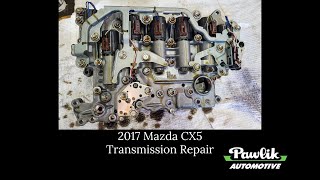
- Transmission overheating. 🎬 Watch: Troubleshooting guide for jerky shifts and slipping gears.
- Replacing only Shift Solenoid 'A' without addressing the underlying valve body contamination issue. The problem will likely return because the root cause (sticking pressure switches or contaminated fluid) was not resolved.
Most Likely Causes


- Internal Transmission Valve Body Failure (Sticking Pressure Switches) 🔴 High Probability → Shop Transmission Valve Body As documented in Mazda TSB 05-002/15 and its successors like 05-001/21, the SKYACTIV-Drive transmission is susceptible to internal contamination that causes oil pressure switches 'A' and/or 'B' to stick. This prevents correct hydraulic pressure routing, leading the TCM to flag a solenoid performance code like P0751.
How to confirm: After ruling out fluid and wiring issues, a technician will remove the transmission oil pan to access the valve body. Finding significant metallic debris in the pan is a strong indicator of widespread wear. The issue is confirmed by following the TSB diagnostic procedure, which often leads to replacing the oil pressure switches on the valve body.
Typical fix: Following the TSB, the most common professional repair is to replace the affected oil pressure switches (Part FZ01-21-2C0) on the valve body. In cases of severe contamination or if the valve body itself is damaged, the entire valve body assembly is replaced. A transmission fluid and filter change is mandatory, followed by a TCM re-learn procedure.
Est. part cost: $800-$1400 for an OEM valve body assembly, or ~$50 per pressure switch if replacing individually. - Low or Dirty Transmission Fluid 🟡 Medium Probability → Shop Transmission Assembly Dirty or degraded fluid is the source of the contamination that leads to the more serious valve body issues. This transmission does not have a dipstick, making fluid level and condition checks less frequent for many owners and leading to prolonged operation with contaminated fluid.
How to confirm: The fluid level must be checked via the fill plug with the vehicle level and at a specific temperature (approx. 122°F / 50°C). The fluid should be bright blue (for OEM FZ fluid) and clear. If it is dark, brown, smells burnt, or contains metallic particles, it is contaminated and has likely caused internal component issues.
Typical fix: Perform a complete transmission fluid drain and fill using only Mazda FZ specification fluid. If the code is already present due to a stuck component, a fluid change alone is unlikely to be a complete fix but is a necessary part of the repair.
Est. part cost: $80-$150 for OEM fluid. - Failed Shift Solenoid 'A' ⚪ Low Probability → Shop Transmission Valve Body While the code directly names the solenoid, it's more often a symptom on this platform. The solenoid itself can fail electrically or become mechanically stuck from the same debris that affects the pressure switches, but this is less probable than the wider valve body issue documented by Mazda.
How to confirm: After removing the transmission pan, a technician can test the solenoid's resistance with a multimeter (should be 5-7 ohms for linear solenoids) and check if it actuates ('clicks') when voltage is applied.
Typical fix: Replace the individual shift solenoid. This is typically done as part of a larger valve body service, but replacing it in isolation is not the recommended first step for this vehicle.
Est. part cost: $50-$150
Rare But Worth Checking
- Wiring Harness or Connector Damage: The wiring to the transmission is in a harsh environment. Check for any signs of corrosion, chafing, or damage to the main connector at the transmission case before beginning expensive internal repairs.
- Faulty Transmission Control Module (TCM): → Shop Transmission Assembly The TCM is integrated into the valve body on this transmission. While a failure of the control module itself is possible, it is very uncommon and should only be considered after all other mechanical, hydraulic, and wiring issues have been definitively ruled out by a professional.
Diagnosis Steps
- Verify the code with a reliable OBD-II scanner.
- Check for other stored transmission-related codes (e.g., P0780, P0842). A Reddit user with a 2013 CX-5 reported P0751 and P0780 appearing together when their car went into limp mode.
- Check the transmission fluid level and condition. This must be done at the correct operating temperature (around 122°F / 50°C). Note any burnt smell or discoloration.
- Inspect the transmission wiring harness and main connector for any visible damage, corrosion, or loose connections.
- Review Mazda TSBs 05-002/15 and its successors (like 05-001/21) to understand the known issue with valve body contamination and the specific repair path (TCM reprogram or pressure switch replacement).
- If the fluid is dirty or other TSB-related codes are present, the next step is to remove the transmission oil pan.
- Inspect the pan for excessive metal shavings or clutch material, which indicates a severe internal failure requiring a transmission rebuild or replacement. 🎬 Watch: Deep dive into common FW6A transmission internal failures.
- Inspect and test the components on the valve body, specifically the oil pressure switches as directed by the TSB.
- Based on findings, replace the faulty individual pressure switches or the entire valve body assembly.
- Install a new transmission filter, clean the pan, and reinstall with a new gasket and fresh, correct-spec (Mazda FZ) fluid.
- Perform the mandatory 'Initial Learning Procedure' with a compatible high-level scan tool.
Parts You'll Likely Need
- Transmission Valve Body
(OEM #FZ21-21-100J)— This is the most likely root cause of the problem on this specific vehicle, as it contains the solenoids and pressure switches that get stuck due to contamination. Multiple parts vendors confirm this part number for the CX-5 without turbo.
Trusted brands: Mazda (OEM)
OEM price range: $1100-$1400
Aftermarket price range: $600-$900 (Remanufactured) - Automatic Transmission Fluid (Mazda FZ)
(OEM #0000-FZ-113E-01)— New fluid is required anytime the transmission is serviced. Using the correct OEM-specification fluid is critical for the longevity of SKYACTIV transmissions. An owner on Mazdas247 confirmed this part number was used in their valve body replacement service.
Trusted brands: Mazda (OEM), Idemitsu ATF Type M
OEM price range: $20-$25 per quart
Aftermarket price range: $15-$20 per quart - Automatic Transmission Filter
(OEM #FZ01-21-500)— Should always be replaced when the transmission pan is removed for service, especially when contamination is the suspected cause of failure.
Trusted brands: Mazda (OEM)
OEM price range: $40-$60
Aftermarket price range: $20-$40
Related Codes That Often Appear With This One
- P0780 — P0780 indicates a 'Shift Malfunction'. This is a general code that often appears with more specific solenoid or pressure switch codes like P0751 because the underlying problem is preventing proper gear changes.
- P0842, P0847, P0872, P0877 — These are codes for stuck oil pressure switches within the same valve body. Their presence strongly supports the diagnosis of internal contamination as described in Mazda TSBs 05-002/15 and 05-001/21.
Technical Service Bulletins (TSBs) & Recalls
- CHECK ENGINE LIGHT AND A/T WARNING LIGHT ON WITH ONE OR MORE OF THESE DTCS (P0842, P0847, P0872, P0877, P0780) STORED IN TCM MEMORY: This is a key TSB that supersedes many previous versions. It states the cause is contamination causing oil pressure switches A and/or B in the valve body to get stuck. The repair procedure involves checking the TCM software version and, if it's updated, proceeding to replace the individual oil pressure switches (Part FZ01-21-2C0), not necessarily the entire valve body. It also notes that if significant foreign material is in the pan, the oil strainer should be replaced.
- A/T WARNING LIGHT ON WITH DTC P0780, P0842, P0847, P0872, P0877, P1738: This is a later bulletin that supersedes 05-002/15 and expands the model year range for affected vehicles, including the CX-5 up to 2021. It reiterates that the cause is stuck oil pressure switches due to contamination and outlines a repair procedure of either reprogramming the TCM or replacing the switches.
- Bulletin #05-003-14-2898A: This manufacturer bulletin notes that P0751:00 may be stored in memory alongside P1738 (Automatic Transaxle Internal Malfunction) and other pressure switch codes like P0842:00 and P0847:00.
- Bulletin #05-003-14-2898: An earlier manufacturer bulletin similarly identifies P0751:00 as a code that can be stored in conjunction with internal transaxle malfunctions and pressure switch circuit errors.
Platform-Specific Known Issues
- The SKYACTIV-Drive 6-speed automatic transmission (FW6A-EL) is known to be sensitive to fluid contamination, which leads to pressure switches and solenoids sticking inside the valve body, triggering this code and others like it. This is documented in several Mazda TSBs.
- Real Owner Experience: A user on the Mazdas247 forum with an early model CX-5 experienced a transmission failure where the car would not exceed 20mph. The dealer diagnosed the issue using the CEL codes and determined the valve body needed replacement. The repair involved replacing the valve body (part PEX2-21-C00, an older part number), a clamp, and Mazda FZ fluid, followed by a TCM 'relearn' procedure, which successfully fixed the car.
Mechanic-Grade Diagnostic Values
- Shift Solenoid 'A' (and other linear solenoids) resistance — expected: 5-7 ohms. Failure: A reading outside this range indicates a failed solenoid coil.
- On/Off Solenoid resistance — expected: 11-14 ohms. Failure: A reading outside this range indicates a failed solenoid coil.
- Voltage at Solenoid 'A' connector (Key On) — expected: ~12.6 V (Battery Voltage). Failure: Voltage significantly lower than battery voltage (greater than 0.5V drop) suggests a wiring or TCM power supply issue.
Scan Tool Commands That Help
- Mazda M-MDS (or compatible high-level scanner like FORScan): Initial Learning Procedure — This is mandatory after replacing the valve body or oil pressure switches. It allows the TCM to learn the hydraulic characteristics of the new components. Failure to perform this procedure can result in harsh shifts or persistent codes.
- High-level bidirectional scanner: Solenoid Activation Test (e.g., 'Activate Solenoid A') — This command manually energizes the solenoid, allowing a technician to listen for a 'click' and monitor pressure changes on a live data stream. It helps isolate a faulty solenoid from a wiring or TCM driver issue.
Wiring & Ground Locations
- G09 — Behind the instrument cluster.. This is a major ground distribution point for many in-cabin electronics, including modules that communicate with the TCM. A poor connection here can cause communication errors.
- G03 — Left front of the engine compartment.. This is a primary chassis ground in the engine bay. The TCM and transmission case rely on a clean chassis ground path back to the battery. Corrosion or a loose connection here can cause erratic behavior in the transmission's electronic controls.
- Transmission Case Ground — A large ground cable typically bolted from the transmission case to the vehicle's chassis/frame, often near the engine mount under the battery tray.. This is the main ground for the entire transmission assembly, including the internal TCM and all solenoids. A loose or corroded connection here is a critical failure point that can directly cause solenoid performance codes like P0751.
Real Owner Repair Stories
- Reddit user in /r/CX5 (2013 Mazda CX-5 with 127,000 miles) — Car went into limp mode during a road trip, bucking at low RPMs, and crawling very slowly up hills. Scanned codes P0751 and P0780.
❌ Tried (didn't work) The user did not report any attempted fixes before posting, but was considering dropping the transmission pan to investigate.
✅ What actually fixed it While the original poster did not follow up, another user in a similar thread with a 2015 CX-5 and code P0780 reported a successful fix with only a TCM reprogram and a transmission fluid flush, which cost $170 at a dealer. This aligns with the known TSB-related fixes. - NHTSA ODI #11596026: An owner reported that the check engine light came on along with the AT and traction lights, resulting in absolutely no power to the transmission; diagnostic codes P0780 and P0751 were present.
Model Year Variations Within This Range
- 2016.5: For the 2016.5 mid-year refresh, Mazda discontinued the 2.0L engine in automatic transmission base (GX) models, making the 2.5L engine standard. This does not directly affect the P0751 fault, as both engines used the same FW6A-EL transmission, but it is a key identifier for the later part of the model year range.
Diagnostic Flowchart
Used vs. New Parts: Buying Guide for This Vehicle
When a used part is the smart pick: A used valve body is generally NOT recommended for this repair. The primary cause of failure is fluid contamination, which means a used part from a junkyard likely suffers from the same or worse contamination unless it has been professionally remanufactured and tested. A remanufactured unit from a reputable supplier is a viable, cost-effective alternative to a new OEM part.
Donor-vehicle mileage cap: roughly under 50000 miles for the part to have meaningful remaining life.
What to inspect on the donor part:
- For a remanufactured unit, verify it comes with a warranty (1 year is common).
- Ensure the seller guarantees it has been tested and that all solenoids are verified to be within spec.
- Ask the seller to confirm that internal bores have been inspected for wear and that updated parts (like improved pressure switches) have been installed.
- Some sellers require you to send pictures of your original valve body to ensure the correct version is shipped.
OEM-only on this vehicle (don't cheap out):
- Transmission Fluid (Mazda FZ) - While some aftermarket fluids are now certified as FZ-compatible, using the OEM fluid eliminates any risk of incompatibility, which is critical in these sensitive transmissions.
Aftermarket brands forum-validated for this vehicle:
- Aisin ATF-MFZ (Fluid)
- Ravenol FZ (Fluid)
- Castrol Transmax ATF/CVT Universal (Fluid)
- Valvoline Max-Life Multi-Vehicle ATF (Fluid)
Brands owners have reported issues with on this vehicle:
- Universal or 'multi-vehicle' fluids that do not explicitly state they meet the Mazda FZ specification. Using a non-compliant fluid is highly risky, as factory remanufacturing facilities have noted transmission failures after being filled with incorrect red ATF.
Real Owner Stories
Aggregated from forums and TSBs cited above. Mileages and costs reflect what owners reported in those sources.
2013 Mazda CX-5
Symptoms: The car would not exceed 20mph.
What fixed it: The dealer replaced the valve body (part PEX2-21-C00), a clamp, and Mazda FZ fluid, then performed a TCM 'relearn' procedure.
Source hint: Mazdas247 forum user experience detailed in vehicle_specific_issues
2013 Mazda CX-5
Symptoms: Car went into limp mode.
What fixed it: The context notes the owner saw codes P0751 and P0780 together, but does not specify the final repair.
Source hint: Reddit user report mentioned in diagnosis_steps
Related OBD-II Codes
Frequently Asked Questions
My mechanic says the whole valve body needs to be replaced for a P0751 code. Is this always necessary on my CX-5?
What is the correct transmission fluid for my 2013-2016 Mazda CX-5?
Is the P0751 code on my CX-5 more likely a bad solenoid or something else?
Why is this transmission problem so common on the Mazda CX-5?
Do the Mazda TSBs for this issue apply to my 2016 CX-5?
After the parts are replaced, is the repair for P0751 complete?
Helpful Videos



We Have This Part in Stock




The information in this article is provided for general reference and educational purposes only. Vehicle specifications, procedures, and part compatibility can vary by production date, trim level, and region. Always consult your vehicle's factory service manual and verify part numbers before purchasing or performing repairs. Safety-critical components such as airbags, seat belts, and braking systems should be installed by a qualified professional.
- Mazda CX-5:
- 🧭 Diagnostic Flowchart
- 🎬 Helpful Videos
- 🛍️ Shop This Part
- What's Unique About the 2013-2016 Mazda CX-5
- Symptoms You May Notice
- Most Likely Causes
- Rare But Worth Checking
- Diagnosis Steps
- Parts You'll Likely Need
- Related Codes That Often Appear With This One
- Technical Service Bulletins (TSBs) & Recalls
- Platform-Specific Known Issues
- Mechanic-Grade Diagnostic Values
- Scan Tool Commands That Help
- Wiring & Ground Locations
- Real Owner Repair Stories
- Model Year Variations Within This Range
- Used vs. New Parts: Buying Guide for This Vehicle
- Real Owner Stories
- 2013 Mazda CX-5
- 2013 Mazda CX-5
- Related OBD-II Codes
- Frequently Asked Questions
- 🎟️ Get 5% Off