

P0756 on 1999-2004 Honda Odyssey: Shift Solenoid B Performance/Stuck Off Guide
P0756 on a 1999-2004 Odyssey indicates a problem with Shift Solenoid B. While the solenoid itself can fail, this code is often an early warning of the widespread transmission failures known to affect this generation. The first step is checking the fluid and its condition; however, the ultimate fix frequently requires a transmission rebuild due to internal clutch debris clogging passages.
- P0756 on a 1999-2004 Odyssey is a serious code that points to a fault with Shift Solenoid B.
- Always start diagnosis by checking the transmission fluid level and condition; low or dirty fluid is a common trigger.
- Be aware that this code is a frequent symptom of the widespread, underlying transmission failures that plague this specific vehicle generation.
- Replacing the solenoid is a possible fix, but if the fluid is full of debris, a transmission rebuild or replacement is likely necessary.
- Always use Honda-specific automatic transmission fluid (ATF-DW1) for any fluid service.
What's Unique About the 1999-2004 Honda Odyssey
The second-generation Honda Odyssey (1999-2004) is infamous for its automatic transmission problems, leading to class-action lawsuits and recalls. These transmissions are prone to premature failure of the internal clutch packs, particularly for 2nd and 3rd gear. This wear creates an excessive amount of debris that contaminates the fluid, clogs the small screens on the solenoids, and blocks passages in the valve body. While P0756 can be a simple solenoid issue, on this specific vehicle, it frequently points to these more severe, underlying mechanical failures. A major recall (NHTSA Campaign ID 04V176000) for 2002-2004 models involved installing a fluid jet kit to improve lubrication to the second gear, highlighting the transmission's design flaws related to heat buildup.
Symptoms You May Notice
- Flashing 'D', 'D4', or 'D5' indicator light
- Check Engine Light is on
- Harsh, delayed, or failed shifts, especially from 1st to 2nd gear.
- Transmission slipping between gears
- Vehicle enters 'limp mode' (stuck in a single gear, often 2nd or 3rd).
- Transmission overheating.
- Reduced fuel economy.
- Inability to shift into a gear at all.
- Immediately replacing the transmission without first checking fluid level/condition, performing a 3x3 fluid change, and inspecting/cleaning the external solenoid screens. These relatively inexpensive steps can sometimes restore function, at least temporarily.
Most Likely Causes
- Low or Dirty Transmission Fluid 🔴 High Probability → Shop Transmission Assembly These transmissions are sensitive to fluid condition and level. Internal clutch wear creates excessive metallic debris that contaminates the fluid quickly, leading to blockages.
How to confirm: Check the transmission fluid dipstick for level and color. The fluid should be red/pink and clear, not brown, black, or smelling burnt. A small amount of fine metal dust on the drain plug magnet is normal, but large shavings or a thick paste of material indicate severe internal wear.
Typical fix: Perform a series of drain-and-fills (often called a "3x3 flush") using only Honda Genuine ATF-DW1 (or the older, compatible ATF-Z1). This involves draining the 3-4 quarts in the pan, refilling, driving a short distance, and repeating the process two more times to replace a majority of the total fluid.
Est. part cost: $80-$150 for 9-12 quarts of fluid - Failed Shift Solenoid 'B' 🟡 Medium Probability → Shop Transmission Valve Body
How to confirm: Test the solenoid's resistance with a multimeter (it should be within the manufacturer's specified range, typically 12-25 ohms). You can also apply 12V power to the solenoid to listen for a distinct click, indicating mechanical operation. The solenoid is located on the exterior of the transmission case.
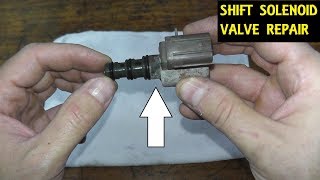
Typical fix: Replace the faulty shift solenoid. 🎬 Watch: How to test and replace your shift solenoid It is often recommended to replace the associated gasket/screen (part # 28252-PAX-000) at the same time, as it is often clogged with debris.
Est. part cost: $50-$150 - Clogged Transmission Fluid Passages or Filter 🔴 High Probability → Shop Transmission Assembly This is a direct consequence of the transmission's tendency to self-destruct. Clutch material breaks down and clogs the tiny screens on the shift solenoids and linear solenoid, as well as passages within the valve body, starving them of the pressure needed to operate.
How to confirm: This is difficult to confirm without disassembly. If new solenoids and clean fluid do not resolve the issue, a clogged passage is likely. Inspecting the solenoid screens upon removal will often show significant debris.
Typical fix: Remove and clean or replace the shift solenoid screens and the main linear solenoid screen/gasket. In severe cases, the valve body must be removed for a thorough cleaning.
Est. part cost: $15-$60 for gaskets and screens - Internal Mechanical Transmission Failure 🔴 High Probability → Shop Transmission Assembly This is the most feared and common major failure on this platform. The 2nd and 3rd gear clutch packs are known weak points that wear out prematurely, causing the debris that leads to other symptoms.
How to confirm: Confirmed by finding excessive clutch material (a thick, grey paste) in the transmission pan and on the magnetic drain plug, performing pressure tests that show internal leaks, or by eliminating all other possible causes.
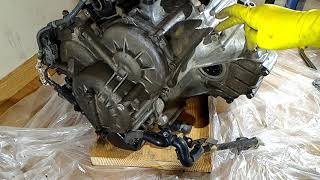
Typical fix: The transmission must be rebuilt by a specialist familiar with Honda issues or replaced with a quality remanufactured unit. 🎬 Watch: A full teardown of this specific transmission A simple used transmission is likely to have the same defect.
Est. part cost: $2500-$4500
Rare But Worth Checking
- Damaged Wiring or Connectors: Check the wiring harness leading to the transmission solenoids for any signs of corrosion, fraying, or loose connections, especially the connector at the solenoid itself.
- Faulty Powertrain Control Module (PCM): This is extremely rare. The PCM should only be considered after all other possibilities, including a full transmission inspection and verification of all wiring, have been exhausted.
Diagnosis Steps
- Check the transmission fluid level and condition. If it is low, top it off. If it is dark, burnt, or full of debris, perform a 3x3 drain-and-fill procedure using Honda ATF-DW1.
- Scan for any other transmission-related trouble codes to get a more complete picture of the fault.
- Inspect the wiring harness and connector for Shift Solenoid B for any visible damage, corrosion, or loose pins.
- Locate Shift Solenoid B on the front of the transmission. Test its internal resistance using a multimeter (spec is typically 12-25 ohms).
- If resistance is good, apply 12-volt power directly to the solenoid and listen for an audible click. No click means the solenoid is mechanically stuck.
- Remove the solenoid and inspect its filter screens for metallic debris or sludge. A clogged screen is a strong indicator of internal transmission wear.
- Also inspect and clean/replace the nearby linear solenoid gasket/screen (Part # 28252-PAX-000), which is a very common collection point for debris.
- If the solenoid and screens are clean and test good, but the problem persists with fresh fluid, a transmission pressure test by a qualified technician is the next step to diagnose internal hydraulic leaks or blockages before condemning the entire transmission.
Parts You'll Likely Need
- Shift Solenoid 'B'
(OEM #28500-P6H-013 (supersedes 28500-P6H-003))— This solenoid is directly identified by the code P0756. It can fail electrically or become mechanically stuck.
Trusted brands: Honda (Genuine), Standard Motor Products (SMP), Dorman, Rostra
OEM price range: $100-$180
Aftermarket price range: $40-$90 - Automatic Transmission Fluid
(OEM #08200-9008 (ATF-DW1))— Low or dirty fluid is a primary cause of solenoid and transmission issues. Using the correct OEM fluid is critical for Honda transmissions. A 3x3 drain/fill requires 9-12 quarts.
Trusted brands: Honda (Genuine)
OEM price range: $10-$15 per quart
Aftermarket price range: $8-$12 per quart - Linear Solenoid Gasket / Screen
(OEM #28252-PAX-000)— This gasket contains a small filter screen that is notorious for getting clogged with clutch debris, restricting hydraulic pressure. It's inexpensive and should be replaced whenever servicing the solenoids.
Trusted brands: Honda (Genuine)
OEM price range: $8-$15
Aftermarket price range: $5-$10 - Remanufactured Automatic Transmission — Due to the high failure rate of this specific transmission, if the cause is internal wear, a full replacement with an updated remanufactured unit is the most common and reliable long-term solution.
Trusted brands: Jasper, Moveras
Related Codes That Often Appear With This One
- P0751 — This code indicates Shift Solenoid 'A' is stuck off. Solenoids A and B work together, and a hydraulic blockage or electrical issue affecting the transmission can trigger codes for multiple solenoids.
- P0730 — This code means 'Incorrect Gear Ratio'. It often appears with solenoid codes because if a solenoid fails to engage a clutch pack correctly, the PCM detects that the resulting gear ratio (from comparing engine speed to output shaft speed) is not what was commanded.
- P0740 — This code relates to the Torque Converter Clutch (TCC) Solenoid. Widespread debris and fluid degradation in these transmissions often affect all solenoids, and a failing torque converter is another common symptom of the overall transmission failure.
Technical Service Bulletins (TSBs) & Recalls
- While not directly for P0756, TSB 02-062 is related as it addresses harsh shifting on these transmissions, recommending software updates and inspection that are relevant to the overall transmission issues.
- NHTSA Campaign ID 04V176000 is the key recall for this transmission's underlying design flaw.
- A manufacturer service news article titled "Hard or Delayed Shifting with A/T DTCs P0756 and P0847" provides specific diagnostic guidance for these codes, as noted in NHTSA ODI #10836670.
Platform-Specific Known Issues
- Widespread automatic transmission failures are the most significant issue for the 1999-2004 Honda Odyssey. Failures are often attributed to poor internal lubrication and premature wear of clutch materials, which then clog fluid passages and cause solenoid faults like P0756 before total failure occurs.
- A recall and service campaign (NHTSA 04V176000) for 2002-2004 models involved installing an oil jet kit in the transmission to provide additional lubrication to the second gear clutch pack in an attempt to prolong its life by reducing heat buildup.
- NHTSA ODI #11533512 describes a scenario where the transmission has intermittent harsh or jerky upshifts with steady acceleration or the MIL comes on with DTC P0756, sometimes resulting in an inability to shift into reverse.
Mechanic-Grade Diagnostic Values
- Shift Solenoid 'B' internal resistance — expected: 12 - 25 Ohms. Failure: A reading of 0 Ohms (short circuit), infinite resistance/OL (open circuit), or a value significantly outside the expected range. A reading just outside, like 26 Ohms, is also suspect.
- Shift Solenoid 'B' mechanical function test — expected: An audible 'click' when 12V power is briefly applied to the solenoid's terminals.. Failure: No clicking sound, which indicates the internal plunger is mechanically stuck.
Scan Tool Commands That Help
- Honda Diagnostic System (HDS) or advanced bidirectional scanner (e.g., Autel): Active Test / Bidirectional Control for Shift Solenoids — This allows a technician to command the solenoid on and off directly from the scan tool, bypassing the PCM's normal logic. It helps confirm if the solenoid itself is capable of functioning and if the wiring between the PCM and solenoid is intact. If the solenoid clicks during the active test but fails during normal operation, it points towards a PCM or sensor input issue.
Wiring & Ground Locations
- G101 — Typically located on the front of the engine or on the transmission housing itself. It serves as a primary ground point for the engine and transmission components, including the PCM.. Corrosion on this main ground strap can cause a weak or intermittent ground for the entire transmission control system. This can lead to erratic voltage, incorrect sensor readings, and unpredictable solenoid behavior, potentially triggering a P0756 code even if the solenoid itself is good.
- Shift Solenoid B Connector — On the exterior of the transmission case, typically on the front side, near other solenoids.. This is the direct electrical connection to the solenoid. It should be inspected for corrosion, pushed-out pins, or fluid intrusion. The resistance and voltage tests are performed at this connector or its corresponding pins at the PCM.
Real Owner Repair Stories
- Paraphrased from multiple forum discussions (e.g., Odyclub) and diagnostic videos. (2003 Honda Odyssey) — Check Engine Light on, flashing 'D5' light, harsh 1-2 shift, and occasional slipping.
❌ Tried (didn't work) Performing a single drain-and-fill of the transmission fluid., Clearing the code without performing any repairs (code returned within a day).
✅ What actually fixed it The owner performed a full '3x3' drain-and-fill (draining and refilling the transmission three consecutive times with short drives in between) using genuine Honda ATF. They also removed, cleaned, and tested the shift solenoids. The screen on the linear solenoid (sharing a gasket with the shift solenoids) was found to be almost completely clogged with a grey, metallic paste. After cleaning all screens and completing the fluid exchange, the code was cleared and did not return, and shift quality was restored. This highlights that cleaning the associated solenoid screens is as important as servicing the specific one in the code. - An owner reported in NHTSA ODI #10836670 that their vehicle's transmission "D" light came on and it began shifting roughly while in motion on city streets, with diagnostic codes P0756 and P0847 present.
OEM Part Supersession History
28500-P6H-003→28500-P6H-013— Part revision by the manufacturer, likely for improved reliability or material changes.
Heads up: The new part number (28500-P6H-013) is the correct and direct replacement for the original. Using old stock of the -003 part is not recommended.
Model Year Variations Within This Range
- 2002-2004: These model years were subject to NHTSA recall 04V176000 for insufficient lubrication of the second gear, which could lead to heat buildup and failure. The fix depended on mileage. Vehicles with over 15,000 miles were inspected for heat damage (discoloration); if found, the transmission was replaced. If no damage was found, or on vehicles with less than 15,000 miles, an 'oil jet kit' was installed to improve fluid flow. In some cases where the transmission was replaced, a new PCM was also required and shipped separately.
Diagnostic Flowchart
Other Known Issues on This Vehicle
Issues unrelated to this code that are worth knowing about as an owner of this generation:
- Clogged EGR Passages (P0401) 🟠 Medium — Extremely common, typically occurs between 80,000 and 150,000 miles. Causes rough idle, hesitation, and check engine light. (Ref: Honda TSB 05-026 addresses this issue for 1999-2003 models.)
- Power Sliding Door Failure 🟠 Medium — Very common. Failure of the center roller bearing, cables, or motor can cause the door to jam, make grinding noises, or stop working entirely.
- Failed Engine Mounts 🟠 Medium — The hydraulic engine mounts are prone to leaking and collapsing, leading to excessive engine vibration felt in the cabin, especially at idle and in gear.
- Ignition Switch Failure 🔴 High — A recall was issued (NHTSA 02V120000) because the ignition switch could fail, causing the engine to stall without warning while driving. (Ref: NHTSA Recall ID: 02V120000)
Used vs. New Parts: Buying Guide for This Vehicle
When a used part is the smart pick: For external, bolt-on components like a shift solenoid, a used part from a documented low-mileage wreck can be a cost-effective way to diagnose the problem. If the used solenoid fixes the issue, you can decide whether to keep it or buy a new one for long-term peace of mind.
Donor-vehicle mileage cap: roughly under 80000 miles for the part to have meaningful remaining life.
What to inspect on the donor part:
- Verify the donor vehicle's mileage if possible.
- Inspect the solenoid's filter screen for any signs of thick sludge or large metal particles; a clean screen is a good sign.
- Check the electrical connector for corrosion or damage.
- Ask the seller if the transmission fluid from the donor car was clean and red, not brown or burnt-smelling.
OEM-only on this vehicle (don't cheap out):
- Automatic Transmission Fluid (ATF): Only use Honda Genuine ATF-DW1 (or its compatible predecessor, ATF-Z1). These transmissions are notoriously sensitive to fluid type, and using a generic multi-vehicle ATF is a common cause of failure.
Aftermarket brands forum-validated for this vehicle:
- Standard Motor Products (SMP) for solenoids is generally regarded as a reliable OE-quality alternative.
- Rostra is another known aftermarket manufacturer of transmission solenoids.
Brands owners have reported issues with on this vehicle:
- Be cautious with no-name or unbranded solenoids from online marketplaces. While cheap, their quality control, internal coil resistance, and durability can be inconsistent, potentially causing performance issues or failing prematurely. ATP is a budget brand with mixed reviews.
Real Owner Stories
Aggregated from forums and TSBs cited above. Mileages and costs reflect what owners reported in those sources.
1999-2004 Honda Odyssey
Symptoms: The P0756 code appeared, leading to concerns about a full transmission rebuild.
What fixed it: Advised by other owners to first try a '3x3 drain and fill' using Honda ATF-DW1 and to clean the solenoid screens as a low-cost diagnostic step before condemning the transmission.
Source hint: Odyclub.com: Numerous threads detail owner experiences with P0756 leading to transmission rebuilds.
2001-2004 Honda Accord (V6)
Symptoms: Experienced a P0756 code along with a flashing D5 light, which ultimately progressed to total transmission failure.
What fixed it: The issue was confirmed to be the same widespread transmission failure that affects the Odyssey, requiring a replacement or rebuild.
Source hint: DriveAccord.net: Owners of the V6 Accord, a platform mate, share identical stories of P0756 codes, flashing D5 lights, and eventual transmission failure, confirming the issue is not isolated to the Odyssey.
Related OBD-II Codes
Frequently Asked Questions
My 'D' light is flashing on my 2002 Odyssey. Is this related to the P0756 code?
What is the official recall for the transmission on my 2003 Honda Odyssey?
What is the correct transmission fluid for my Odyssey and how should I change it?
I'm replacing Shift Solenoid 'B'. Is there any other part I should replace at the same time?
Why is this P0756 code so common on the 1999-2004 Odyssey?
My mechanic says the transmission is shot. Is it safe to install a used one from a junkyard?
Helpful Videos
We Have This Part in Stock

The information in this article is provided for general reference and educational purposes only. Vehicle specifications, procedures, and part compatibility can vary by production date, trim level, and region. Always consult your vehicle's factory service manual and verify part numbers before purchasing or performing repairs. Safety-critical components such as airbags, seat belts, and braking systems should be installed by a qualified professional.
- Honda Odyssey:
- 🧭 Diagnostic Flowchart
- 🎬 Helpful Videos
- 🛍️ Shop This Part
- What's Unique About the 1999-2004 Honda Odyssey
- Symptoms You May Notice
- Most Likely Causes
- Rare But Worth Checking
- Diagnosis Steps
- Parts You'll Likely Need
- Related Codes That Often Appear With This One
- Technical Service Bulletins (TSBs) & Recalls
- Platform-Specific Known Issues
- Mechanic-Grade Diagnostic Values
- Scan Tool Commands That Help
- Wiring & Ground Locations
- Real Owner Repair Stories
- OEM Part Supersession History
- Model Year Variations Within This Range
- Other Known Issues on This Vehicle
- Used vs. New Parts: Buying Guide for This Vehicle
- Real Owner Stories
- 1999-2004 Honda Odyssey
- 2001-2004 Honda Accord (V6)
- Related OBD-II Codes
- Frequently Asked Questions
- 🎟️ Get 5% Off