

P0757 on 2004-2013 Mazda 3: Shift Solenoid 'B' Stuck On Causes and Fixes
For 2004-2012 Mazda 3s with MZR engines, P0757 is likely caused by low/dirty fluid or a bad shift solenoid 'B', a ~$250-$450 repair. For 2012-2013 models with a SKYACTIV engine, this code usually points to a failed transmission valve body requiring replacement, a much costlier repair ($1500+).
- First, identify your engine: Is it a standard MZR or a SKYACTIV? The diagnosis depends entirely on this.
- For all models, the first and cheapest step is to check the transmission fluid's level and condition.
- If you have a 2012-2013 SKYACTIV model, P0757 strongly suggests a known valve body issue that requires professional replacement, not just a single solenoid.
- If you have a non-SKYACTIV (MZR) model, the problem is more likely a bad solenoid or low/dirty fluid, which is a less expensive repair.
- Do not continue to drive with this code. You risk causing severe, expensive damage to the transmission.
What's Unique About the 2004-2013 Mazda 3
The 2004-2013 Mazda 3 spans two generations and three different automatic transmissions, making the diagnosis for P0757 highly specific. First-generation models (2004-2009) and non-SKYACTIV second-generation models (2010-2013) use the 4-speed (FN4A-EL) or 5-speed (FS5A-EL) automatic. On these, P0757 is a typical solenoid or fluid issue. However, on 2012-2013 models with the 2.0L SKYACTIV engine and 6-speed automatic (FW6A-EL), this code is a well-documented indicator of a failing valve body assembly. This specific failure is addressed by Mazda Technical Service Bulletin (TSB) #05-005/14, which superseded previous versions and lists P0757 as one of the related DTCs.
Generation note: This guide covers the first generation (BK, 2004-2009) and second generation (BL, 2010-2013) Mazda 3. The primary difference for this code is not the generation itself, but the powertrain. BK models used MZR engines with 4-speed (FN4A-EL) or 5-speed (FS5A-EL) automatics. BL models used MZR engines with a 5-speed automatic, but introduced the 2.0L SKYACTIV-G engine with a 6-speed automatic (FW6A-EL) in 2012. The diagnosis and fix are different for SKYACTIV vs. non-SKYACTIV (MZR) models.
Symptoms You May Notice
- Check Engine Light or 'AT' (Automatic Transaxle) warning light is on
- Transmission is stuck in one gear (usually 3rd gear, known as 'limp mode')
- Harsh, jerky, or delayed gear shifts
- Failure to shift into certain gears
- Inability to shift past 2nd or 3rd gear
- Transmission slipping (engine RPMs rise without an increase in vehicle speed)
- Reduced fuel economy
- Replacing only the shift solenoid 'B' on a 2012-2013 SKYACTIV model. The TSB indicates the problem is the entire valve body, and the code will likely return.
- Assuming a full transmission replacement is needed when only a valve body (on SKYACTIV) or a single solenoid (on MZR) is the actual point of failure.
- Neglecting to perform the 'Initial Learning Procedure' after replacing a valve body on a SKYACTIV model, which can cause continued shifting issues.
Most Likely Causes
- Low, Dirty, or Contaminated Transmission Fluid 🔴 High Probability → Shop Transmission Assembly This is the most common cause across all automatic transmissions. Degraded or contaminated fluid can cause solenoid plungers to physically stick or clog the fine passages within the valve body.
How to confirm: Check the transmission fluid level and condition. On MZR models, use the dipstick. The fluid should be bright red (Mazda M-V) and not smell burnt. On SKYACTIV models (no dipstick), use the check plug; the fluid is typically blue or red/brown with use (Mazda FZ). Very dark or metallic-smelling fluid indicates a more serious internal problem.
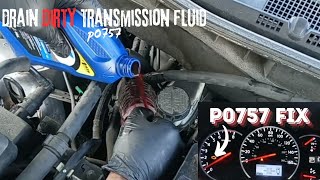
Typical fix: Perform a transmission fluid drain-and-fill. If the fluid is very dirty, replacing the transmission filter is also recommended. 🎬 Watch: How to perform a SKYACTIV transmission fluid drain and fill.
Est. part cost: $50-$100 - Faulty Shift Solenoid 'B' 🟡 Medium Probability → Shop Transmission Valve Body Applies mainly to non-SKYACTIV (MZR) models with the FN4A-EL or FS5A-EL transmission. The solenoid can fail electrically or mechanically due to age and heat cycles.
How to confirm: After confirming fluid is good, access the solenoid by removing the transmission pan. Test the solenoid's resistance with a multimeter. For the FN4A-EL, the shift solenoid resistance should be between 10.9 and 26.2 ohms. A reading outside this range indicates a failed solenoid. A bi-directional scan tool can also command it on and off to verify mechanical operation.
Typical fix: Replace the faulty shift solenoid. On the FN4A-EL and FS5A-EL transmissions, solenoids 'A' and 'B' are identical on/off solenoids, and it's good practice to replace them as a pair.
Est. part cost: $60-$150 - Failed Control Valve Body Assembly 🔴 High Probability → Shop Transmission Valve Body This is the most likely cause for 2012-2013 Mazda 3s with the SKYACTIV engine and 6-speed FW6A-EL automatic. Mazda TSB #05-005/14 identifies an internal malfunction in the valve body as the root cause for P0757 and a host of other codes. The issue can be contamination in passages or failure of the integrated TCM. 🎬 Watch: A detailed look at the SKYACTIV valve body assembly and parts.
How to confirm: Verify the vehicle is a SKYACTIV model and check if the VIN falls within the range specified in the TSB. A professional diagnosis is required to confirm before replacement, as the part is very expensive.
Typical fix: Replace the entire control valve body assembly, which is a mechatronic unit that includes the solenoids and the integrated TCM. This part must be programmed to the vehicle using a process called 'Initial Learning Procedure'.
Est. part cost: $1200-$1800
Rare But Worth Checking
- Wiring Harness or Connector Issue: Corrosion or damage to the wiring between the TCM and the transmission can cause a short to power, making the solenoid stick on. This can happen on any model but is less common than fluid or component failure. On MZR models, check the main connector to the transmission case.
- Faulty Transmission Control Module (TCM): → Shop Transmission Assembly On non-SKYACTIV models, the external TCM can fail, though this is rare. The TCM is located on top of the transmission, under the battery tray, and is prone to failure from heat and vibration. On SKYACTIV models, the TCM is part of the valve body, so it's replaced during that common failure.
Diagnosis Steps
- Scan the vehicle's computer for all stored trouble codes to see if other codes are present.
- Identify the vehicle's engine and transmission. Is it a non-SKYACTIV MZR (4/5-speed FN4A-EL/FS5A-EL) or a SKYACTIV (6-speed FW6A-EL)? This is the most critical step.
- For all models: Check the transmission fluid level and condition. If low, dark, or burnt-smelling, perform a fluid and filter change first. This simple step resolves the issue in some cases.
- If SKYACTIV model: Check the vehicle's VIN against Mazda TSB #05-005/14 or the superseding #05-002/15. If it matches and codes like P0780 or P0842 are also present, the valve body is the highly probable cause. Professional diagnosis is recommended to confirm.
- If non-SKYACTIV (MZR) model: If fluid is good, inspect the external wiring and connector to the transmission for damage or corrosion.
- Drop the transmission pan to access the valve body and solenoids. Visually inspect for excessive metal debris, which would indicate a more severe mechanical failure.
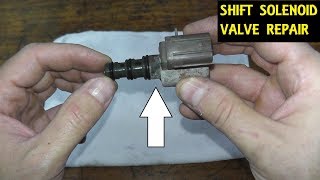
- Test the resistance of shift solenoid 'B' with a multimeter. The specification for the FN4A-EL/FS5A-EL shift solenoid is 10.9-26.2 Ohms. A reading significantly outside this range confirms a bad solenoid. 🎬 See this walkthrough on how to test and replace shift solenoids.
- If tools are available, use a bi-directional scanner to command the solenoid on/off to verify its mechanical operation. You should hear a faint click from the solenoid as it actuates.
Parts You'll Likely Need
- Control Valve Body Assembly
(OEM #FW6A-19-9F0 (example, VIN dependent, also seen as FZ01-19-9F0))— The required fix for most 2012-2013 SKYACTIV models per Mazda TSB #05-005/14.
Trusted brands: Mazda (Genuine OEM)
OEM price range: $1200-$1800
Aftermarket price range: $250-$700 (Remanufactured) - Automatic Transmission Shift Solenoid 'B'
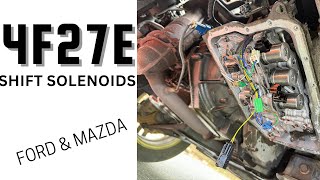
(OEM #FN01-21-1G1C)— The likely fix for non-SKYACTIV (MZR) models if the fluid is in good condition. This part is an on/off solenoid used for both Shift A and B functions in the FN4A-EL. It is also shared with the Ford 4F27E transmission.
Trusted brands: Mazda (Genuine OEM), Rostra, ATP, Transtar
OEM price range: $80-$160
Aftermarket price range: $40-$115 - Automatic Transmission Fluid — Low or dirty fluid is a primary cause. Use Mazda M-V (Type M5) for 4/5-speed MZR models, and Mazda FZ for 6-speed SKYACTIV models. Using the correct fluid is critical.
Trusted brands: Mazda (Genuine OEM), Idemitsu, ENEOS, Valvoline MaxLife ATF (check for compatibility)
OEM price range: $15-$25 per quart
Aftermarket price range: $10-$18 per quart
Related Codes That Often Appear With This One
- P0780 — On SKYACTIV models, P0780 (Shift Malfunction) is often stored along with P0757, and both are listed in TSB #05-002/15 as pointing to a valve body failure.
- P1738 — Another code (Automatic Transaxle Internal Malfunction) listed in the SKYACTIV valve body TSB that can accompany P0757.
- P0842 — This code, for 'Transmission Fluid Pressure Sensor/Switch 'A' Circuit Low', is also listed in TSBs #05-005/14 and #05-002/15 for the SKYACTIV models, pointing to the same root cause of contamination in the valve body.
Technical Service Bulletins (TSBs) & Recalls
- Mazda TSB #05-005/14: Supersedes previous bulletins. Addresses MIL on with DTCs P0780, P1738, and a long list of others including P0757, on 2012-2013 SKYACTIV models. Recommends replacement of the valve body assembly.
- Mazda TSB #05-003/14: Addresses MIL on with DTCs for oil pressure switches (P0842, P0847, etc.) on SKYACTIV models, caused by contamination in the valve body. This is related to the overall valve body problem.
- TSB Bulletin #05-003-14-2898A: Notes that P0757:00 may be stored in memory alongside an internal transaxle malfunction, with or without communication code U0401.
- TSB Bulletin #05-003-14-2898: Describes instances where P0757:00 is found with other shift and pressure sensor codes (such as P0746:00 and P0842:00) indicating internal transmission issues.
Platform-Specific Known Issues
- A known issue for 2012-2013 Mazda 3s with the SKYACTIV 2.0L engine and 6-speed automatic transmission is an internal failure of the control valve body, which triggers code P0757. This is documented by Mazda TSB #05-005/14 and requires replacing the entire valve body, not just the individual solenoid.
Mechanic-Grade Diagnostic Values
- Shift Solenoid 'A'/'B'/'C'/'D'/'E'/'F' Resistance (non-SKYACTIV FN4A-EL/FS5A-EL) — expected: 10.9 – 26.2 Ω. Failure: A reading outside this range indicates a failed solenoid coil.
- Pressure Control (PC) Solenoid Resistance (non-SKYACTIV FN4A-EL) — expected: 2.4 – 7.3 Ω. Failure: A reading outside this range indicates a failed pressure control solenoid, which can affect overall transmission operation and potentially trigger other codes.
- ATF Temperature for Initial Learning (SKYACTIV FW6A-EL) — expected: 40–110 °C (104–230 °F). Failure: Attempting the learning procedure outside this temperature range may cause it to fail or not complete successfully.
Hidden / Shadow Codes Worth Checking
- P06B8:00: Non-Volatile Random Access Memory (NVRAM) Error (see via This code is often displayed on the Mazda M-MDS (dealer scan tool) after a new valve body is installed on a SKYACTIV model but before the 'Initial Learning Procedure' has been completed. It indicates that the learning process is necessary.)
Scan Tool Commands That Help
- Mazda M-MDS (or equivalent like FORScan): Initial Learning Procedure — This is a mandatory procedure after replacing the control valve body or certain other internal components on the SKYACTIV FW6A-EL transmission. Failure to perform this step will result in poor shifting and may leave warning lights on.
- Mazda M-MDS (or equivalent like FORScan): Module Reprogramming (TCM) — For certain SKYACTIV vehicles within specific VIN ranges, Mazda TSBs require a TCM software update as part of the repair for P0757-related issues to improve diagnostic logic before replacing hardware.
- Bidirectional Scan Tool: Shift Solenoid B - On/Off Command — This function is used to directly test the mechanical operation of the solenoid. While monitoring live data, a technician can command the solenoid off and should see the corresponding voltage drop. If the voltage remains high (~12V), it confirms a 'stuck on' electrical condition.
Wiring & Ground Locations
- External TCM Location (non-SKYACTIV) — Located on top of the transmission case, underneath the battery and battery tray assembly in the engine compartment.. This location makes the TCM susceptible to heat and vibration from the transmission, which is a known cause of failure. A faulty TCM can incorrectly report a solenoid issue. Some repair shops recommend relocating the repaired/replaced TCM to a cooler location, such as zip-tying it to the firewall or brake lines nearby.
- Transmission Case Grounds — There are several key ground points on the transmission case itself. One is on top of the transmission harness, and two more are on the front of the case (one large wire, one small). Another common ground point is a bolt on the transmission bell housing.. A poor ground connection can cause erratic voltage signals and unpredictable behavior from electronic components like shift solenoids, potentially mimicking a component failure.
- TCM Fuse (2004-2009 models) — Fuse #27 in the engine compartment fuse box.. While a blown fuse would typically cause a 'no communication' code, checking it is a fundamental first step in any electrical diagnosis involving the TCM or its components.
Real Owner Repair Stories
- YouTube user TT Autogarages (2012 Mazda 6 (with similar non-SKYACTIV transmission)) — Transmission would not shift past 40 mph, stuck in gear, code P0757 present.
❌ Tried (didn't work) The owner considered immediately replacing the solenoid.
✅ What actually fixed it The owner first checked the transmission fluid and found it to be extremely dirty. A simple drain and refill with four quarts of fresh ATF completely resolved the shifting issue and the code. - Reddit user on r/MechanicAdvice (2007 Mazda 3 2.3L) — Car randomly started struggling to shift into 2nd gear, then went into limp mode (1st and 3rd gear only) with code P0757.
❌ Tried (didn't work) Sent the TCM out for repair twice (was told it was not the issue)., Performed a transmission service with new fluid and a new filter.
✅ What actually fixed it The thread was left unresolved. After trying a fluid/filter change and verifying the TCM was good, the next logical step pointed to by the symptoms and code is a faulty shift solenoid 'B' or an internal wiring issue within the transmission.
OEM Part Supersession History
FW6A-19-9F0→FZ01-19-9F0, FZ21-19-9F3— This part number refers to the valve body/transmission oil cooler assembly for SKYACTIV models. The supersessions likely represent revisions to address the contamination and sticking switch issues outlined in the TSBs.
Heads up: These parts are often VIN-specific. While FZ01-19-9F0 is widely cited, it is critical to verify the correct part number for the specific vehicle's VIN before ordering.FN01-21-1G1C→XS4Z-7H148-AA (Ford part number)— The Mazda FN4A-EL transmission is shared with Ford, where it is known as the 4F27E. The shift solenoids are interchangeable.
Heads up: Solenoids 'A' and 'B' are simple on/off solenoids, while 'C', 'D', and 'E' are different PWM solenoids. Ensure you are replacing the correct type.
Model Year Variations Within This Range
- 2004-2011 (non-SKYACTIV): These models use an external Transmission Control Module (TCM) mounted directly on the transmission case. This unit is a common point of failure due to heat and vibration, and can cause solenoid codes.
- 2012-2013 (SKYACTIV): These models have the TCM integrated into the valve body assembly inside the transmission pan. For P0757, the failure is almost always the entire valve body assembly as described in Mazda TSBs, not an external computer.
Diagnostic Flowchart
Other Known Issues on This Vehicle
Issues unrelated to this code that are worth knowing about as an owner of this generation:
- Melting / Sticky Dashboard 🟠 Medium — Very common on 2009-2011 models, especially in high-heat, high-humidity climates. Can cause dangerous windshield glare. (Ref: Mazda issued a warranty extension (up to 10 years) for this issue on 2010 models, but it has since expired for most owners.)
- Failing Passenger-Side Engine Mount 🟠 Medium — Common across all years (2004-2013). The hydraulic mount fails, causing excessive vibration at idle and clunking noises. Later SKYACTIV models also had TSBs for engine mount vibration. (Ref: TSB #01-012/16 and #01-017/19 for later models (2014+), but the issue is well-documented on earlier generations as well.)
- Timing Chain Wear (Petrol Models) 🔴 High — A known issue on MZR petrol engines. The timing chain can stretch or the plastic guides can fail, typically after 80,000-120,000 miles. Symptoms include a rattling noise on cold starts.
- Failing Transmission Control Module (TCM) 🟠 Medium → Shop Transmission Assembly — More common on first-gen (2004-2009) models. The TCM is mounted directly on the transmission, exposing it to heat and vibration, which can lead to failure causing erratic shifting and communication codes.
- Warping Instrument Panel Above Center Display 🟡 Low — Common on 2010-2013 models. The plastic dashboard above the info display can warp and lift in the heat, creating a gap. (Ref: Mazda issued a warranty extension (SSP) for this specific issue, which has likely expired.)
- Loose or Rusted Rear Sway Bar Links 🟡 Low — Common on 2004-2012 models. The links can bend, loosen, or rust, causing a distinct rattling or clunking noise from the rear suspension over bumps.
Used vs. New Parts: Buying Guide for This Vehicle
When a used part is the smart pick: For non-SKYACTIV models, a used shift solenoid from a reputable salvage yard is a reasonable, cost-effective repair, as they are simple components. A used external TCM can also be an option, but carries risk as its failure is often due to heat cycles over time.
Donor-vehicle mileage cap: roughly under 80000 miles for the part to have meaningful remaining life.
What to inspect on the donor part:
- For a solenoid, ask the salvage yard about the donor vehicle's mileage and reason for being salvaged (avoid transmissions from cars with known transmission failure).
- When buying a used TCM, check for any physical damage or corrosion on the case and connectors.
- Prefer sellers who offer a short-term warranty (e.g., 30-90 days) on used electronic parts.
OEM-only on this vehicle (don't cheap out):
- Control Valve Body Assembly (SKYACTIV models): Due to the known defects addressed by TSBs and the requirement for programming (Initial Learning), a new Genuine Mazda part is strongly recommended to ensure the latest revisions are included. A professionally remanufactured unit from a specialist with a good warranty is a viable second option, but a random used part is very high-risk.
Aftermarket brands forum-validated for this vehicle:
- Rostra: A well-regarded aftermarket manufacturer for transmission solenoids with a reputation for quality comparable to OEM for many applications.
Brands owners have reported issues with on this vehicle:
- Unbranded, no-name solenoids from online marketplaces can have high failure rates and incorrect resistance values, leading to a repeat repair. It is better to pay slightly more for a known brand or a warranted used part.
Real Owner Stories
Aggregated from forums and TSBs cited above. Mileages and costs reflect what owners reported in those sources.
2013 Mazda 3 SKYACTIV
Symptoms: A no-communication issue with the internal TCM, requiring a valve body replacement.
What fixed it: Dealer quoted a full valve body replacement.
Cost: $1700-$1900
Source hint: Reddit r/mazda3 - 'Dealer said I need a valve body replacement...'
2007 Mazda 3 MZR
Symptoms: Vehicle stuck in limp mode with code P0757.
What fixed it: The owner had the TCM repaired and the transmission fluid changed, but the problem remained, indicating a difficult diagnosis.
Source hint: Reddit r/MechanicAdvice - '2007 Mazda3 P0757 SOLENOID B'
2007 Mazda 3 MZR
Symptoms: Transmission only has 1st and 3rd gear, with code P0757.
What fixed it: The owner replaced all solenoids and the wiring harness without success. A failed TCM was suspected as the remaining cause.
Source hint: Mazdas247 Forum - 'Only Have 1st & 3rd Gear! Help!!'
Related OBD-II Codes
Frequently Asked Questions
My car is a 2012 Mazda 3 with a SKYACTIV engine and has code P0757. What is the most likely cause?
How can I test Shift Solenoid 'B' on my older MZR engine Mazda 3?
What type of transmission fluid should I use for a fluid change to fix P0757?
Does TSB #05-005/14 for the valve body apply to my 2009 Mazda 3?
My mechanic is replacing only Shift Solenoid 'B' on my 2007 Mazda 3. Is this correct?
Is there a special procedure required after replacing the valve body on a SKYACTIV Mazda 3?
Helpful Videos



We Have This Part in Stock




The information in this article is provided for general reference and educational purposes only. Vehicle specifications, procedures, and part compatibility can vary by production date, trim level, and region. Always consult your vehicle's factory service manual and verify part numbers before purchasing or performing repairs. Safety-critical components such as airbags, seat belts, and braking systems should be installed by a qualified professional.
- Mazda 3:
- 🧭 Diagnostic Flowchart
- 🎬 Helpful Videos
- 🛍️ Shop This Part
- What's Unique About the 2004-2013 Mazda 3
- Symptoms You May Notice
- Most Likely Causes
- Rare But Worth Checking
- Diagnosis Steps
- Parts You'll Likely Need
- Related Codes That Often Appear With This One
- Technical Service Bulletins (TSBs) & Recalls
- Platform-Specific Known Issues
- Mechanic-Grade Diagnostic Values
- Hidden / Shadow Codes Worth Checking
- Scan Tool Commands That Help
- Wiring & Ground Locations
- Real Owner Repair Stories
- OEM Part Supersession History
- Model Year Variations Within This Range
- Other Known Issues on This Vehicle
- Used vs. New Parts: Buying Guide for This Vehicle
- Real Owner Stories
- 2013 Mazda 3 SKYACTIV
- 2007 Mazda 3 MZR
- 2007 Mazda 3 MZR
- Related OBD-II Codes
- Frequently Asked Questions
- 🎟️ Get 5% Off