

P0772 on 2004-2009 Mazda 3: Shift Solenoid 'E' Stuck On Causes and Fixes
This code indicates Shift Solenoid 'E' is stuck on in your Mazda 3's FN4A-EL transmission. The most common causes are low/dirty transmission fluid or a failed shift solenoid. A DIY solenoid replacement costs around $100-$200 for parts (solenoid, fluid, filter), while a shop may charge $300-$650. Ignoring this can lead to severe transmission damage.
- P0772 on a 2004-2009 Mazda 3 points to Shift Solenoid 'E' being stuck on, which causes serious shifting problems.
- Always start by checking the transmission fluid level and condition, as low or dirty fluid is a very common cause.
- The part you likely need is a 'PWM Shift Solenoid'. In the FN4A-EL transmission, solenoids C, D, and E are identical, making sourcing a replacement easier.
- This is not a beginner-friendly DIY repair. Due to the complexity and risk of damaging the transmission, professional service is recommended.
- Do not ignore this code. Driving with a P0772 can lead to severe internal transmission damage, escalating repair costs significantly.
What's Unique About the 2004-2009 Mazda 3
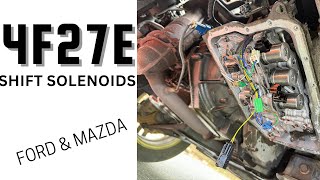
The 2004-2009 Mazda 3 uses the FN4A-EL automatic transmission, which is mechanically identical to the 4F27E used in 🎬 Watch: This Ford Focus walkthrough shows the identical solenoid replacement process. many Ford models like the Focus and Transit Connect. This is beneficial because parts and repair information are widely available. For this specific transmission, 'Shift Solenoid E' is a Pulse-Width Modulated (PWM) solenoid that is physically and functionally identical to solenoids 'C' and 'D'. This interchangeability can simplify finding a replacement part. The Mazda diagnostic procedure for this code is very methodical, starting with fluid checks before moving to component testing.
Symptoms You May Notice
- Automatic Transmission (AT) warning light is on.
- Check Engine Light is on.
- Harsh, delayed, or erratic shifting between gears.
- Transmission gets stuck in one gear (limp mode).
- Slamming hard into reverse when shifting from Park.
- Engine may stall when coming to a stop.
- Noticeable decrease in fuel economy.
- Replacing only the solenoid when the transmission fluid is extremely dirty and full of debris. The new solenoid can quickly fail if the underlying fluid contamination issue isn't resolved with a flush and filter change.
- Replacing the TCM without first thoroughly testing the solenoids and wiring. While TCM failure is common, it is more expensive than a solenoid and should not be the first part replaced.
Most Likely Causes
- Low or Dirty Automatic Transmission Fluid (ATF) 🔴 High Probability → Shop Transmission Assembly Over time, fluid breaks down and collects clutch material and metal shavings. The FN4A-EL is sensitive to fluid condition and level, and contaminated fluid can cause the fine mechanical parts of a solenoid to stick.
How to confirm: Check the transmission fluid dipstick for level and color with the engine warm and running. The fluid should be bright red and clear, not brown, black, or smelling burnt. If the level is low, a leak must be found and fixed.
Typical fix: Perform a transmission fluid and filter change. This is often the first and most cost-effective step. Ensure only Mazda M-V (Type M5) or a fully compatible fluid is used, as the wrong fluid can cause shift problems.
Est. part cost: $60-$120 for fluid and a filter kit. - Faulty Shift Solenoid 'E' 🔴 High Probability → Shop Transmission Valve Body Solenoids are electro-mechanical parts that wear out over time. The internal coil can short or burn out, or the valve can become physically stuck from debris in the fluid.
How to confirm: After removing the transmission pan, the solenoid can be tested with a multimeter for proper resistance. For the 🎬 See how to properly test and clean your Mazda solenoids. 4F27E/FN4A-EL, the resistance for PWM solenoids (C, D, E) is typically between 1.0 - 4.2 Ohms. A reading outside this range indicates a failed solenoid. You can also apply a 12v source to the solenoid to listen for a 'click', though this doesn't guarantee the valve isn't sticking internally.
Typical fix: Replace the faulty shift solenoid. Since the pan is already off, many owners and shops choose to replace all three PWM solenoids (C, D, and E) or the complete solenoid pack at the same time for reliability.
Est. part cost: $40-$80 for one aftermarket solenoid, $100-$250 for a full aftermarket kit. - Contaminated or Failing Valve Body ⚪ Low Probability → Shop Transmission Valve Body If the transmission fluid is very dirty, small metal particles can get lodged in the intricate passages of the valve body, causing valves to stick and preventing proper hydraulic pressure regulation.
How to confirm: This is a process of elimination. If a fluid change and solenoid replacement do not fix the issue, the valve body is the next likely suspect. A professional may use a pressure gauge to perform a line pressure test as outlined in the Mazda service manual.
Typical fix: The valve body must be removed, disassembled, cleaned, and inspected. In many cases, installing a remanufactured valve body is more time and cost-effective. Manufacturer service bulletins such as TSB Bulletin #05-003-14-2898A note that when P0772 is stored in memory alongside other shift codes, a new programmed valve body may be required to correct the problem.
Est. part cost: $250-$500 for a remanufactured valve body.
Rare But Worth Checking
- Wiring Harness Damage: The internal transmission wiring harness can become brittle from constant heat cycles and age. While the pan is off, check the connector and wires leading to Shift Solenoid E for any signs of corrosion, breaks, or loose pins.
- PCM/TCM Malfunction: This is a notable cause for this platform. The Transmission Control Module (TCM) is mounted directly to the transmission case, where it is exposed to significant heat and vibration, leading to a high failure rate. Solder joints on the circuit board can crack, causing erratic signals, communication errors (U0100, U0101), or sending a constant 'on' signal to the solenoid. This should be considered if new solenoids don't resolve the code.
Diagnosis Steps
- Scan for Codes: Confirm P0772 is present and document any other related transmission or communication (U-codes).
- Check Transmission Fluid: With the engine warm and running in Park, check the ATF level and condition. If low, top it off and check for leaks. If dark, burnt, or containing debris, a fluid and filter change is the mandatory first step.
- Inspect External Wiring: Check the main transmission harness connector and the TCM connector for damage, corrosion, or loose pins.
- Drop the Transmission Pan: Drain the fluid and remove the pan to access the valve body and solenoids. Inspect the fluid in the pan and the magnet for excessive metal shavings, which could indicate severe internal wear.
- Identify and Test Solenoid E: Locate the three identical PWM solenoids (C, D, E). Disconnect the connector for Solenoid E and measure its resistance with a multimeter. The reading should be within the 1.0-4.2 Ohms specification.
- Inspect Internal Wiring: While the pan is off, visually inspect the wiring going to the solenoids for any signs of brittleness, cracking, or damage.
- Replace Parts: If the solenoid is faulty, replace it. It is highly recommended to also replace the transmission filter and pan gasket. Many owners replace the full solenoid pack for peace of mind.
- Reassemble and Refill: Reinstall the pan, torquing bolts to the manufacturer's specification (typically around 6-8 ft-lbs). Refill with the correct type of ATF (Mazda M-V or a compatible equivalent ONLY).
- Clear Codes and Test Drive: Clear the P0772 code with a scan tool and perform a test drive, allowing the transmission to shift through all gears to confirm the repair was successful.
Parts You'll Likely Need
- Transmission Shift Solenoid (PWM Type C/D/E)
(OEM #FN01-21-550 (Mazda) / XS4Z-7G484-AA (Ford))— This is the solenoid identified by the code. It often fails electrically or mechanically, causing the 'stuck on' condition. The Ford part number is often easier to find and cheaper.
Trusted brands: Ford/Motorcraft, Rostra, ATP Automotive, Sonnax
OEM price range: $70-$140
Aftermarket price range: $30-$70 - Automatic Transmission Filter Kit
(OEM #FN01-21-5X0 (Filter) / FNC1-21-51Y (Gasket))— Must be replaced whenever the transmission pan is removed. A clogged filter can cause pressure issues that lead to solenoid problems.
Trusted brands: Wix, Fram, ATP
OEM price range: $30-$50
Aftermarket price range: $15-$30 - Automatic Transmission Fluid (ATF)
(OEM #0000-77-112E-01)— Required to refill the transmission after dropping the pan. Using the correct Mazda M-V fluid is critical for proper transmission function.
Trusted brands: Mazda (OEM), Castrol Transmax, Valvoline MaxLife
OEM price range: $15-$25 per quart
Aftermarket price range: $8-$15 per quart
Related Codes That Often Appear With This One
- P0700 — P0700 is a generic code that simply means the Transmission Control Module (TCM) has stored a fault. It often appears alongside more specific transmission codes like P0772 to alert the main engine computer of the issue.
- P0771 — This code means 'Shift Solenoid E Performance or Stuck Off,' which is the opposite of P0772. Seeing them together, or in succession, could indicate a very erratic solenoid, a wiring issue, or a failing TCM causing unpredictable commands.
- P0773 — This code indicates 'Shift Solenoid E Electrical,' pointing to a circuit problem like a short or open. A Reddit user reported seeing P0771, P0772, and P0773 together after a repair, pointing to a complex electrical fault.
- U0100/U0101 — These codes indicate a loss of communication with the TCM. On this Mazda 3 generation, they are a strong indicator of a failing TCM due to heat-related solder joint failure and often accompany shifting performance codes.
Technical Service Bulletins (TSBs) & Recalls
- TSB 05-005/08 (and its successor 05-002/13): This bulletin specifically warns technicians to use the correct Automatic Transmission Fluid. It states that ATF M-V (Type M5) must be used in the Mazda 3 and that it is not the same as Mercon V. Using the wrong fluid can cause shift quality complaints.
- TSB Bulletin #05-003-14-2898: This bulletin identifies that P0772:00 may be stored in memory along with several other transmission codes such as P0746:00, P0751:00, and P0762:00. It suggests that a new programmed valve body is the necessary correction for these stored DTCs.
Platform-Specific Known Issues
- TCM Location and Failure: The TCM is bolted directly to the top of the transmission, exposing it to extreme heat and vibration. This is a known design flaw that causes internal solder joints to crack over time, leading to a host of shifting problems and codes, including P0772. If solenoid replacement doesn't work, a faulty TCM is a very high probability.
Mechanic-Grade Diagnostic Values
- Shift Solenoid C, D, or E Resistance — expected: 1.0 - 4.2 Ohms. Failure: A reading of infinite resistance (open) or near-zero resistance (short) indicates a failed solenoid coil.
- Line Pressure Test — expected: Refer to Mazda factory service manual for specific pressures at idle, stall speed in D, and stall speed in R.. Failure: Pressures outside the specified ranges can indicate a faulty pump, clogged filter, or internal leaks in the valve body or clutch packs.
Scan Tool Commands That Help
- Mazda M-MDS or equivalent professional scan tool: Reset Keep Alive Memory (KAM) — After replacing the valve body, solenoids, or performing a fluid service, this function should be used to clear the old adaptive learning values from the TCM, forcing it to relearn shift points and pressures with the new components/fluid.
Wiring & Ground Locations
- TCM Location — Mounted directly on top of the transmission case, under the battery and air intake assembly.. This location exposes the TCM to significant heat and vibration, leading to a high rate of failure from cracked internal solder joints, which can cause this code.
- G5 — Main ground point located on the transaxle case itself.. A poor ground at this location can cause erratic behavior and fault codes for all transmission sensors and solenoids, including P0772.
- Solenoid E at TCM Connector — The wire for Shift Solenoid E can be identified at the main TCM connector for continuity or voltage testing, eliminating the need to drop the pan for initial electrical checks. Refer to the specific wiring diagram for your model year for the exact pin number and wire color.. Allows a technician to test the entire circuit from the control module to the solenoid, helping to differentiate between a wiring fault, a solenoid fault, or a TCM driver fault.
Real Owner Repair Stories
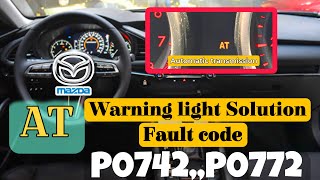
- YouTube channel 'Automotive Mechanic PRO' (Mazda 3, year not specified but within the generation.) — AT warning light on, gear jerking, not shifting properly.
❌ Tried (didn't work) The video begins with the diagnosis of P0772 (Shift Solenoid E Stuck On) and P0742 (TCC Solenoid Stuck On).
✅ What actually fixed it The mechanic replaced the entire transmission valve body, which includes all the solenoids. After replacement and clearing codes, the car was fixed and all warning lights were off. - YouTube channel 'Pro-Choice Auto Repair' (2006 Mazda 3) — Check engine light on, no reverse gear, and a shift solenoid electrical code (P0753, Solenoid 'A').
❌ Tried (didn't work) Swapped the transmission, but the electrical code remained., Tested the internal solenoid and harness, which were good.
✅ What actually fixed it The technician proved the TCM was faulty by wiring an external, known-good solenoid directly to the TCM output wire, bypassing all vehicle wiring. When the code still returned, it confirmed the TCM driver circuit was bad. Replacing the TCM was the ultimate fix. This diagnostic strategy is directly applicable to a P0772 electrical fault.
When the Usual Fixes Don't Work
- While replacing the solenoid is a common fix, the high failure rate of the Transmission Control Module (TCM) on this platform presents a significant counter-narrative. Due to its mounting location on the hot, vibrating transmission case, the TCM's internal solder joints are prone to cracking. A master technician demonstrated that even when a solenoid and internal wiring test perfectly, the TCM itself can be the source of the 'stuck on' signal, causing the P0772 code. In such cases, replacing the solenoid will not fix the problem, and the true root cause is a failed control module.
OEM Part Supersession History
XS4Z-7G484-AA (Ford)→No common supersession found. This part number remains valid.— N/A
Heads up: This Ford part is a direct, interchangeable replacement for the Mazda PWM Shift Solenoids C, D, and E in the FN4A-EL transmission and is often easier to source.
Model Year Variations Within This Range
- 2004-2009: Mazda 3 models with the 2.0L engine were typically equipped with the 4-speed FN4A-EL, to which this P0772 code applies. Models with the 2.3L engine often came with the 5-speed FNR5 automatic transmission. The FNR5 uses different solenoid designations and control logic, so this specific guide is not applicable to 5-speed models.
Diagnostic Flowchart
Other Known Issues on This Vehicle
Issues unrelated to this code that are worth knowing about as an owner of this generation:
- Passenger-Side Engine Mount Failure 🔴 High — Extremely common, often failing after 60,000-100,000 miles. Causes excessive vibration in the cabin, especially at idle and in gear.
- Transmission Control Module (TCM) Failure 🔴 High → Shop Transmission Assembly — Very common on 2006-2014 models. The module is mounted on the transmission, leading to overheating and solder joint failure. Symptoms include harsh shifting, AT light, and communication codes (U0100).
- Rear Quarter Panel and Wheel Well Rust 🟠 Medium — Common in regions that use road salt. Poor drainage and paint protection in the rear wheel arches lead to significant corrosion over time.
- Thermostat Failure (Stuck Open) 🟠 Medium — A frequent issue causing the engine to not reach full operating temperature, triggering codes like P0126 or P0128 and poor heater performance.
- Leaking Rear Shock Absorbers 🟡 Low — The original rear shocks are prone to leaking at higher mileage (over 100,000 miles), resulting in a bouncy or loose feeling rear suspension.
Used vs. New Parts: Buying Guide for This Vehicle
When a used part is the smart pick: A complete, used valve body assembly from a verified low-mileage donor vehicle can be a cost-effective repair, as it includes all solenoids. A used TCM is a high-risk purchase unless it is from a specialized rebuilder who has repaired the common failure points and offers a warranty.
Donor-vehicle mileage cap: roughly under 80000 miles for the part to have meaningful remaining life.
What to inspect on the donor part:
- Verify the donor vehicle's mileage and check for accident history.
- If possible, inspect the color and smell of the transmission fluid from the donor car; it should not be dark brown or burnt.
- Examine all electrical connectors on the valve body or TCM for corrosion, bent pins, or cracked plastic.
OEM-only on this vehicle (don't cheap out):
- No parts for this specific repair are strictly OEM-only, but using OEM or a highly reputable aftermarket brand for the TCM is recommended due to the complexity and programming requirements.
Aftermarket brands forum-validated for this vehicle:
- Sonnax (for valve body repair kits and components)
- Rostra (for replacement solenoids)
- UpFix (for TCM repair services)
Brands owners have reported issues with on this vehicle:
- Unbranded, no-name solenoid kits from online marketplaces can have high failure rates and are best avoided.
Real Owner Stories
Aggregated from forums and TSBs cited above. Mileages and costs reflect what owners reported in those sources.
2006 Mazda 3
Symptoms: AT warning light was on, experiencing shift shock, and code P0772 was present.
What fixed it: The owner was advised by a mechanic to start with an Automatic Transmission Fluid (ATF) change as the first diagnostic step.
Source hint: Mazda3Club.com - 'Shift Shock, AT light, DTC P0772... Any experiences?'
2010 Mazda 3 2.0L
Symptoms: The main symptom was a hard slam into reverse. Codes P0771, P0772, and P0773 were present simultaneously.
What fixed it: The issue persisted even after replacing the valve body, suggesting the actual cause was related to wiring or a faulty replacement part.
Source hint: Reddit r/MechanicAdvice - '2010 Mazda 3 2.0 Shift solenoid...again?!'
2007 Mazda 3 — ~110000 miles
Symptoms: Harsh shifting, AT light on, and communication codes like U0100 appearing with transmission codes.
What fixed it: Replacement of the Transmission Control Module (TCM), which is known to fail due to its mounting location on the transmission.
Source hint: Known Issues: Transmission Control Module (TCM) Failure
Related OBD-II Codes
Frequently Asked Questions
What specific transmission fluid should I use for my Mazda 3 to fix a P0772 code?
I replaced Shift Solenoid 'E' but the P0772 code came back. What's the most likely cause on this car?
Is it better to replace just the one faulty solenoid or the whole pack?
I have a 2005 Ford Focus with code P0772. Is the information for the Mazda 3 relevant?
What is the correct electrical resistance for Shift Solenoid 'E' when I test it?
My transmission is slamming hard into reverse. Could this be related to P0772?
Helpful Videos

We Have This Part in Stock

The information in this article is provided for general reference and educational purposes only. Vehicle specifications, procedures, and part compatibility can vary by production date, trim level, and region. Always consult your vehicle's factory service manual and verify part numbers before purchasing or performing repairs. Safety-critical components such as airbags, seat belts, and braking systems should be installed by a qualified professional.
- Mazda 3:
- 🧭 Diagnostic Flowchart
- 🎬 Helpful Videos
- 🛍️ Shop This Part
- What's Unique About the 2004-2009 Mazda 3
- Symptoms You May Notice
- Most Likely Causes
- Rare But Worth Checking
- Diagnosis Steps
- Parts You'll Likely Need
- Related Codes That Often Appear With This One
- Technical Service Bulletins (TSBs) & Recalls
- Platform-Specific Known Issues
- Mechanic-Grade Diagnostic Values
- Scan Tool Commands That Help
- Wiring & Ground Locations
- Real Owner Repair Stories
- When the Usual Fixes Don't Work
- OEM Part Supersession History
- Model Year Variations Within This Range
- Other Known Issues on This Vehicle
- Used vs. New Parts: Buying Guide for This Vehicle
- Real Owner Stories
- 2006 Mazda 3
- 2010 Mazda 3 2.0L
- 2007 Mazda 3 — ~110000 miles
- Related OBD-II Codes
- Frequently Asked Questions
- 🎟️ Get 5% Off