

P0780 on 2002-2006 Honda Odyssey: Shift Malfunction Causes and Fixes
On a 2002-2006 Honda Odyssey, code P0780 almost always indicates a serious internal transmission problem. It's typically caused by clutch material, particularly from the 3rd gear clutch pack, breaking down and clogging solenoid screens and fluid passages. This is not a simple sensor or solenoid fix; it usually requires a transmission rebuild or replacement for a permanent solution.
- P0780 on a 2002-2006 Odyssey is a serious code that usually signals the beginning of the end for the transmission.
- The first and most important diagnostic step is to inspect the transmission fluid for darkness, a burnt smell, and metallic particles.
- Cleaning or replacing external solenoids is often a temporary fix that does not address the root cause, which is internal mechanical wear.
- The only reliable, long-term solution is a transmission rebuild or replacement.
- Always use genuine Honda ATF (DW-1 or Z1) fluid. Using incorrect fluid can accelerate failure.
What's Unique About the 2002-2006 Honda Odyssey
The 5-speed automatic transmissions (codename BYA, B7XA) in this generation of Honda Odyssey are notoriously prone to premature failure. A key design flaw appears to be related to the 3rd gear clutch pack, which wears out and sheds its friction material. Unlike many other vehicles where P0780 might be a simple solenoid or sensor issue, on the Odyssey it is a very strong indicator of advanced internal wear. This friction material contaminates the entire hydraulic system, clogging the tiny filter screens on the shift solenoids, pressure control solenoids, and torque converter clutch solenoid, leading to the shift malfunction.
Generation note: This range covers the end of the second generation (2002-2004) and the start of the third generation (2005-2006). Both generations used 5-speed automatic transmissions (part of the B7XA/BYA family) that are well-documented to have high failure rates, and the causes and symptoms for code P0780 are largely the same for both.
Symptoms You May Notice
- Check Engine Light (CEL) is on
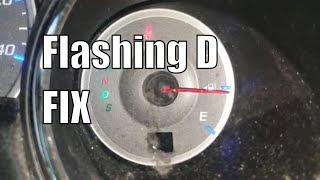
- Flashing 'D' or 'D5' gear indicator light
- Harsh, erratic, or delayed shifting
- Transmission slipping (engine RPMs flare up without an increase in speed)
- Vehicle gets stuck in one gear (limp mode, often 2nd or 3rd gear)
- Grinding or whining noises from the transmission
- Failure to move, especially when the vehicle warms up.
- A sudden clunk when shifting, particularly from 1st to 2nd gear
- Abrupt gear changes that can create dangerous driving situations (NHTSA ODI #10610071)
- Replacing only one shift solenoid. While a solenoid can fail electrically, the P0780 code on this vehicle is most often caused by hydraulic issues from contamination. Replacing one solenoid without addressing the debris source won't fix the problem.
- Assuming it's a simple fluid change fix. If the transmission is already slipping and generating debris, a fluid change alone is not enough to repair the mechanical wear that has already occurred. Many owners report the problem returning shortly after a fluid change.
Most Likely Causes
- Internal Transmission Failure (Worn Clutches and Contamination) 🔴 High Probability → Shop Transmission Assembly The transmissions in this era of Odyssey were known for issues with the clutch packs, particularly the 2nd and 3rd gear clutches, which wear out prematurely. This releases a large amount of friction material into the fluid, causing widespread hydraulic problems.
How to confirm: Check the transmission fluid. If it is dark, burnt-smelling, and contains fine, glittery metallic particles, it confirms internal clutch wear. Dropping the transmission pan will reveal significant clutch material on the magnets. Also, inspect the screens on the linear solenoids (located on the front and top of the transmission case); if they are clogged with black sludge, it confirms systemic contamination.
Typical fix: The only permanent fix is to replace or rebuild the transmission. Simply cleaning or replacing external solenoids is a temporary solution at best, as the internal wear will continue to generate debris.
Est. part cost: $2000-$4500 for a remanufactured transmission. - Clogged Shift Solenoid or Pressure Control Solenoid Screens 🟡 Medium Probability → Shop Transmission Clutch Pressure Control Solenoid This is a direct result of the high-probability internal failure. The debris from worn clutches travels through the fluid and gets trapped in the fine mesh screens of the various solenoids, starving them of fluid pressure and causing them to malfunction.
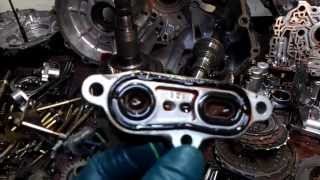
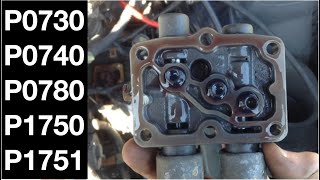
How to confirm: Remove the solenoid packs from the exterior of the transmission case. The small screens at the base of the solenoids will be visibly clogged with a black, pasty material. 🎬 See how to clean clogged solenoid screens to restore shifting A popular YouTube video shows this exact process and the resulting clogged screens.
Typical fix: The solenoids can be removed, and the screens can be cleaned with brake cleaner and compressed air. However, this is considered a temporary fix. If the screens are clogged, the transmission is already failing internally and will continue to produce debris, causing the problem to return.
Est. part cost: $0 if cleaning, $200-$500 for a new solenoid pack. - Low or Degraded Transmission Fluid ⚪ Low Probability → Shop Transmission Assembly While this can cause the code on any vehicle, on the Odyssey it's more often a symptom of a larger problem (like a leak from a bad seal) or the result of internal failure contaminating the fluid, rather than the root cause itself.
How to confirm: Check the transmission fluid dipstick with the engine warm and turned off. The level should be between the marks. The fluid should be reddish-pink and translucent, not dark brown, black, or smelling burnt.
Typical fix: Perform a transmission fluid drain and fill (or multiple) using only genuine Honda ATF-Z1 or its successor, ATF-DW1. If the fluid is heavily contaminated, this will not solve the underlying mechanical issue.
Est. part cost: $40-$120 for fluid.
Diagnosis Steps
- Scan for all diagnostic trouble codes. Note any other transmission codes like P0730 or P0740, as they strongly point to an internal issue. NHTSA ODI #10413834 notes that P0780 may also appear alongside P0710 and P1750.
- Check the transmission fluid level and condition. Pull the dipstick (engine off, car warm), wipe it, re-insert, and check the level. Note the color and smell. If the fluid is dark, smells burnt, or has visible metallic 'glitter', internal failure is highly likely.
- If the fluid is clean and at the correct level, the next step is to inspect the external solenoids. Remove the linear solenoid pack (dual solenoids on the front of the case) and the TCC solenoid (on top of the case).
- Carefully inspect the small filter screens on the solenoids. If they are covered in black, sludgy material, this confirms widespread internal contamination. This is the most critical diagnostic step for this specific vehicle.
- At this point, if significant contamination is found, the diagnosis is complete: the transmission has failed internally. Further electrical testing of solenoids is unlikely to be productive as the root cause is mechanical and hydraulic.
- If no contamination is found (which is rare for this code on this platform), you can test the resistance of the solenoids with a multimeter to check for electrical failure, but this is an uncommon cause.
Parts You'll Likely Need
- Remanufactured Automatic Transmission Assembly — This is the most common and reliable fix, as the original transmission has failed internally. A remanufactured unit typically includes updates to address the original design flaws.
Trusted brands: Honda (OEM), Jasper, Moveras
OEM price range: $3500-$4500
Aftermarket price range: $2000-$3500 - Clutch Pressure Control Solenoid Assembly (Linear Solenoids)
(OEM #28250-P7W-003)— Often replaced as a first attempt at a fix, or if the screens are clogged. This part contains multiple solenoids that control shift pressure. Replacing it may temporarily restore function if the issue is minor clogging. This part is a genuine Honda/Keihin part.
Trusted brands: Honda (OEM), Rostra
OEM price range: $300-$550
Aftermarket price range: $150-$250 - Honda Genuine Automatic Transmission Fluid (ATF-DW1 or ATF-Z1)
(OEM #08200-9008 (DW-1), 08200-9001 (Z1))— Required for any fluid change or transmission replacement. Using non-Honda fluid is a common cause of transmission problems. DW-1 is the backward-compatible replacement for the older Z1 fluid.
Trusted brands: Honda (OEM)
OEM price range: $10-$15 per quart
Aftermarket price range: N/A
Related Codes That Often Appear With This One
- P0730 — Incorrect Gear Ratio. This code is often logged alongside P0780 because the underlying slip or failure to shift that triggers P0780 is detected as an incorrect gear ratio by the TCM. NHTSA ODI #10382971 confirms these two codes are frequently found together in cases of total transmission failure.
- P0740 — Torque Converter Clutch Circuit Malfunction. The same clutch debris that clogs the shift solenoids also clogs the TCC solenoid, causing it to malfunction and triggering this code.
- P0741 — Torque Converter Clutch Performance or Stuck Off. Similar to P0740, this indicates a problem with the torque converter locking up, often due to internal debris or a failing torque converter, which is a common issue on these transmissions.
Technical Service Bulletins (TSBs) & Recalls
- 02-062: Honda extended the warranty on the automatic transmission and torque converter to 7 years or 100,000 miles for certain vehicles, including 1999-2001 Odysseys, due to a higher-than-normal number of failures from premature wear. While the 2002-2006 models were not all covered under this specific TSB, it establishes Honda's official acknowledgment of the underlying design flaw in this transmission family.
Platform-Specific Known Issues
- Owner Experience: The Inevitable Rebuild: On forums like Odyclub and Reddit, a common story emerges: an owner gets a P0780 code and flashing 'D' light. They first try a 3x drain-and-fill with Honda ATF-DW1. When that doesn't work, they clean or replace the external solenoid packs. This may provide temporary relief for a few hundred or a few thousand miles, but the shifting problems inevitably return, usually worse than before. The consensus is that by the time P0780 appears, the internal clutch packs (especially 3rd gear) have failed, and the only long-term solution is a transmission rebuild or replacement.
Mechanic-Grade Diagnostic Values
- Shift Solenoid Resistance — expected: 12-25 Ohms. Failure: A reading outside this range indicates a faulty solenoid coil. This is a generic value; always confirm with a model-specific service manual if possible.
- Clutch Pressure Control (Linear) Solenoid Resistance — expected: 3-10 Ohms. Failure: A reading outside this range indicates a faulty solenoid coil.
- TCM Main Power Feed Voltage — expected: 12V (or battery voltage). Failure: Voltage below 10V indicates a power supply issue to the module, which must be fixed before condemning the TCM or transmission.
- TCM Ground Circuit Resistance — expected: < 0.5 Ohms. Failure: Resistance above 0.5 Ohms indicates a poor ground connection, which can cause erratic behavior.
Hidden / Shadow Codes Worth Checking
- No specific shadow codes identified: While specific shadow codes for P0780 are not publicly documented, the dealer-level Honda Diagnostic System (HDS) or i-HDS provides much more detailed data streams and freeze-frame data than a standard OBD-II scanner. It can show the exact commanded gear vs. the actual gear ratio at the moment of the fault, which is critical for diagnosis. (see via Honda Diagnostic System (HDS) or i-HDS software, typically used by dealers or specialist shops.)
Scan Tool Commands That Help
- Honda HDS / i-HDS: Function Tests / Actuator Tests — To individually command each shift solenoid and clutch pressure solenoid to energize. This helps determine if a specific solenoid is electrically functional or if the wiring to it is intact. This is useful if the solenoid screens are found to be clean, pointing away from the typical contamination issue.
- Honda HDS / i-HDS: CKP (Crankshaft Position) Pattern Clear/Learn — While not a direct fix for P0780, if the engine computer or transmission has been replaced or major engine work was done, the CKP pattern may need to be relearned for the PCM to accurately calculate engine speed, which is a key input for transmission control.
- Honda HDS / i-HDS: ECU Reprogramming — If Honda has issued a software update (TSB) to address shift logic issues. While unlikely to fix a P0780 caused by mechanical failure, it's a step to consider if a replacement TCM is installed.
Wiring & Ground Locations
- G101 — On the thermostat housing, located on the engine block. It serves as a primary ground termination point for the ECU/PCM.. A poor connection at this critical ground can cause a wide range of erratic electronic behaviors, including incorrect sensor readings and faulty commands from the PCM to the TCM, potentially mimicking transmission issues.
- Transmission-to-Chassis Ground Strap — A braided metal strap connecting the transmission case directly to the vehicle's frame rail or subframe.. This strap provides the main ground path for the transmission and its sensors. It is highly susceptible to corrosion. A corroded or broken strap can cause poor sensor signals and solenoid actuation failures, leading to various transmission codes, including P0780.
- PCM/TCM Connectors — The PCM is typically located behind the center console, requiring removal of side trim panels for access. The TCM is integrated within the PCM on these models.. Technicians may need to perform pin-out tests for voltage and resistance at these connectors to diagnose wiring issues between the PCM and the transmission solenoids or sensors.
Real Owner Repair Stories
- YouTube channel 'transmisionautomatica' (Transmission Technician Teardown) (2001 Honda Odyssey (2nd Gen, but with the same failure pattern as 2002-2006 models)) — Codes P0780 (Shift Malfunction), P0730 (Incorrect Gear Ratio), and P0740 (TCC Malfunction). Vehicle would not move when hot.
❌ Tried (didn't work) Multiple transmission flushes by the owner.
✅ What actually fixed it A complete transmission teardown and rebuild was required. The technician showed that the torque converter clutch solenoid and clutch pressure control solenoid screens were completely blocked with black friction material. The 2nd gear clutch pack frictions were found to be severely burnt and worn out, confirming this as the source of the debris. The only permanent fix was a rebuild. - NHTSA ODI #10246981 — An owner reported the check engine light coming on along with a flashing indicator light. A local Honda service department diagnosed the fault code P0780 and recommended a full transmission replacement.
- NHTSA ODI #10455886 — After a vehicle was left overnight, the owner checked diagnostic codes and found P0730 and P0780. A dealership quoted $4,565.00 to replace the failed transmission.
OEM Part Supersession History
28400-P6H-003→28400-P6H-013— Part revision or manufacturer change for the single Shift Control Solenoid.28250-P7W-003→None— This part number for the dual linear solenoid assembly remains the current OEM part number for the specified vehicle range.
Model Year Variations Within This Range
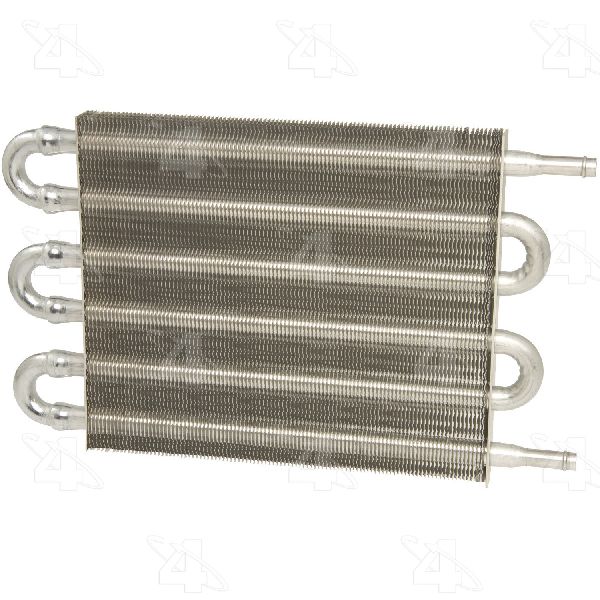
- 2005-2006: The third-generation Odyssey (starting in 2005) came equipped with an external transmission fluid cooler from the factory as part of the towing package, which became more common. The 2002-2004 models often relied solely on the cooler integrated into the radiator. Heat is a primary killer of these transmissions, so the 2005+ models have a slight advantage in longevity, though they are still prone to the same internal clutch failure. Adding an aftermarket cooler to a 2002-2004 model is a highly recommended preventative measure.
- 2002-2004 vs 2005-2006: The 2002-2004 models used the BYA transmission. The 2005-2006 models used the B7XA (also referred to as BGRA/PGRA family). While they are both 5-speed automatics with the same fundamental flaws and failure modes regarding P0780, internal parts and cases may not be interchangeable.
Diagnostic Flowchart
Other Known Issues on This Vehicle
Issues unrelated to this code that are worth knowing about as an owner of this generation:
- Premature Engine Mount Failure 🔴 High — Very common, often occurs between 60,000 and 100,000 miles. The front, side, and rear mounts can all fail, causing excessive engine vibration and noise.
- Power Steering Pump Whine/Failure 🟠 Medium — Commonly reported issue causing a whining or buzzing noise, especially in colder weather. Can lead to a loss of power steering assist. (Ref: Honda TSB 07-005 addresses a defective power steering reservoir causing noise. A recall was also issued for some 2004-2007 models for a power steering pump bolt that could break.)
- Power Sliding Door Malfunction 🟠 Medium — Widespread problem where the cables for the power sliding doors snap or the motor fails, causing the doors to become inoperable.
- Warped Front Brake Rotors 🟡 Low — A frequent complaint causing vibration or pulsation through the steering wheel and brake pedal when braking.
- Fuel Pump Relay Failure 🟠 Medium — A recall (05V-132) was issued for 2005 models where a faulty fuel pump relay could cause the engine to stall or fail to start. (Ref: NHTSA ID: 05V132000)
Used vs. New Parts: Buying Guide for This Vehicle
When a used part is the smart pick: For this specific P0780 fault, sourcing a used transmission assembly from a junkyard is almost never a smart choice. The failure is a known, widespread design flaw, meaning a used unit is highly likely to have the same wear or fail soon after installation. Used external solenoids are also a gamble, as they may have been exposed to the same debris from their donor transmission.
Donor-vehicle mileage cap: roughly under 40000 miles for the part to have meaningful remaining life.
What to inspect on the donor part:
- If considering a used transmission, demand proof of a recent rebuild from a reputable shop with documentation.
- For any used part, check the fluid from the donor vehicle if possible. Any fluid that is dark, burnt, or contains metallic particles is an immediate red flag.
- Ask for a warranty of at least 6 months, which is unlikely for a junkyard transmission.
OEM-only on this vehicle (don't cheap out):
- Automatic Transmission Fluid (Honda ATF-DW1 is mandatory).
- Transmission Control Module (PCM/TCM) - Aftermarket or improperly programmed modules can cause significant issues.
Aftermarket brands forum-validated for this vehicle:
- Rostra is a commonly cited aftermarket brand for transmission solenoids, though user experiences can be mixed compared to OEM.
- For a full replacement, remanufactured units from Jasper or Moveras are generally considered more reliable than a local rebuild unless the shop specializes in Honda transmissions.
Brands owners have reported issues with on this vehicle:
- Unbranded, low-cost solenoid packs from online marketplaces are a significant risk. They often have incorrect resistance values or fail quickly, leading to repeat labor costs.
Real Owner Stories
Aggregated from forums and TSBs cited above. Mileages and costs reflect what owners reported in those sources.
2002-2006 Honda Odyssey
Symptoms: Owner gets a P0780 code and flashing 'D' light, along with shifting problems.
What fixed it: Attempts to fix with a 3x drain-and-fill and cleaning/replacing external solenoids provided only temporary relief for a few hundred or thousand miles. The only long-term solution was a transmission rebuild or replacement.
Source hint: Owner Experience: The Inevitable Rebuild
2003 Honda Pilot
Symptoms: The vehicle set a P0780 trouble code.
What fixed it: The owner performed three drain-and-fills and replaced the dual shift solenoid, but these actions did not fix the problem and the transmission ultimately failed.
Source hint: Reddit r/hondapilot: 2003 Pilot Transmission P0780
2003 Acura TL-S — 400 miles
Symptoms: A P0780 code appeared just 400 miles after a dealer transmission replacement.
What fixed it: The issue was traced to a bad solenoid on the newly installed remanufactured transmission, which was replaced under warranty.
Source hint: Acurazine: P0780 on recently replaced tranny
2002 Acura TL-S
Symptoms: Severe shifting problems accompanied by codes P0730, P0740, and P0780.
What fixed it: The owner accessed and cleaned the clutch pressure control solenoid screens, which reportedly fixed the severe shifting problems, though this is often a temporary solution.
Source hint: YouTube: Transmission Fix: How to Clean Solenoid Screen Filters for Honda/Acura
NHTSA ODI #10610071
Symptoms: An owner reported that the car abruptly changed gears, creating a scary situation where the car behind almost hit them. Diagnostic codes P0730 and P0780 were present.
What fixed it: The owner noted numerous complaints on the web regarding the same transmission problem due to a fault in the shift solenoid or internal components.
NHTSA ODI #10413834
Symptoms: After owning the vehicle for about a year, the owner took it to a dealership where it was found to have three malfunction codes: P0710, P0780, and P1750.
What fixed it: The dealership determined the vehicle needed a new transmission at 148,417 miles.
Related OBD-II Codes
Frequently Asked Questions
My 2005 Odyssey has a flashing 'D' light and code P0780. Will just changing the transmission fluid fix it?
I cleaned the clogged solenoid screens on my transmission and the harsh shifting stopped. Is the problem solved for good?
What is the correct transmission fluid to use in my 2002-2006 Odyssey?
I found TSB 02-062 about a warranty extension for Odyssey transmissions. Does this apply to my 2004 model?
How can I confirm the P0780 code on my Odyssey is caused by internal failure without a teardown?
Is it common for the transmission to need a full rebuild or replacement when a P0780 code appears on these vans?
Helpful Videos
We Have This Part in Stock

The information in this article is provided for general reference and educational purposes only. Vehicle specifications, procedures, and part compatibility can vary by production date, trim level, and region. Always consult your vehicle's factory service manual and verify part numbers before purchasing or performing repairs. Safety-critical components such as airbags, seat belts, and braking systems should be installed by a qualified professional.
- Honda Odyssey:
- 🧭 Diagnostic Flowchart
- 🎬 Helpful Videos
- 🛍️ Shop This Part
- What's Unique About the 2002-2006 Honda Odyssey
- Symptoms You May Notice
- Most Likely Causes
- Diagnosis Steps
- Parts You'll Likely Need
- Related Codes That Often Appear With This One
- Technical Service Bulletins (TSBs) & Recalls
- Platform-Specific Known Issues
- Mechanic-Grade Diagnostic Values
- Hidden / Shadow Codes Worth Checking
- Scan Tool Commands That Help
- Wiring & Ground Locations
- Real Owner Repair Stories
- OEM Part Supersession History
- Model Year Variations Within This Range
- Other Known Issues on This Vehicle
- Used vs. New Parts: Buying Guide for This Vehicle
- Real Owner Stories
- 2002-2006 Honda Odyssey
- 2003 Honda Pilot
- 2003 Acura TL-S — 400 miles
- 2002 Acura TL-S
- NHTSA ODI #10610071
- NHTSA ODI #10413834
- Related OBD-II Codes
- Frequently Asked Questions
- 🎟️ Get 5% Off