

P0780 on 2003-2005 Honda Pilot: Shift Malfunction Causes and Fixes
On a 2003-2005 Honda Pilot, code P0780 almost always indicates a problem with the transmission shift control solenoids or a more serious internal transmission failure. The most common fix is replacing the A/T clutch pressure control linear solenoid assembly, but if this doesn't work, a transmission rebuild or replacement is often necessary. This is a very common and serious issue for this generation of Pilot and its platform-mates.
- P0780 on a 2003-2005 Pilot is a serious code that points to a problem with shift solenoids or internal transmission failure.
- Before considering major repairs, check the transmission fluid level and condition. Use only Honda-specific ATF for any fluid changes.
- The most common repair is to replace the A/T Clutch Pressure Control Solenoid assembly (Part No. 28250-P7W-003).
- If replacing the solenoids and changing the fluid does not resolve the code, the transmission itself has likely failed and will require a costly rebuild or replacement.
- Due to the known issues with these transmissions, professional diagnosis is highly recommended to avoid unnecessary expense.
What's Unique About the 2003-2005 Honda Pilot
The 5-speed automatic transmission (code: BVGA) in the first-generation Honda Pilot (and related Odyssey and Acura MDX models) is known for having a higher-than-average failure rate. Code P0780 on this vehicle is often a precursor to significant transmission problems. While the issue can sometimes be resolved by addressing the external solenoids and their integrated filter screens which get clogged with clutch material, it often points to deeper internal wear that the solenoids can no longer compensate for. The factory service manual's diagnostic path is telling: it quickly escalates from replacing solenoids to replacing the entire transmission if the code returns. Many owners report that replacing solenoids and fluid only provides temporary relief before the transmission fails completely.
Symptoms You May Notice
- Check Engine Light is on
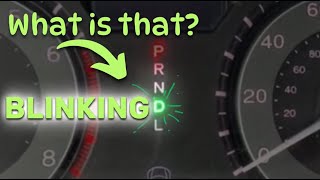
- Flashing 'D' (Drive) indicator light on the instrument cluster
- Harsh or delayed shifting between gears
- Transmission slipping (engine RPMs increase but vehicle speed does not)
- Vehicle feels stuck in a single gear (limp mode)
- Inability to shift into or out of certain gears
- Lurching or jerking during acceleration or deceleration
- Whining noise from the transmission
- Replacing only one of the shift solenoids when the issue is in the main pressure control assembly.
- Replacing the transmission without first attempting to replace the external solenoid assembly, which is a much cheaper and easier repair, though often not a permanent one.
- Assuming a single drain-and-fill will fix a fluid-related problem; multiple changes are needed to get the fluid concentration high enough.
- Mistaking the issue for a bad speed sensor, which is less common for this specific code on this platform.
Most Likely Causes
- Faulty A/T Clutch Pressure Control Solenoids (Linear Solenoid Assembly) 🔴 High Probability → Shop Transmission Clutch Pressure Control Solenoid The filter screens on these solenoids are known to clog with clutch material and other debris from normal (and abnormal) wear, restricting hydraulic pressure and causing shifting errors. This is often the first component to show symptoms of a failing transmission.
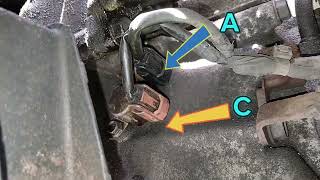
How to confirm: Inspect the solenoid screens for debris. A professional can test solenoid operation with a capable scan tool or by applying 12V power directly. However, given the high failure rate, replacement is often performed as the first step after checking the fluid. The assembly is located on the top/front of the transmission and requires removing the battery and battery tray for access. 🎬 See: Honda V6 solenoid and sensor locations
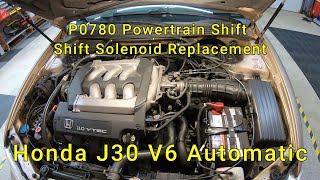
Typical fix: Replace the entire A/T clutch pressure control solenoid assembly (a dual linear solenoid pack). 🎬 Watch: Step-by-step shift solenoid replacement walkthrough It is critical to also replace the gasket and ensure the mating surface on the transmission is perfectly clean. Some owners attempt to clean the screens, but this is often a temporary fix if the solenoids are electrically failing or if internal transmission wear is advanced.
Est. part cost: $150-$450 - Low, Burnt, or Contaminated Automatic Transmission Fluid (ATF) 🟡 Medium Probability → Shop Transmission Assembly These transmissions are extremely sensitive to fluid condition and type. Old fluid loses its properties and can't provide the necessary hydraulic pressure, and it contributes to the sludge that clogs solenoids and internal passages.
How to confirm: Check the transmission fluid dipstick. The fluid should be bright red and not smell burnt. If it is dark brown/black, smells burnt, or has visible metallic particles, it is degraded and indicates significant wear.
Typical fix: Perform a series of 3 to 4 drain-and-fills (never a pressurized flush) using only Honda Genuine ATF-DW1 (or the older, compatible ATF-Z1). One drain-and-fill only replaces about a third of the fluid. This is a necessary step but may not be a final solution if mechanical wear is the root cause.
Est. part cost: $40-$120 for fluid - Internal Transmission Mechanical Failure 🔴 High Probability → Shop Transmission Assembly Worn internal clutch packs, particularly for 3rd gear, are a known, widespread weakness in this 5-speed automatic transmission (BVGA). When they wear, they shed material that clogs filters and passages, and they can no longer hold pressure to engage gears properly, leading directly to the P0780 code.
How to confirm: If new solenoids and multiple drain-and-fills with clean fluid do not fix the code, internal failure is the almost certain cause. A transmission shop can perform a pressure test. Inspecting the drain plug magnet and old fluid for excessive metallic shavings or clutch material is a strong indicator of terminal failure.
Typical fix: The transmission must be rebuilt by a specialist familiar with Honda issues or replaced with a quality remanufactured unit.
Est. part cost: $2000-$4500 for a rebuilt unit
Rare But Worth Checking
- Faulty Powertrain Control Module (PCM): → Shop Engine Control Module (ECM) This is extremely rare. The PCM should only be considered after all other transmission-related possibilities have been exhausted.
- Crossed Solenoid Connectors: There is a Honda service news article mentioning that P0780 can be set if the solenoid electrical connectors are accidentally swapped during a previous repair. It's worth double-checking the connector positions if any recent work has been done.
Diagnosis Steps
- Check the level and condition of the automatic transmission fluid. If it is low, dark, or smells burnt, perform a series of 3-4 drain-and-fills with Honda Genuine ATF-DW1.
- Scan for other transmission-related codes. If P0730 is present, prioritize the P0780 diagnosis.
- Inspect the wiring and connectors for the transmission solenoids for any damage or corrosion. Ensure the connectors are not swapped, per Honda service news.
- Based on the high probability, replace the A/T Clutch Pressure Control Solenoid assembly (dual linear solenoid) along with its gasket. Carefully clean the mounting surface before installing the new part.
- After replacing parts, clear the codes from the PCM and perform a test drive, shifting through all gears for several minutes.
- If the code returns after replacing the solenoids and ensuring the fluid is clean, it indicates a probable internal mechanical failure. At this point, consult a professional transmission shop for a diagnosis or quote for a rebuild/replacement.
Parts You'll Likely Need
- A/T Clutch Pressure Control Solenoid Assembly (Linear)
(OEM #28250-P7W-003)— This is the most frequent cause of P0780 on this vehicle, as its internal filters get clogged, leading to incorrect hydraulic pressure for shifting.
Trusted brands: Honda (OEM), WVE, ATP, Rostra
OEM price range: $350-$520
Aftermarket price range: $100-$250 - Honda Genuine Automatic Transmission Fluid (ATF-DW1)
(OEM #08200-9008)— These transmissions are very sensitive to fluid type and condition. Using only Honda-specific fluid is critical for longevity and proper function. Using non-OEM fluid can accelerate wear.
Trusted brands: Honda (OEM)
OEM price range: $10-$15 per quart
Aftermarket price range: N/A - A/T Clutch Pressure Control Solenoid Gasket
(OEM #28251-P7W-003)— The gasket for the solenoid assembly is a required replacement part to prevent leaks after the repair. It is often sold separately from the solenoid itself.
Trusted brands: Honda (OEM)
OEM price range: $10-$20
Aftermarket price range: $5-$15
Related Codes That Often Appear With This One
- P0730 — P0730 means 'Incorrect Gear Ratio'. P0780 is the command failure, and P0730 is the resulting ratio error (slipping). The service manual for the 2003 Pilot specifically states that if both codes are present, troubleshooting for P0780 should be performed first.
- P0740 — This code relates to the Torque Converter Clutch (TCC) solenoid. The same contaminated fluid and debris that clogs the shift solenoids can also affect the TCC solenoid, causing both codes to appear. The presence of both codes strongly points to widespread internal contamination and likely failure.
Technical Service Bulletins (TSBs) & Recalls
- NHTSA Recall #04V176000: While not for P0780 specifically, this recall addressed a defect in the transmission's second gear that could lead to gear breakage and transmission lock-up. It highlights the known vulnerabilities of this transmission generation.
Platform-Specific Known Issues
- The 2003 and 2005 model year Pilots are specifically cited as having a high number of transmission problems, with the BVGA transmission being a known weak point.
Mechanic-Grade Diagnostic Values
- A/T Clutch Pressure Control Solenoid (Linear Solenoid) Resistance — expected: 5.0 - 5.6 Ohms. Failure: A reading outside of this range, or an Open/OL reading, indicates a faulty solenoid coil.
- Shift Solenoid 'Click Test' — expected: An audible click when 12V power is applied directly to the solenoid's terminals.. Failure: No click indicates the solenoid is mechanically stuck and needs replacement.
Scan Tool Commands That Help
- Honda HDS (or equivalent): Clear DTCs — After replacing any transmission components (like solenoids) or performing a fluid service, the stored fault codes must be cleared from the PCM/TCM. This resets the system and allows for a proper test drive to verify if the repair was successful and the code does not return.
Wiring & Ground Locations
- G101 — At the left rear of the engine.. This is a primary engine and transmission ground. A poor connection at G101 can cause erratic behavior in various electronic components, including transmission solenoids and sensors, potentially leading to incorrect operation and triggering fault codes like P0780.
- Transmission Case Ground — A braided ground strap connecting the transmission housing directly to the vehicle's chassis/frame.. This strap ensures the entire transmission assembly has a solid ground path. Corrosion or a loose connection here can create floating voltages and intermittent electronic faults for all transmission sensors and solenoids.
Real Owner Repair Stories
- Go-Parts.com analysis of early 2000s Honda transmission failures (Early 2000s Honda (platform-mate to Pilot)) — Harsh shifting, P0780 code.
❌ Tried (didn't work) Replacing external transmission solenoids.
✅ What actually fixed it A full transmission rebuild was required. The root cause was determined to be internal clutch pack failure, which is a known weakness. The shed clutch material clogs passages and solenoids, but replacing the solenoids alone does not fix the underlying mechanical wear. - NHTSA ODI #10298588 — An owner reported that the clutch slipped between the first three gears below 40 MPH; the dealership pulled code P0780 despite the transmission fluid appearing pink and not smelling burnt.
- NHTSA ODI #10693871 — A report describes a vehicle with no reverse and no 3rd gear where the fluid smelled burnt; a shop pulled codes P0730 and P0780 and recommended a full transmission replacement.
OEM Part Supersession History
Honda ATF-Z1→Honda ATF-DW1 (08200-9008)— ATF-DW1 is a full synthetic fluid developed to improve performance, especially at low temperatures, and enhance fuel economy.
Heads up: ATF-DW1 is fully backward-compatible with transmissions that originally specified ATF-Z1. You can safely mix DW-1 with remaining Z-1 during a drain-and-fill. However, the older Z-1 is not forward-compatible for newer transmissions that require DW-1 from the factory.
Model Year Variations Within This Range
- 2003-2004 vs 2005: The 2003-2004 Pilot models used the BVGA transmission. The 2005 model year introduced a revised transmission, coded PVGA, along with a more powerful engine with a Drive-by-Wire throttle system. While both are 5-speeds and share similar issues, the 2005 PVGA is considered slightly more robust than the earlier BVGA, though still prone to failure.
Diagnostic Flowchart
Other Known Issues on This Vehicle
Issues unrelated to this code that are worth knowing about as an owner of this generation:
- Premature Timing Belt Tensioner Failure 🔴 High — The timing belt itself has a 105k mile service interval, but the hydraulic tensioner can fail earlier. Failure is catastrophic as the J35A4 is an interference engine.
- Takata Airbag Inflator Recall 🔴 High — Affects nearly all 2003-2005 Pilots. The inflators can rupture during deployment, causing serious injury or death. This is a critical safety recall. (Ref: NHTSA Recalls (e.g., #19V182000, #16V344000))
- Failing Ignition Switch 🟠 Medium — A common issue where the vehicle may stall while driving or fail to start due to a faulty electrical component in the ignition switch. (Ref: NHTSA Recall #02V120000)
- Power Steering Whine/Groan 🟡 Low — A common complaint caused by air entering the power steering system due to a failing O-ring on the power steering pump inlet. The fix is simple and cheap.
- Excessive Oil Consumption 🟠 Medium — While more pronounced on later J35 engines with VCM, some J35A engines can also consume oil, leading to potential engine damage if the level is not monitored.
Used vs. New Parts: Buying Guide for This Vehicle
When a used part is the smart pick: A used A/T Clutch Pressure Control Solenoid Assembly (28250-P7W-003) from a junkyard can be a cost-effective option IF it comes from a low-mileage, documented rear-end collision vehicle where the transmission was known to be in good working order. It is a gamble, but much cheaper than a new OEM part.
Donor-vehicle mileage cap: roughly under 80000 miles for the part to have meaningful remaining life.
What to inspect on the donor part:
- Verify the donor vehicle's mileage is under 80,000 miles.
- Inspect the solenoid's filter screens; they should be perfectly clean with no metallic debris.
- Check the electrical connector pins for any signs of corrosion or damage.
- If possible, perform a resistance test on the solenoid pins before purchase; it should be within the 5.0-5.6 Ohm range.
OEM-only on this vehicle (don't cheap out):
- Automatic Transmission Fluid (ATF): Only use Honda Genuine ATF-DW1. Aftermarket 'universal' fluids are a major cause of shifting problems and accelerated wear in these sensitive transmissions.
- Internal Transmission Components: If a rebuild is necessary, using OEM or proven high-quality aftermarket rebuild kits (like those from Sonnax) is critical. Avoid unspecified, cheap internal parts.
Aftermarket brands forum-validated for this vehicle:
- Rostra: Often cited as a reliable aftermarket manufacturer for transmission solenoids.
- Sonnax: Specializes in high-quality, problem-solving parts for transmission rebuilds, including updated valves to address factory design flaws.
Brands owners have reported issues with on this vehicle:
- Unbranded, generic solenoids from online marketplaces can have high failure rates and may not meet OEM specifications for hydraulic control, leading to the code returning quickly.
Real Owner Stories
Aggregated from forums and TSBs cited above. Mileages and costs reflect what owners reported in those sources.
2003 Honda Pilot 3.5L V6
Symptoms: P0780 code present. Owner performed 3 drain-and-fills of the transmission fluid and replaced the dual shift solenoid, but the symptoms persisted.
What fixed it: The transmission was determined to be 'toast' and required replacement as the solenoid and fluid changes did not resolve the internal failure.
Source hint: Reddit r/hondapilot - '2003 Pilot Transmission P0780'
2003 Honda Pilot 3.5L V6
Symptoms: P0780 code and shift issues. Owner attempted the 3x drain-and-fill procedure and installed a new dual solenoid.
What fixed it: The repairs did not fix the issue and the car was eventually scrapped due to internal transmission failure.
Source hint: Reddit r/MechanicAdvice - 'Honda Pilot 2003 Transmission P0780'
Related OBD-II Codes
Frequently Asked Questions
Does the NHTSA recall for second gear breakage apply to my P0780 code?
Can I just clean the screens on the A/T Clutch Pressure Control Solenoids to fix the P0780 code?
What specific transmission fluid should I use for my 2003-2005 Honda Pilot?
Should I have my transmission flushed to clear out the debris causing the P0780 code?
Where is the A/T clutch pressure control solenoid assembly located on the 3.5L V6?
Are there other major recalls I should be aware of for the 2003-2005 Pilot while fixing the transmission?
Helpful Videos
We Have This Part in Stock

The information in this article is provided for general reference and educational purposes only. Vehicle specifications, procedures, and part compatibility can vary by production date, trim level, and region. Always consult your vehicle's factory service manual and verify part numbers before purchasing or performing repairs. Safety-critical components such as airbags, seat belts, and braking systems should be installed by a qualified professional.
- Honda Pilot:
- 🧭 Diagnostic Flowchart
- 🎬 Helpful Videos
- 🛍️ Shop This Part
- What's Unique About the 2003-2005 Honda Pilot
- Symptoms You May Notice
- Most Likely Causes
- Rare But Worth Checking
- Diagnosis Steps
- Parts You'll Likely Need
- Related Codes That Often Appear With This One
- Technical Service Bulletins (TSBs) & Recalls
- Platform-Specific Known Issues
- Mechanic-Grade Diagnostic Values
- Scan Tool Commands That Help
- Wiring & Ground Locations
- Real Owner Repair Stories
- OEM Part Supersession History
- Model Year Variations Within This Range
- Other Known Issues on This Vehicle
- Used vs. New Parts: Buying Guide for This Vehicle
- Real Owner Stories
- 2003 Honda Pilot 3.5L V6
- 2003 Honda Pilot 3.5L V6
- Related OBD-II Codes
- Frequently Asked Questions
- 🎟️ Get 5% Off