

P0841 on 2008-2014 Dodge Avenger: Transmission Pressure Sensor Causes and Fixes
On a 2008-2014 Dodge Avenger, P0841 usually points to a faulty transmission pressure switch, which is part of the solenoid pack (or valve body assembly). This is a very common failure on the 6-speed 62TE automatic transmission. The fix typically involves replacing this entire assembly, which can cost between $200 and $400 for the part.
- P0841 on a Dodge Avenger points specifically to a problem with the Low/Reverse (L/R) pressure switch circuit.
- The most likely cause is a failed solenoid pack, which houses the pressure switches inside the transmission.
- Symptoms are serious and include the transmission going into 'limp mode,' being stuck in gear, and harsh shifting.
- The fix is not simple; it requires removing the transmission pan to replace the solenoid pack and should generally be left to a professional.
- Always check for other transmission codes, as they can help confirm the diagnosis before starting repairs.
What's Unique About the 2008-2014 Dodge Avenger
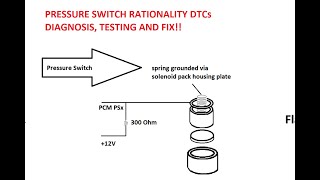
The Dodge Avenger from this era, particularly those equipped with the V6 engine and the 6-speed 62TE automatic transmission, is known for issues with its solenoid pack. The 2.4L 4-cylinder models typically used a 4-speed automatic (40TES/41TES) which has different failure modes, though some 2.4L models were also paired with the 62TE. On the 62TE, the pressure switches are not simple, externally-mounted parts; they are integral to the main solenoid/valve body assembly inside the transmission pan. This makes the repair more involved than a simple sensor swap and is the primary reason P0841 is so common 🎬 Watch: Understanding pressure switch rationality codes and how to fix them. on these vehicles.
Symptoms You May Notice
- Check Engine Light is on
- Transmission defaults to 'limp-in' mode (stuck in 2nd or 3rd gear)
- Vehicle launches from a stop in 2nd gear
- Harsh, erratic, or delayed shifting
- Inability to shift into certain gears
- Reduced fuel economy
- A whining noise during acceleration or a loud "pop" heard while braking (as noted in NHTSA ODI #11707919 and #10177075)
- Replacing only an external speed sensor when the problem is the internal pressure switch.
- Condemning the entire transmission without first diagnosing the solenoid pack and wiring.
Most Likely Causes
- Faulty Transmission Solenoid Pack / Pressure Switch Assembly 🔴 High Probability → Shop Transmission Assembly The pressure switches are integrated into the solenoid pack on the 62TE transmission, and this assembly is a known, high-failure part on many Chrysler/Dodge vehicles. Internal failure of the switch itself is the most common trigger for this code.
How to confirm: A professional technician would use a scan tool to monitor the state of the L/R pressure switch while driving. If the switch state doesn't change correctly with gear changes, or if electrical tests on the circuit show the wiring is good, the solenoid pack is condemned. Resistance checks across specific pins on the solenoid connector can also identify a failed component.
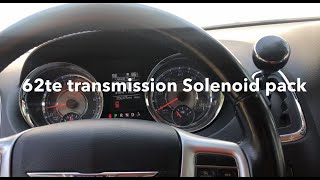
Typical fix: Replace the entire transmission solenoid/pressure switch assembly. This part is located inside the transmission, on the valve body. 🎬 See this step-by-step 62TE solenoid pack replacement walkthrough.
Est. part cost: $200-$400 - Low or Dirty Transmission Fluid 🟡 Medium Probability → Shop Transmission Assembly
How to confirm: Check the transmission fluid level and condition. The fluid should be at the correct level and bright red, not brown, black, or burnt-smelling. Note that many of these vehicles do not have a traditional dipstick and require a special tool or procedure to check the level at the correct temperature. In some cases, a loss of pump prime can trigger this code alongside P0841 (NHTSA ODI #10456949).
Typical fix: Perform a transmission fluid and filter change using the correct ATF+4 fluid. If the fluid is very contaminated, this may be a symptom of a larger internal issue.
Est. part cost: $50-$150 - Damaged Wiring or Corroded Connector ⚪ Low Probability
How to confirm: Visually inspect the wiring harness leading to the transmission's main connector. Check for corrosion, bent pins, or damaged wires. A multimeter can be used to test for continuity and proper voltage on the L/R pressure signal circuit (T50 circuit, per service manuals) between the TCM/PCM and the transmission connector.
Typical fix: Repair the damaged section of the wiring harness or clean/replace the connector.
Est. part cost: $20-$100
Rare But Worth Checking
- Faulty Powertrain Control Module (PCM) or Transmission Control Module (TCM): → Shop Transmission Assembly This is uncommon, but if all other causes have been ruled out, the module itself could be failing to interpret the sensor signal correctly. This should be the last item to consider.
- Internal Mechanical Transmission Failure: → Shop Transmission Assembly A more serious internal problem, like a leaking clutch pack or a stuck valve in the valve body, can cause a loss of hydraulic pressure that triggers the code. This is usually accompanied by other symptoms like loud noises or severe slipping.
Diagnosis Steps
- Check Transmission Fluid: Verify the transmission fluid level is correct and the fluid is in good condition (not burnt or dirty). Top off or change if necessary. Use the proper procedure as no dipstick is present.
- Scan for All Codes: Use an advanced scan tool to check for other related transmission codes, such as P1776, P0846, or P0868. This can help pinpoint the problem faster.
- Monitor Live Data: Use the scan tool to monitor the status of the 'L/R Pressure Switch'. Observe if its state (Open/Closed) changes logically as you shift gears. An unchanging or erratic reading points to a sensor or circuit issue.
- Inspect Wiring: Visually inspect the main transmission wiring harness and connector for any signs of damage, corrosion, or loose connections.
- Perform Electrical Tests: Following the service manual procedure, disconnect the connectors at the PCM and transmission. Use a multimeter to check for continuity, shorts to ground, or shorts to power on the L/R pressure switch signal circuit (identified as the T50 circuit).
- Diagnose the Solenoid Pack: If the wiring is confirmed to be good, the fault lies within the transmission. At this point, the solenoid/pressure switch assembly is the most likely culprit and should be replaced.
- Inspect Valve Body: When the solenoid pack is replaced, it is a good practice to inspect the valve body for any obvious signs of debris or stuck valves.
Parts You'll Likely Need
- Transmission Solenoid / Pressure Switch Pack
(OEM #68376696AA (supersedes 5078709AB))— This is the most common cause of P0841 on the Avenger's 62TE transmission, as it contains the L/R pressure switch that fails.
Trusted brands: Mopar, Dorman (609-040), Rostra
OEM price range: $250-$450
Aftermarket price range: $180-$300 - Automatic Transmission Fluid (ATF+4)
(OEM #MS-9602)— The transmission pan must be dropped to access the solenoid pack, requiring the fluid to be drained and refilled. Approximately 5.5 quarts are needed for a pan drop.
Trusted brands: Mopar ATF+4, Valvoline ATF+4, Castrol ATF+4
OEM price range: $10-$15 per quart
Aftermarket price range: $8-$12 per quart - Transmission Filter and Pan Gasket — These should always be replaced whenever the transmission pan is removed for service.
Trusted brands: Mopar, Wix, ATP
OEM price range: $30-$50
Aftermarket price range: $15-$30
Related Codes That Often Appear With This One
- P1776 — This code means 'Solenoid Switch Valve Latched in LR Position,' which is a direct mechanical/hydraulic fault related to the same L/R circuit that P0841 monitors electrically. Seeing them together strongly points to an issue within the valve body or solenoid pack.
- P0846 — This code relates to the '2/4 Pressure Switch Rationality'. Since the pressure switches are housed together in the solenoid pack, a failure of the pack can often trigger multiple pressure switch codes simultaneously.
- P0868 — This code indicates 'Transmission Fluid Pressure Low'. While P0841 is a circuit performance issue, a genuine low fluid level or failing pump can cause erratic pressure readings that may trigger P0841 as a secondary code.
- P0733 & P0944 — As seen in NHTSA ODI #10456949, P0841 can appear alongside gear ratio errors and loss of pump prime, indicating more severe hydraulic failure.
Technical Service Bulletins (TSBs) & Recalls
- This TSB from 2012 provides a software update for the TCM to improve shift quality, addressing issues like 1-2 upshift clunks. While not a direct fix for a failed part causing P0841, ensuring the TCM software is up-to-date is a good diagnostic step.
- This bulletin discusses the need to clear adaptation memory cells using a scan tool after replacing the valve body or overhauling the transmission to ensure proper shift quality.
Platform-Specific Known Issues
- A user on avengerforumz.com with a 2012 Avenger V6 reported getting codes P0841 and P0868. After replacing the solenoid pack (also called the 'valve body assembly' by the dealer), the problem was resolved. The repair cost them approximately $900 at a dealership.
- On dodge-journey.net, a forum for a platform-mate vehicle, a user details the DIY replacement of the solenoid pack to fix P0841. They emphasize the importance of getting the correct, updated Mopar part and carefully cleaning the valve body surface before installation.
- Multiple owners across different forums have noted that while the Dorman aftermarket solenoid pack (609-040) is cheaper, it has mixed reviews, with some reporting failures shortly after installation, leading to the recommendation of using the OEM Mopar part.
Mechanic-Grade Diagnostic Values
- L/R Pressure Switch Signal Circuit (T50) to Ground Resistance — expected: Above 5.0 Ohms. Failure: A reading below 5.0 Ohms indicates a short to ground in the circuit.
- L/R Pressure Switch Signal Circuit (T50) Voltage — expected: Below 0.5 Volts. Failure: A reading above 0.5 Volts indicates a short to voltage in the circuit.
- Resistance of various solenoids in the pack (tested at the main connector) — expected: Approximately 1.5-1.8 Ohms for most shift solenoids, ~5.0 Ohms for the line pressure solenoid. Values should be consistent across similar solenoids.. Failure: A reading of infinity (open circuit) or a value significantly different from other similar solenoids (e.g., 7.2 Ohms when others are 1.6 Ohms) indicates a failed solenoid within the pack.
- Resistance of pressure switches (tested at the main connector) — expected: Approximately 280-305 Ohms.. Failure: A reading that is significantly out of this range points to a faulty pressure switch inside the solenoid pack.
Scan Tool Commands That Help
- wiTECH (or equivalent advanced scan tool): Reset Adaptive Values — After replacing the solenoid pack or valve body, this function must be performed to clear the old learned values and force the TCM to relearn the characteristics of the new components for proper shift quality.
- wiTECH (or equivalent advanced scan tool): Quick Learn Procedure — A more comprehensive procedure that should be performed after major transmission repairs or replacement. It cycles the transmission through clutches and gears to establish baseline data. Do not perform if any DTCs are present.
Wiring & Ground Locations
- Solenoid Pack Connector Pin 16 — On the main round connector on the side of the 62TE transmission.. This is the pin for the L/R (Low/Reverse) pressure switch signal, which is the specific circuit monitored by code P0841. Electrical tests for this code are focused here.
- T50 Circuit — The wire running from the PCM/TCM to Pin 16 of the transmission solenoid connector.. This is the official service manual designation for the L/R Pressure Switch Signal circuit. Technicians use this identifier to locate the correct wire on diagrams for testing continuity, shorts to ground, or shorts to voltage.
- Solenoid Pack Connector Pin 10 — On the main round connector on the side of the 62TE transmission.. This pin supplies the 12-volt power feed to multiple solenoids within the pack. It is used as a reference point for resistance testing of individual solenoids.
Real Owner Repair Stories
- YouTube user Patrick Neil (2010 Volkswagen Routan SE 4.0L V6 (platform-mate with 62TE transmission)) — Transmission in limp mode, would not shift past 3rd gear, speed limited to ~40 mph.
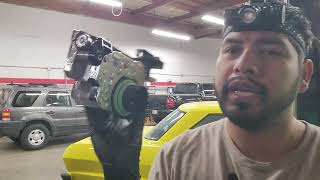
✅ What actually fixed it The user performed a DIY replacement of the entire 62TE solenoid pack. The video details the process of removing the valve body to access the solenoid pack bolts on the back, replacing the pack, and reinstalling. This resolved the limp mode and shifting issues. - Owner of a platform-mate vehicle (NHTSA ODI #11707919) — Reported a loss of propulsion while accelerating accompanied by a P0841 code and a distinct whining noise.
- Owner of a platform-mate vehicle (NHTSA ODI #10456949) — Reported the vehicle would not move under its own power and required towing; diagnostics revealed P0841 (Left Rear Pressure Switch Rationality) along with gear ratio errors.
OEM Part Supersession History
5078709AB→68376696AA— The part was updated by Mopar to improve reliability and address common failure modes of the internal pressure switches and solenoids.
Heads up: The new part (68376696AA) is a direct replacement for the old part and is fully compatible. It is recommended to use the newest part number available.
Model Year Variations Within This Range
- 2011-2014: For the 2011 model year, the Avenger received a major refresh which included the introduction of the 3.6L Pentastar V6 engine, which was paired with the 62TE transmission. Earlier V6 models used 2.7L or 3.5L engines, also with the 62TE. While the transmission is the same, TCM software updates were released over the years to improve shift quality, and it's crucial to ensure the latest software is installed.
Diagnostic Flowchart
Other Known Issues on This Vehicle
Issues unrelated to this code that are worth knowing about as an owner of this generation:
- Front Subframe (Engine Cradle) Corrosion 🔴 High — Very common in salt-belt states. Can become structurally unsound, leading to popping noises or catastrophic failure. (Ref: Chrysler issued a warranty extension (X69) to 10 years for this issue on related platforms like the Dodge Caliber, but not officially for the Avenger, though the problem is identical.)
- Electronic Throttle Body Failure 🔴 High — A widespread and well-documented problem for this generation, often occurring around 90,000 miles. Symptoms include a rough idle, stalling, and the 'red lightning bolt' Electronic Throttle Control (ETC) warning light, which puts the car in limp mode. (Ref: No recall, but it is a very common repair, costing around $300-$500.)
- Totally Integrated Power Module (TIPM) Failure 🟠 Medium — Common failure item causing a wide range of bizarre electrical issues, such as the engine not starting, stalling, horn blaring, or lights not working. Problems can be intermittent and difficult to diagnose. (Ref: No recall for the Avenger, but class-action lawsuits were filed for this part on other Dodge/Chrysler vehicles. Repair can involve a costly replacement or sending the unit for repair.)
- Engine Stalling 🔴 High — Owners report the engine stalling while driving, which can be caused by either a faulty throttle body or a failing TIPM.
Used vs. New Parts: Buying Guide for This Vehicle
When a used part is the smart pick: For this specific repair, purchasing a used solenoid pack is strongly discouraged. The part is a known high-failure item, and a used unit from a salvage yard has an unknown history and a high probability of either being faulty already or failing shortly after installation.
Donor-vehicle mileage cap: roughly under 10000 miles for the part to have meaningful remaining life.
What to inspect on the donor part:
- If forced to consider used, look for parts from a vehicle that was clearly wrecked due to collision, not scrapped for mechanical failure.
- Ask for the VIN of the donor vehicle to check its history and mileage.
- Inspect the electrical connector pins for any signs of corrosion, damage, or moisture intrusion.
OEM-only on this vehicle (don't cheap out):
- Transmission Solenoid Pack
Aftermarket brands forum-validated for this vehicle:
- Mopar (OEM)
Brands owners have reported issues with on this vehicle:
- Dorman (mixed reviews, with reports of early failure)
- Unbranded/white-box units from online marketplaces (high risk of being faulty or remanufactured to poor standards)
Real Owner Stories
Aggregated from forums and TSBs cited above. Mileages and costs reflect what owners reported in those sources.
2012 Dodge Avenger V6
Symptoms: Check Engine Light came on with codes P0841 and P0868.
What fixed it: The dealership replaced the solenoid pack, which they referred to as the 'valve body assembly'.
Cost: $900-$900
Source hint: AvengerForumz - P0841 & P0868 Check Engine Codes
Dodge Journey (V6 Platform Mate)
Symptoms: Experienced code P0841.
What fixed it: A DIY replacement of the solenoid pack. The owner stressed the importance of using an updated OEM Mopar part and cleaning the valve body surface before installation.
Source hint: Dodge Journey Forum - P0841 Code Discussion
Dodge Intrepid (Related Platform)
Symptoms: Owner reported the MIL lamp coming on with codes P0700, P1776, and P0841, often accompanied by a loud "pop" heard while braking.
What fixed it: Research indicated this was a frequent problem for this model line, typically requiring solenoid/valve body attention.
Source hint: NHTSA ODI #10177075
Related OBD-II Codes
Frequently Asked Questions
What is the most common part that fails and causes code P0841 on my 2008-2014 Avenger?
Is it okay to use a cheaper aftermarket Dorman solenoid pack (609-040) instead of the OEM Mopar part?
My Avenger doesn't have a transmission dipstick. How can I check the fluid level?
Will the software update from TSB 21-012-12 REV A fix my P0841 code?
After replacing the solenoid pack, is there anything else a mechanic should do?
What other vehicles share this same transmission problem with the P0841 code?
Helpful Videos
We Have This Part in Stock

The information in this article is provided for general reference and educational purposes only. Vehicle specifications, procedures, and part compatibility can vary by production date, trim level, and region. Always consult your vehicle's factory service manual and verify part numbers before purchasing or performing repairs. Safety-critical components such as airbags, seat belts, and braking systems should be installed by a qualified professional.
- Dodge Avenger:
- 🧭 Diagnostic Flowchart
- 🎬 Helpful Videos
- 🛍️ Shop This Part
- What's Unique About the 2008-2014 Dodge Avenger
- Symptoms You May Notice
- Most Likely Causes
- Rare But Worth Checking
- Diagnosis Steps
- Parts You'll Likely Need
- Related Codes That Often Appear With This One
- Technical Service Bulletins (TSBs) & Recalls
- Platform-Specific Known Issues
- Mechanic-Grade Diagnostic Values
- Scan Tool Commands That Help
- Wiring & Ground Locations
- Real Owner Repair Stories
- OEM Part Supersession History
- Model Year Variations Within This Range
- Other Known Issues on This Vehicle
- Used vs. New Parts: Buying Guide for This Vehicle
- Real Owner Stories
- 2012 Dodge Avenger V6
- Dodge Journey (V6 Platform Mate)
- Dodge Intrepid (Related Platform)
- Related OBD-II Codes
- Frequently Asked Questions
- 🎟️ Get 5% Off