

P0843 on 2007-2008 Honda Fit: 2nd Clutch Pressure Switch Failure Causes and Fixes
This code almost always points to a failed 2nd clutch transmission fluid pressure switch. It's a common, inexpensive part to replace and is accessible for DIY repair, often resolving shifting issues and the blinking 'D' light. The switch is located on the top, exterior of the transmission and can be replaced with a 22mm deep socket.
- P0843 on a 2007-2008 Fit almost always means you need a new 2nd clutch pressure switch (Part No. 28600-RPC-004).
- Look for a flashing 'D' light on your dash as a key symptom.
- This is a very DIY-friendly repair that can be done in under an hour with basic tools, including a 22mm deep socket.
- Always use the correct Honda DW-1 transmission fluid for any top-offs or fluid changes.
- Don't forget to replace the small crush washer (Part No. 90471-PW7-A00) with the new switch to prevent leaks.
What's Unique About the 2007-2008 Honda Fit
For the first-generation Honda Fit (and many other Hondas from this era), the automatic transmission uses several external pressure switches to monitor the hydraulic circuits for different clutches. These switches are a known failure point as they age. The P0843 code specifically targets the switch for the 2nd gear clutch, and it's a very common and well-documented issue in owner forums. Unlike more complex internal transmission failures, this is often a simple, external component swap 🎬 See this walkthrough of the 2nd clutch pressure switch replacement that doesn't require removing the transmission.
Symptoms You May Notice
- Check Engine Light is on
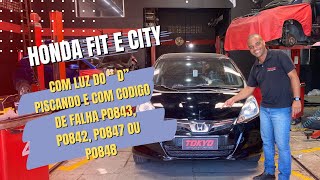
- Flashing 'D' (Drive) indicator light on the instrument cluster 🎬 Watch: How to fix a flashing D light on your Fit
- Harsh or delayed shifting, particularly involving 2nd gear.
- Transmission may feel like it's slipping, hesitating, or shuddering from a stop.
- Inability to use Sport mode or paddle shifters (if equipped).
- Vehicle may feel sluggish or 'stuck' in a single gear (limp mode).
- Replacing the entire transmission valve body
- Assuming a major internal transmission failure without first checking this simple, common switch.
- Performing a transmission fluid flush expecting it to fix an electrical circuit code.
Most Likely Causes
- Failed 2nd Clutch Transmission Fluid Pressure Switch 🔴 High Probability → Shop Transmission Assembly These pressure switches are a very common failure item on Honda automatic transmissions of this vintage due to age, heat cycles, and internal wear.
How to confirm: The most definitive and cost-effective test is to replace the switch. A technician could use a scan tool to monitor the switch's on/off status while driving; if the status doesn't change when shifting into 2nd gear, the switch or wiring is faulty. The switch itself can be tested for continuity with a multimeter and a pressure source.
Typical fix: Replace the 2nd clutch transmission fluid pressure switch and the associated crush washer. This can often be done without draining the transmission fluid.
Est. part cost: $30-$60 - Wiring or Connector Issue 🟡 Medium Probability The switch is located on the exterior of the transmission, exposed to engine heat and road debris. Rodents have also been known to chew the single wire leading to the connector, causing an open circuit. The soy-based wire insulation used by Honda in this era is known to be attractive to rodents.
How to confirm: Visually inspect the single blue/yellow wire and connector leading to the pressure switch for any signs of damage, corrosion, or loose pins. With the key on (engine off), check for a 5-volt reference signal at the connector. Check for continuity to ground through the switch.
Typical fix: Repair the damaged section of wiring or clean/replace the connector pigtail. Apply dielectric grease to the new connection to prevent future corrosion.
Est. part cost: $5-$25 - Low or Dirty Transmission Fluid ⚪ Low Probability → Shop Transmission Assembly
How to confirm: Check the transmission fluid level and condition using the dipstick. The fluid should be at the correct level and should not be dark brown, black, or smell burnt. One owner on a forum noted that their car worked perfectly for a few miles after topping off low fluid, but the P0843 code quickly returned, indicating the switch was the root cause.
Typical fix: Perform a transmission fluid drain and fill using Honda Genuine DW-1 ATF. This is good maintenance but is unlikely to fix a 'Circuit High' code on its own, as it is an electrical fault.
Est. part cost: $40-$80
Rare But Worth Checking
- Faulty Powertrain Control Module (PCM): This is extremely rare. The PCM should only be considered after all other possibilities, including the switch and wiring, have been thoroughly ruled out by testing. A faulty PCM will usually cause multiple other codes and more erratic behavior.
Diagnosis Steps
- Read the code with an OBD-II scanner to confirm P0843 is present.
- Check for the common symptoms: flashing 'D' light and erratic shifting.
- Check the transmission fluid level and condition. If low or dirty, perform a drain and fill with Honda DW-1 ATF, but understand this is unlikely to be the final fix.
- Locate the 2nd clutch pressure switch. It is on the top/front of the transmission case, often visible by looking down past the air filter box. It has a blue or brown electrical connector.
- To gain access, you may need to remove the air cleaner box assembly 🎬 Watch: A guide to locating and replacing the pressure sensor (top and bottom halves).
- Inspect the wiring and connector going to the switch for any visible damage, corrosion, or looseness.
- If the wiring looks good and the fluid level is correct, the most likely cause is the switch itself. Disconnect the electrical connector.
- Using a 22mm deep well socket, remove the old switch.
- Install the new crush washer (gasket) and thread in the new pressure switch. Torque to 14 ft-lbs (20 N-m) if a torque wrench is available, otherwise snug it firmly.
- Reconnect the electrical connector, applying a small amount of dielectric grease to the contacts is recommended.
- Reassemble the air cleaner box.
- Clear the trouble code with the scanner and perform a test drive to ensure the issue is resolved.
Parts You'll Likely Need
- 2nd Clutch Transmission Fluid Pressure Switch
(OEM #28600-RPC-004)— This switch is the most common failure point for code P0843 on this vehicle. The original part 28600-RPC-003 was superseded by 28600-RPC-013, which was then superseded by 28600-RPC-004.
Trusted brands: Honda (Genuine), Standard Motor Products, Wells, Rostra
OEM price range: $50-$95
Aftermarket price range: $25-$50 - Crush Washer / Gasket for Pressure Switch
(OEM #90471-PW7-A00)— A new crush washer is required to ensure a proper seal when replacing the pressure switch and prevent transmission fluid leaks. Some aftermarket switches may not include one.
Trusted brands: Honda (Genuine)
OEM price range: $2-$5
Aftermarket price range: $1-$3
Platform-Specific Known Issues
- The pressure switches for the 2nd and 3rd clutches are a known weak point on this generation of Honda automatic transmissions. Many owners choose to replace them proactively or at the first sign of trouble.
Mechanic-Grade Diagnostic Values
- Voltage at the pressure switch connector (wire side) with connector unplugged, key on, engine off. — expected: Approximately 5 volts.. Failure: No voltage indicates a wiring problem or a fault in the PCM's 5V reference circuit. This must be fixed before condemning the switch.
- Continuity test of the pressure switch itself (off the vehicle). — expected: No continuity (open circuit) when no pressure is applied. Continuity (closed circuit) when specified air pressure (approx. 25 PSI) is applied.. Failure: Continuity when no pressure is applied, or no continuity when pressure is applied, indicates a failed switch.
- Jumper Wire Test (Live Data). — expected: With a scan tool monitoring live data for the switch, use a jumper wire to ground the signal pin at the sensor connector. The voltage should drop to 0V.. Failure: If the voltage drops to 0V, the wiring and PCM are confirmed good, and the sensor itself is faulty. If the voltage remains high, there is an open circuit in the wiring between the connector and the PCM.
Scan Tool Commands That Help
- Honda Diagnostic System (HDS): A/T Data List — To monitor the live status (ON/OFF) of the 2nd clutch pressure switch while driving or shifting gears. If the status does not change when 2nd gear is engaged, it points to a fault in the switch or circuit.
- Honda Diagnostic System (HDS): Clear DTC — Required after the repair to clear the P0843 code and turn off the Check Engine Light and flashing 'D' indicator.
- Honda Diagnostic System (HDS): Monitor OBD STATUS — Used during the post-repair verification test drive to confirm that the fault does not return and the system status changes to 'PASSED'.
Wiring & Ground Locations
- PCM (Powertrain Control Module) — Located behind the passenger side glovebox.. The PCM receives the signal from the pressure switch. The wire from the switch runs to a specific pin on the PCM connectors (Connector B, Pin 49 in some similar models). A wiring fault is often between the switch and this location.
- G101 — A primary engine wiring harness ground, typically located on or near the thermostat housing.. A poor G101 ground can cause numerous erratic engine and transmission electrical issues. While not a direct cause of a 'Circuit High' code (which is an open), ensuring all grounds are clean and tight is a critical step in any electrical diagnosis.
- G3 — The main transmission ground wire/strap.. The pressure switch grounds through the transmission case. A poor transmission ground can create voltage offsets and unreliable sensor readings for all transmission sensors.
Real Owner Repair Stories
- fitfreak.net user 'Dennis_Oates' (2007 Honda Fit Sport Automatic, 195,000 miles) — Will not shift into 5th gear, flashing 'D' light, P0843 code set.
❌ Tried (didn't work) Replacing the 2nd clutch pressure switch (the new switch tested good on the bench with air pressure)., Replacing the transmission oil filter., Two transmission fluid drain-and-fills.
✅ What actually fixed it The user noted that the transmission fluid was initially low. After topping it off, the car worked perfectly for about 3 miles before the problem returned and the code was set again. This strongly implies that while fluid level was a contributing factor, the pressure switch was indeed the root cause, failing under normal operating conditions despite passing a bench test. The ultimate resolution was the switch replacement. - YouTube channel 'Fix It All' (Honda Fit (approx. 2015, but demonstrates a common Honda issue)) — Sudden check engine light for a transmission solenoid, harsh shifting.
❌ Tried (didn't work) Initially considered replacing the solenoid, but the dealer had never sold one, indicating it's not a common failure part.
✅ What actually fixed it The cause was rodent damage. The soy-based insulation on the wiring harness leading to the transmission solenoids had been chewed through, causing an open circuit. The fix was to repair the chewed wires by soldering in new sections, which resolved the code and shifting issues. - Honda Odyssey Owner (Cross-Manufacturer Reference) — While occurring on a different model, NHTSA ODI #11698241 describes a scenario where a check engine light was illuminated and code P0843 was retrieved alongside a cylinder 3 misfire and an oil leak. This highlights that P0843 can sometimes appear in conjunction with other engine performance issues.
OEM Part Supersession History
28600-RPC-003→28600-RPC-013, then 28600-RPC-004— Part revision and improvement by the manufacturer.
Heads up: The newest part number, 28600-RPC-004, is the correct and fully compatible replacement for all previous versions for this vehicle.
Model Year Variations Within This Range
- 2007-2008: There are no significant differences between the 2007 and 2008 model year Honda Fit automatic transmissions that would affect the diagnosis or repair of code P0843. Parts are interchangeable.
Diagnostic Flowchart
Other Known Issues on This Vehicle
Issues unrelated to this code that are worth knowing about as an owner of this generation:
- Driver's Master Power Window Switch Failure 🔴 High — Very common. Subject to multiple recalls (NHTSA 10V-033, 13V-260) due to fire risk. (Ref: NHTSA Recall #13V-260. Water can enter the switch, causing it to short out, overheat, and potentially cause a fire. The initial recall fix was found to be insufficient, leading to a second recall.)
- Water Leaks into Cabin/Trunk 🟠 Medium — Commonly reported by owners. Onset can be anytime. (Ref: null. Owners on forums report cracks in the roof seam welds near the rear hatch as a primary cause, allowing water to seep into the spare tire well. Other leaks are reported through door seals.)
- Lost Motion Spring Failure (2009-2010 models) 🔴 High — Common enough to trigger a recall for the subsequent model years (2009-2010), but the underlying engine design is similar. Affects the valvetrain. (Ref: Recall for 2009-2010 models. The springs can bend or break, causing engine noise, damage, or stalling. While the recall is not for 07-08 models, it highlights a potential weakness in the L-series engine family.)
- Ignition Coil Failure 🟠 Medium — A common cause for a rough running engine and misfire codes (P0301-P0304) as the vehicle ages. (Ref: null. This is a typical wear-and-tear item, but frequently discussed by owners as a primary tune-up part to replace along with spark plugs to resolve engine hesitation.)
- Electric Power Steering (EPS) Faults 🔴 High — A notable number of complaints led to a warranty extension. (Ref: Warranty Extension (not a recall) for the EPS unit to 10 years/150,000 miles. Can cause heavy steering and store various EPS-related trouble codes.)
Used vs. New Parts: Buying Guide for This Vehicle
When a used part is the smart pick: For this specific repair, a used part is NOT recommended. The part is a low-cost electronic switch with a high failure rate due to age and heat cycles. The labor to replace it, while not extensive, is enough to make installing a used part with an unknown lifespan a poor value proposition.
What to inspect on the donor part:
- Not applicable as used parts are not recommended.
OEM-only on this vehicle (don't cheap out):
- While not strictly 'OEM-only', using a Genuine Honda (28600-RPC-004) switch is the safest bet for guaranteed compatibility and longevity. Transmission fluid should always be Honda Genuine DW-1.
Aftermarket brands forum-validated for this vehicle:
- Standard Motor Products (Intermotor)
- Wells
- Denso (often the OEM manufacturer)
Brands owners have reported issues with on this vehicle:
- Avoid unbranded, no-name parts from online marketplaces. Many forum users report issues with cheap knock-off sensors failing prematurely.
Real Owner Stories
Aggregated from forums and TSBs cited above. Mileages and costs reflect what owners reported in those sources.
2007-2008 Honda Fit
Symptoms: The car had a P0843 code and a flashing 'D' light. After discovering the transmission fluid was low and topping it off, the car drove perfectly for about 3 miles before the code and shifting issues returned.
What fixed it: Replacing the 2nd clutch transmission fluid pressure switch ultimately resolved the problem.
Source hint: fitfreak.net - Unofficial Honda FIT Forums
Honda Odyssey (Cross-Manufacturer Reference)
Symptoms: An owner reported that the check engine light was illuminated. Upon diagnosis at a local dealer, a cylinder 3 misfire and DTC P0843 were retrieved, along with an oil leak (NHTSA ODI #11698241).
What fixed it: The vehicle was not repaired at the time of the report, but the diagnosis confirmed the presence of the P0843 code alongside other engine faults.
Source hint: NHTSA ODI #11698241
Related OBD-II Codes
Frequently Asked Questions
Where is the 2nd clutch pressure switch located on my 2007 Fit?
Is the P0843 code a common problem on the 2007-2008 Honda Fit?
What is the part number for the pressure switch that causes P0843?
Can I replace the P0843 pressure switch myself?
Why might rodents cause the P0843 code on my Honda Fit?
What type of transmission fluid should I use in my 2008 Fit if I check the level?
Helpful Videos

We Have This Part in Stock

The information in this article is provided for general reference and educational purposes only. Vehicle specifications, procedures, and part compatibility can vary by production date, trim level, and region. Always consult your vehicle's factory service manual and verify part numbers before purchasing or performing repairs. Safety-critical components such as airbags, seat belts, and braking systems should be installed by a qualified professional.
- Honda Fit:
- 🧭 Diagnostic Flowchart
- 🎬 Helpful Videos
- 🛍️ Shop This Part
- What's Unique About the 2007-2008 Honda Fit
- Symptoms You May Notice
- Most Likely Causes
- Rare But Worth Checking
- Diagnosis Steps
- Parts You'll Likely Need
- Platform-Specific Known Issues
- Mechanic-Grade Diagnostic Values
- Scan Tool Commands That Help
- Wiring & Ground Locations
- Real Owner Repair Stories
- OEM Part Supersession History
- Model Year Variations Within This Range
- Other Known Issues on This Vehicle
- Used vs. New Parts: Buying Guide for This Vehicle
- Real Owner Stories
- 2007-2008 Honda Fit
- Honda Odyssey (Cross-Manufacturer Reference)
- Related OBD-II Codes
- Frequently Asked Questions
- 🎟️ Get 5% Off