

P0868 on 2007-2012 Dodge Caliber: CVT Transmission Fluid Pressure Low Causes and Fixes
On a 2007-2012 Dodge Caliber, P0868 almost always points to an issue with the Jatco JF011E CVT transmission, most commonly low/degraded fluid or clogged filters. This is a serious code that requires immediate attention to prevent catastrophic transmission failure, which is common on this vehicle and its platform mates like the Jeep Compass and Patriot.
- P0868 on a Dodge Caliber is a critical warning of low pressure in the CVT, often a precursor to complete transmission failure.
- The most common and easiest things to check first are the CVT fluid level and condition. This requires a special tool.
- This transmission has two filters; both must be replaced during a fluid service to ensure proper fluid flow.
- Always use Mopar CVTF+4 or an exact equivalent. The wrong fluid will cause severe damage.
- Do not continue to drive the vehicle. Addressing the issue immediately by servicing the fluid and filters may prevent a multi-thousand dollar transmission replacement.
What's Unique About the 2007-2012 Dodge Caliber
The 2007-2012 Dodge Caliber uses a Jatco JF011E Continuously Variable Transmission (CVT), which is known for being particularly sensitive to fluid condition and level. Unlike many vehicles, the Caliber has no traditional transmission dipstick 🎬 Watch: How to check fluid levels without a dipstick, requiring a special tool and a temperature-based chart for an accurate fluid level check. Furthermore, this CVT has two filters—a primary one in the pan and a secondary, often-overlooked cartridge filter for the transmission cooler—both of which can get clogged and cause the low pressure condition that triggers code P0868. 🎬 See this guide on diagnosing the P0868 trouble code Neglecting the secondary filter is a very common cause of repeat failures.
Symptoms You May Notice
- Check Engine Light is on
- Transmission overheating warning light illuminates
- Whining or grinding noise from the transmission, especially at highway speeds
- Vehicle enters 'limp mode' (stuck in a low ratio, reduced power)
- Hesitation, slipping, or shuddering during acceleration
- Complete loss of power to the wheels
- Burning smell from overheated fluid
- Delayed engagement when shifting from Park to Drive or Reverse
- Replacing only the main filter in the pan and not the secondary cooler filter.
- Replacing the entire transmission without first verifying the fluid level/condition and checking for clogged filters.
- Adding incorrect transmission fluid (e.g., standard ATF instead of CVTF+4), which can quickly destroy the CVT.
- Assuming the transmission is bad when the issue is a simple wiring problem to the pressure sensor.
Most Likely Causes
- Low, Degraded, or Incorrect Transmission Fluid 🔴 High Probability → Shop Transmission Assembly The CVT is highly sensitive to fluid quality and level. The lack of a dipstick makes it difficult for owners to check, leading to neglect. Using anything other than the specified Mopar CVTF+4 fluid can cause damage and pressure issues.
How to confirm: Check the fluid level using a special dipstick tool (sold separately) and a temperature chart. The fluid should be clear and greenish, not dark brown or black, and should not have a burnt smell.
Typical fix: Perform a transmission fluid and filter service using the correct Mopar CVTF+4 fluid (Part #5191184AB or equivalent).
Est. part cost: $100-$200 - Clogged Transmission Filters 🔴 High Probability → Shop Transmission Assembly This CVT has two filters. The secondary cooler filter is in a separate housing near the battery and is frequently missed during service, leading to restricted flow and pressure drops.
How to confirm: During a fluid service, inspect the filter in the pan. If it is clogged with debris, the secondary cooler filter is almost certainly clogged as well and must be replaced. Many owners report the P0868 code appearing specifically because this filter was neglected. 🎬 Watch: A breakdown of common P0868 engine code causes
Typical fix: Replace both the main transmission pan filter and the secondary cooler filter cartridge.
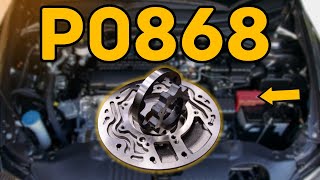
Est. part cost: $40-$80 - Failing Transmission Oil Pump 🟡 Medium Probability → Shop Transmission Assembly The oil pump creates all hydraulic pressure. Wear and tear, exacerbated by old fluid or overheating, can cause it to fail. A common failure point within the pump is a worn flow control valve, which leads to a direct loss of pressure.
How to confirm: After confirming fluid and filters are good, a technician must use a scan tool to monitor desired vs. actual line pressure. If actual pressure is consistently low, the pump is a likely culprit.
Typical fix: This is a major repair requiring transmission removal to replace the oil pump or its internal components. Often, a full transmission rebuild or replacement is more cost-effective.
Est. part cost: $1500-$4000 - Faulty Transmission Fluid Pressure Sensor ⚪ Low Probability → Shop Transmission Assembly
How to confirm: If a manual pressure gauge shows pressure is normal but the code persists, the sensor may be sending false low readings. This involves testing the sensor's circuit and voltage.
Typical fix: Replace the transmission fluid pressure sensor, which is often located on the valve body inside the transmission pan.
Est. part cost: $50-$150
Rare But Worth Checking
- Failing Valve Body: → Shop Transmission Valve Body The valve body directs fluid flow. A stuck solenoid, a worn bore, or a malfunctioning ratio control valve within the assembly can cause a pressure drop. This is an internal transmission repair.
- Faulty Transmission Control Module (TCM): → Shop Transmission Assembly While rare, the TCM itself can fail and misinterpret pressure readings. This is usually diagnosed after all other mechanical and electrical causes have been ruled out.
Diagnosis Steps
- Scan for all diagnostic trouble codes. Note if P0700 is present with P0868.
- Check for any active transmission fluid leaks around the pan, axle seals, and cooler lines.
- Using the correct special tool, check the CVT fluid level and condition, referencing a temperature chart for accuracy. Note the color and smell of the fluid.
- If the fluid is low, dirty, or old, perform a fluid and filter change. CRITICAL: You must replace BOTH the pan filter and the secondary cooler filter located under the battery tray.
- Use only Mopar CVTF+4 (Part #5191184AB) or a fully compatible equivalent fluid.
- After the service, clear the codes and perform a test drive to see if the code returns. Many owners report the code appears under load, such as going up a hill.
- If the code persists, use a professional scan tool to monitor live transmission data, comparing desired line pressure to actual line pressure.
- If actual pressure is confirmed to be low, the issue is likely mechanical (oil pump, valve body, internal leak). If actual pressure is good but the code returns, suspect a faulty pressure sensor or wiring.
- Inspect the wiring harness to the transmission for any damage or corrosion. Battery acid dripping from the tray above can corrode the harness leading to the case connector.
- If major components like the valve body or transmission are replaced, perform the 'Adaptation Drive Learn' procedure as outlined in Chrysler service literature to ensure proper shifting.
Parts You'll Likely Need
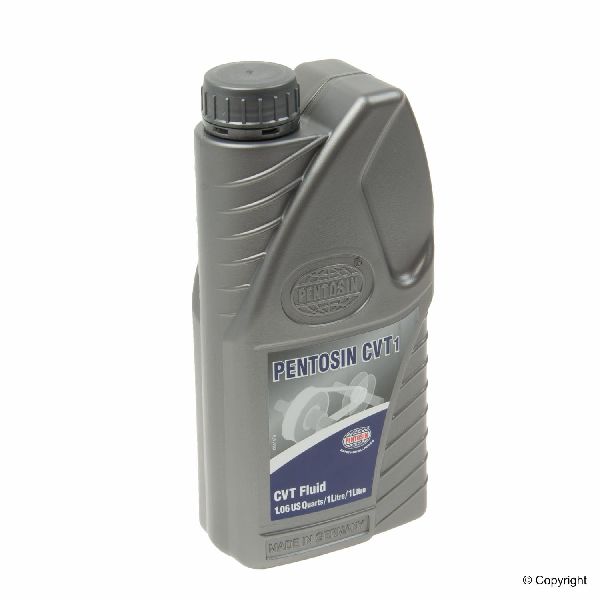
- CVT Fluid
(OEM #5191184AB (Quart), 05191185AC (5-Liter))— The correct fluid (Mopar CVTF+4) is critical for the health and function of the Jatco CVT.
Trusted brands: Mopar
OEM price range: $25-$35 per quart
Aftermarket price range: $15-$25 per quart - CVT Filter Kit (Pan Filter and Cooler Filter)
(OEM #5191890AA)— Clogged filters are a primary cause of low fluid pressure. Both must be replaced during a service.
Trusted brands: Mopar, Wix, ATP
OEM price range: $60-$100
Aftermarket price range: $30-$60 - Transmission Fluid Pressure Sensor
(OEM #68003360AC (verify with dealer))— Can fail and send incorrect low-pressure signals to the TCM, triggering the code even if the pressure is mechanically sound.
Trusted brands: Mopar, Standard Motor Products (SMP), Dorman
OEM price range: $100-$180
Aftermarket price range: $50-$120
Related Codes That Often Appear With This One
- P0700 — P0700 is a generic code that means the Transmission Control Module (TCM) has stored a fault. It acts as a 'check engine light' for the transmission, and P0868 is the specific fault it has detected.
Technical Service Bulletins (TSBs) & Recalls
- While no Dodge TSB directly for P0868 on the Caliber was found, TSB 21-013-08 was issued for other Chrysler models to fix transmission issues with a software update, indicating that a PCM flash could be a potential step in diagnosis.
- Chrysler Service Bulletin 21-013-13 details the mandatory 'Adaptation Drive Learn' procedure required after replacing a valve body or overhauling the transmission to ensure proper shift quality and prevent future codes.
Platform-Specific Known Issues
- The Jatco JF011E CVT is known for premature failures, often preceded by code P0868, with many failing between 80,000 and 120,000 km.
- The vehicle does not have a user-serviceable transmission dipstick, making fluid checks difficult for the average owner.
- The presence of a secondary, 'hidden' transmission cooler filter that is often neglected during service, leading to flow blockages and subsequent low pressure codes.
- Owners often report the first instance of P0868 and limp mode occurs during high-load driving, like accelerating onto a highway or climbing a steep grade, which demands maximum hydraulic pressure.
- Cross-manufacturer records for Dodge vehicles show that P0868 is frequently associated with other transmission faults; for instance, NHTSA ODI #11580539 notes P0868 appearing alongside P1790 and P0733 when a transmission failed.
Mechanic-Grade Diagnostic Values
- CVT Fluid Temperature Sensor Resistance — expected: ~6.5 kΩ at 20°C (68°F), ~0.9 kΩ at 80°C (176°F).. Failure: Readings significantly outside the expected range for a given temperature indicate a faulty sensor.
- Line Pressure and Secondary Pressure Control Solenoid Resistance — expected: 3.0 - 7.0 Ω.. Failure: Resistance outside this range indicates a failed solenoid coil.
- Torque Converter Clutch (TCC) Control Solenoid Resistance — expected: 3.0 - 9.0 Ω.. Failure: Resistance outside this range points to a faulty TCC control solenoid.
- Lock-Up Select Switch Solenoid Resistance — expected: 15.0 - 38.0 Ω.. Failure: An out-of-spec reading suggests the solenoid needs replacement.
- Scan Tool Live Data: Actual vs. Desired Line Pressure — expected: Actual pressure should closely track desired pressure. During shifts or in Park/Neutral, pressure is preset to 827-931 kPa (120-135 PSI).. Failure: If actual pressure is consistently more than 10 PSI below desired pressure, the P0868 code will set, indicating a mechanical pressure loss (pump, filter, leak).
- Pressure Sensor Circuit Voltage (Scan Tool) — expected: 0.5 - 4.5V.. Failure: A voltage reading above 5V suggests a short to voltage in the sensor or wiring.
- 5-Volt Supply Circuit to Pressure Sensor — expected: Resistance to ground should be above 5.0 ohms.. Failure: Resistance below 5.0 ohms indicates a short to ground in the F856 5-volt supply circuit.
Scan Tool Commands That Help
- wiTECH (or equivalent professional scanner): CVT Adaptation Learn Procedure — This procedure is mandatory after replacing the transmission, valve body, or TCM. It allows the control module to learn the hydraulic and mechanical characteristics of the new components to ensure smooth operation and prevent future codes.
- wiTECH (or equivalent professional scanner): Live Data Monitoring (Desired vs. Actual Line Pressure) — This is the primary diagnostic step to determine if P0868 is caused by a true low-pressure condition or a sensor/electrical fault. If actual pressure is low, the problem is mechanical. If actual pressure is good but the code sets, the problem is electrical.
- wiTECH (or equivalent professional scanner): Actuation Tests / Bi-Directional Pump Activation — Allows a technician to manually command the transmission's oil pump to run with the engine off. By connecting a mechanical pressure gauge, this test can isolate a faulty pump if it fails to build adequate pressure when commanded.
Wiring & Ground Locations
- G110 — On the right frame rail, located just ahead of or below the windshield washer reservoir.. This is a major chassis ground point. A poor connection here can cause a variety of seemingly unrelated high-circuit codes and electrical issues, potentially affecting transmission sensor readings.
- Transmission Case Connector Harness — The wiring harness leading to the main transmission case connector, routed underneath the battery tray.. Battery acid can leak from the drain tube in the battery tray directly onto this harness, causing corrosion and disintegration of the wires. This can lead to open or shorted circuits for the pressure sensors and solenoids, directly causing P0868 and other transmission codes.
- TCM Ground — The Transmission Control Module (TCM) has a dedicated ground circuit. On a 2011 Caliber, it is part of the main ground distribution system.. A faulty ground for the TCM can cause it to misread sensor inputs or operate solenoids incorrectly, leading to false pressure codes.
- Transmission Solenoid/TRS Assembly Connector — The main electrical connector on the transmission case.. This is the central point for testing solenoid and sensor circuits. For Dodge/Jeep applications of the JF011E, terminal 6 in this connector must be used as the ground path when checking resistance for several key solenoids.
Real Owner Repair Stories
- The Flat Rate Mechanic on YouTube (2007-2008 Dodge Patriot 2.4L (Same platform/drivetrain as Caliber)) — Check Engine Light with multiple codes (P0647, P2010, P0032), A/C not working.
❌ Tried (didn't work) Cleaning the G110 ground connection did not resolve the issue.
✅ What actually fixed it The ground wire (Z916 circuit, Black/White) in the C100 connector was broken somewhere in the harness. The mechanic fixed it by splicing into the wire at the connector and running a new, redundant ground wire directly to a clean chassis ground point. This resolved all the trouble codes. - NHTSA ODI #11443161 — An owner of a similar Dodge vehicle reported the transmission started making a grinding noise followed by fault code P0868, with a dealership repair estimate exceeding $1,500.
- NHTSA ODI #11120197 — A Dodge owner reported receiving P0868 (Transmission Fluid Pressure Low) along with P0740 (Torque Converter Clutch Circuit/Open) and P0732 (Gear 2 Incorrect Ratio).
OEM Part Supersession History
5191184AA (Quart)→5191184AB (Quart)— Standard part number update/revision.5191185AA (Gallon)→5191185AC (5-Liter)— Standard part number update/revision and change in volume.5189840AA (Secondary Revolution Sensor)→5189840AB— Standard part number update/revision.68070618AA (Valve Body Kit)→RL070618AA— Part number updated to reflect it is a remanufactured component.
Diagnostic Flowchart
Other Known Issues on This Vehicle
Issues unrelated to this code that are worth knowing about as an owner of this generation:
- Front and Rear Subframe Corrosion 🔴 High — Very common, especially in regions using road salt. Can become structurally unsafe. An extended warranty was issued for 2007 models, but later years are also affected. (Ref: Extended Warranty (X23) for 2007 models, but not a formal recall.)
- Prematurely Worn Suspension Components 🟠 Medium — Frequently reported between 70,000 and 120,000 km. Owners complain of clunking noises, bouncy ride, and uneven tire wear due to failing control arms, ball joints, and tie rod ends.
- Engine Stalling or Hesitation 🟠 Medium — Commonly reported issue often traced to a faulty throttle body, powertrain control module (PCM) software, or other sensors.
- Sunroof Drain Tube Leaks 🟡 Low — Clogged or detached sunroof drain tubes are a common source of water leaking into the cabin, potentially damaging the headliner and interior electronics.
Used vs. New Parts: Buying Guide for This Vehicle
When a used part is the smart pick: For this specific repair, sourcing used parts is generally not recommended for major components. However, a used valve body from a known-good, low-mileage donor vehicle can be a cost-effective option if the issue is confirmed to be isolated to the valve body and not the pump or pulleys. External components like sensors or wiring harnesses are also reasonable used purchases.
Donor-vehicle mileage cap: roughly under 80000 miles for the part to have meaningful remaining life.
What to inspect on the donor part:
- Verify the donor vehicle's mileage; lower is always better for a CVT.
- Ask for service records if possible, specifically looking for regular CVT fluid changes.
- When buying a complete used transmission, inspect the fluid from the donor unit. If it is dark, burnt, or contains metal particles, reject the part.
- Check the transmission case for any signs of external damage or previous repairs.
OEM-only on this vehicle (don't cheap out):
- CVT Fluid (Mopar CVTF+4 or a fluid that explicitly meets the CVTF+4 spec). Using generic CVT fluid or standard ATF will cause damage.
Aftermarket brands forum-validated for this vehicle:
- For filters, brands like Wix, ATP, and Carquest Premium are frequently cited as reliable alternatives to OEM.
Brands owners have reported issues with on this vehicle:
- Avoid unbranded, 'white box' solenoid kits and sensors from online marketplaces, as their quality control can be inconsistent and lead to repeat failures.
Real Owner Stories
Aggregated from forums and TSBs cited above. Mileages and costs reflect what owners reported in those sources.
2007-2012 Dodge Caliber
Symptoms: The P0868 code appeared intermittently, specifically when towing a trailer.
What fixed it: The owner was advised by other forum members that the cause was a low pressure issue, which should be investigated starting with fluid and filters.
Source hint: DodgeForum.com - 'P0868 code, occasionally'
2007-2012 Dodge Caliber — ~62000 miles
Symptoms: The first instance of P0868 and limp mode occurred during high-load driving, like accelerating onto a highway or climbing a grade.
What fixed it: This scenario is commonly caused by restricted fluid flow from a clogged secondary transmission cooler filter, which is often neglected during service.
Source hint: Vehicle Specific Issues
2007-2012 Dodge Caliber
Symptoms: After a transmission fluid service, the vehicle developed a whining noise and the P0868 code appeared, putting the car into limp mode.
What fixed it: The problem was resolved by replacing the secondary cooler filter cartridge, which had been missed during the initial service.
Cost: $40-$80
Source hint: Common Causes - Clogged Transmission Filters
Documented NHTSA Reports
NHTSA ODI #11683914
Symptoms: An owner reported the transmission was slipping in first gear. Dealership diagnostics confirmed codes P0944 (Loss of Prime) and P0868 (Low Pressure).
NHTSA ODI #11680414
Symptoms: A report filed with the NHTSA noted a P0868 low pressure condition and suggested that existing transmission recalls should be expanded to cover more manufacturing dates.
Related OBD-II Codes
Frequently Asked Questions
Where is the 'hidden' transmission filter on my 2007-2012 Dodge Caliber that my mechanic might miss?
What is the exact transmission fluid I should use for my Caliber's CVT?
Why does my Caliber only go into 'limp mode' when I'm accelerating hard or going up a hill?
I can't find a transmission dipstick on my Caliber. How do I check the fluid level?
My mechanic replaced the valve body. Is there a special procedure required afterwards?
Is the CVT in my Dodge Caliber known to be unreliable?
Could a simple software update fix my P0868 code?
Helpful Videos
We Have This Part in Stock

The information in this article is provided for general reference and educational purposes only. Vehicle specifications, procedures, and part compatibility can vary by production date, trim level, and region. Always consult your vehicle's factory service manual and verify part numbers before purchasing or performing repairs. Safety-critical components such as airbags, seat belts, and braking systems should be installed by a qualified professional.
- Dodge Caliber:
- 🧭 Diagnostic Flowchart
- 🎬 Helpful Videos
- 🛍️ Shop This Part
- What's Unique About the 2007-2012 Dodge Caliber
- Symptoms You May Notice
- Most Likely Causes
- Rare But Worth Checking
- Diagnosis Steps
- Parts You'll Likely Need
- Related Codes That Often Appear With This One
- Technical Service Bulletins (TSBs) & Recalls
- Platform-Specific Known Issues
- Mechanic-Grade Diagnostic Values
- Scan Tool Commands That Help
- Wiring & Ground Locations
- Real Owner Repair Stories
- OEM Part Supersession History
- Other Known Issues on This Vehicle
- Used vs. New Parts: Buying Guide for This Vehicle
- Real Owner Stories
- 2007-2012 Dodge Caliber
- 2007-2012 Dodge Caliber — ~62000 miles
- 2007-2012 Dodge Caliber
- Documented NHTSA Reports
- NHTSA ODI #11683914
- NHTSA ODI #11680414
- Related OBD-II Codes
- Frequently Asked Questions
- 🎟️ Get 5% Off