

P1066 on 2006-2015 Audi Q7 4.2L V8: Intake Manifold Solenoid Short to Positive
This code indicates an electrical fault in the intake manifold runner control solenoid. The most common fix is replacing the solenoid itself or repairing a damaged wire. Expect a part cost of $50-$150 for the solenoid.
- P1066 on your Audi Q7 4.2L V8 points to an electrical short in the intake manifold runner control solenoid circuit.
- This is not a generic code; ignore definitions related to Fiat/Chrysler vehicles.
- The most likely cause is a failed solenoid (Part No. 06E906517A), followed by damaged wiring.
- Diagnosis involves using a multimeter to check the solenoid's resistance and test the wiring for a short to power.
- Replacing the solenoid is a moderately difficult DIY task (3.5/5) because the intake manifold must be removed for access.
What's Unique About the 2006-2015 Audi Q7
The Audi 4.2L V8 FSI (BAR) engine, shared with the VW Touareg, features a complex dual-length intake manifold to improve both low-speed torque and high-RPM horsepower. The P1066 code points specifically to an electrical failure ('short to positive') in the control circuit for this system, not a mechanical failure of the flaps themselves (which would typically set a 'stuck open/closed' code like P2004, P2006/P2007). Owners should be aware that diagnosing this requires electrical testing with a multimeter, not just mechanical inspection of the intake manifold flaps.
Symptoms You May Notice
- Check Engine Light is on
- Reduced engine power, particularly at high or low RPMs
- Rough or unstable idle
- Decreased fuel economy
- Failure to pass an emissions test
- Hesitation or stumbling during acceleration
- Replacing the entire intake manifold. The P1066 code points to an electrical fault with the control solenoid, not a mechanical problem with the manifold flaps themselves (which sets codes like P2015).
- Replacing the intake manifold runner position sensor (G336). While related, this sensor reports the position of the flaps and would set different codes (e.g., P2015, P2020) if it failed.
- Mistaking the IMRC solenoid for the EVAP Purge Valve (N80). While they may look similar and be located in the same general area on some engines, they are different parts with different functions.
Most Likely Causes
- Failed Intake Manifold Runner Control Solenoid (N335) 🔴 High Probability The solenoid, also known as a changeover valve, is an electro-mechanical part subject to constant heat and vibration at the back of the engine, leading to internal shorts or open circuits over time. Its location under the intake manifold makes it susceptible to high temperatures.
How to confirm: Disconnect the solenoid's electrical connector. Use a multimeter to check for resistance between the solenoid's pins. A repair manual for the 4.2L BAR engine specifies a resistance of approximately 25 +/- 10 ohms. A reading far outside this range (e.g., 0 ohms or infinite/OL) indicates a failed solenoid.
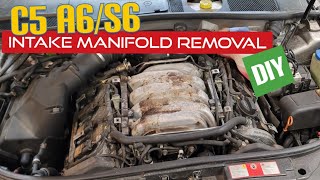
Typical fix: Replace the faulty Intake Manifold Runner Control Solenoid. The part is often referred to as a changeover valve or control valve. Access requires removing the intake manifold. 🎬 See how to disassemble and service the intake manifold
Est. part cost: $50-$150 - Wiring Short to Power 🟡 Medium Probability The engine wiring harness, particularly the section running to the back of the intake manifold, is exposed to extreme heat cycles. Over time, the wire insulation can become brittle, crack, and chafe, leading to wires shorting against each other or a power source.
How to confirm: With the solenoid disconnected and the ignition on (engine off), use a multimeter to test for voltage on the signal wire at the solenoid's harness-side connector. If you find battery voltage on the signal wire (which should be ground-controlled by the ECM), there is a short to power somewhere in the harness that must be traced.
Typical fix: Inspect the wiring harness between the ECM and the solenoid. Locate the shorted section, repair the damaged wire, and protect it with new heat-resistant loom or electrical tape.
Est. part cost: $5-$25
Rare But Worth Checking
- Damaged Electrical Connector: The plastic connector or its pins can become corroded or damaged during other engine service, causing an intermittent short. Always inspect the connector for green/white corrosion, broken locking tabs, or loose pins when the solenoid is accessed.
- Failed Engine Control Module (ECM): → Shop Engine Control Module (ECM) This is extremely rare. The ECM should only be considered as a potential cause after all other possibilities (solenoid, wiring, connectors) have been exhaustively tested and ruled out. A failed driver circuit within the ECM can theoretically cause this fault.
Diagnosis Steps
- Verify the presence of code P1066 with an OBD-II scanner.
- Visually inspect the wiring harness and connector for the intake manifold runner control solenoid. On the 4.2L BAR engine, this requires removing the intake manifold to access the rear of the engine where the solenoid is located.
- Once accessed, check for any obvious signs of damage, melting, or corrosion on the wiring and connector.
- Disconnect the solenoid's electrical connector. Turn the ignition to the 'On' position without starting the engine.
- Use a multimeter to check for voltage on the signal wire in the harness-side connector. If voltage is present, it confirms a short to power in the wiring harness that needs to be traced and repaired.
- If no voltage is found, use a multimeter to test the resistance across the two pins on the solenoid itself. The expected value is around 25 ohms. A reading of infinity (OL) indicates an open circuit, while a reading of zero indicates an internal short. Either confirms a failed solenoid.
- If the solenoid resistance is within spec, you can perform an actuation test by applying a 12V power source and ground directly to the solenoid pins to see if it clicks audibly.
- If the solenoid and wiring test good, the fault may be intermittent or, in very rare cases, with the ECM itself.
Parts You'll Likely Need
- Intake Manifold Runner Control Solenoid / Changeover Valve
(OEM #06E906517A)— This is the most common failure point for a P1066 code, as it is an electro-mechanical part that fails internally. Note that this part number is also used for the EVAP purge valve (N80) on many VW/Audi vehicles, but in this location and context, it functions as the IMRC solenoid (N335).
Trusted brands: Pierburg (OEM supplier), Bosch, Dorman, Genuine Volkswagen/Audi
OEM price range: $100-$200
Aftermarket price range: $40-$120
Related Codes That Often Appear With This One
- P2008 — This code means 'Intake Manifold Runner Control Circuit/Open'. An electrical fault in the solenoid or wiring can sometimes present as both a short (P1066) and an open circuit at different times, especially with intermittent wiring damage.
- P1067 — This code means 'Intake Manifold Air Control Solenoid - Short to Ground'. If there is significant wiring damage, the circuit could short to ground as well as to power, causing multiple codes to appear.
- P2006 / P2007 — These codes indicate 'Intake Manifold Runner Control Stuck Closed'. While P1066 is electrical, a failed solenoid can prevent the flaps from moving, which may eventually lead to a mechanical 'stuck' code being logged by the position sensor.
Technical Service Bulletins (TSBs) & Recalls
- While no TSB directly addresses P1066, TSB 2030192/1 for related codes P2015 and P2020 on the 4.2L FSI engine in the Q7 (and other models) points to issues with the intake manifold flap position sender, which is part of the same system.
- TSB 2016868/2 discusses related intake flap motor and sensor issues on other Audi engines, indicating a pattern of issues within the IMRC system family.
Platform-Specific Known Issues
- Difficult Access to Solenoid: The intake manifold runner control solenoid (N335) is located on the back of the engine, underneath the intake manifold. Replacing it is not a simple bolt-off, bolt-on job from the top. The entire intake manifold must be removed to gain access, which increases labor time and complexity compared to engines where the solenoid is more accessible.
Mechanic-Grade Diagnostic Values
- Intake Manifold Runner Control Solenoid (N335) internal resistance — expected: 25 +/- 10 ohms. Failure: A reading of 0 ohms (dead short) or infinite/OL (open circuit) indicates a failed solenoid.
- Wiring harness continuity check from solenoid connector to ECM connector — expected: Max 1.5 ohms. Failure: A resistance value higher than 1.5 ohms indicates excessive resistance or an open circuit in the wiring harness.
- Voltage check at solenoid harness connector (signal wire to ground) — expected: Battery Voltage (approx. 12V) with ignition on, engine off.. Failure: No voltage indicates a problem with the power supply to the solenoid circuit (fuse, relay, or wiring).
Scan Tool Commands That Help
- VCDS (VAG-COM): Basic Settings - Group 142 (or similar for intake flaps) — After replacing components or to test the mechanical range of motion of the intake flaps. It runs an adaptation sequence. The tool will show commanded vs. actual position, which can help differentiate a sensor/mechanical issue from this electrical code.
- VCDS (VAG-COM): Measuring Value Blocks (MVB) - Group 142 — To observe the live data of the intake manifold runner position sensor (G336). While P1066 is for the solenoid, watching the 'actual' vs 'commanded' position in this block can reveal if the solenoid's failure is preventing any flap movement, which would show a static 'actual' value.
- VAS (Dealer Tool): Reset DPF adaptations / Reset DPF pressure sensor adaptations — While not directly for P1066, forum posts indicate that on some older Q7 models, VCDS has limited communication with certain engine modules, and the dealer-level VAS tool may be required for full diagnostic and reset functions, especially if other codes are present.
Wiring & Ground Locations
- Engine Harness Ground Points — The main engine-to-chassis grounds are typically located on the front frame long members. Specifically, look for Ground Connection 1 (671) on the left front long member and Ground Connection 1 (685) on the right front long member.. A weak or corroded engine ground can cause floating voltages and unpredictable electrical behavior in all engine sensors and actuators, including the N335 solenoid, potentially triggering short-to-positive or other electrical faults.
- Plenum Chamber Grounds — There are ground connections in the plenum chamber (the area under the windshield where the ECM is often located), such as Ground Connection (609) and Ground Connection (608).. The ECM controls the N335 solenoid. The ECM and its associated wiring are grounded in this area. A fault with one of these grounds can directly impact the ECM's ability to correctly control and monitor the solenoid circuit.
- N335 Solenoid Connector — On the back of the engine, underneath the intake manifold. It is a 2-pin connector attached to the solenoid body.. This is the primary point for testing. Pin 1 is typically the power supply (from a fuse/relay) and Pin 2 is the ground-side control wire from the ECM. The P1066 code suggests a short to power is being detected on the control wire (Pin 2).
- Common Chafe Point — The engine wiring harness can chafe against the front corner of the left-hand cylinder head or the drive belt idler pulley bracket.. Although a general TSB, this highlights known areas where harness damage occurs. Vibration and heat can cause the insulation on the N335 control wire to wear through, allowing it to contact a 12V power wire within the same harness bundle, creating a short to positive.
Real Owner Repair Stories
- AudiWorld Forums user 'spitanddirt' (2009 Audi A8L 4.2L (similar engine and intake design)) — Rough idling.
❌ Tried (didn't work) Initial diagnosis was unclear, could have been multiple causes.
✅ What actually fixed it The user's rough idle was caused by a failed vacuum solenoid that controls the intake flaps. Although the user did not report a P1066 specifically, they confirmed the solenoid is a failure point and is labor-intensive to access, requiring intake manifold removal. This validates the solenoid as the primary failure component for the IMRC system.
OEM Part Supersession History
06E906517→06E906517A— Standard part revision by the manufacturer, likely for improved reliability or a change in supplier.
Heads up: The part number 06E906517A is widely used across the VW/Audi group for multiple functions, most commonly as the N80 EVAP Purge Valve. While it is physically and electrically identical, it's crucial to confirm it is being installed in the correct location for the Intake Manifold Runner Control (N335) on the 4.2L BAR engine. Using it as an N80 valve is incorrect for this fault.
Model Year Variations Within This Range
- 2006-2010: The 4.2L V8 FSI (BAR) engine was only available in the Audi Q7 from 2006 to 2010. Later Q7 models (2011-2015) used different engines (e.g., 3.0T V6), so this specific fault and repair information does not apply to them. Within the 2006-2010 range, there are no significant documented changes to the intake manifold runner control system or the N335 solenoid.
Diagnostic Flowchart
Other Known Issues on This Vehicle
Issues unrelated to this code that are worth knowing about as an owner of this generation:
- Intake Valve Carbon Buildup 🔴 High — Inevitable on FSI (direct injection) engines. Significant performance loss and misfires can occur starting around 60,000-80,000 miles. Recommended cleaning every 40,000-50,000 miles.
- Timing Chain Guide Failure 🔴 High — The plastic timing chain guides become brittle with age and heat cycles, typically showing signs of failure between 80,000 and 150,000 miles. A 'rattle' on cold start is the primary warning sign. This is an engine-out repair.
- Excessive Oil Consumption 🟠 Medium — Many owners report consuming 1 quart of oil every 2,000-5,000 miles, with consumption often worsening after 60,000 miles. This is often attributed to piston ring design.
- Oil Filter Housing Gasket Leak 🟠 Medium → Shop Engine Oil Filter Adapter — The gaskets for the oil filter housing, located in the 'V' of the engine under the intake manifold, can flatten and leak oil. This is a common source of oil leaks that appear at the front or sides of the engine.
- Failed Fuel Injectors 🟠 Medium — Fuel injectors can fail or become clogged, especially on higher-mileage vehicles, leading to misfires (e.g., P030x codes), rough idle, and poor performance.
Used vs. New Parts: Buying Guide for This Vehicle
When a used part is the smart pick: For this repair, a used part is generally not recommended. The solenoid is an electro-mechanical part prone to failure from heat and vibration. A used part from a junkyard has unknown remaining life and carries a high risk of premature failure. Given the high labor cost to access the part (intake manifold removal), the savings on a used solenoid are not worth the risk of having to repeat the job.
Donor-vehicle mileage cap: roughly under 15000 miles for the part to have meaningful remaining life.
What to inspect on the donor part:
- If forced to use a used part, source it from the lowest-mileage donor vehicle possible.
- Visually inspect the plastic housing for cracks or signs of extreme heat exposure.
- Test the resistance of the used solenoid with a multimeter before installation; it must be within the 25 +/- 10 ohm specification.
OEM-only on this vehicle (don't cheap out):
- While not strictly 'OEM-only', using a reputable OEM supplier is highly recommended for the solenoid.
Aftermarket brands forum-validated for this vehicle:
- Pierburg (often the original OEM supplier)
- Bosch
Brands owners have reported issues with on this vehicle:
- Unknown, no-name brands from online marketplaces. The quality control is highly variable, and a failed part requires re-doing a significant labor-intensive job.
Real Owner Stories
Aggregated from forums and TSBs cited above. Mileages and costs reflect what owners reported in those sources.
2008 Volkswagen Touareg 4.2L FSI BAR
Symptoms: The owner described complex misfire issues and potential vacuum issues related to the intake system on the BAR engine platform.
What fixed it: The source highlights diagnostic complexity involving the intake and vacuum systems, though it serves as a reference for the shared BAR engine architecture rather than a single-part fix.
Source hint: Ross-Tech Forums - 2008 Touareg 4.2 FSI BAR Misfiring
Related OBD-II Codes
Frequently Asked Questions
Does TSB 2030192/1 apply to my Audi Q7 4.2L FSI when I have intake manifold codes?
Can I replace the N335 solenoid on my Q7 without removing the intake manifold?
What resistance should I look for when testing the changeover valve on my 4.2L BAR engine?
Are there any other Audi engines that share this intake flap issue?
Is it safe to use a used solenoid from a salvage yard to fix P1066?
Does the Volkswagen Touareg suffer from the same P1066 code as the Audi Q7?
Helpful Videos
We Have This Part in Stock

The information in this article is provided for general reference and educational purposes only. Vehicle specifications, procedures, and part compatibility can vary by production date, trim level, and region. Always consult your vehicle's factory service manual and verify part numbers before purchasing or performing repairs. Safety-critical components such as airbags, seat belts, and braking systems should be installed by a qualified professional.
- Audi Q7:
- 🧭 Diagnostic Flowchart
- 🎬 Helpful Videos
- 🛍️ Shop This Part
- What's Unique About the 2006-2015 Audi Q7
- Symptoms You May Notice
- Most Likely Causes
- Rare But Worth Checking
- Diagnosis Steps
- Parts You'll Likely Need
- Related Codes That Often Appear With This One
- Technical Service Bulletins (TSBs) & Recalls
- Platform-Specific Known Issues
- Mechanic-Grade Diagnostic Values
- Scan Tool Commands That Help
- Wiring & Ground Locations
- Real Owner Repair Stories
- OEM Part Supersession History
- Model Year Variations Within This Range
- Other Known Issues on This Vehicle
- Used vs. New Parts: Buying Guide for This Vehicle
- Real Owner Stories
- 2008 Volkswagen Touareg 4.2L FSI BAR
- Related OBD-II Codes
- Frequently Asked Questions
- 🎟️ Get 5% Off