

P1185 on 1995-2010 BMW 5-Series: O2 Sensor Heater Circuit Fault (Bank 2 Sensor 1), Causes, and Fixes
On gasoline-powered 1995-2010 BMW 5-Series, code P1185 specifically indicates a failed heater circuit for the pre-catalytic converter oxygen sensor on Bank 2 (cylinders 4-6). This almost always means the sensor itself has failed. The internal heater element burns out, requiring sensor replacement. Expect to pay $60-$150 for a quality OEM Bosch sensor and perform a relatively simple DIY replacement.
- P1185 on a gasoline BMW 5-Series means there is an open circuit in the O2 sensor heater for Bank 2, Sensor 1 (pre-cat).
- The most common cause is a failed O2 sensor; replacement is a straightforward DIY job.
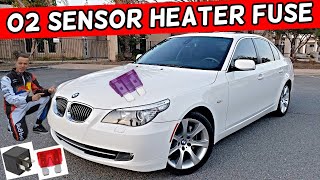
- Before replacing the sensor, always check the specific O2 sensor heater fuse, which is often hidden in the engine bay's electronics box.
- This code is NOT related to fuel pressure on a BMW, unlike on some other vehicle makes.
- Bank 2 refers to cylinders 4-6, which is the driver's side on LHD vehicles.
What's Unique About the 1995-2010 BMW 5-Series
Unlike on many other car brands like Hyundai, Kia, or Dodge where P1185 points to a fuel pressure problem, on BMW gasoline engines this code is specifically for the O2 sensor heater circuit. This often causes confusion. While fuel system issues like a weak fuel pump can cause similar symptoms like power loss on these cars, they will set different fault codes. The P1185 code directs the diagnosis specifically to the emissions control system, not the fuel delivery system.
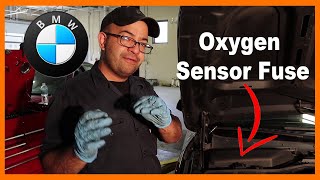
Generation note: This guide covers the E39 (1995-2003) and E60/E61 (2003-2010) generations of the 5-Series. While the meaning of the code is the same for gasoline engines in both generations (e.g., M54, N52), the exact O2 sensor part numbers, fuse locations, and sensor positions will differ. For E39 models, the O2 sensor heater fuse is often F4 (30A) in the engine bay E-Box. For E60 models, there is a small fuse block with 5 fuses in the E-Box under the passenger-side cabin air filter housing; the O2 heater fuses are typically the 2nd and 4th fuses in this block. 🎬 Watch: Locate the hidden O2 sensor heater fuses on E60 models. The diagnostic process, however, remains identical.
Symptoms You May Notice
- Check Engine Light (Malfunction Indicator Lamp) is on
- Reduced fuel economy
- Rough or unstable idle, especially when the engine is cold
- Hesitation during acceleration
- Failure to pass an emissions/smog test
- Smell of gasoline from exhaust due to rich fuel mixture
- Replacing the fuel pump or fuel pressure regulator. P1185 on a gasoline BMW is not a fuel pressure code. While fuel pressure issues can cause similar drivability problems, they will generate different codes.
- Replacing the mass airflow (MAF) sensor. While a faulty MAF can cause performance issues, it is not directly related to the O2 sensor heater circuit.
- Replacing the wrong O2 sensor. P1185 is for Bank 2, Sensor 1 (pre-cat). Bank 1 is cylinders 1-3, and Bank 2 is cylinders 4-6. Sensor 1 is pre-catalyst, and Sensor 2 is post-catalyst.
Most Likely Causes
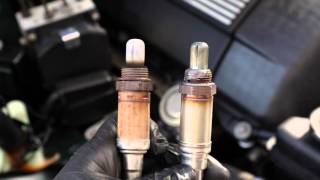
- Failed Oxygen (O2) Sensor (Bank 2, Sensor 1) 🔴 High Probability → Shop Oxygen Sensor The internal heater element is a common wear-and-tear component that eventually burns out like a lightbulb filament, creating an open circuit. This is the most frequent cause for P1185.
How to confirm: Disconnect the sensor and use a multimeter set to resistance (ohms) to test the two heater circuit wires (often two white or two black wires). A healthy Bosch sensor will show a low resistance reading, typically 2-10 ohms. An infinite resistance reading (Open Line or 'OL') confirms the heater element is broken.
Typical fix: Replace the faulty oxygen sensor (Bank 2, Sensor 1). It is often recommended to replace them in pairs (e.g., both pre-catalyst sensors, Bank 1 and Bank 2) if they are original and have high mileage, as the other is likely near the end of its service life.
Est. part cost: $60 - $180 - Damaged Wiring or Connector 🟡 Medium Probability The O2 sensor wiring is routed near the hot exhaust and is exposed to the elements, which can cause wires to become brittle, melt, or chafe over time. The connector pins can also corrode, especially if the vehicle is in a rust-prone area.
How to confirm: Visually inspect the entire length of the sensor's wiring harness from the sensor to the main harness for any signs of melting, chafing against the chassis or engine, or broken wires. Check the electrical connector for green or white corrosion on the pins. A short in the wiring can also cause the fuse to blow repeatedly.
Typical fix: Repair the damaged section of wire with a new piece of wire and heat-shrink butt connectors. Clean corroded connectors with electrical contact cleaner or replace the connector pigtail if damage is severe.
Est. part cost: $5 - $30 - Blown Fuse ⚪ Low Probability
How to confirm: Consult your vehicle's fuse diagram to find the fuse(s) for the oxygen sensor heaters. On E39s, check fuse F4 (30A) in the electronics box under the hood. On E60s, check the small 5-fuse block in the E-box; it's often fuse #2 or #4. Pull the fuse and visually inspect if it is blown. If multiple O2 heater codes are present (e.g., P1184 and P1185), a blown fuse is a more likely cause.
Typical fix: Replace the blown fuse. If the fuse blows again immediately, it indicates a short circuit in the wiring or a faulty sensor that must be found and rectified.
Est. part cost: $1 - $10
Rare But Worth Checking
- Faulty Engine Computer (DME): This is extremely rare. The DME's internal driver for the heater circuit can fail, but all other possibilities should be exhausted before considering DME replacement. This would typically be suspected only if voltage is not being sent from the DME to the heater circuit despite a good fuse and wiring.
Diagnosis Steps
- Scan the vehicle to confirm P1185 is the active code. This code specifically points to the pre-catalytic sensor on Bank 2 (cylinders 4-6).
- Turn the vehicle off and locate the specified O2 sensor. On LHD cars, Bank 2 is on the driver's side. Visually inspect its wiring harness and connector for obvious damage like melting, chafing, or corrosion.
- Disconnect the sensor. Using a multimeter set to measure resistance (Ohms), probe the two wires for the heater circuit on the sensor side of the connector. These wires are typically the same color (e.g., two white wires on many Bosch sensors).
- If the multimeter reads infinite resistance ('OL'), the heater element inside the sensor has failed. The sensor must be replaced. A good sensor should read between 2-10 Ohms.
- If the resistance is within spec, the sensor itself is likely good. The problem is in the vehicle's wiring or power supply.
- Check the fuse for the O2 sensor heaters. For E39, check fuse F4 (30A) in the engine bay E-box. For E60, check the small fuse block in the E-box under the passenger cowl. If it is blown, replace it. If it blows again, you have a short circuit to ground in the harness that needs to be traced.
- If the fuse is good, turn the ignition on (engine off) and use a multimeter to check for battery voltage (approx. 12V) at the corresponding heater circuit pin on the vehicle's harness connector. If there is no voltage, there is an open circuit between the fuse box and the connector that must be repaired.
Parts You'll Likely Need
- Oxygen Sensor (O2 Sensor / Lambda Sensor, Bank 2 Sensor 1)
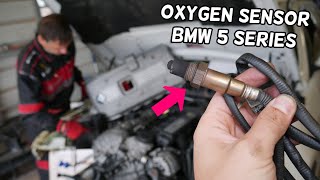
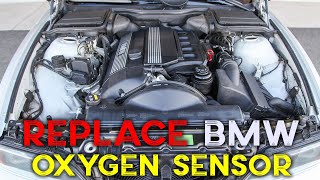
(OEM #BMW: 11781742050 (E39 M54), 🎬 Watch: How to replace upstream oxygen sensors on the M54 engine. BMW: 11787558055 (E60 N52))🎬 See this N52 engine oxygen sensor replacement walkthrough. — This is the most common cause of P1185, as the internal heater element fails with age and use. The specific sensor is the pre-catalyst one for cylinders 4-6.
Trusted brands: Bosch (OEM), NTK, Denso
OEM price range: $150-$250
Aftermarket price range: $60-$180
Related Codes That Often Appear With This One
- P1184 — P1184 is the equivalent code for the Bank 1, Sensor 1 heater circuit. Seeing both P1184 and P1185 together strongly suggests a common power supply problem, like a blown fuse, rather than two simultaneously failed sensors.
- P0155 — This is the generic SAE equivalent code for 'O2 Sensor Heater Circuit Malfunction (Bank 2 Sensor 1)'. A generic OBD-II scanner might show P0155, while a BMW-specific scanner will typically show the more precise P1185 code for the same fault.
- 2C9D — This is the BMW-specific hexadecimal fault code for 'DME: Oxygen sensor heater 2 before catalytic converter'. It is the direct equivalent of P1185 and will be displayed by BMW-specific diagnostic tools like ISTA or INPA. Seeing this code confirms the fault is on the Bank 2 pre-cat sensor heater.
Platform-Specific Known Issues
- E39 Fuse Location: The fuse for the O2 sensor heaters (and other components) is located in the 'E-Box', a white or black plastic box in the engine bay, typically on the passenger side near the firewall. It is often a 30A fuse at position F4.
- E60 Fuse Location: The O2 heater fuses are notoriously hidden. They are in a small, separate 5-fuse holder within the main E-Box, which is under the passenger side cabin air filter housing. You must remove the cowl and the E-Box lid to access it. Fuses at position 2 and 4 are typically for the O2 heaters.
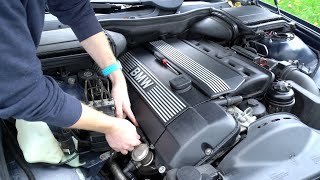
- Accessing Bank 2 Sensor: On inline-6 engines, the Bank 2 sensor (cylinders 4-6) is on the driver's side of the exhaust manifold (for LHD vehicles). Access can be tight, and a specialized 22mm O2 sensor socket with a slit for the wire is highly recommended for removal and installation.
Mechanic-Grade Diagnostic Values
- O2 Sensor Heater Element Resistance — expected: 2-6 Ohms at 68°F (20°C). Resistance increases with temperature.. Failure: Infinite resistance (OL) indicates a broken heater element. A reading far outside the expected range suggests a faulty sensor.
- O2 Sensor Heater Circuit Current Draw — expected: 0.25A to 1.5A when the heater is active.. Failure: Zero amps indicates an open circuit (blown fuse, bad wiring, or failed heater). Excessively high amperage (e.g., >2A) indicates a short circuit within the sensor or wiring, which can damage the DME driver.
- DME Heater Control Signal (PWM) — expected: On later models (E60 with N52), the DME controls the heater with a Pulse Width Modulated (PWM) ground signal. A multimeter set to DC voltage may show a fluctuating reading (e.g., 5-7V average) when the engine is running and the heater is active. An oscilloscope is required to properly view the square wave.. Failure: A steady 0V or 12V on the control wire when the heater should be active points to a DME driver issue or a wiring fault.
Hidden / Shadow Codes Worth Checking
- 2C9D: DME: Oxygen sensor heater 2 before catalytic converter, activation. This is the direct BMW-specific hex code for P1185. (see via BMW-specific diagnostic software like ISTA, INPA, or high-end scanners with BMW software.)
- 2C9C: DME: Oxygen sensor heater 1 before catalytic converter, activation. This is the equivalent code for Bank 1 (P1184). Seeing 2C9C and 2C9D together strongly points to a common power supply issue like a blown fuse. (see via BMW-specific diagnostic software like ISTA, INPA.)
Scan Tool Commands That Help
- ISTA/D: Call up ECU functions -> DME -> Diagnosis scan -> Oxygen sensor control -> Oxygen sensor before catalytic converter 2, heating: Status — This allows a technician to view the live status and activation state of the Bank 2 Sensor 1 heater circuit directly from the DME. It helps confirm if the DME is attempting to activate the heater, which is crucial for differentiating between a wiring/sensor fault and a DME control issue.
- ISTA/D: Vehicle management -> Service function -> Powertrain -> Engine Electronics -> Delete adaptations — While not strictly required for an O2 sensor replacement, it is good practice to reset fuel trim and other engine adaptations after replacing a critical sensor that affects air/fuel mixture. This forces the DME to relearn values with the new, correctly functioning sensor.
Wiring & Ground Locations
- DME Connector X60002 (MS45 DME) — On the MS45 DME used in later E39 M54 engines, connector X60002 handles the O2 sensor signals.. For Bank 2 Sensor 1, the heater ground is Pin 10 and the heater signal is Pin 12. Testing for continuity from the sensor connector to these specific pins can identify a wiring break without having to trace the entire harness.
- DME Connector (MSV70/MSV80 DME) — On the MSV70/MSV80 DME used in E60 N52 engines, the O2 sensor heater circuits are also routed directly to the main DME connectors in the E-Box.. The heater for Bank 2 Sensor 1 (X62201) has its power supply from the fuse block and its ground controlled by a specific pin on the DME. A wiring diagram is essential to trace the correct pin, as a break in this ground control wire will cause a P1185/2C9D fault.
Real Owner Repair Stories
- Reddit user on r/BmwTech (2007 BMW 328i E92 (N52 Engine - similar architecture to E60 N52)) — Check engine light with codes for all four oxygen sensor heaters (2C9C, 2C9D, 2C9E, 2C9F).
❌ Tried (didn't work) Initially suspected the PCV heater recall was related, but having the recall performed did not fix the issue.
✅ What actually fixed it The final confirmed fix was not posted in the thread, but the strong suggestion from commenters was to check the 30A fuse for the O2 sensor heaters located in the DME box (E-box) before replacing any sensors, as it is highly improbable for all four heaters to fail simultaneously.
OEM Part Supersession History
11781742049→11781742050— Part number consolidation and potential minor revision by the manufacturer (Bosch).
Heads up: These parts are generally cross-compatible for the specified M52TU/M54 engines.11787558055→11787558073— Manufacturer revision for N52/N53/N54 engines.
Heads up: For the E60 N52, 11787558055 is the correct pre-catalyst sensor. While 11787558073 may be listed for other models, it's critical to use the exact part number specified for the vehicle's production date and engine type.
Model Year Variations Within This Range
- 1995-2003 (E39 with M52TU/M54): The DME (MS42/MS43/MS45) provides a simple 12V power supply to the O2 sensor heaters via a relay and fuse. The control is less complex than later models. The sensors are typically narrowband types.
- 2003-2010 (E60 with N52): The DME (MSV70/MSV80) uses Pulse Width Modulation (PWM) to control the ground side of the heater circuit. This allows for more precise and gradual heating of the sensor to prevent thermal shock and optimize warm-up time. Testing this circuit with a simple voltmeter can be misleading due to the pulsing signal. Some very late E60s may use wideband sensors, which are fundamentally different from the earlier narrowband types.
Diagnostic Flowchart
Other Known Issues on This Vehicle
Issues unrelated to this code that are worth knowing about as an owner of this generation:
- Cooling System Failures (E39 & E60) 🔴 High — Very common, typically between 60,000-100,000 miles. Affects plastic components like the expansion tank, radiator necks, thermostat housing, and water pump (especially the electric pump on the N52).
- Oil Leaks (M54 & N52) 🟠 Medium — Extremely common with age and mileage (>80,000 miles). Valve cover gasket, oil filter housing gasket, and oil pan gasket are the primary culprits.
- VANOS System Degradation (M54 & N52) 🟠 Medium — Seals in the VANOS unit harden and fail over time (typically >70,000 miles), causing rough idle, loss of low-end torque, and fault codes.
- Crankcase Ventilation (CCV/PCV) System Failure (M54) 🟠 Medium — Common failure, especially in cold climates. Hoses become brittle and crack, or the valve itself clogs, leading to high oil consumption, rough idle, and vacuum leaks.
- E39 Front Suspension Thrust Arm Bushings 🟠 Medium — A frequent wear item, often failing around 75,000 miles, causing steering wheel shimmy during braking and a feeling of looseness in the front end.
- E60 iDrive (CCC) Failures 🟠 Medium — The Car Communication Computer (CCC) unit in pre-LCI (2004-2007) models is prone to failure, resulting in a blank or rebooting iDrive screen.
- E60 Sunroof Drain Clogging 🔴 High — Drains for the sunroof can clog with debris, causing water to leak into the cabin and potentially damage sensitive electronic modules located in the trunk floor, such as the MULF or MPM.
Used vs. New Parts: Buying Guide for This Vehicle
When a used part is the smart pick: Almost never. O2 sensors are wear-and-tear items with a finite service life of approximately 100,000 miles. A used sensor has an unknown history and remaining lifespan, making it a poor value proposition. The labor to install it often outweighs the cost savings, especially if it fails shortly after installation.
Donor-vehicle mileage cap: roughly under 30000 miles for the part to have meaningful remaining life.
What to inspect on the donor part:
- Verify the part number on the sensor itself matches the required OEM number exactly.
- Inspect the wiring and connector for any signs of brittleness, melting, or corrosion.
- Ask for the mileage of the donor vehicle; anything over 50,000 miles is a significant gamble.
OEM-only on this vehicle (don't cheap out):
- While not strictly 'OEM-only', using the original equipment manufacturer (Bosch for this application) is highly recommended. Cheaper, unbranded sensors are notorious for having incorrect heater resistances or slow response times, leading to persistent codes or poor performance.
Aftermarket brands forum-validated for this vehicle:
- Bosch (OEM)
- NTK
- Denso
Brands owners have reported issues with on this vehicle:
- Unbranded, 'no-name' sensors from online marketplaces are frequently cited on forums as being problematic and a waste of money.
Real Owner Stories
Aggregated from forums and TSBs cited above. Mileages and costs reflect what owners reported in those sources.
E39 528i
Symptoms: The owner had fault codes P1185 (Bank 2 Pre-Cat) and P1187 (Bank 2 Post-Cat) stored.
What fixed it: The issue was resolved by replacing both oxygen sensors on Bank 2.
Source hint: Bimmerforums - 'P1185 and P1187 codes'
Related OBD-II Codes
Frequently Asked Questions
Where is the O2 sensor fuse located on my E39 5-Series?
I can't find the O2 sensor fuse on my E60 5-Series. Where is it?
Which specific sensor is 'Bank 2, Sensor 1' on my inline-6 BMW?
How can I test the O2 sensor heater myself to confirm it's bad?
I have P1185 and another O2 heater code at the same time. What should I check first?
Should I replace just the one faulty O2 sensor or both front sensors?
What special tool is needed to remove the O2 sensor?
Helpful Videos

The information in this article is provided for general reference and educational purposes only. Vehicle specifications, procedures, and part compatibility can vary by production date, trim level, and region. Always consult your vehicle's factory service manual and verify part numbers before purchasing or performing repairs. Safety-critical components such as airbags, seat belts, and braking systems should be installed by a qualified professional.
- BMW 5-Series:
- 🧭 Diagnostic Flowchart
- 🎬 Helpful Videos
- What's Unique About the 1995-2010 BMW 5-Series
- Symptoms You May Notice
- Most Likely Causes
- Rare But Worth Checking
- Diagnosis Steps
- Parts You'll Likely Need
- Related Codes That Often Appear With This One
- Platform-Specific Known Issues
- Mechanic-Grade Diagnostic Values
- Hidden / Shadow Codes Worth Checking
- Scan Tool Commands That Help
- Wiring & Ground Locations
- Real Owner Repair Stories
- OEM Part Supersession History
- Model Year Variations Within This Range
- Other Known Issues on This Vehicle
- Used vs. New Parts: Buying Guide for This Vehicle
- Real Owner Stories
- E39 528i
- Related OBD-II Codes
- Frequently Asked Questions
- 🎟️ Get 5% Off