

P1434 on 2013-2019 Ford Escape: A/C Temperature Circuit High Causes and Fixes
On a Ford Escape, code P1434 means the A/C won't work correctly due to a fault with the A/C evaporator temperature sensor or its wiring. The most common fix is replacing the sensor, which is located behind the glove box.
- P1434 on a Ford Escape means your A/C isn't working because of an electrical fault with the evaporator temperature sensor, not a refrigerant leak.
- The most common cause is a failed A/C evaporator temperature sensor, part number YH-1771.
- Diagnosis involves checking the sensor's reading with a scan tool; an illogical, very low temperature reading (like -40°F) confirms the fault.
- The repair is DIY-friendly for most, involving the replacement of the sensor located behind the glove box.
What's Unique About the 2013-2019 Ford Escape
While P1434 means something completely different on other brands like BMW or Peugeot (often relating to EVAP or diesel additive systems), on Ford vehicles it is consistently tied to the air conditioning system. For the third-generation Escape and its platform-mates like the Ford Focus and Lincoln MKC, this fault directly impacts comfort features by disabling the A/C compressor based on faulty sensor data. The diagnostic process is straightforward and does not involve the complex emissions components associated with P1434 on other makes.
Generation note: The 2013-2019 Ford Escape is the third generation. The 1.5L EcoBoost engine was specifically offered from the 2017 to 2019 model years. The diagnosis and repair for this A/C-related code are consistent across these model years within the generation, as well as on other vehicles built on the same Ford Global C platform.
Symptoms You May Notice
- Air conditioning blows warm or hot air
- A/C compressor does not turn on (no 'click' sound when A/C is activated)
- A/C works intermittently, cycling on and off incorrectly
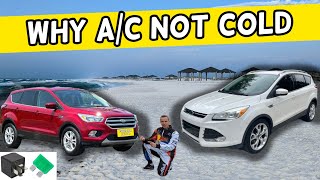
- Check Engine Light is illuminated 🎬 Watch: Diagnose why your Ford Escape A/C is blowing warm air
- Replacing A/C refrigerant: A 'Circuit High' code is an electrical fault. While low refrigerant can cause A/C issues, it will not set a P1434 code.
- Replacing the A/C compressor: The compressor is likely disabled by the control module due to the faulty sensor reading. It is the symptom, not the cause.
Most Likely Causes
- Failed A/C Evaporator Temperature Sensor 🔴 High Probability The sensor is a thermistor that operates in a moist environment within the HVAC case, making it susceptible to failure over time. Corrosion or internal failure can cause it to send an incorrect voltage signal, essentially 'lying' to the computer that the evaporator is frozen.
How to confirm: Using a scan tool, check the live data for the A/C evaporator temperature. If it shows an unreasonably low temperature (e.g., -40°F) when the ambient temperature is warm, the sensor has failed. Alternatively, test the sensor's resistance with a multimeter and compare it to the manufacturer's temperature/resistance chart. At 77°F (25°C), the resistance should be between 1.38 and 1.64 kΩ.
Typical fix: Replace the A/C evaporator temperature sensor. This part is typically accessed by removing the glove box and a lower dash panel.
Est. part cost: $25-$60 - Wiring Harness or Connector Issue 🟡 Medium Probability Wiring behind the dashboard can be subject to chafing or damage during prior repairs (e.g., cabin air filter replacement). The connector at the sensor can also become corroded or loose. Some owners report rodents chewing on the soy-based wiring insulation used in these vehicles, causing shorts or opens.
How to confirm: Visually inspect the wiring and connector for any signs of damage, corrosion, or loose pins. Perform a wiggle test on the harness while monitoring the sensor's live data on a scan tool. Check for 5V reference and good ground at the sensor connector with the key on. In some cases, rusty pins in the main ECU/TCM box, caused by a warped case letting in moisture, have been the root cause.
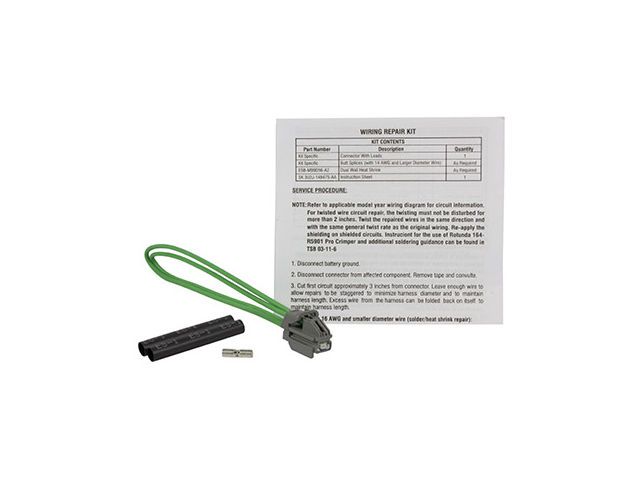
Typical fix: Repair the damaged section of the wiring harness or clean/replace the electrical connector. Ford has specific procedures for splicing damaged wires using solder and heat shrink.
Est. part cost: $5-$30 - Short to Power in the Signal Circuit ⚪ Low Probability A wire could be pinched or chafed, causing it to contact a power source. This would send a constant high voltage signal to the control module. This can sometimes be related to other wiring repairs being performed in the dash.
How to confirm: With the sensor disconnected, use a multimeter to check for voltage on the signal wire at the sensor connector. There should be no voltage present. If voltage is found, trace the wire to find the short.
Typical fix: Locate and insulate the shorted section of the wire.
Est. part cost: $0-$10
Rare But Worth Checking
- Faulty HVAC Control Module or PCM: This is highly unlikely and should only be considered after all other possibilities (sensor, wiring) have been exhaustively ruled out. A faulty module can misinterpret a correct sensor signal.
Diagnosis Steps
- Connect an OBD-II scanner and confirm P1434 is the active code. Note any other codes present.
- Access live data on the scanner and view the parameter for the 'A/C Evaporator Temperature Sensor'.
- If the reading is stuck at an extremely low value (e.g., -40°F/C) regardless of the actual cabin temperature, the sensor or its circuit is faulty.
- Turn the vehicle off. Access the A/C evaporator temperature sensor, which is typically located behind the glove compartment, plugged into the side of the HVAC case.
- Visually inspect the sensor's connector and nearby wiring for any obvious signs of damage, corrosion, or loose connections. Pay close attention to areas where the harness might rub against dash supports.
- Disconnect the sensor. Turn the ignition to 'ON' (engine off). Use a multimeter to verify there is a 5-volt reference signal on one wire and a good ground on another.
- If voltage and ground are correct, the sensor is the most likely culprit. You can test the sensor itself by measuring its resistance and comparing it to a temperature/resistance chart for the vehicle. For example, at 68°F (20°C), the expected resistance is between 1.71 and 2.05 kΩ.
- If reference voltage or ground is missing, the issue is in the wiring harness or the control module, and further circuit tracing is required. Check for TSBs related to wiring splices, as Ford has issued several for this vehicle generation.
Parts You'll Likely Need
- A/C Evaporator Temperature Sensor
(OEM #YH-1771 (Motorcraft))— This sensor is the primary component that fails, leading to the P1434 code. It directly measures the temperature that the code reports as faulty.
Trusted brands: Motorcraft, Standard Motor Products (SMP), Dorman, Duralast
OEM price range: $35-$60
Aftermarket price range: $25-$50
Technical Service Bulletins (TSBs) & Recalls
- TSB 15-0005: While not for P1434 specifically, this TSB addresses wiring problems in the engine harness of 2013-2014 Escapes with the 1.6L engine, indicating a history of wiring splice issues on this platform. It advises dealers to replace signal return splices using a soldering method.
Platform-Specific Known Issues
- The soy-based wire insulation used on this generation of Ford vehicles has been known to attract rodents, which can chew through harnesses and cause electrical faults like P1434.
- Water intrusion into the main computer (PCM/TCM) box, located in front of the left wheel well, can cause rusty pins and various electrical issues. One owner fixed a similar issue by cleaning the pins and sealing a warped case.
Mechanic-Grade Diagnostic Values
- A/C Evaporator Temperature Sensor Resistance — expected: Resistance changes with temperature. At 32°F (0°C): 4.40-5.35 kΩ. At 50°F (10°C): 2.70-3.25 kΩ. At 68°F (20°C): 1.71-2.05 kΩ. At 86°F (30°C): 1.11-1.32 kΩ.. Failure: An open circuit (infinite resistance) or a short (near-zero resistance) indicates a failed sensor. A 'Circuit High' code like P1434 is often caused by an open circuit or a break in the wiring.
- Sensor Connector Voltage (Key On, Engine Off) — expected: Approximately 5 volts on the reference wire (VT-BN / Violet-Brown) and a good ground (less than 0.1 volts) on the signal return wire (GY-BU / Gray-Blue).. Failure: No voltage or ground indicates a wiring issue upstream of the sensor. Voltage present on the signal return wire with the sensor disconnected indicates a short to power.
Hidden / Shadow Codes Worth Checking
- B1B71:15: Evaporator Temperature Sensor: Circuit Short to Battery or Open. This is the corresponding Body Diagnostic Trouble Code (DTC) that the HVAC module will set. P1434 is the generic powertrain code, but B1B71:15 is the specific body code a dealer-level scanner would see. (see via Ford IDS (Integrated Diagnostic System) or a high-end professional scan tool with access to the HVAC module.)
Scan Tool Commands That Help
- Ford IDS: Live Network Monitor — If the fault is intermittent, this function can be used to monitor communication status with the HVAC module in real-time. A technician can wiggle wires while watching the monitor to see if the module drops offline, helping to pinpoint intermittent connection issues.
- Ford IDS or equivalent (FORScan): Datalogger for HVAC PIDs — Use this to graph the 'EVAP_TEMP' PID (Parameter ID). A reading that is stuck at -40°F/C is a definitive sign of an open circuit fault that triggers P1434. This is the first diagnostic step before physically accessing the sensor.
Wiring & Ground Locations
- Evaporator Temperature Sensor Connector — On the driver's side of the HVAC unit, accessible after removing the panels under the steering column or behind the glove box.. This is where all physical tests (voltage, resistance) are performed. Pin 1 is the Signal Return (GY-BU wire) and Pin 2 is the Sensor Reference Voltage (VT-BN wire).
- HVAC Module Connector C228 — The HVAC control module is part of the center stack controls. Connector C228 is the main plug into this module.. The sensor wires terminate here. Specifically, the VT-BN wire goes to pin 19 and the GY-BU wire goes to pin 20 of connector C228. Testing for continuity between the sensor connector and these pins can confirm if the wiring is intact.
- G205 / G206 — G205 is a primary chassis ground located in the driver's side left kick panel. G206 is in the passenger's side right kick panel.. While the sensor has a dedicated signal return to the module, a faulty main ground for the HVAC module itself could cause erratic behavior and codes. These are the primary grounds to check for the interior electronics.
OEM Part Supersession History
BE8Z-19C734-A→DG9Z-19C734-A (Motorcraft YH-1771)— Part consolidation and potential minor design updates across platforms (Focus, C-Max, Escape, etc.).
Heads up: The parts are generally interchangeable for this generation, but always verify fitment with the vehicle's VIN.
Model Year Variations Within This Range
- 2017-2019: The 1.5L EcoBoost engine was introduced in 2017, replacing the 1.6L. However, the A/C system, including the evaporator temperature sensor and its location within the Global C platform chassis, remained fundamentally the same. The part number YH-1771 is consistent across the entire 2013-2019 generation.
Diagnostic Flowchart
Other Known Issues on This Vehicle
Issues unrelated to this code that are worth knowing about as an owner of this generation:
- 1.5L EcoBoost Coolant Intrusion 🔴 High — Widespread issue for 2017-2019 models. A design flaw in the engine block allows coolant to leak into the cylinders, leading to misfires, white smoke, and eventual engine failure. (Ref: TSB 20-2100 (supersedes 19-2375, 19-2139). Ford also had Customer Satisfaction Program 21N12 which extended warranty coverage for this specific issue, but it has since expired.)
- Faulty Door Latches 🔴 High — Common on 2013-2015 models. A component within the door latch can break, preventing the door from latching securely or causing it to open while driving. (Ref: Ford Safety Recall 16S30. Multiple recalls and campaigns have been issued for this problem.)
- Transmission Failure / Shifting Issues 🟠 Medium — Reported across the generation, particularly with the 6F35 automatic transmission. Symptoms range from harsh shifting and hesitation to complete transmission failure, sometimes at relatively low mileage.
- Engine Stalling / Wiring Harness Splice Failure 🟠 Medium — More prevalent on 2013-2014 models with 1.6L and 2.0L engines but indicates a platform-wide vulnerability. Poorly executed splices in the engine wiring harness can corrode and fail, causing stalling and other drivability problems. (Ref: TSB 15-0005, Recall 14S17.)
Used vs. New Parts: Buying Guide for This Vehicle
When a used part is the smart pick: Never. This is an inexpensive electronic sensor that is a common failure item. The cost savings of a used part are minimal and not worth the risk of premature failure or the labor to install it.
What to inspect on the donor part:
- Not applicable as a used part is not recommended.
OEM-only on this vehicle (don't cheap out):
- While not strictly 'OEM-only', using the Motorcraft (YH-1771) part is highly recommended. The price difference is small, and it ensures correct resistance values and longevity.
Aftermarket brands forum-validated for this vehicle:
- Standard Motor Products (SMP)
- Dorman
Brands owners have reported issues with on this vehicle:
- Avoid unbranded, 'white-box' parts from online marketplaces, as their thermistor accuracy can be questionable, leading to improper A/C cycling even if the code is resolved.
Real Owner Stories
Aggregated from forums and TSBs cited above. Mileages and costs reflect what owners reported in those sources.
2013 Ford Escape
Symptoms: Recurring electrical issues and sensor faults.
What fixed it: Discovered and cleaned rusty pins on the ECM/TCM connector caused by a warped, non-weatherproof case, then sealed the case to prevent further moisture intrusion.
Source hint: CarComplaints.com - 2013 Ford Escape Wiring Harness Faulty
2013 Ford Escape
Symptoms: Electrical faults and damaged wiring.
What fixed it: Repaired wiring harness after discovering rodents had chewed through the soy-based insulation.
Source hint: CarComplaints.com - 2013 Ford Escape Wiring Harness Faulty
Related OBD-II Codes
Frequently Asked Questions
Does TSB 15-0005 apply to my 2013-2014 Ford Escape with the P1434 code?
Can I use a used A/C evaporator temperature sensor to fix my Escape?
Is there a recall for the wiring issues causing my A/C to fail?
Why does my scan tool show -40°F for the evaporator temperature?
Could rodents be the reason my A/C stopped working and threw a P1434 code?
What should the resistance of the A/C sensor be if it is working correctly?
Helpful Videos
We Have This Part in Stock

The information in this article is provided for general reference and educational purposes only. Vehicle specifications, procedures, and part compatibility can vary by production date, trim level, and region. Always consult your vehicle's factory service manual and verify part numbers before purchasing or performing repairs. Safety-critical components such as airbags, seat belts, and braking systems should be installed by a qualified professional.
- Ford Escape:
- 🧭 Diagnostic Flowchart
- 🎬 Helpful Videos
- 🛍️ Shop This Part
- What's Unique About the 2013-2019 Ford Escape
- Symptoms You May Notice
- Most Likely Causes
- Rare But Worth Checking
- Diagnosis Steps
- Parts You'll Likely Need
- Technical Service Bulletins (TSBs) & Recalls
- Platform-Specific Known Issues
- Mechanic-Grade Diagnostic Values
- Hidden / Shadow Codes Worth Checking
- Scan Tool Commands That Help
- Wiring & Ground Locations
- OEM Part Supersession History
- Model Year Variations Within This Range
- Other Known Issues on This Vehicle
- Used vs. New Parts: Buying Guide for This Vehicle
- Real Owner Stories
- 2013 Ford Escape
- 2013 Ford Escape
- Related OBD-II Codes
- Frequently Asked Questions
- 🎟️ Get 5% Off