

P1437 on 2005-2011 Ford Focus: A/C System Fault vs. Instrument Cluster Communication Error
For the 2005-2011 Ford Focus, code P1437 most commonly indicates a fault in the HVAC system, specifically 'A/C Evaporator Air Temperature Circuit High' or 'Blower Motor Speed Circuit Malfunction'. This typically results in the A/C not blowing cold. However, on 2008-2011 models, it can also appear as a symptom of the widespread instrument cluster failure, which causes various communication errors.
- **Definition is Uncertain:** Do not buy parts based on this code alone. The meaning of P1437 for the 2005-2011 Focus is not well-documented.
- **Could be HVAC:** The most likely interpretation, based on general Ford information, is a fault with the A/C system, such as the evaporator temperature sensor or blower motor resistor.
- **Could be Electrical:** On 2008-2011 models, be aware of the common instrument cluster failure that causes widespread communication errors. This code could be a symptom of that larger issue.
- **Professional Scan Recommended:** A professional diagnosis with an advanced scan tool is the best first step to see how the tool interprets the code and to check for other related faults.
What's Unique About the 2005-2011 Ford Focus
The 2008-2011 Ford Focus (the second generation in North America) is known for having electrical issues related to poor solder joints on the main instrument cluster. This well-documented problem can cause a cascade of communication errors between various modules on the CAN bus, leading to a wide range of seemingly unrelated fault codes and symptoms, including total loss of gauges and a no-start condition. While there is no direct evidence linking P1437 specifically to this issue in forums, the code's alternative definition as a 'CAN Bus Communication' error makes it a plausible symptom of this larger, common platform problem. Therefore, diagnosis must differentiate between a simple HVAC component failure and a more complex cluster-related communication fault.
Generation note: This range covers the end of the first-generation Ford Focus (facelift, 2005-2007) and the entire second-generation (2008-2011) in North America. The first generation is built on the C170 platform, while the second generation is a heavily restyled version still based on the C170 platform. The second generation (2008-2011) is particularly known for instrument cluster electrical issues that can cause widespread communication faults, a result of brittle lead-free solder used during manufacturing. The P1437 code as an HVAC fault could apply to both, but as a communication error, it's more suspect on the 2008-2011 models.
Symptoms You May Notice
- Air conditioning does not blow cold or does not turn on.
- A/C compressor clutch does not engage.
- Blower fan only works on the highest speed setting.
- Unpredictable electrical behavior (if related to a broader communication issue), such as gauges dropping to zero or warning lights flashing.
- Check Engine Light is on.
- Replacing A/C components like the compressor without confirming the code's definition and checking sensor data first.
- Chasing network errors without checking for the common instrument cluster fault on 2008-2011 models.
- Replacing the blower motor resistor when the underlying cause is a worn blower motor drawing excessive current.
Most Likely Causes
- Failed A/C Evaporator Temperature Sensor
- Failed Blower Motor Resistor
Rare But Worth Checking
- Faulty Instrument Cluster: → Shop Instrument Cluster On 2008-2011 models, the instrument cluster is a known failure point that can cause various communication-related DTCs. Cracked solder joints on the main connector are the culprit. If P1437 is accompanied by 'U' codes or other bizarre electrical symptoms, the cluster is a prime suspect.
- Wiring Damage: A damaged wire or loose connection in the A/C evaporator temperature sensor 🎬 See this quick fix for the evaporator temperature sensor circuit can cause a 'Circuit High' fault. This could be chafing or a pin backing out of a connector.
Diagnosis Steps
- Use a High-Quality Scan Tool: Use a professional-grade scan tool to see how the tool defines P1437 for the specific vehicle and to read live data. Check all modules for other codes.
- Analyze Live Data: If the code definition points to the A/C evaporator sensor, check the live data PID for that sensor. A reading of -40°F or -40°C confirms a 'Circuit High' fault, most likely a failed sensor.
- Check for Other Codes: Scan all vehicle modules (PCM, BCM, IC, etc.). The presence of multiple 'U' codes (especially U1900) alongside P1437 🎬 Watch: How to repair the U1900 CAN bus communication error on a 2008-2011 model strongly points to the instrument cluster solder joint issue.
- Test HVAC Function: Test the blower motor on all speeds. If it only works on high, the blower motor resistor is the most likely culprit. 🎬 Watch: Step-by-step blower motor resistor replacement guide
- Investigate Instrument Cluster (2008-2011 models): If multiple communication codes are present or other strange electrical issues are occurring (gauges dropping, random warnings), tap the top of the dashboard above the cluster. If this action causes or clears the fault, it further confirms a bad connection within the cluster. The cluster will need to be removed and the main connector pins resoldered.
- Inspect Wiring: If the sensor data is erratic but not stuck at -40°, inspect the wiring harness to the A/C evaporator temperature sensor for any signs of damage or corrosion, particularly behind the glove box.
Parts You'll Likely Need
- A/C Evaporator Temperature Sensor
- Blower Motor Resistor
- Instrument Cluster
Related Codes That Often Appear With This One
- U1900 —
- P1436 —
Platform-Specific Known Issues
- The 2008-2011 Ford Focus is widely known for having faulty solder joints on the instrument cluster's main connector. This can lead to a loss of communication on the CAN bus, causing the 'Engine Malfunction' light to appear, gauges to stop working, and numerous random error codes (like U1900) to be stored. This is a more likely cause for general electrical faults than any single component indicated by an uncertain code like P1437. The repair involves removing the cluster and re-soldering the connector pins.
Mechanic-Grade Diagnostic Values
- A/C Evaporator Temperature Sensor Resistance — expected: Resistance should correlate to ambient temperature. Example values: 2.14 to 2.58 kΩ at 15°C (59°F), 1.71 to 2.05 kΩ at 20°C (68°F), 1.38 to 1.64 kΩ at 25°C (77°F).. Failure: An open circuit (infinite resistance) or a value that does not change with temperature. A scan tool reading of -40°C/F also indicates an open circuit.
- A/C Evaporator Temperature Sensor Signal Voltage — expected: Approximately 5V on the reference wire from the control module with the sensor disconnected and ignition on.. Failure: No voltage indicates a wiring or module issue, not a sensor failure.
Hidden / Shadow Codes Worth Checking
- Mode 6, Test ID $53 (pre-CAN) or $A2-$AF (CAN): This is not a DTC, but a diagnostic function. For Ford, Mode 6 data provides raw test results from the PCM's self-tests, including misfire counts per cylinder for the current and last 10 drive cycles. While often used for misfires, it can show which monitors have run and their results, potentially revealing intermittent issues before a code is set. (see via Requires a scan tool with Mode 6 capability, such as Forscan software or professional-grade scanners.)
Scan Tool Commands That Help
- Ford IDS (Integrated Diagnostic System): Live Network Monitor / Network Test — This function is used when suspecting a CAN bus communication issue, such as the instrument cluster fault. It actively 'pings' all modules on the network and shows their status (online/offline) in real-time. It can even provide an audio cue when a module drops off the network, helping to confirm intermittent connection problems that cause codes like U1900.
Wiring & Ground Locations
- Main Engine Bay Ground — On the driver's side frame rail, located under the air filter box. You must remove the airbox to access it.. This is a primary ground point for the battery and various engine bay components. Corrosion or looseness here can cause a wide range of intermittent electrical issues, including communication faults.
- Transmission Ground Strap — A ground strap that connects from the chassis (often near the main engine bay ground point under the airbox) to a bolt on the transmission bell housing.. This ground is critical for the starter and overall powertrain electrical system. If left disconnected after transmission work, it can cause a no-start condition that might be misdiagnosed as a module or key issue.
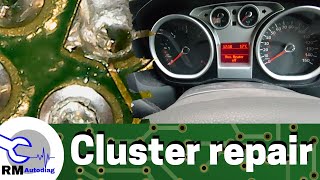
- Instrument Cluster Connector — The large, main electrical connector on the back of the instrument cluster circuit board.. This is the specific failure point for the common 2008-2011 cluster issue. The solder joints for the pins of this connector crack, causing intermittent loss of power and data communication for the cluster, which acts as a gateway for the CAN bus.
Real Owner Repair Stories
- Multiple YouTube videos and forum posts (2008-2011 Ford Focus (all trims)) — Multiple warning lights on dash ('Engine Malfunction'), gauges drop to zero, immobilizer light flashes, no-start condition, power steering warnings, multiple 'U' codes like U1900.
❌ Tried (didn't work) Replacing the battery., Clearing codes (they return immediately)., Diagnosing individual modules mentioned in the error codes.
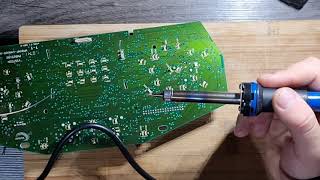
✅ What actually fixed it Removing the instrument cluster, disassembling it, and re-soldering all the pins on the main connector on the printed circuit board (PCB). Tapping firmly on the dashboard above the cluster could temporarily make the problem appear or disappear, confirming the bad connection. - Reddit user in r/FordFocus (2017 Ford Focus 1.0L EcoBoost (Note: Newer model but same principle applies to ground locations)) — Car would not start after replacing the slave cylinder.
❌ Tried (didn't work) Retracing steps from the previous repair.
✅ What actually fixed it The user found a ground wire that had been disconnected during the repair. One end was bolted to the chassis under the airbox, and the other end was supposed to bolt to the transmission bell housing. Reconnecting this ground strap to the transmission fixed the no-start issue.
OEM Part Supersession History
7L1Z-19C734-A (Example A/C Temp Sensor)→9L1Z-19C734-A— Part revision or supplier change.
Heads up: While many Ford temperature sensors are similar, always verify the specific part number for your vehicle's VIN, as internal resistance curves can vary between part numbers like 6E5Z-19C734-BA and 9L1Z-19C734-A.
Model Year Variations Within This Range
- 2008-2011: These North American Mk2/2.5 models are highly susceptible to the instrument cluster failure due to the use of brittle lead-free solder on the main connector's PCB pins. While earlier 2005-2007 models can have cluster problems, the specific failure mode of cracked solder joints causing widespread CAN bus faults (U1900) is the signature problem of the 2008-2011 generation.
Diagnostic Flowchart
Other Known Issues on This Vehicle
Issues unrelated to this code that are worth knowing about as an owner of this generation:
- Passenger-Side Engine Mount Failure 🔴 High — Very common. The hydraulic mount fails, leaking fluid and causing severe vibration in the cabin, especially at idle. (Ref: A TSB was issued for 2000-2011 models recommending specific mount replacements.)
- Instrument Cluster Solder Joint Failure (2008-2011) 🔴 High → Shop Instrument Cluster — Extremely common. Causes loss of communication, gauge failure, no-start conditions, and numerous 'U' codes.
- Premature Rear Wheel Bearing Failure 🟠 Medium — Commonly reported. Leads to a loud humming or grinding noise from the rear of the vehicle that changes with speed.
- Automatic Transmission Problems (4-speed AT) 🟠 Medium — Owners report issues with harsh shifting, slipping, and solenoid failures in the 4-speed automatic (4F27E) used in this generation. This is distinct from the later, more infamous 'PowerShift' DCT transmission.
- Suspension Clunks and Noises 🟡 Low — Worn control arm bushings and other suspension components can cause clunking noises over bumps.
- Canister Purge Valve Failure 🟡 Low — A malfunctioning canister purge valve is a common cause for an illuminated Check Engine Light, often with code P0456 (small EVAP leak).
Used vs. New Parts: Buying Guide for This Vehicle
When a used part is the smart pick: For simple electrical components like the A/C Evaporator Temperature Sensor or the Blower Motor Resistor, a used part from a reputable salvage yard is a cost-effective option. These parts do not require programming and are easy to test.
Donor-vehicle mileage cap: roughly under 120000 miles for the part to have meaningful remaining life.
What to inspect on the donor part:
- For sensors/resistors, ensure connectors are not corroded or damaged.
- Check that the plastic housing is not cracked or showing signs of extreme heat.
- If possible, test the resistance of a used sensor before purchase to ensure it's within an expected range for the ambient temperature.
OEM-only on this vehicle (don't cheap out):
- Instrument Cluster - A used cluster is NOT recommended. The vehicle's immobilizer system (PATS) is integrated into the cluster, and a used unit will not allow the car to start without expensive and difficult reprogramming by a specialist or dealer. The correct fix is to repair the original cluster.
Aftermarket brands forum-validated for this vehicle:
- Blower Motor Resistor: Dorman, Four Seasons, and Standard Motor Products (SMP) are widely available aftermarket options.
- Instrument Cluster Repair: Several mail-in repair services specialize in fixing Ford clusters (e.g., Circuit Board Medics, Customod). This is the preferred method over replacement.
Brands owners have reported issues with on this vehicle:
- For the instrument cluster, avoid purchasing a used, unrepaired unit from eBay or a junkyard, as it will likely have the same solder joint defect and will cause immobilizer problems.
Real Owner Stories
Aggregated from forums and TSBs cited above. Mileages and costs reflect what owners reported in those sources.
2008-2011 Ford Focus
Symptoms: Intermittent instrument cluster fault where gauges drop to zero and the 'Engine Malfunction' light appears. Tapping or hitting the top of the dashboard above the cluster can sometimes induce or clear the fault.
What fixed it: Removing the instrument cluster and re-soldering the main PCB connector pins to repair faulty solder joints.
Source hint: Ford Focus Club - 'Intermittent Instrument Custer Fault - Not usual PCB fault'
2008-2011 Ford Focus
Symptoms: Widespread communication errors on the CAN bus and random error codes being stored.
What fixed it: Reflowing the solder joints on the PCB connector of the instrument cluster.
Source hint: Reddit r/FordFocus thread about cluster issues
Related OBD-II Codes
Frequently Asked Questions
My 2008 Ford Focus has a Check Engine Light and the gauges are dropping to zero; is there a TSB for this?
Is there a TSB for the severe vibration I'm feeling in my 2011 Ford Focus at idle?
My A/C isn't working and the scan tool shows -40°F for the evaporator sensor. Can I use a used part?
Can I swap the instrument cluster from a junkyard Focus to fix my electrical issues?
Why does my blower fan only work on the highest speed setting?
Does the Mazda 3 share the P1437 code with the Ford Focus?
Helpful Videos


We Have This Part in Stock


The information in this article is provided for general reference and educational purposes only. Vehicle specifications, procedures, and part compatibility can vary by production date, trim level, and region. Always consult your vehicle's factory service manual and verify part numbers before purchasing or performing repairs. Safety-critical components such as airbags, seat belts, and braking systems should be installed by a qualified professional.
- Ford Focus:
- 🧭 Diagnostic Flowchart
- 🎬 Helpful Videos
- 🛍️ Shop This Part
- What's Unique About the 2005-2011 Ford Focus
- Symptoms You May Notice
- Most Likely Causes
- Rare But Worth Checking
- Diagnosis Steps
- Parts You'll Likely Need
- Related Codes That Often Appear With This One
- Platform-Specific Known Issues
- Mechanic-Grade Diagnostic Values
- Hidden / Shadow Codes Worth Checking
- Scan Tool Commands That Help
- Wiring & Ground Locations
- Real Owner Repair Stories
- OEM Part Supersession History
- Model Year Variations Within This Range
- Other Known Issues on This Vehicle
- Used vs. New Parts: Buying Guide for This Vehicle
- Real Owner Stories
- 2008-2011 Ford Focus
- 2008-2011 Ford Focus
- Related OBD-II Codes
- Frequently Asked Questions
- 🎟️ Get 5% Off