

P1605 on 2008-2013 Volkswagen Golf: Rough Road Sensor Malfunction Explained
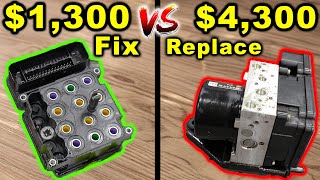
On a 2008-2013 VW Golf, code P1605 almost always means the ABS control module has failed internally. This is a very common issue with the ATE Teves Mk60 unit used in these cars. The fix is to have the module rebuilt by a specialist for $150-$450 or replaced, which is much more expensive ($1500+).
- P1605 on a VW Golf is an electrical communication error between your ABS module and engine computer, not an engine problem.
- The most likely cause by a wide margin is a failed ABS control module, a known common issue for this vehicle generation due to internal broken wires.
- Your ABS and traction control will not work with this fault present. Drive with extra caution, especially in poor weather.
- The most cost-effective solution is to have your original ABS module rebuilt by a reputable electronics repair service for a few hundred dollars.
- Do not waste money on parts like MAF sensors or spark plugs; they are unrelated to this specific code on a Volkswagen.
What's Unique About the 2008-2013 Volkswagen Golf
Unlike many other car brands like Toyota or Ford where P1605 points to rough idling or memory failures, on modern Volkswagens it is specifically tied to the chassis electronics. The ATE Teves Mk60 ABS control modules used in the Mk5 and Mk6 Golf generations are a known weak point, frequently failing due to internal electronic issues. Heat and vibration over time cause microscopic bond wires connecting the circuit board to the main connector to break, leading to a loss of communication. This makes an internal module fault the most likely cause, rather than a wiring or sensor issue elsewhere.
Generation note: This range covers the end of the Volkswagen Golf Mk5 (sold as the Rabbit in the US until 2009) and the entire Mk6 generation (2010-2014 in the US). Both generations are built on the PQ35 platform and share the notoriously failure-prone ATE Teves Mk60 ABS module, making this a very common problem across the entire 2008-2013 range.
Symptoms You May Notice
- Check Engine Light is on
- ABS warning light is on (solid or flashing)
- ESP (Electronic Stability Program) or Traction Control (ASR) light is on
- Brake pedal may feel normal during regular driving, but some owners report a spongy or unresponsive feel.
- No anti-lock brake function during hard braking
- Flashing brake light on the instrument cluster
- Replacing wheel speed sensors. While wheel speed sensors can cause ABS faults, they typically generate their own specific codes and do not cause the P1605 communication error.
- Diagnosing a vacuum leak or cleaning the MAF sensor. This is the correct procedure for a P1605 code on a Toyota or Lexus, but it is completely irrelevant for a Volkswagen, as the code has a different meaning.
- Replacing the entire ABS hydraulic pump assembly. In most cases, only the electronic control module attached to the pump has failed. The hydraulic block itself is generally reliable. Replacing only the electronic module is far cheaper and doesn't require opening the hydraulic system.
Most Likely Causes
- Internal ABS Control Module Failure 🔴 High Probability → Shop ABS Control Module The ATE Teves Mk60 ABS module used in these cars is known for internal failures of its electronics. The primary failure mode is the fracture of microscopic aluminum bond wires that connect the internal circuit board to the external connector pins, caused by years of heat cycles and vibration.
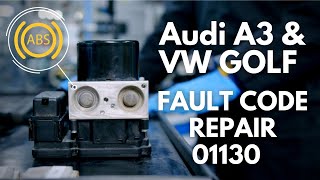
How to confirm: Use a VW-specific scan tool (like VCDS by Ross-Tech) to check for communication with the ABS module (Address 03). If the module is unresponsive ('Cannot be reached') or shows internal fault codes like 01130, 16352, or 01276, it has almost certainly failed.
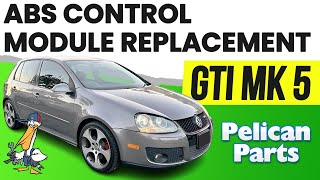
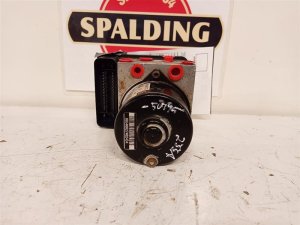
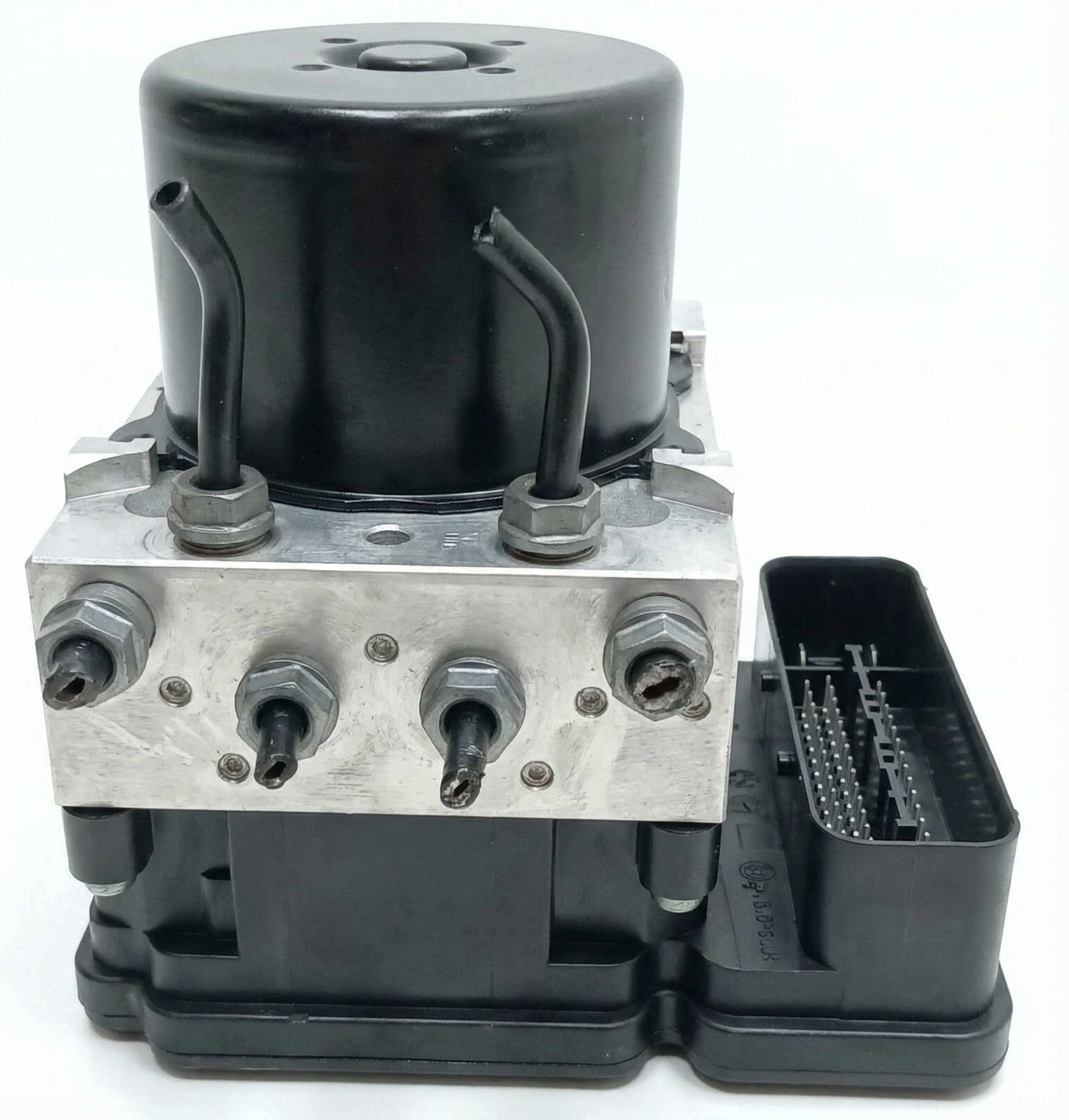
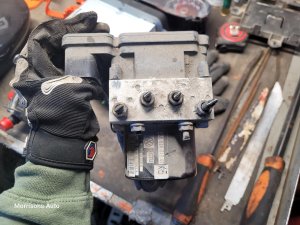
Typical fix: Remove the electronic portion of the ABS module (the 'black box') and send it to a specialist electronics rebuilder. This is the most cost-effective fix. Alternatively, replace the module with a new or used unit and have it coded to the vehicle by a dealer or specialist.
Est. part cost: $150-$450 for a rebuild service, $1200-$1800 for a new OEM module. - Wiring Harness or Connector Issue ⚪ Low Probability While less common than module failure, corrosion at the main ABS module connector can cause communication issues. The connector is located in the engine bay and can be susceptible to moisture ingress over time.
How to confirm: Visually inspect the large multi-pin connector at the ABS module for any signs of green or white corrosion, bent pins, or damaged wires. Disconnect the connector and check for continuity on the CAN bus (typically twisted pair, often orange/black and orange/brown) and power/ground wires between the ABS module and the gateway module or ECM.
Typical fix: Clean the connector pins with a specialized contact cleaner. If corrosion is severe, the connector may need to be replaced. Repair any damaged sections of the wiring harness.
Est. part cost: $10-$50 for wiring repair supplies. - Faulty Fuse for ABS Module ⚪ Low Probability → Shop ABS Control Module
How to confirm: Check the fuses for the ABS system. There are typically two: a large-amperage fuse in the engine bay fuse box (E-box) and a smaller fuse in the cabin fuse panel. A visual inspection or a multimeter can confirm if a fuse is blown.
Typical fix: Replace the blown fuse. If it blows again, there is an underlying short circuit that must be diagnosed, possibly in the ABS pump motor or wiring.
Est. part cost: $1-$5
Diagnosis Steps
- Scan for Codes: Use a VW-compatible scanner (VCDS is highly recommended) to read codes from both the Engine (01) and ABS (03) control modules. Note all codes present.
- Check for Communication: Attempt to communicate directly with the ABS control module (Address 03). If the scanner reports 'No Communication' or 'Cannot be reached', this is a classic symptom of a failed module.
- Inspect Fuses: Check all fuses related to the ABS system. There is a large fuse (e.g., 30A or 40A) in the engine bay fuse box and often a smaller one in the interior fuse panel. Check for power at these fuses.
- Inspect Wiring and Connector: Visually inspect the main electrical connector and wiring harness at the ABS module. Look for green crust (corrosion), chafed wires, or other visible damage. Unplug it and check for clean, straight pins.
- Test Power and Ground: If tools are available, use a multimeter to verify that the module is receiving proper battery voltage and has a solid ground connection at its main connector. Schematics are required for pinout information.
- Condemn the Module: If all wiring, fuses, power, and grounds are good, and especially if codes like 01130 or 16352 are present (or if there is no communication), the ABS control module is faulty and needs to be rebuilt or replaced.
Parts You'll Likely Need
- ABS Control Module Rebuild Service
(OEM #1K0907379AD, 1K0907379AC, 1K0907379AE, 1K0907379AN)— This is the most common failure. A rebuild service corrects the internal electronic faults (broken bond wires) that cause the P1605 code.
Trusted brands: ModuleMaster, BBA Reman, XeMODeX
OEM price range: $1200-$1800 (for new part)
Aftermarket price range: $150-$450 (for rebuild service)
Related Codes That Often Appear With This One
- 01130 — This is a common VAG-specific fault code for 'ABS Operation - Implausible Signal'. It frequently appears alongside P1605 and points directly to an internal failure of the ABS module.
- 16352 — This VAG-specific code means 'Control Module - Electrical Error' and is another strong indicator that the ABS module itself is defective.
- 01276 — This code indicates a fault with the 'ABS Hydraulic Pump (V64)'. While it can mean the pump motor is bad, it often appears with other communication faults when the control module has failed internally.
Platform-Specific Known Issues
- The ATE Teves Mk60 ABS pump and module assembly is notoriously prone to failure across many VW, Audi, and other European models from this era, leading to various communication and pressure sensor faults.
- Owner experiences frequently cite dealer quotes of $2,500 to over $4,000 for a full ABS module and pump replacement, whereas a DIY removal and mail-in rebuild of the electronic module can cost under $500.
Mechanic-Grade Diagnostic Values
- CAN Bus Network Resistance — expected: Approximately 60 Ohms. Failure: A reading of 120 Ohms indicates an open in the bus or one of the two terminating resistors (one is in the ABS module, the other in the CAN Gateway) is offline. A reading near 0 Ohms indicates a short between CAN-High and CAN-Low wires.
- CAN Bus Voltage (Key On, Engine Off) — expected: CAN-High: ~2.5-3.5V to ground. CAN-Low: ~1.5-2.5V to ground. The sum of both voltages should be approximately 5V.. Failure: Voltages stuck at 0V, battery voltage, or not summing to ~5V indicate a wiring short or a faulty module pulling the bus down.
- ABS Module Power and Ground — expected: Pins T47c/1 and T47c/32 should have battery voltage at all times (Terminal 30). Pin T47c/8 should have battery voltage with ignition on (Terminal 15). Pin T47c/47 should have continuity to ground (<1.0 Ohm).. Failure: Absence of voltage or a poor ground connection prevents the module from powering on and communicating.
Hidden / Shadow Codes Worth Checking
- 00003: Control Module: No or Incorrect Basic Setting / Adaptation. This code appears after a new or used ABS module is installed but has not been coded and calibrated to the car. (see via Appears in the ABS Brakes (03) module scan using a VW-specific tool like VCDS.)
Scan Tool Commands That Help
- VCDS (Ross-Tech): Long Coding — This is required when installing a new or used ABS module. The long code from the original module (if readable) must be copied to the replacement. If the original code is lost, it must be generated based on the vehicle's equipment.
- VCDS (Ross-Tech): Security Access (Login Code 40168) — This security code must be entered into the ABS (03) module to enable the Basic Settings functions required for calibration after coding.
- VCDS (Ross-Tech): Basic Settings (Groups 063, 066, 069) — After coding a new module, several sensors must be calibrated. This includes the Steering Angle Sensor (G85), Lateral Acceleration Sensor (G200), and Brake Pressure Sensor (G201). Failure to perform these basic settings will leave ABS/ESP warning lights on and store fault code 00003.
Wiring & Ground Locations
- J104 Connector (T47c) — The large 47-pin electrical connector on the ABS control module, located on the hydraulic unit in the engine bay.. This is the single point of connection for all power, ground, and CAN bus signals to the module. Testing for power at pins 1, 32, and 8, ground at pin 47, and CAN signals at pins 12 and 13 is the primary electrical diagnostic step.
- J533 (CAN Gateway) — On most Mk5/Mk6 Golfs, it is located high up in the driver's footwell, above the accelerator pedal, often attached to a metal bracket.. The CAN Gateway is the central hub for all data networks. A failure here can cut off communication to multiple modules, including the ABS module, potentially causing a P1605. It also contains one of the two 120-ohm terminating resistors for the powertrain CAN bus.
- Ground Point 12 — In the engine compartment on the left side, below the battery tray.. This is a major grounding point for several engine bay harnesses. While the ABS module has its own dedicated ground wires, corrosion at this common ground point can cause intermittent electrical issues throughout the vehicle.
- Ground Point 44 — At the bottom of the driver's side A-pillar, behind the kick panel.. This is a key interior ground point. A wiring diagram shows a ground connection for the ABS module harness running to this area.
Real Owner Repair Stories
- Ross-Tech Forums user 'Itsjosh' (2009 MK6 Golf TSI 1.4L (CAVD) Manual) — ABS/ESP lights on, ABS module not coded.
❌ Tried (didn't work) A mobile mechanic installed an ABS pump with the wrong part number (1K0907379BL instead of the original 1K0907379AD)., Attempting to enter the correct long code into the incorrect module resulted in the code being accepted but then immediately lost upon cycling the ignition.
✅ What actually fixed it The owner purchased another ABS pump with the correct original part number (1K0907379AD), installed it himself, and then successfully coded it. The key was realizing the replacement part was incompatible and that basic settings must be performed immediately after coding without cycling the ignition. - Ross-Tech Forums user 'gbran18' (MK6 Golf GTD) — Dashboard lit up with multiple warnings (ABS, Traction, Handbrake flashing), no communication with OBD scanner, car would not start.
❌ Tried (didn't work) Initial garage could not diagnose due to no communication.
✅ What actually fixed it The fault was a completely failed (fried) CAN Gateway module (J533). After replacing the gateway with a used unit and coding it, communication was restored. However, the ABS module had lost its coding as a result of the gateway failure. The ABS module then needed to be re-coded to fix the remaining ABS-related warning lights.
OEM Part Supersession History
1K0907379AD→1K0907379AN, 1K0907379BE— Revisions to improve reliability and accommodate changes in vehicle production.
Heads up: Part numbers are not always interchangeable. For example, a 1K0907379BL from a 2013 Jetta is not compatible with a 2009 GTI that originally used a 1K0907379AD module. Using an incompatible module will result in coding rejection. Always verify the correct part number for the specific vehicle VIN with a dealer or parts catalog before purchasing a replacement.
Model Year Variations Within This Range
- 2008-2009 (Mk5) vs 2010-2013 (Mk6): While both use the ATE Mk60 family, there can be hardware and software differences. Upgrading a Mk5 to a Mk6 ABS module (e.g., to enable XDS) is complex and may require changing brake lines due to different fitting sizes (10mm vs 12mm) and rewiring the connector. For a direct replacement, using the exact part number or a confirmed superseded part number is critical.
Diagnostic Flowchart
Other Known Issues on This Vehicle
Issues unrelated to this code that are worth knowing about as an owner of this generation:
- Timing Chain Tensioner Failure (2.0T TSI) 🔴 High — Common on 2008-2012 models with the TSI engine. An early version of the tensioner can fail without warning, leading to jumped timing and catastrophic engine damage. Failure can occur at any mileage, some as low as 30k miles. (Ref: VW TSB 15-12-01 was issued, and a class-action lawsuit resulted in an extended warranty for some vehicles.)
- DSG Mechatronic Unit Failure 🔴 High — Common across models with the Direct-Shift Gearbox (DSG). Symptoms include harsh/jerky shifting, flashing 'PRNDS' indicator, and loss of drive. Can occur on both 6-speed (DQ250) and 7-speed (DQ200) versions. (Ref: Multiple service campaigns and extended warranties have been issued for specific DSG issues over the years.)
- Water Pump and Thermostat Housing Leaks 🟠 Medium — The plastic water pump and/or thermostat housing assembly is prone to cracking and leaking coolant. This is a very common issue across multiple engines (TSI and TDI) in this generation. Failure can lead to overheating. (Ref: Extended warranties were offered for this issue on certain models/engines.)
- Carbon Buildup on Intake Valves (TSI engines) 🟠 Medium — As a direct-injection engine, fuel doesn't wash over the intake valves. This leads to carbon deposits building up over 60k-100k miles, causing misfires, rough idling, and reduced performance. Requires manual cleaning (walnut blasting).
- High-Pressure Fuel Pump (HPFP) Failure (TDI engines) 🔴 High — The Bosch CP4 HPFP used in TDI models can fail, sending metal shavings throughout the entire fuel system, requiring a very expensive replacement of the pump, injectors, lines, and fuel tank. This was a central part of the 'Dieselgate' scandal recalls. (Ref: Part of the TDI emissions modification and extended warranty settlement.)
Used vs. New Parts: Buying Guide for This Vehicle
When a used part is the smart pick: A used ABS module from a donor vehicle is a viable, cost-effective option, but ONLY if it is the exact same part number as the original. A rebuilt service for your original module is often the safest and most economical choice, as it requires no coding upon reinstallation.
Donor-vehicle mileage cap: roughly under 120000 miles for the part to have meaningful remaining life.
What to inspect on the donor part:
- Verify the part number on the used module EXACTLY matches the original or a confirmed superseded number. Suffixes like 'AD', 'AN', 'BE' are critical.
- Obtain the VIN of the donor car if possible. This can help a specialist generate the correct 'long coding' if the original code is lost.
- Inspect the electrical connector for any corrosion, bent pins, or physical damage.
- Ask the seller if the module was tested and confirmed to be communicating before removal.
OEM-only on this vehicle (don't cheap out):
- ABS Control Module. While the 'part' can be used, rebuilt, or aftermarket, it must be a genuine ATE Teves unit that is compatible. Generic, no-name clones are not an option.
Aftermarket brands forum-validated for this vehicle:
- For rebuild services: ModuleMaster, BBA Reman, XeMODeX are frequently cited on forums as reliable.
- For replacement parts: ATE (the original equipment manufacturer) is the only trusted brand.
Brands owners have reported issues with on this vehicle:
- Any unbranded or generic ABS control modules sold on marketplaces. These will not code to the vehicle and are a waste of money and time.
Real Owner Stories
Aggregated from forums and TSBs cited above. Mileages and costs reflect what owners reported in those sources.
2009 Volkswagen Golf Mk5 GTD
Symptoms: The car experienced the classic trio of ABS, ESP, and Brake lights on the dashboard with fault code 01130.
What fixed it: Identified as a hallmark of the ABS module failure, requiring module repair or replacement.
Source hint: Ross-Tech Forums - 'VW Golf Mk5 GTD 2009 ABS 01130 Fault Code Help'
2008-2013 Volkswagen Golf
Symptoms: Dealer quoted over $4,000 for a full ABS module and pump replacement.
What fixed it: Users recommended using a mail-in rebuild service like XeMODeX as a cost-effective alternative to the dealer's full unit replacement.
Cost: $150-$500
Source hint: Reddit r/Volkswagen - 'Replace ABS Module and ABS Pump = $4,219!'
2008-2013 Volkswagen Golf
Symptoms: Failed brake pressure sensor which is internal to the ABS module; dealer quoted $2500 for the repair.
What fixed it: The owner successfully had the module rebuilt by BBA Reman, which resolved the issue.
Cost: $440-$440
Source hint: Car Talk Community - 'Volkswagen ABS Module'
Related OBD-II Codes
Frequently Asked Questions
My dealer quoted me over $4,000 to fix the ABS system on my Golf. Is there a cheaper way to resolve P1605?
Which specific ABS system is prone to failure in the 2008-2013 Volkswagen Golf?
Can I use a standard OBD-II scanner to diagnose this issue on my VW?
Are there any other common mechanical issues I should watch for on my 2008-2012 Golf with the 2.0T TSI engine?
If my ABS light is flashing, is it definitely a failed module?
Helpful Videos
We Have This Part in Stock

The information in this article is provided for general reference and educational purposes only. Vehicle specifications, procedures, and part compatibility can vary by production date, trim level, and region. Always consult your vehicle's factory service manual and verify part numbers before purchasing or performing repairs. Safety-critical components such as airbags, seat belts, and braking systems should be installed by a qualified professional.
- Volkswagen Golf:
- 🧭 Diagnostic Flowchart
- 🎬 Helpful Videos
- 🛍️ Shop This Part
- What's Unique About the 2008-2013 Volkswagen Golf
- Symptoms You May Notice
- Most Likely Causes
- Diagnosis Steps
- Parts You'll Likely Need
- Related Codes That Often Appear With This One
- Platform-Specific Known Issues
- Mechanic-Grade Diagnostic Values
- Hidden / Shadow Codes Worth Checking
- Scan Tool Commands That Help
- Wiring & Ground Locations
- Real Owner Repair Stories
- OEM Part Supersession History
- Model Year Variations Within This Range
- Other Known Issues on This Vehicle
- Used vs. New Parts: Buying Guide for This Vehicle
- Real Owner Stories
- 2009 Volkswagen Golf Mk5 GTD
- 2008-2013 Volkswagen Golf
- 2008-2013 Volkswagen Golf
- Related OBD-II Codes
- Frequently Asked Questions
- 🎟️ Get 5% Off