

P1605 on 2011-2018 Volkswagen Jetta: ABS Signal Malfunction Causes & Fixes
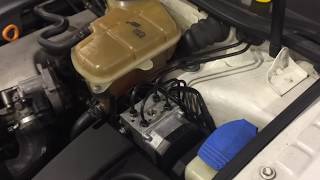
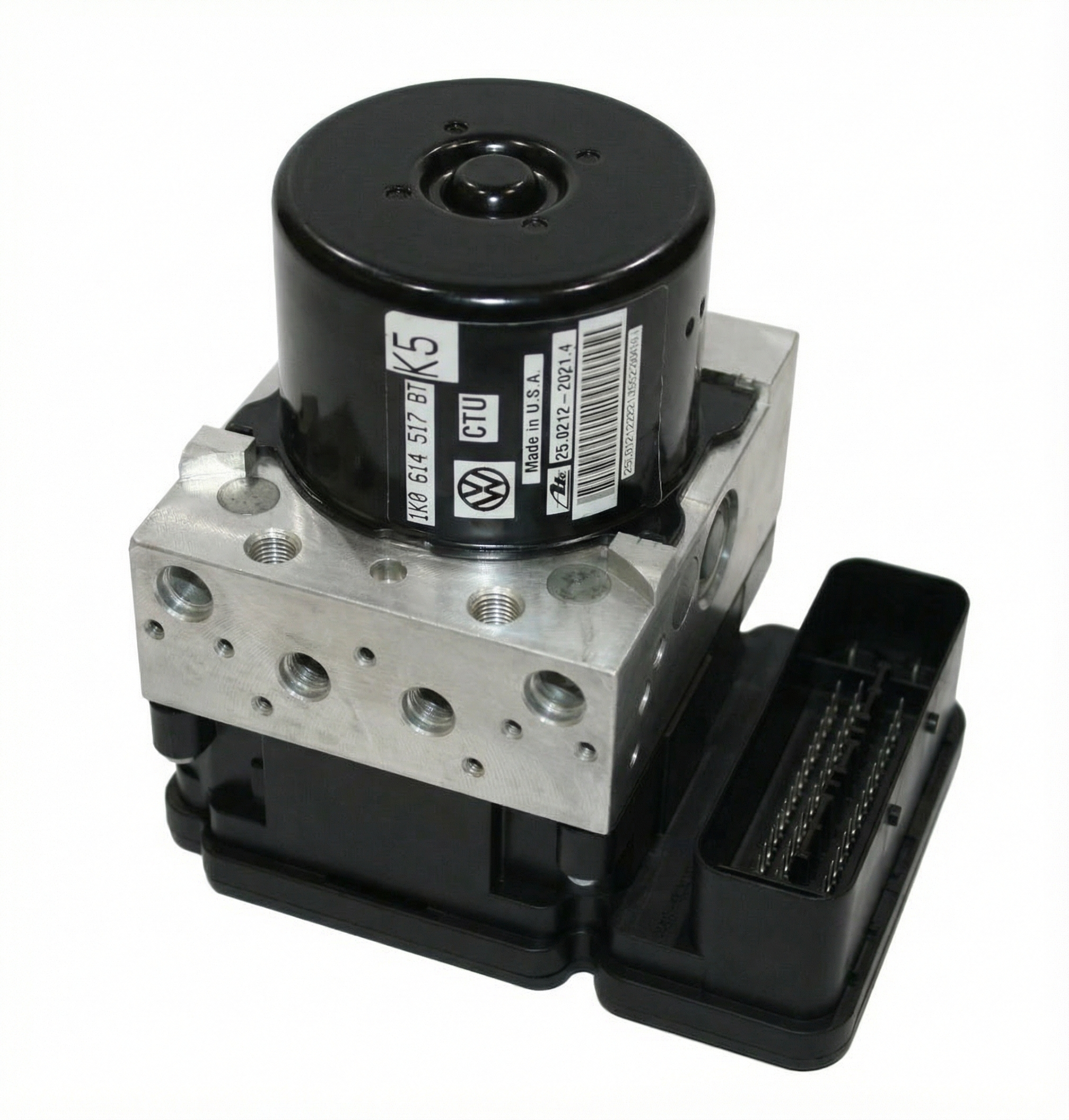
On a 2011-2018 VW Jetta, code P1605 means there's an electrical malfunction with the 'Rough Road' signal from your ABS module. This is almost always caused by a failed ATE MK60 ABS control module, a very common issue on this platform. The fix is to repair or replace the ABS module.
- P1605 on your Jetta is an ABS problem, not an engine problem.
- The most likely cause is a failed ATE MK60 ABS control module, a very common issue for this vehicle.
- Do not drive aggressively. Your ABS and stability control are disabled, which affects braking performance in emergencies.
- The most cost-effective fix is often to have your original ABS module repaired by a specialist, which avoids the need for reprogramming.
- A DIY fix is not recommended unless you are experienced with brake system work and have access to VW-specific diagnostic software (like VCDS) for coding and bleeding.
What's Unique About the 2011-2018 Volkswagen Jetta
Unlike on other brands like Toyota where P1605 means 'Rough Idle', on modern Volkswagens it points directly to a communication breakdown with the ABS system. The engine itself is usually fine. The ATE MK60 ABS module on the Jetta A6 platform is known to fail internally, causing this specific engine code to appear, often accompanied by ABS and traction control warning lights. This is a well-documented issue in the VW community, frequently appearing alongside VAG-specific code 01130 (ABS Operation Implausible Signal).
Symptoms You May Notice
- Check Engine Light is on
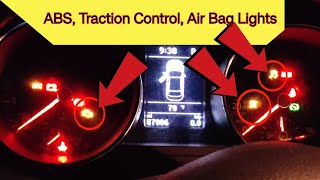
- ABS warning light is on
- ESP (Electronic Stability Program) or Traction Control light is on (often flashing)
- Brake warning light may be on and flashing, accompanied by an audible chime
- Brake pedal feels spongy, unresponsive, or requires more effort
- Inability to communicate with the ABS module (address 03) using a diagnostic scan tool
- Brakes may lock up during hard braking
- Speedometer may work intermittently or not at all if the failure affects wheel speed signal processing
- Replacing engine sensors (like crank or cam sensors) to fix a perceived engine issue, when the problem is actually in the ABS system.
- Assuming the code means 'Rough Idle' (as on a Toyota) and looking for vacuum leaks or fuel delivery problems.
- Replacing a wheel speed sensor without confirming a specific wheel speed sensor fault code. P1605 is a module-level fault, not a sensor fault.
Most Likely Causes
- Failed ABS Control Module 🔴 High Probability → Shop ABS Control Module The ATE MK60 electronic control unit is highly susceptible to internal failure. Heat cycles and vibration cause microscopic bond wires connecting the circuit board to the main connector pins to break, leading to a total loss of communication. Another common failure is the internal brake pressure sensor (G201).
How to confirm: Use a VAG-COM (VCDS) or other advanced scan tool to attempt communication with the ABS control module (address 03). If the module does not respond, and its main power and ground connections are verified as good, the module itself has failed internally. This is the definitive test. A multimeter may show voltage at the power pins, but a test light is needed to confirm the circuit can carry a load; if the test light fails to illuminate brightly, 🎬 Watch: How to test and repair an ABS module it indicates high resistance in the power feed, not necessarily a bad module.
Typical fix: The most cost-effective solution is to remove the electronic portion of the ABS module and send it to a specialist for repair. Alternatively, replace the entire ABS pump and module assembly with a new or remanufactured unit. After replacement, the new module must be coded to the car's VIN and specifications, and the brake system must be bled using the scan tool's ABS pump cycling procedure.
Est. part cost: $200-$500 (for repair service), $800-$1500 (for a new OEM unit) - Damaged Wiring or Connectors 🟡 Medium Probability The wiring harness to the ABS module is located in the engine bay and can be subject to heat, moisture, and physical damage over time. The connector pins can also corrode.
How to confirm: Visually inspect the wiring harness and the large connector at the ABS module for corrosion, frayed wires, or loose pins. Use a multimeter and a vehicle-specific wiring diagram to test for consistent battery voltage and solid ground at the module's connector pins. Wiggling the harness while testing can help identify intermittent connections.
Typical fix: Repair the damaged section of the wiring harness or replace the connector pigtail. Clean any corrosion from the connector pins using an electronics-safe cleaner.
Est. part cost: $20-$100 - Blown Fuse for ABS Module ⚪ Low Probability → Shop ABS Control Module
How to confirm: Check the fuses related to the ABS system in the vehicle's fuse box(es), particularly the main fuses in the engine bay fuse box. There are typically multiple high-amperage fuses for the ABS pump and module. On this platform, the fuse box itself can sometimes melt at the ABS fuse terminal due to high resistance.
Typical fix: Replace the blown fuse. If the fuse blows again immediately, it indicates a short circuit in the wiring or, more likely, a shorted ABS pump motor or module that must be diagnosed further. If the fuse holder is melted, the fuse box must be replaced.
Est. part cost: $1-$5 (fuse), $50-$150 (fuse box)
Diagnosis Steps
- Scan for codes in all vehicle modules using a VW-compatible scan tool (like VCDS). Note any codes stored in the Engine (01), ABS (03), and Gateway (19) modules.
- Attempt to communicate directly with the ABS module at address 03. If it's 'Not Reachable' or 'No Communication', this strongly suggests a module failure or power supply issue.
- Locate the fuses for the ABS pump and module in the engine bay and interior fuse panels. Visually inspect and test them with a multimeter for continuity. For this platform, check fuses SB23 and SB25 in the E-box under the hood.
- If fuses are good, access the ABS module connector (T47c). Using a multimeter and a wiring diagram, verify that the module is receiving proper battery voltage on its main power pins and has a solid ground connection on its ground pins. These are the most critical checks.
- Check the CAN bus communication lines at the same connector for proper voltage (around 2.5V on each line, fluctuating slightly).
- If power, ground, and CAN lines appear correct, but the module is unresponsive, the ABS control module is confirmed to be faulty.
- If you can communicate with the module, review the fault codes. Codes like 16352, 01130, or internal pressure sensor faults (G201/01435) also condemn the module.
- As a final check, gently wiggle the wiring harness near the ABS connector while monitoring scan tool communication to rule out an intermittent wiring break.
Parts You'll Likely Need
- ABS Control Module & Pump Assembly
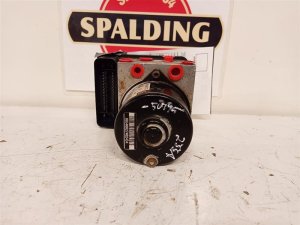
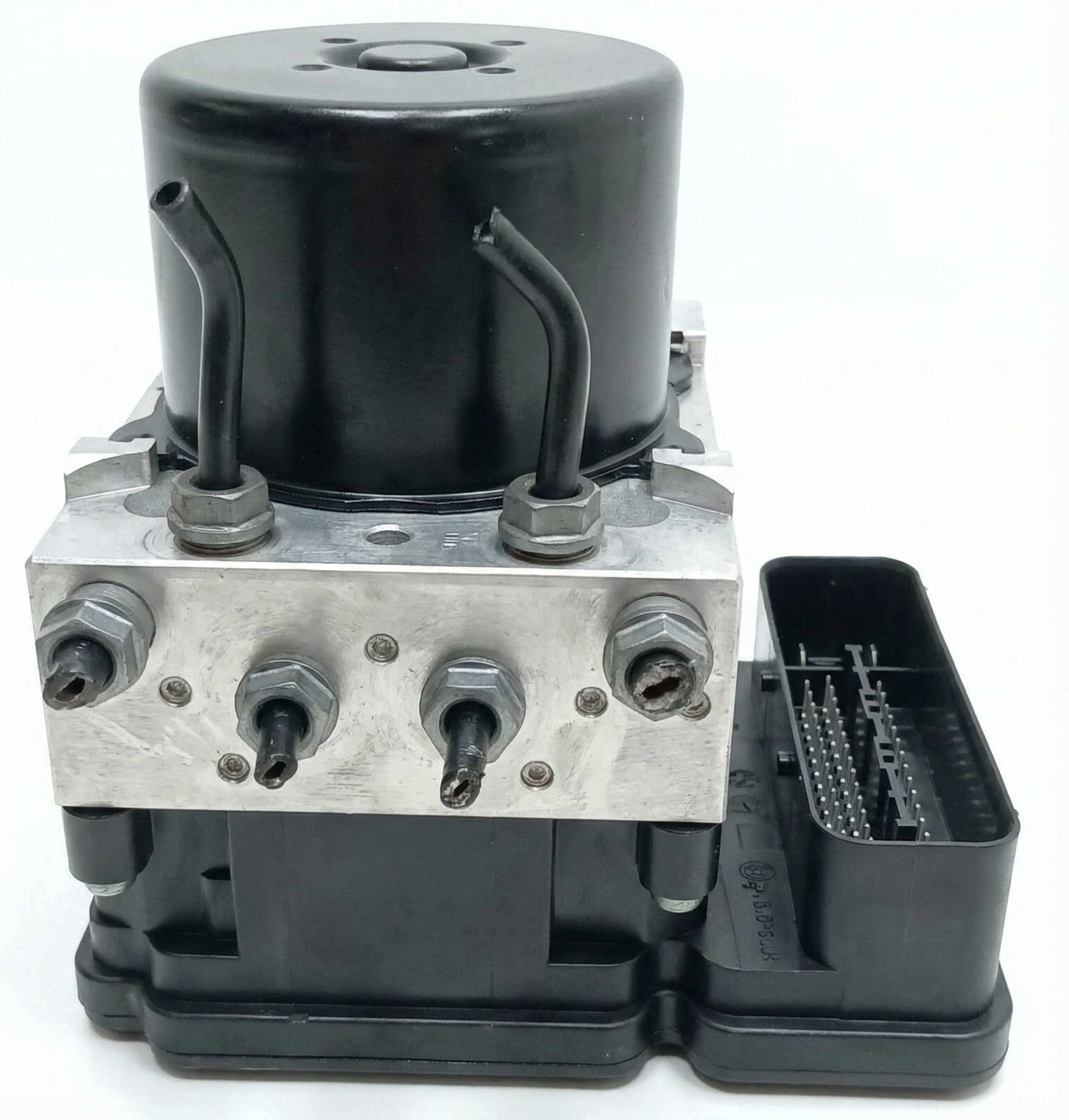
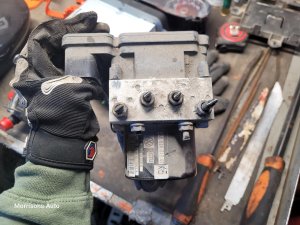
(OEM #1K0907379AD, 1K0907379AC, 1K0907379AE, 1K0907379AN, 1K0907379BE, 1K0907379BJ (verify by VIN, many variants exist))— This is the component that most commonly fails internally, causing the P1605 code by failing to send the required signal to the ECM.
Trusted brands: ATE (OEM), Bosch
OEM price range: $1000-$1500
Aftermarket price range: $600-$900 (Remanufactured) - ABS Module Repair Service — A cost-effective alternative to buying a new unit. Specialists rebuild the electronic part of the module, fixing the common internal failure points like broken bond wires. This avoids the need for coding if you reinstall your original, repaired module.
Trusted brands: ModuleMaster, MyAirbags, ECU Testing, ACtronics
Aftermarket price range: $200-$500
Related Codes That Often Appear With This One
- 01130 — This is a common VAG-specific fault code for 'ABS Operation - Implausible Signal', which directly points to the ABS module as the source of the problem and frequently accompanies P1605 when communication is lost.
- U0121 — A generic OBD-II code for 'Lost Communication With Anti-Lock Brake System (ABS) Control Module', which confirms the diagnosis from the perspective of other modules like the ECM.
- 16352 — This is another VAG-specific code for 'Control Module - Electrical Error' or 'Control Module Faulty', which is a definitive sign of internal ABS module failure.
- 01276 — VAG code for 'ABS Hydraulic Pump (V64) - Electrical Fault in Circuit'. This often points to an internal failure within the ABS module assembly.
Technical Service Bulletins (TSBs) & Recalls
- VW TSB #45 15 01 (also Audi TSB #A45-15-10): While not for P1605 specifically, this bulletin addresses diagnostic communication issues with ABS modules caused by a broken internal ground bond wire, which is the same type of failure that causes P1605.
Platform-Specific Known Issues
- The ATE MK60 ABS module used in this Jetta generation is widely known for internal electronic failures, which often manifest as this P1605 code alongside ABS/ESP lights and a no-communication fault.
- The failure is specifically tied to the electronic controller part of the assembly, where internal connections fail due to thermal stress and vibration over the vehicle's life.
Mechanic-Grade Diagnostic Values
- ABS Module Power Supply (under load) — expected: 12V+ (Test light should illuminate brightly). Failure: Multimeter shows 12V, but test light is dim or off, indicating high resistance in the power feed wiring or fuse box.
- ABS Module Ground Connection — expected: Near 0 Ohms to chassis ground. (Test light connected to battery positive should illuminate brightly when touching ground pins).. Failure: High resistance or an open circuit on the ground pins.
- CAN Bus Voltage (at ABS connector) — expected: CAN-High and CAN-Low should both read approx. 2.5V with key on, engine off. Voltage will fluctuate during communication.. Failure: Voltages stuck high (5V), low (0V), or showing no activity.
Scan Tool Commands That Help
- VCDS (VAG-COM): 03-ABS Brakes -> Security Access-16 -> Enter Login Code (e.g., 40168) — Required before you can perform coding or basic settings on the ABS module. This 'unlocks' the module for changes.
- VCDS (VAG-COM): 03-ABS Brakes -> Coding-07 -> Long Coding Helper — After installing a new or used ABS module, you must enter the correct software coding based on your vehicle's specific equipment (engine, transmission, etc.). The Long Coding Helper assists in building the correct code string.
- VCDS (VAG-COM): 03-ABS Brakes -> Basic Settings-04 -> Group 001 (or select 'Bleed Brakes' from dropdown) — After replacing the ABS hydraulic unit or opening any brake lines, this procedure must be run to cycle the internal ABS pump and valves to purge trapped air from the hydraulic block, which cannot be done with a manual bleed.
- VCDS (VAG-COM): 03-ABS Brakes -> Basic Settings-04 -> Sensor Calibration (G85, G200, G201, G251) — After coding a new module, the steering angle sensor (G85), lateral/longitudinal acceleration sensors (G200/G251), and brake pressure sensor (G201) must be calibrated. This is critical for ESP functionality.
Wiring & Ground Locations
- T47c — The large 47-pin electrical connector on the ABS control module itself, located in the engine bay.. This is the single point of connection for all power, ground, and communication lines to the module. All electrical testing starts here.
- T47c, Pin 47 — Pin 47 on the 47-pin ABS module connector.. This is a primary ground connection for the ABS module. A bad connection here will cause a no-communication fault.
- T47c, Pins 1 & 32 — Pins 1 and 32 on the 47-pin ABS module connector.. These are the main power supply pins for the ABS module from the under-hood fuse box (E-box). Loss of voltage here is a common cause of failure.
- Ground Point 640 — A common ground connection point in the left side of the engine compartment, often near the battery tray or plenum chamber.. This is a potential termination point for the ABS module's ground wire. Corrosion at this shared ground can cause issues with multiple systems, including the ABS.
- Ground Point 12 — In the engine compartment on the left side, below the battery tray.. This is the main ground point for the headlight wiring harness and other components, and serves as a key grounding location in the engine bay that should be checked for corrosion.
Real Owner Repair Stories
- Ross-Tech Forums user 'BackyardMTMechanic' (2007 Jetta Wolfsburg Edition) — No ABS module communication, flashing brake light, ABS light on, no speedometer movement.
❌ Tried (didn't work) Initially had a crank-no-start, which was fixed by repairing a corroded power wire to the ECU.
✅ What actually fixed it The user confirmed good power and ground to the ABS module. The final diagnosis, accepted by forum experts, was a failed ABS module itself, which is the standard resolution when power/ground are verified good but communication is absent. - Ross-Tech Forums user 'jcutter004' (2010 Jetta, Mileage: 129,350 miles) — ABS light on, no communication with ABS module (intermittent).
❌ Tried (didn't work) Replaced original ABS module with a used one of the same part number., Performed basic settings and bleeding with VCDS.
✅ What actually fixed it After confirming good power at pins T47/1 and T47/32 and good ground at T47/47, the user was advised that the replacement (used) module was also likely faulty. The final fix was using a VCDS 'cheat code' (Security Access 40168, Basic Settings, Channel 103) to force the system to initialize, which cleared the lights, though this is not the recommended procedure as it bypasses a full self-test.
OEM Part Supersession History
1K0907379AD→1K0907379AN— Part revision and update by the manufacturer.
Heads up: A forum user confirmed with VW that the 'AD' module was replaced by the 'AN' version. While they should be interchangeable, it's critical to match the base part number (1K0 907 379) and ensure the replacement is coded correctly.
Model Year Variations Within This Range
- 2011-2018: While most Jettas in this range use the ATE MK60 or MK60EC1 ABS module, some later or higher-trim models may have been fitted with the ATE MK100 system. The diagnostic and replacement procedure is similar, but part numbers are completely different. It is absolutely critical to verify the part number on the original module before ordering a replacement.
- N/A (Upgrade Path): Some owners upgrade from the older MK60 to the MK60EC1 module. This is not a direct swap. It requires a different mounting bracket and the front brake line fittings change from M10 to M12 and M12 to M10, necessitating either new brake lines or adapters (which are prone to leaking).
Diagnostic Flowchart
Other Known Issues on This Vehicle
Issues unrelated to this code that are worth knowing about as an owner of this generation:
- Timing Chain Tensioner Failure (1.8T/2.0T TSI) 🔴 High — Common on pre-2015 models, especially over 80,000 miles. Failure can occur without warning, causing catastrophic engine damage. (Ref: No recall, but a known class-action lawsuit issue. An updated tensioner design resolves the problem.)
- Clogged Heater Core 🟠 Medium — Very common across all engines, leading to no heat in the cabin. Often caused by sediment buildup or degrading G13 coolant.
- Water Pump Failure (1.8T/2.0T TSI) 🟠 Medium — The plastic housing is prone to cracking and leaking coolant, typically between 60,000 and 100,000 miles. (Ref: A class-action settlement covered some vehicles for this issue.)
- Ignition Coil Failure 🟡 Low → Shop Ignition Coil — Common failure item causing engine misfires (P030x codes). Relatively easy and inexpensive to replace.
- Leaking Vacuum Pump (2.5L Engine) 🟡 Low — A very common oil leak on the 2.5L 5-cylinder engine. The gasket fails over time. Usually a minor leak but can make a mess.
- DSG Mechatronic Unit Failure 🔴 High — Affects cars with the DSG automatic transmission, particularly the DQ200 7-speed dry clutch version. Can cause harsh shifting, loss of drive, and is very expensive to repair. (Ref: Various service campaigns and recalls have been issued in different markets.)
Used vs. New Parts: Buying Guide for This Vehicle
When a used part is the smart pick: A used ABS module is a high-risk purchase for this vehicle. The failure is due to an inherent design flaw related to heat and vibration, meaning a used part from a similar-aged vehicle is likely to have the same defect or fail soon. It only makes sense if the donor vehicle is significantly newer, has very low mileage, and the part comes with a warranty and return policy.
Donor-vehicle mileage cap: roughly under 40000 miles for the part to have meaningful remaining life.
What to inspect on the donor part:
- Verify the part number EXACTLY matches the original. Even a one-letter difference can mean incompatibility.
- Inspect the electrical connector pins for any signs of corrosion or damage.
- Ask for the VIN of the donor car to check its age and history if possible.
- Ensure the seller offers a warranty of at least 90 days.
OEM-only on this vehicle (don't cheap out):
- Due to the complexity and safety-critical nature, a new OEM unit or a professionally repaired original unit are the most recommended options. Avoid unbranded, no-name aftermarket modules.
Aftermarket brands forum-validated for this vehicle:
- ATE (OEM supplier)
- Bosch (OEM supplier)
Brands owners have reported issues with on this vehicle:
- Unbranded 'white box' modules from online marketplaces without a warranty or clear return policy.
Real Owner Stories
Aggregated from forums and TSBs cited above. Mileages and costs reflect what owners reported in those sources.
2009 Volkswagen GTI (PQ35 Platform)
Symptoms: Owner reported classic failure symptoms with codes 01130 and 01276, specifically noting internal pressure sensor (G201) and hydraulic pump faults.
What fixed it: The owner discussed DIY and cheap repair options for the MK60e ABS module failure, confirming the widespread nature of the internal electronic failure.
Source hint: GOLFMKV.com: 'Mk60e ABS module failure - DIY and/or cheap repair options?'
2011-2018 Volkswagen Jetta
Symptoms: No-communication faults with the MK60 ABS module; diagnostic scan tool could not reach address 03.
What fixed it: After verifying power and ground at the module connector were good, the module was condemned and required replacement or internal repair of the electronic controller.
Source hint: Ross-Tech Forums thread titled '7599'
Related OBD-II Codes
Frequently Asked Questions
Does VW TSB #45 15 01 apply to the communication issues I'm having with my ABS module?
My Jetta's ABS light is on and the brake warning light is chiming. Is this related to the P1605 code?
Can I just replace the fuse if my ABS module isn't communicating?
Is the ATE MK60 ABS module failure common in other Volkswagens besides the Jetta?
If I replace the ABS module to fix the P1605 code, do I need special tools?
Why does the ATE MK60 module fail so often on the 2011-2018 Jetta?
Helpful Videos
We Have This Part in Stock

The information in this article is provided for general reference and educational purposes only. Vehicle specifications, procedures, and part compatibility can vary by production date, trim level, and region. Always consult your vehicle's factory service manual and verify part numbers before purchasing or performing repairs. Safety-critical components such as airbags, seat belts, and braking systems should be installed by a qualified professional.
- Volkswagen Jetta:
- 🧭 Diagnostic Flowchart
- 🎬 Helpful Videos
- 🛍️ Shop This Part
- What's Unique About the 2011-2018 Volkswagen Jetta
- Symptoms You May Notice
- Most Likely Causes
- Diagnosis Steps
- Parts You'll Likely Need
- Related Codes That Often Appear With This One
- Technical Service Bulletins (TSBs) & Recalls
- Platform-Specific Known Issues
- Mechanic-Grade Diagnostic Values
- Scan Tool Commands That Help
- Wiring & Ground Locations
- Real Owner Repair Stories
- OEM Part Supersession History
- Model Year Variations Within This Range
- Other Known Issues on This Vehicle
- Used vs. New Parts: Buying Guide for This Vehicle
- Real Owner Stories
- 2009 Volkswagen GTI (PQ35 Platform)
- 2011-2018 Volkswagen Jetta
- Related OBD-II Codes
- Frequently Asked Questions
- 🎟️ Get 5% Off