

P1715 on 1998-2004 Ford Explorer: Shift Solenoid 'B' Malfunction Causes and Fixes
On a 1998-2004 Ford Explorer, P1715 almost always points to a failing transmission solenoid block. The fix involves dropping the transmission pan and replacing the entire solenoid block assembly, which costs around $150-$300 for the part. This is a very common failure on the 5R55E/W/S transmissions used in these vehicles.
- P1715 on a 1998-2004 Explorer specifically means there's a problem with Shift Solenoid 'B'.
- The most likely culprit is a failed transmission solenoid block assembly, a very common issue on these vehicles.
- The fix involves replacing the solenoid block, which is located inside the transmission oil pan.
- While doing the repair, you must also replace the transmission filter and refill with fresh Mercon V fluid.
- This is a moderately difficult DIY job, and professional help is recommended if you are not comfortable working on transmissions.
What's Unique About the 1998-2004 Ford Explorer
The 1998-2004 Ford Explorer, spanning the second and third generations, primarily uses the 5R55E/W/S automatic transmission. These transmissions are well-known for issues with the main solenoid block assembly. The P1715 code is a very common indicator of this specific, frequent failure point on the platform, making it a highly probable diagnosis compared to wiring or computer issues. Another extremely common failure on these transmissions is wear in the servo pin bores in the aluminum case, which causes pressure loss and shift flares, but this typically sets different codes (like P0732, P0733, P0735).
Generation note: This range covers the second generation (1998-2001) and third generation (2002-2004) Explorer. Both generations used variations of the 5R55 family of transmissions (5R55E, 5R55W, 5R55S), and the cause and fix for P1715 are consistent across these models. However, there are important differences in the solenoid packs between early and late models in this range.
Symptoms You May Notice
- Check Engine Light is on
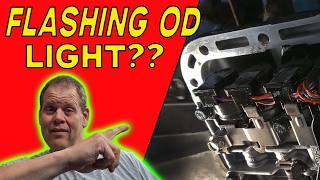
- Flashing Overdrive (O/D) light on the shifter 🎬 Watch: How to fix a flashing O/D light
- Harsh, erratic, or delayed shifts
- Transmission may feel like it's slipping
- Vehicle may get stuck in one gear (limp mode)
- Delayed engagement when shifting from Park to Drive or Reverse
- Replacing only the Shift Solenoid 'B' individually, when it's part of a larger, non-serviceable block.
- Condemning the entire transmission for a rebuild when only the external solenoid block is faulty.
- Mistaking the code for a Turbine Speed Sensor fault, which can be the definition for P1715 on other makes like Subaru or Nissan, but not on Fords.
Most Likely Causes
- Failed Shift Solenoid Block Assembly 🔴 High Probability → Shop Transmission Valve Body The 5R55 series transmissions used in these Explorers have a high rate of failure for the solenoid block. Contamination in the fluid, heat, and simple wear and tear cause the solenoids to stick or fail electrically. The solenoid is a small plunger activated by a coil of wire; over time, the coil can short or the plunger can stick in its bore.
How to confirm: After verifying fluid level and condition, the most definitive test is to drop the transmission pan and test the resistance of the Shift Solenoid 'B' pins at the solenoid connector. A reading outside of the manufacturer's specification (typically 20-40 ohms) confirms a bad solenoid. However, given the high failure rate and labor involved, it is common practice to replace the entire block if the code is present and symptoms align.
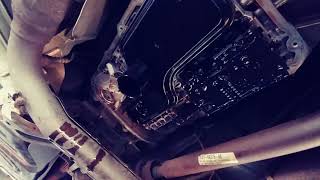
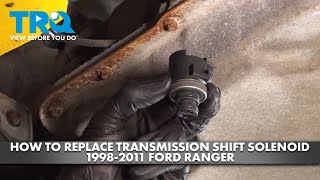
Typical fix: Replace the entire transmission solenoid block assembly. 🎬 Watch: 5R55S solenoid pack and filter removal walkthrough This part contains all the shift solenoids in one unit. 🎬 See how to replace transmission shift solenoids
Est. part cost: $150-$300 - Low or Degraded Transmission Fluid 🟡 Medium Probability → Shop Transmission Assembly Fluid leaks or lack of maintenance can lead to low fluid levels or fluid that has lost its protective properties, causing solenoids to operate poorly or overheat. While often a contributing factor, it's less commonly the sole cause for a specific inductive signature fault code like P1715.
How to confirm: Check the transmission fluid level and condition using the dipstick. The fluid should be at the correct level, red in color, and not smell burnt. Dark, brown, or metallic fluid indicates a problem.
Typical fix: Perform a transmission fluid and filter change. If the fluid is very low, the source of the leak must be found and repaired. This is a good first step but may not clear the code if the solenoid is already damaged.
Est. part cost: $50-$100 - Damaged Internal Transmission Wiring Harness ⚪ Low Probability → Shop Transmission Assembly The internal harness lives in a harsh environment of heat and fluid, which can make wires brittle or insulation crack over time, leading to shorts.
How to confirm: Visually inspect the wiring harness that connects to the solenoid block when the transmission pan is removed. Check for broken wires, damaged insulation, or corroded connector pins.
Typical fix: Repair the damaged section of the harness or replace the internal harness.
Est. part cost: $40-$80
Rare But Worth Checking
- Faulty Powertrain Control Module (PCM): This is very rare. The PCM should only be considered after all other possibilities, including solenoids and wiring, have been exhaustively checked and ruled out.
Diagnosis Steps
- Verify the code with an OBD-II scanner. Note if the O/D light is flashing.
- Check the transmission fluid level and condition. If low, top it off and check for leaks. If burnt or dirty, a fluid and filter change is a good first step, but may not solve the solenoid issue.
- If the fluid is okay, the next step is to gain access to the solenoid block. This requires safely lifting the vehicle and draining the transmission fluid to remove the oil pan.
- Inspect the transmission pan for excessive metal shavings or clutch material. A small amount of fine gray material is normal, but large chunks indicate a more severe mechanical failure.
- Disconnect the main electrical connector from the solenoid block.
- Using a multimeter, test the resistance of the pins corresponding to Shift Solenoid 'B'. Compare the reading to the manufacturer's specification (typically 20-40 ohms for shift solenoids A, B, and C). A reading that is open (infinite), shorted (near zero), or out of spec confirms a failed solenoid.
- Given the high failure rate and the fact that other solenoids may be near failure, it is strongly recommended to replace the entire solenoid block assembly while the pan is off.
- Install the new solenoid block, a new transmission filter, and a new pan gasket. Ensure all connectors are securely fastened.
- Reinstall the transmission pan, torquing bolts to the manufacturer's specification (typically 10-12 ft-lbs / 71 in-lbs for the 5R55S).
- Refill with the correct type and amount of transmission fluid (Mercon V). This usually requires 4-5 quarts for a pan drop.
- Clear the trouble codes with the scanner and perform a test drive, allowing the transmission to shift through all gears to ensure normal operation. It may be necessary to perform a transmission adaptive learning procedure.
Parts You'll Likely Need
- Transmission Solenoid Block Assembly
(OEM #XW4Z-7A098-AB)— This is the most common failure point for code P1715. It contains all the shift solenoids, including the faulty 'B' solenoid.
Trusted brands: Motorcraft, Dorman, Rostra, Bosch
OEM price range: $250-$350
Aftermarket price range: $150-$250 - Transmission Filter Kit (Filter and Pan Gasket)
(OEM #XL2Z-7A098-AB)— Must be replaced whenever the transmission pan is removed for service.
Trusted brands: Motorcraft, Wix, ATP
OEM price range: $30-$50
Aftermarket price range: $15-$30 - Mercon V Automatic Transmission Fluid — The transmission must be refilled with the correct fluid after the pan is dropped. The 5R55E typically requires 4-5 quarts for a pan drop and refill.
Trusted brands: Motorcraft, Valvoline, Castrol
OEM price range: $8-$12 per quart
Aftermarket price range: $6-$10 per quart
Related Codes That Often Appear With This One
- P1714 (SSA Inductive Signature Malfunction)
- P1716 (SSC Inductive Signature Malfunction)
- P0775 (Pressure Control Solenoid 'B' Fault)
Technical Service Bulletins (TSBs) & Recalls
- TSB 09-12-12: Shift Concerns / Band Failure: While not directly for P1715, Ford issued TSB 09-12-12 for 5R55S/W/N transmissions regarding loss of 2nd, 3rd, and 5th gears due to servo pin case bore wear. This is another extremely common failure on this transmission family that causes shift flares and incorrect ratio codes, but is a separate issue from the P1715 solenoid fault.
Platform-Specific Known Issues
- Owner Experience: Intermittent Fault: An owner of a 1998 Explorer with P1715 noted that the check engine light would sometimes go away after resetting the PCM (by disconnecting the battery), only to return later. The transmission seemed to shift normally at first. This highlights the intermittent nature of a sticking solenoid, which can work correctly for a time before failing again.
- DIY Repair Confirmation: A thread on Ford Truck Enthusiasts forums from 2015 involves a user with code P1715. A former Ford transmission engineer, Mark Kovalsky, chimes in to state, 'The ONLY way this code can set is when shift solenoid B sticks.' He confirms the fix is to replace the solenoids inside the pan, a job that does not require removing the entire transmission.
Mechanic-Grade Diagnostic Values
- Shift Solenoid A, B, C (SSA, SSB, SSC) Resistance — expected: 20-40 Ohms. Failure: A reading of 0 Ohms (short) or infinite Ohms (open) indicates a failed solenoid.
- Pressure Control Solenoids (PCA, PCB, PCC) Resistance — expected: 3.9 - 6.0 Ohms. Failure: A reading outside this range indicates a failed pressure control solenoid.
- Torque Converter Clutch (TCC) Solenoid Resistance — expected: 8.0 - 14.0 Ohms. Failure: A reading outside this range indicates a failed TCC solenoid.
Scan Tool Commands That Help
- Ford IDS, Autel, Innova 5610, or similar bidirectional scanner: Active Test: Shift Solenoid A/B/C Command — This command allows a technician to individually activate each shift solenoid with the key on and engine off. A clicking sound from the transmission pan should be audible, confirming the solenoid's mechanical and electrical operation. The absence of a click from solenoid 'B' when commanded would strongly confirm it as the source of the P1715 code.
- Ford IDS or similar: Reset Transmission Adaptive Tables / Resume Transmission Adaptive Learning — After replacing the solenoid block, the PCM's learned shift pressure values will be incorrect for the new hardware. This function clears the old data and forces the PCM to relearn shift strategies, which is critical for preventing harsh shifts and ensuring the longevity of the new part.
Wiring & Ground Locations
- G100 / G101 — On early models (approx. 1998), G100 is at the LH rear corner of the engine compartment, and G101 is at the LH front near the radiator. On later models (approx. 2001-2004), these grounds are typically on the left front corner of the engine compartment, near the fender apron.. These are primary engine compartment grounds. The PCM and its related sensors rely on clean ground connections. A corroded or loose G100/G101 can cause erratic voltage signals and phantom codes, including transmission faults. They should be inspected and cleaned as a preliminary step in any complex electrical diagnosis.
- Transmission Case Connector (C168A / 23-way connector) — The main electrical connector passing through the passenger side of the transmission case.. This is the main interface between the PCM and the internal transmission components, including the solenoid block. Pinpoint tests for resistance and voltage for Shift Solenoid B are performed at this connector's pins (or the corresponding pins at the PCM connector) to isolate the fault between the PCM, wiring, and the solenoid itself.
Real Owner Repair Stories
- Ford F150 Forum user (2000 Ford F-150 (with similar 4R70W/5R55 family transmission)) — Persistent P1715 code.
❌ Tried (didn't work) Initial diagnosis pointed to a bad batch of aftermarket parts from a local auto parts store.
✅ What actually fixed it The owner replaced both the shift solenoid pack and the bulkhead case connector. Upon removal, he noted the electrical connection on the old solenoid was loose and could be wiggled, while the new one was solid. This resolved the code.
OEM Part Supersession History
1L2Z-7G391-AG (for 5R55W/S)→9L2Z-7G391-A— The original designs had high failure rates. The updated part is an improved design.
Heads up: The updated solenoid pack (9L2Z-7G391-A) is designed for 2004 and newer models. While it may physically fit 2002-2003 models, it is not recommended for use in them due to potential electronic or hydraulic calibration differences between the 5R55W and 5R55S transmissions.
Model Year Variations Within This Range
- 1998-2001 (5R55E): These earlier models use a 5R55E transmission. The solenoid pack for the 5R55E is electronically different and not interchangeable with the later 5R55W/S packs used from 2002-2004.
- 2002-2003 (5R55W/S Early Design): These models introduced the 5R55W and 5R55S transmissions. They use a specific solenoid block that was later superseded. Using a pack intended for a 2004+ model is not recommended.
- 2004 (5R55S Late Design): These models use an updated solenoid block (PN 9L2Z-7G391-A) which replaced earlier, more failure-prone designs. This is the most common replacement part for the later third-generation Explorers.
Diagnostic Flowchart
Other Known Issues on This Vehicle
Issues unrelated to this code that are worth knowing about as an owner of this generation:
- 4.0L SOHC Timing Chain Cassette Failure 🔴 High — Very common, especially on higher-mileage engines (over 100k miles). Often presents as a rattling or slapping noise from the engine, particularly at startup.
- Cracked Plastic Thermostat Housing 🟠 Medium — Extremely common. The OEM two-piece plastic housing is prone to developing cracks and causing significant coolant leaks. Onset can happen at any mileage.
- Broken Rear Liftgate Window Hinges 🟡 Low — Very common. The metal hinges that attach the glass to the liftgate corrode and break, causing the window to rattle or detach. A recall (04V442000) existed for 2002-2003 models, but the problem affects the entire generation. (Ref: NHTSA 04V442000 (for 2002-2003 models))
- Worn Transmission Servo Bores 🔴 High → Shop Transmission Assembly — A well-documented failure on 5R55E/W/S transmissions, typically after 50,000 miles. Causes pressure loss, leading to shift flares (engine revs between gears), especially when hot. (Ref: TSB 09-12-12)
- Cracked Panel Below Rear Window 🟡 Low — A cosmetic but very common issue on the third-generation (2002-2005) models where the plastic applique panel below the rear window cracks, usually near the Ford emblem.
Used vs. New Parts: Buying Guide for This Vehicle
When a used part is the smart pick: Never. The solenoid block is a known high-failure-rate component due to internal wear and tear on its mechanical plungers and electrical coils. Installing a used part from a junkyard is highly likely to result in the same failure in a short amount of time, wasting significant labor costs.
What to inspect on the donor part:
- Not applicable, as used parts are not recommended.
OEM-only on this vehicle (don't cheap out):
- While not strictly 'OEM-only', using a high-quality, new part is critical. Low-quality aftermarket parts are a significant risk.
Aftermarket brands forum-validated for this vehicle:
- Bosch (often the original equipment manufacturer)
- Motorcraft (Ford's OEM brand)
- Rostra
Brands owners have reported issues with on this vehicle:
- Unbranded, no-name solenoid packs sold on marketplaces at a significantly lower price. Forum discussions and mechanic experience suggest these have a very high infant mortality rate. One user specifically noted a problem with a part from a generic auto parts store that was resolved by using a different brand.
Real Owner Stories
Aggregated from forums and TSBs cited above. Mileages and costs reflect what owners reported in those sources.
1998 Ford Explorer
Symptoms: The check engine light would sometimes go away after resetting the PCM by disconnecting the battery, only to return later. The transmission seemed to shift normally at first before the light reappeared.
What fixed it: The issue was identified as an intermittent sticking solenoid, requiring replacement of the solenoids inside the pan.
Source hint: vehicle_specific_issues: 'Owner Experience: Intermittent Fault'
1998 Ford Explorer
Symptoms: The vehicle triggered code P1715. Discussion confirmed the definition as 'SSB Inductive Signature Malfunction'.
What fixed it: Replacing the solenoids inside the pan. A former Ford transmission engineer confirmed this fix does not require removing the entire transmission.
Source hint: Ford Truck Enthusiasts Forums: 'Trouble Code P1715'
Related OBD-II Codes
Frequently Asked Questions
Does TSB 09-12-12 for the 5R55S transmission explain why my 2004 Explorer has code P1715?
I have a 1998 Explorer and the P1715 code goes away when I disconnect the battery. Does this mean the transmission is actually fine?
Can I just replace the one bad solenoid for Shift Solenoid 'B' to save money on my Explorer?
What specific transmission fluid should I use for my 1998-2004 Explorer after replacing the solenoid block?
Is the P1715 code common on other vehicles besides the Explorer?
What is the correct torque specification for the transmission pan bolts on a 5R55S transmission?
Helpful Videos
We Have This Part in Stock

The information in this article is provided for general reference and educational purposes only. Vehicle specifications, procedures, and part compatibility can vary by production date, trim level, and region. Always consult your vehicle's factory service manual and verify part numbers before purchasing or performing repairs. Safety-critical components such as airbags, seat belts, and braking systems should be installed by a qualified professional.
- Ford Explorer:
- 🧭 Diagnostic Flowchart
- 🎬 Helpful Videos
- 🛍️ Shop This Part
- What's Unique About the 1998-2004 Ford Explorer
- Symptoms You May Notice
- Most Likely Causes
- Rare But Worth Checking
- Diagnosis Steps
- Parts You'll Likely Need
- Related Codes That Often Appear With This One
- Technical Service Bulletins (TSBs) & Recalls
- Platform-Specific Known Issues
- Mechanic-Grade Diagnostic Values
- Scan Tool Commands That Help
- Wiring & Ground Locations
- Real Owner Repair Stories
- OEM Part Supersession History
- Model Year Variations Within This Range
- Other Known Issues on This Vehicle
- Used vs. New Parts: Buying Guide for This Vehicle
- Real Owner Stories
- 1998 Ford Explorer
- 1998 Ford Explorer
- Related OBD-II Codes
- Frequently Asked Questions
- 🎟️ Get 5% Off