

P1775 on 2003-2007 Infiniti G35: Torque Converter Clutch Solenoid Causes and Fixes
On a 2003-2007 G35, P1775 points to the Torque Converter Clutch (TCC) solenoid within the RE5R05A transmission. The fix often involves replacing this solenoid inside the transmission valve body. However, be aware that similar symptoms are frequently caused by the more common P1757/P1759 codes, which usually require soldering a broken connection pin on the Transmission Control Module (TCM), not replacing a part. Always confirm the exact code before proceeding.
- P1775 on your G35 means there's a fault with the Torque Converter Clutch (TCC) solenoid or its circuit.
- Before buying any parts, use a scanner to confirm P1775 is the code you have. Similar symptoms are very often caused by the more common P1757 code, which has a different fix (soldering).
- The repair requires removing the valve body from inside the transmission, which is a complex job best left to experienced DIYers or professionals.
- The most likely parts needed are a new solenoid, a transmission pan gasket, and 5-6 quarts of compatible ATF like Nissan Matic-S.
- While the valve body is out, it is critical to inspect the Transmission Control Module (TCM) for the infamous cracked solder joints that plague these models.
What's Unique About the 2003-2007 Infiniti G35
The Infiniti G35 and other Nissan/Infiniti vehicles using the RE5R05A transmission are famously prone to failures within the valve body assembly. While P1775 points to the TCC solenoid, it's far more common for owners to experience codes like P1757 (Front Brake Solenoid). These issues often stem from cracked solder joints on the integrated TCM board, not a failed solenoid itself. Because the symptoms are nearly identical (limp mode, harsh shifting, failure to accelerate from a stop), it's crucial to verify the exact code with a scanner before buying parts. The repair for the more common P1757/P1759 codes is often a careful soldering job on the TCM, a much cheaper fix than replacing components.
Symptoms You May Notice
- Check Engine Light or AT (Automatic Transmission) Check Light is on
- Vehicle enters 'limp mode' (fail-safe), often getting stuck in 4th or 5th gear
- Harsh or delayed shifting, sometimes feeling like being rear-ended
- Inability of the torque converter to lock up at highway speeds, resulting in higher RPMs
- Decreased fuel economy
- Engine stalling when coming to a stop
- Inability to accelerate from a complete stop, as if the car is in neutral
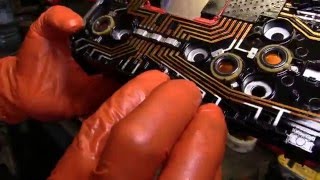
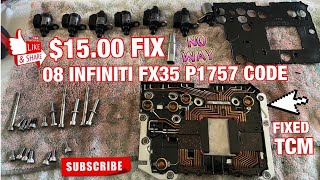
- Replacing the TCC solenoid when the actual code is P1757 or P1759. These codes point to the Front Brake Solenoid circuit and are most often caused by a broken solder joint on the TCM board itself. The fix is to resolder the broken pin, not replace the solenoid. 🎬 Watch: Step-by-step guide to resoldering the TCM board pins. Always verify the specific code with a scanner before ordering parts.
- Replacing the entire transmission. Many shops may recommend a full transmission replacement when the issue is isolated to the serviceable valve body assembly. A valve body repair or replacement is significantly cheaper.
Most Likely Causes
- Faulty Torque Converter Clutch (TCC) Solenoid 🔴 High Probability The solenoids in the RE5R05A transmission are submerged in hot ATF and cycle thousands of times, leading to eventual electrical failure of the internal coil windings or mechanical sticking of the valve.
How to confirm: After removing the valve body, the solenoid can be tested with a multimeter for proper resistance (typically 22-40 ohms). You can also apply a 12V power source to the solenoid's pins to listen for an audible 'click', which indicates the plunger is moving.
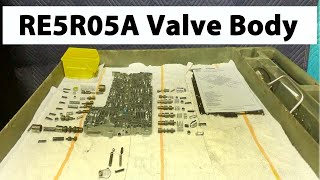
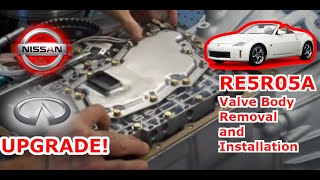
Typical fix: Replace the faulty solenoid. The TCC, Line Pressure, and Front Brake solenoids are often identical parts 🎬 Watch: A detailed overview of the RE5R05A valve body components. and can be purchased individually or as a kit.
Est. part cost: $40-$90 - Low or Degraded Transmission Fluid 🟡 Medium Probability → Shop Transmission Assembly The RE5R05A transmission is sensitive to fluid level and condition. Low fluid can cause pressure drops, while old, burnt fluid can contain clutch material and metal debris that clogs the fine mesh screens on the solenoids, impeding their function.
How to confirm: Check the transmission fluid level and condition using the dipstick (engine running, in park, after reaching operating temperature). The fluid should be a clear red/pink and not smell burnt. Note: Some later models may not have a dipstick, requiring a different check procedure.
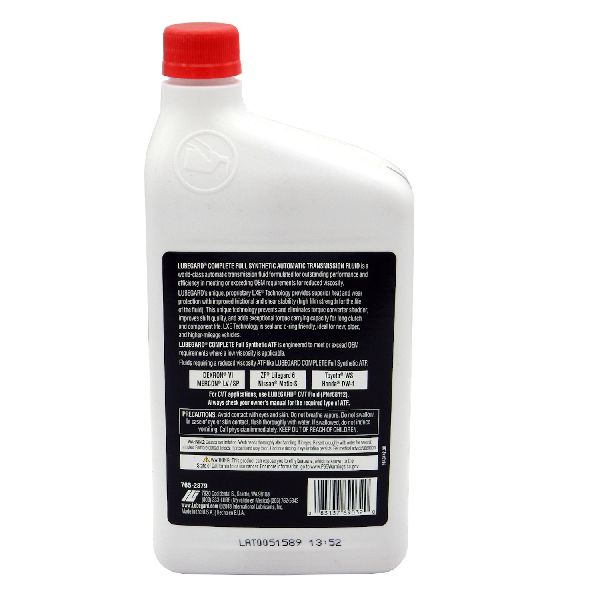
Typical fix: Perform a transmission fluid drain-and-fill with the correct Nissan Matic-S or an equivalent compatible ATF. A full fluid flush is generally not recommended by the manufacturer. If the fluid is very dark or contains debris, a simple fluid change may not be enough to solve the problem.
Est. part cost: $60-$150 for fluid - Damaged Wiring or Connectors inside Transmission ⚪ Low Probability → Shop Transmission Assembly The internal wiring harness and the main connector at the transmission case are constantly exposed to heat and vibration. The plastic can become brittle and wires can fray, though this is less common than TCM or solenoid failure.
How to confirm: Visually inspect the wiring harness and connectors for breaks, corrosion, or ATF intrusion when the valve body is removed. Check for continuity on the relevant wires from the TCM to the solenoid connector.
Typical fix: Repair the specific damaged wire or replace the internal transmission harness if necessary.
Est. part cost: $50-$200 for a harness
Rare But Worth Checking
- Faulty Transmission Control Module (TCM): → Shop Transmission Assembly While a complete TCM failure is less common for this specific code, it's possible for the driver circuit for the TCC solenoid to fail on the board. This is different from the more common broken solder joint that causes code P1757/P1759. In this case, the TCM itself would need to be replaced or sent to a specialist for repair.
Diagnosis Steps
- Check the transmission fluid level and condition. Ensure it is at the correct level and does not appear burnt or full of debris.
- Use a quality OBD-II scanner to confirm P1775 is the primary code. Check for other pending or stored transmission codes like P1757 or P1759, as their diagnosis path differs.
- Clear the codes and test drive the vehicle to see if the code returns. Note the driving conditions (speed, gear, temperature) when it triggers.
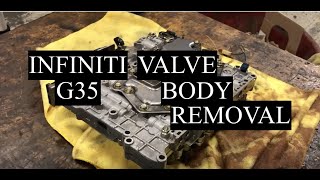
- If the code returns, the next step is to gain access to the valve body. This involves safely lifting the vehicle, draining the transmission fluid (expect ~5 quarts), and removing the 22 bolts of the transmission pan. 🎬 See this walkthrough on safely removing the valve body assembly.
- Remove the valve body assembly. This contains the solenoids and the integrated TCM. Unplug the two main connectors and remove the 12 mounting bolts.
- Locate the TCC solenoid on the valve body. Test its resistance with a multimeter. A healthy solenoid should read between 22 and 40 ohms. Also, apply 12V power to check for a click.
- Even if the code is not P1757/P1759, it is wise to inspect the TCM board for any cracked or broken solder joints, as this is a known weak point of the entire assembly.
- Based on findings, either replace the faulty TCC solenoid, repair the TCM board, or address any wiring issues before reinstalling the valve body with a new pan gasket and fresh, correct-spec ATF.
Parts You'll Likely Need
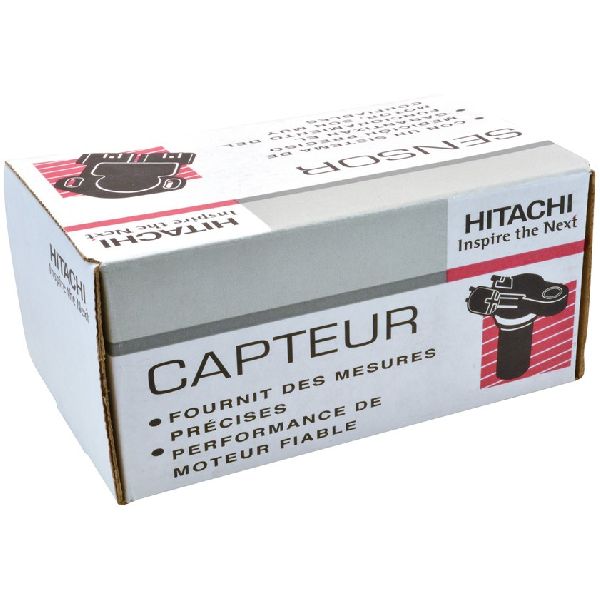
- Transmission Solenoid (TCC/Line Pressure/Front Brake)
(OEM #31941-1FX02)— This is the direct cause of code P1775 if the solenoid itself has failed electrically or mechanically. Several solenoids on the valve body are identical.
Trusted brands: Hitachi, Rostra (often sold in kits like 52-0531), Whatever/Reman
OEM price range: $120-$180
Aftermarket price range: $40-$90 - Transmission Pan Gasket
(OEM #31397-90X0A)— The pan gasket is a single-use item and must be replaced anytime the transmission pan is removed to prevent leaks.
Trusted brands: Fel-Pro, Mahle, OEM
OEM price range: $25-$40
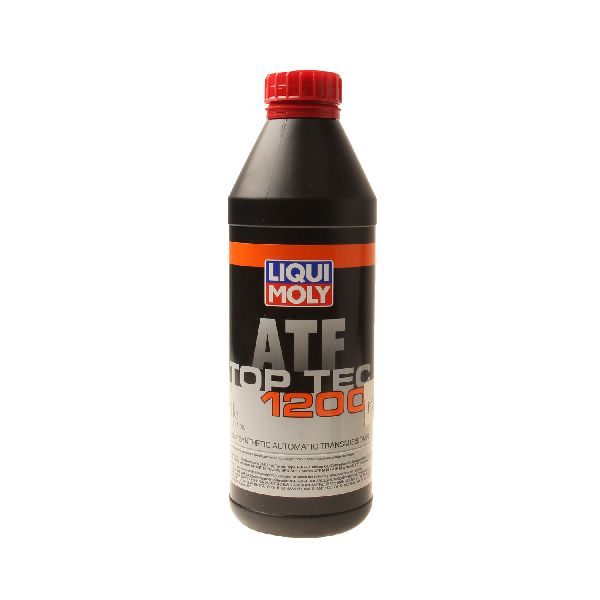
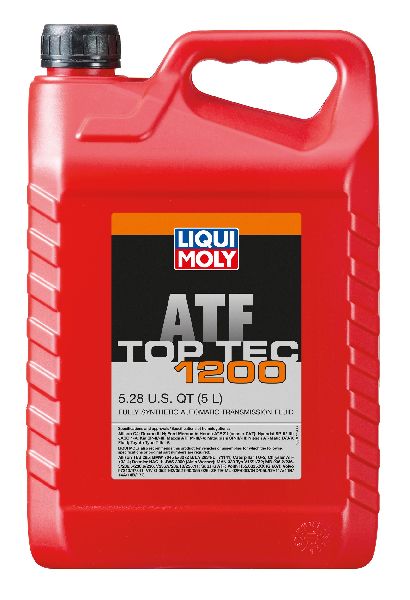
Aftermarket price range: $15-$25 - Nissan Matic-S Automatic Transmission Fluid (or equivalent) — You will need to replace the 5-6 quarts of fluid lost when dropping the pan. Using the correct fluid is critical for transmission health.
Trusted brands: Nissan OEM, Idemitsu Type J/S, Valvoline MaxLife ATF
OEM price range: $18-$25 per quart
Aftermarket price range: $12-$18 per quart
Related Codes That Often Appear With This One
- P0741 — This is a generic code for 'Torque Converter Clutch Circuit Performance or Stuck Off', which points to the same system as the manufacturer-specific P1775 and may be stored concurrently.
- P1757 / P1759 — These codes for the Front Brake Solenoid are extremely common on this transmission and can appear alongside other solenoid codes if the TCM has multiple failing solder joints or there are widespread hydraulic issues. Their symptoms are nearly identical.
Platform-Specific Known Issues
- The most significant issue on this platform is the tendency for solder joints on the Transmission Control Module (TCM) to crack, leading to various solenoid circuit codes (P1757, P1759, etc.). The TCM is integrated into the valve body, requiring its removal for inspection and repair. This failure is more common than the solenoids themselves failing.
- A detailed forum post on G35Driver.com by user 'seymore4' provides a step-by-step guide with pictures for removing the valve body and repairing the broken TCM solder pins for the P1757/P1759 codes, a process which is nearly identica
Mechanic-Grade Diagnostic Values
- Torque Converter Clutch Solenoid Monitor (TCC SOL MON) current — expected: Should increase to 0.4A during steady cruise at or above 25 MPH.. Failure: The current does not increase to 0.4A under the specified driving conditions.
- Resistance of a similar solenoid (Direct Clutch) in the same assembly — expected: Approximately 6.3 ohms. Failure: An open reading (infinite resistance) or a reading significantly different from the specification.
Scan Tool Commands That Help
- Infiniti CONSULT: DATA MONITOR for 'TCC SOL MON' — This is the dealer-level procedure to verify if the TCC solenoid is receiving the correct electrical current from the TCM during a test drive. It's used to confirm an electrical circuit fault before removing mechanical parts.
Wiring & Ground Locations
- Primary Transmission Ground — On the top middle of the engine's front timing chain cover. Two wires are landed on this point, one of which is the main transmission ground.. A poor ground connection at this primary point can cause erratic behavior and incorrect voltage readings for all transmission electronics, potentially triggering false solenoid codes.
- Transmission Housing Bonding Jumper — A smaller ground strap often found on the back side of the transmission housing, connecting it to the vehicle chassis.. While the bellhousing bolts provide a primary ground path to the engine, this bonding jumper ensures a redundant, clean ground. If corroded or broken, it can contribute to electrical noise.
- Ground Points M30 / M66 — For 2003 models, these are chassis ground points located behind the instrument cluster (M30) and behind the right side of the dash (M66).. On early models with an external TCM located in the passenger cabin, these grounds are critical for the proper function of the TCM itself and its communication with other modules.
Real Owner Repair Stories
- Reddit user in r/infiniti (2015 Infiniti Q40 (7-speed AT, but similar diagnostic logic)) — Stalling when coming to a stop, delayed gear engagement, whining/revving noise, TCC target pressure stuck at ~900 PSI at idle.
❌ Tried (didn't work) Replacing the entire valve body assembly.
✅ What actually fixed it The user ultimately performed a complete VR30 engine and transmission swap. The key diagnostic takeaway is that a brand new valve body did not resolve the severe pressure and stalling issues, strongly suggesting the root cause was a mechanical failure in the torque converter or the transmission's front pump, not the electronics. - G35Driver forum user (2003 Infiniti G35 Sedan) — Check Engine Light with code P1762 (Direct Clutch Solenoid, a related solenoid code), transmission in fail-safe mode (stuck in 4th gear).
❌ Tried (didn't work) The user was in the process of diagnosis, no failed fixes were mentioned.
✅ What actually fixed it The final fix was not posted, but the user correctly diagnosed an open circuit in the direct clutch solenoid by measuring resistance at the external TCM connector (found an open circuit vs. an expected ~6.3 ohms). The planned fix was to drop the valve body and replace the solenoid, after confirming the TCM solder pins were intact, which is the correct diagnostic path.
OEM Part Supersession History
N/A→N/A— Component Calibration
Heads up: According to some service information, the individual solenoids are factory-calibrated to the specific Transmission Control Module (TCM) they are paired with. Because of this, replacing a single solenoid is not the recommended procedure. The official repair is to replace the entire valve body assembly, which includes the TCM and a matched set of solenoids. Attempting to replace just one solenoid may result in improper shifting or pressure control.
Model Year Variations Within This Range
- 2003 - early 2004: The Transmission Control Module (TCM) is a separate unit located inside the passenger cabin, typically behind the passenger side kick panel. This makes diagnosing TCM-related issues easier as it doesn't require opening the transmission.
- late 2004 - 2007: The TCM is integrated into the valve body assembly (this combined unit is often called a TEHCM or 'mechatronic' unit) and is located inside the transmission oil pan. This design is more prone to the well-known cracked solder joint issue and requires removing the valve body for any TCM or solenoid service.
- 2003-2007: The TCM manufacturer changed from Bosch to Hitachi during the production run (around the 2004/2005 refresh). Early Bosch units were more easily reprogrammed by independent shops. The later Hitachi units initially required dealer-specific tools for programming after replacement, though aftermarket solutions are now available.
- 2003-2007: There are early and late style valve bodies with different internal arrangements for the accumulator pistons. Parts are not interchangeable between these designs.
Diagnostic Flowchart
Other Known Issues on This Vehicle
Issues unrelated to this code that are worth knowing about as an owner of this generation:
- Excessive Oil Consumption (VQ35DE 'Rev-Up' Engine) 🔴 High — Very common on 2005-2007 models with the 'Rev-Up' version of the VQ35DE, often due to faulty piston rings. Can start as early as 30k-60k miles. (Ref: Infiniti TSB ITB08-002c addressed this, outlining an oil consumption test procedure that could lead to engine replacement under warranty.)
- Crankshaft and Camshaft Position Sensor Failure 🟠 Medium — Extremely common across all 2003-2007 models. Failure can cause stalling, no-start conditions, and loss of power. (Ref: A recall was issued for some model years to address this sensor failure.)
- Cracked Dashboard 🟡 Low — Very common for dashes to develop cracks, especially when exposed to sun and heat. Can start appearing around 60,000 miles.
- Power Window Motor Failure 🟠 Medium — A frequent complaint where the window motor fails, causing the window to get stuck or operate erratically. Often requires motor replacement or a reset procedure.
- Premature Timing Chain Guide/Tensioner Wear 🔴 High — The plastic timing chain guides and tensioners can wear out prematurely, causing rattling noises. If ignored, it can lead to catastrophic engine damage.
- Valve Cover Gasket and Spark Plug Tube Seal Leaks 🟠 Medium — Common oil leak point as the vehicle ages (typically over 100k miles). The spark plug tube seals are integrated into the valve cover, so a leak there requires replacing the entire valve cover.
Used vs. New Parts: Buying Guide for This Vehicle
When a used part is the smart pick: A complete used valve body/TCM assembly can be a viable option if it's from a known-good, low-mileage vehicle. This is most practical if you suspect a complex internal valve body issue beyond a simple solenoid and want to avoid the high cost of a remanufactured unit. However, it carries significant risk of inheriting another problem.
Donor-vehicle mileage cap: roughly under 100000 miles for the part to have meaningful remaining life.
What to inspect on the donor part:
- Confirm the donor vehicle's VIN to ensure compatibility; there are many valve body variations that are VIN-specific.
- Ask for the service history of the donor car to check for transmission issues or coolant contamination.
- Inspect the fluid from the donor transmission if possible. Any sign of a pink/milky 'strawberry milkshake' consistency means the part is junk.
- Visually inspect the main electrical connector pins for corrosion or damage.
OEM-only on this vehicle (don't cheap out):
- Complete Valve Body / TCM Assembly: While aftermarket options exist, a new OEM or professionally remanufactured unit (e.g., from Sonnax) is the safest bet to ensure correct programming and avoid compatibility headaches.
Aftermarket brands forum-validated for this vehicle:
- Sonnax (for remanufactured valve bodies and repair kits)
- Rostra (for individual solenoids or solenoid kits, if attempting that repair)
- Hitachi (OEM supplier for many of the solenoids)
Brands owners have reported issues with on this vehicle:
- Unbranded, low-cost solenoid kits from marketplaces like eBay or Amazon are frequently cited in forums as being unreliable and a risky choice.
Real Owner Stories
Aggregated from forums and TSBs cited above. Mileages and costs reflect what owners reported in those sources.
2005 Infiniti G35
Symptoms: The 'AT Check Light' came on.
What fixed it: The issue was identified as a faulty TCC solenoid, though the owner was also aware of the notorious broken harness pin problem on these transmissions.
Source hint: G35Driver Forum: 'AT Check Light ! HELP !'
2004 Infiniti G35
Symptoms: Vehicle had symptoms identical to those for P1775, such as the AT Check light being on and the transmission entering 'limp mode'.
What fixed it: The problem was a broken pin on the Transmission Control Module (TCM), which was resolved by a soldering repair.
Source hint: YouTube: 'Infiniti G35 Transmission Repair: P1757 Code Fix - RE5R05A' by Automatic Transmission
Related OBD-II Codes
Frequently Asked Questions
My 2005 G35 is stuck in 4th gear with the AT light on. Is it definitely the TCC solenoid causing code P1775?
To fix P1775, can I just do a transmission fluid flush?
How can I test the TCC solenoid on my G35 once I have the valve body out?
I've heard about a common TCM problem on these cars causing codes P1757 and P1759. Is that related to my P1775 code?
Does my 2007 Nissan 350Z have the same transmission and risk for P1775 as the G35?
What specific transmission fluid should I use when refilling my G35's transmission after a repair for P1775?
Helpful Videos
We Have This Part in Stock

The information in this article is provided for general reference and educational purposes only. Vehicle specifications, procedures, and part compatibility can vary by production date, trim level, and region. Always consult your vehicle's factory service manual and verify part numbers before purchasing or performing repairs. Safety-critical components such as airbags, seat belts, and braking systems should be installed by a qualified professional.
- Infiniti G35:
- 🧭 Diagnostic Flowchart
- 🎬 Helpful Videos
- 🛍️ Shop This Part
- What's Unique About the 2003-2007 Infiniti G35
- Symptoms You May Notice
- Most Likely Causes
- Rare But Worth Checking
- Diagnosis Steps
- Parts You'll Likely Need
- Related Codes That Often Appear With This One
- Platform-Specific Known Issues
- Mechanic-Grade Diagnostic Values
- Scan Tool Commands That Help
- Wiring & Ground Locations
- Real Owner Repair Stories
- OEM Part Supersession History
- Model Year Variations Within This Range
- Other Known Issues on This Vehicle
- Used vs. New Parts: Buying Guide for This Vehicle
- Real Owner Stories
- 2005 Infiniti G35
- 2004 Infiniti G35
- Related OBD-II Codes
- Frequently Asked Questions
- 🎟️ Get 5% Off