

P2015 on 2011-2014 Chrysler 200 2.4L: Intake Manifold Causes and Fixes
On a 2011-2014 Chrysler 200 with the 2.4L engine, code P2015 almost always means the entire intake manifold needs to be replaced. The built-in actuator motor fails or the internal flaps bind, requiring a full assembly replacement. Expect to pay $250-$500 for the part and 2-4 hours for labor.
- Code P2015 on your Chrysler 200 2.4L almost certainly means you need a new intake manifold.
- The failure is typically the built-in electronic actuator motor or the internal plastic flaps, not a separate sensor.
- The correct fix is to replace the entire intake manifold assembly along with new gaskets.
What's Unique About the 2011-2014 Chrysler 200
The 2.4L 'World Engine' used in the Chrysler 200 and its siblings (Dodge Avenger/Caliber, Jeep Compass/Patriot) has a known weakness with its intake manifold assembly. Unlike on some vehicles where the sensor or actuator can be replaced separately, on this platform the electronic actuator motor is integrated into the plastic manifold. This motor frequently fails, the internal plastic flaps it controls can bind or break, or heavy carbon buildup can cause the flaps to stick. Due to this integrated design, replacement of the entire manifold assembly is the common and necessary repair.
Symptoms You May Notice
- Check Engine Light is on
- Reduced engine power and sluggish acceleration
- Rough or unstable idle
- Decreased fuel economy
- Engine cranks but will not start (less common)
- Replacing only the position sensor. On this engine, the sensor is rarely the point of failure; the problem is almost always mechanical or with the integrated actuator motor within the manifold itself.
Most Likely Causes
- Failed Intake Manifold Assembly 🔴 High Probability → Shop Engine Intake Manifold The electronic actuator motor for the runner flaps is integrated into the intake manifold and is a very common failure point on the 2.4L World Engine. The internal plastic flaps or linkage can also bind or break, and heavy carbon buildup can cause the flaps to become stuck.
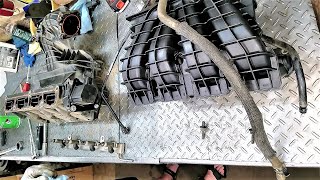
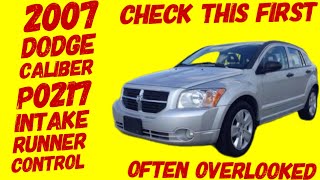
How to confirm: With the engine off, locate the actuator on the side of the intake manifold and attempt to move the linkage by hand. If it feels stuck, binds, or is audibly broken, the manifold has failed. 🎬 Watch: How to diagnose the runner control before replacing parts. A bi-directional scan tool can also be used to command the actuator to move; a lack of movement or an audible clicking/grinding sound confirms failure.
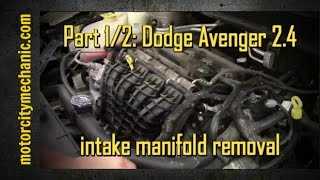
Typical fix: Replace the entire intake manifold assembly with a new unit. This is the most common and reliable repair. 🎬 See this step-by-step guide on removing the intake manifold.
Est. part cost: $250-$500 - Damaged Wiring or Loose Connector ⚪ Low Probability
How to confirm: Visually inspect the wiring harness and connector going to the intake manifold runner control actuator. Check for any signs of damage, corrosion, or loose pins. Use a multimeter to check for proper voltage and ground at the connector according to the vehicle's wiring diagram.
Typical fix: Repair the damaged section of the wiring harness or clean/replace the connector.
Est. part cost: $10-$50
Rare But Worth Checking
- Faulty Powertrain Control Module (PCM): This is extremely rare. The PCM should only be considered after all other possibilities, including the manifold and wiring, have been exhaustively tested and ruled out. A defective PCM was noted as a cause for engine stalling on some 2011-2013 models.
- Weak or Failing Battery: Some owners have reported the P2015 code appearing due to a faulty or weak battery causing erroneous sensor readings. One owner of a 2012 Jeep Patriot reported the P2015 code appeared after charging the battery and disappeared after installing a new one. If the battery is old or showing signs of weakness, it's worth testing it before proceeding with more expensive repairs.
Diagnosis Steps
- Scan the vehicle for any other stored trouble codes to see if P2015 is accompanied by other relevant codes.
- Perform a thorough visual inspection of the intake manifold area. Look for obvious signs of damage, such as a broken actuator arm or disconnected linkage.
- Inspect the wiring harness and electrical connector at the intake manifold runner actuator for damage, corrosion, or loose connections.
- With the engine off, try to move the runner control linkage by hand. It should move smoothly and spring back. If it is stuck, binding, or loose, the manifold has failed.
- If you have a bi-directional scan tool, command the IMRC actuator to open and close while observing its operation. If it fails to move, the actuator motor (part of the manifold) is likely bad.
- If the actuator moves but the code returns, the problem may be with the internal flaps being stuck or broken, often due to carbon buildup.
- If the mechanical parts and actuator seem to work, test the electrical circuit for proper voltage, ground, and signal using a multimeter and wiring diagram.
- If all tests pass, the most likely cause is an internal failure of the intake manifold assembly, which is the most common fix for this code on this engine.
Parts You'll Likely Need
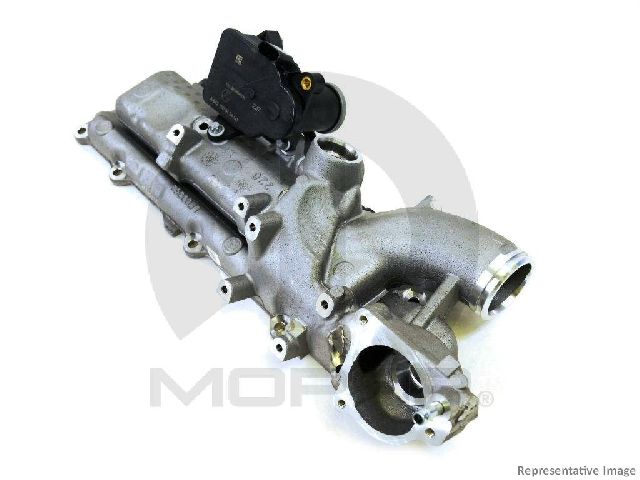
- Intake Manifold Assembly
(OEM #04884495AK)— This is the primary point of failure. The original part has been superseded multiple times, indicating design revisions. The current part 04884495AK replaces previous versions 4884495AD, 4884495AE, 4884495AF, 4884495AG, 4884495AH, 4884495AI, and 4884495AJ. The assembly includes the manifold housing, internal flaps, linkage, and the integrated electronic actuator motor.
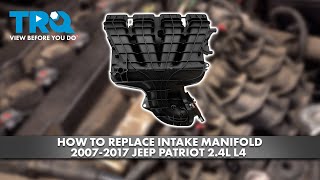
Trusted brands: Mopar, Dorman (p/n 615-905) 🎬 Watch: A complete walkthrough of the intake manifold replacement process.
OEM price range: $450-$550
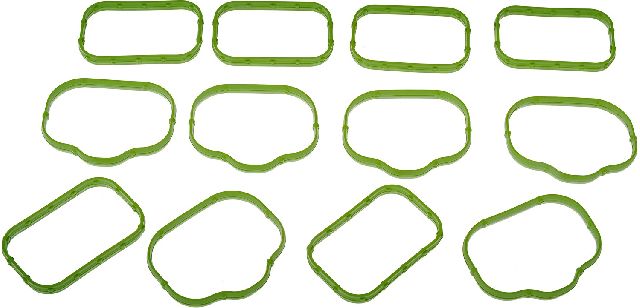
Aftermarket price range: $250-$400 - Intake Manifold Gasket Set — The gaskets must be replaced whenever the intake manifold is removed to ensure a proper seal against vacuum leaks.
Trusted brands: Fel-Pro, MAHLE, Victor Reinz
OEM price range: $40-$60
Aftermarket price range: $10-$30
Related Codes That Often Appear With This One
- P2004 — This code means 'Intake Manifold Runner Control Stuck Open'. It often appears with P2015 because a mechanical failure (stuck flap) will also cause a sensor performance issue.
- P2006 — This code means 'Intake Manifold Runner Control Stuck Closed'. Like P2004, it points to a mechanical jam in the system that P2015 also detects as a performance problem.
- P2017 — This code for 'Intake Manifold Runner Position Sensor/Switch Circuit High' can sometimes accompany P2015 if there is an electrical fault in addition to the mechanical/performance issue.
Technical Service Bulletins (TSBs) & Recalls
- No specific, widely-cited Technical Service Bulletin (TSB) for code P2015 on the 2.4L engine has been found. While TSBs exist for other engines (like the 3.6L) or other codes, this specific issue is typically addressed as a standard component failure and replacement.
Platform-Specific Known Issues
- The 2.4L World Engine platform is well-documented for failure of the intake manifold runner control system, making P2015 a very common code that almost always points to replacing the entire manifold.
Mechanic-Grade Diagnostic Values
- Intake Manifold Runner Position Sensor PID — expected: A voltage between 0.5V and 4.5V that changes in response to engine RPM and load.. Failure: A voltage that is stuck, does not change when commanded, or is outside the 0.5V-4.5V range. A reading stuck at the high end (e.g., ~4.5V) can indicate a circuit high fault.
Scan Tool Commands That Help
- Professional Bi-Directional Scan Tool (e.g., Chrysler wiTECH): IMRC Actuator Command / Test — This function is used during diagnosis to command the intake manifold runner actuator to open and close. It allows a technician to verify if the actuator motor is functional and if the flaps are moving, without having to manually access the linkage.
- Professional Bi-Directional Scan Tool (e.g., Chrysler wiTECH): Intake Manifold Adaptation / Relearn — After replacing the intake manifold, a relearn or adaptation procedure may be required to teach the PCM the new sensor's position values. While some sources suggest this is a necessary step, some owners have reported that the system may also self-adapt after a short drive cycle. If the code returns immediately after replacement, performing this function is the next logical step.
Wiring & Ground Locations
- G100 — Under the battery tray, near the left frame rail.. This is a primary chassis ground point. A corroded or loose G100 can cause a variety of difficult-to-diagnose electrical issues and erroneous sensor readings across the engine management system. Checking this ground should be part of any electrical diagnosis for persistent or unusual codes.
- Engine Block Ground Strap — A braided wire or thick cable connecting the engine block or cylinder head directly to the vehicle's firewall or frame.. This strap provides the main ground path for the alternator, starter, and ignition system. A poor engine ground can lead to unstable sensor voltages and incorrect readings from components mounted on the engine, including the intake manifold runner position sensor.
Model Year Variations Within This Range
- 2011-2014: There may be a difference between intake manifolds for standard (Federal emissions) and PZEV (Partial Zero-Emission Vehicle) versions of the 2.4L engine. PZEV models may incorporate a port for an EGR tube, which would be absent on a non-PZEV manifold. It is critical to match the new intake manifold to the vehicle's specific emissions package to ensure proper fitment and function.
Diagnostic Flowchart
Used vs. New Parts: Buying Guide for This Vehicle
When a used part is the smart pick: Buying a used intake manifold for this specific repair is highly risky due to the high rate of failure of the original design. A used part should only be considered if it is from a very low-mileage donor vehicle (under 50,000 miles) and can be physically inspected before purchase. Otherwise, the risk of inheriting the same problem is significant.
Donor-vehicle mileage cap: roughly under 50000 miles for the part to have meaningful remaining life.
What to inspect on the donor part:
- Manually move the actuator linkage arm on the side of the manifold. It must move smoothly through its full range of motion without any binding, sticking, or gritty feeling.
- Ensure the linkage springs back firmly to its resting position when released.
- Visually inspect the entire plastic housing for cracks, especially around the actuator motor mount and seams.
- Verify if the donor vehicle was a PZEV or non-PZEV model to ensure the manifold is compatible with your engine.
OEM-only on this vehicle (don't cheap out):
- Intake Manifold Assembly
Brands owners have reported issues with on this vehicle:
- Dorman (Reputation is mixed): While Dorman (p/n 615-905) is the most common aftermarket alternative, owner and mechanic feedback is inconsistent. Some users report successful, long-term repairs. Others report low quality, fitment issues, and premature failure, sometimes due to the use of plastic for threaded inserts instead of brass. Given the labor involved, the risk of using a part with a mixed reputation may not be worth the initial cost savings over a new OEM part.
Real Owner Stories
Aggregated from forums and TSBs cited above. Mileages and costs reflect what owners reported in those sources.
2008 Chrysler Sebring 2.4L
Symptoms: Flashing red lightning bolt on dash (Electronic Throttle Control light), car won't go over 5-10mph, won't rev up more than about 1200rpm.
What fixed it: The user did not report a final solution; they were still at a loss after replacing multiple parts including the intake manifold runner position sensor/valve and throttle body.
Source hint: Flashing red lightning bolt on dash - Chrysler Forum
2012 Jeep Patriot
Symptoms: Code P2015 appeared after removing the battery for charging.
What fixed it: The issue was resolved completely by installing a new battery, which suggests a weak or failing battery can sometimes trigger a false P2015 code.
Source hint: Reddit - r/JeepPatriot: A user with a 2012 Jeep Patriot reported that code P2015 appeared after removing the battery for charging and was resolved completely by installing a new battery, suggesting a weak battery can cause false codes.
2013 Jeep Compass
Symptoms: A crank-no-start condition along with code P2015.
What fixed it: The source did not specify the final repair, but confirmed that a no-start condition is a possible symptom.
Source hint: 2carpros.com: A 2013 Jeep Compass owner reported a crank-no-start condition along with code P2015, indicating a more severe symptom is possible.
2008 Dodge Avenger — 225000 miles
Symptoms: Dealing with codes P2017 and P2015 simultaneously.
What fixed it: The source did not specify the final repair, but confirmed that P2017 often appears with P2015.
Source hint: CarKiller.com Forum: An owner of a 2008 Dodge Avenger (platform mate) with 225k miles reported dealing with codes P2017 and P2015 simultaneously, confirming these codes often appear together.
Related OBD-II Codes
Frequently Asked Questions
Is it really necessary to replace the entire intake manifold for a P2015 code on my Chrysler 200?
Can I use a Dorman aftermarket intake manifold (part 615-905) to save money?
Are there any official TSBs or recalls from Chrysler for the P2015 code on the 2.4L engine?
My car has a P2015 code and now it cranks but won't start. Is this related?
How can I check the intake manifold myself before buying a new one?
I have a Jeep Patriot/Compass with the 2.4L engine. Does this P2015 information apply to my vehicle?
Helpful Videos
We Have This Part in Stock


The information in this article is provided for general reference and educational purposes only. Vehicle specifications, procedures, and part compatibility can vary by production date, trim level, and region. Always consult your vehicle's factory service manual and verify part numbers before purchasing or performing repairs. Safety-critical components such as airbags, seat belts, and braking systems should be installed by a qualified professional.
- Chrysler 200:
- 🧭 Diagnostic Flowchart
- 🎬 Helpful Videos
- 🛍️ Shop This Part
- What's Unique About the 2011-2014 Chrysler 200
- Symptoms You May Notice
- Most Likely Causes
- Rare But Worth Checking
- Diagnosis Steps
- Parts You'll Likely Need
- Related Codes That Often Appear With This One
- Technical Service Bulletins (TSBs) & Recalls
- Platform-Specific Known Issues
- Mechanic-Grade Diagnostic Values
- Scan Tool Commands That Help
- Wiring & Ground Locations
- Model Year Variations Within This Range
- Used vs. New Parts: Buying Guide for This Vehicle
- Real Owner Stories
- 2008 Chrysler Sebring 2.4L
- 2012 Jeep Patriot
- 2013 Jeep Compass
- 2008 Dodge Avenger — 225000 miles
- Related OBD-II Codes
- Frequently Asked Questions
- 🎟️ Get 5% Off