

P2135 on 2009-2014 Hyundai Genesis: Throttle Position Sensor Causes and Fixes
On a 2009-2014 Hyundai Genesis, code P2135 is most often caused by a faulty Throttle Position Sensor (TPS). Hyundai issued a Technical Service Bulletin (TSB 10-FL-010) for this exact problem, which involves replacing the sensor with an updated part and mandatorily updating the engine computer's software. The sensor itself is relatively inexpensive, but the software update requires a dealer or properly equipped shop, making it a crucial step for a permanent fix.
- P2135 on a 2009-2014 Genesis almost always points to a faulty Throttle Position Sensor (TPS), not the entire throttle body.
- This is a known issue with a specific Technical Service Bulletin (TSB 10-FL-010) from Hyundai.
- The correct repair involves replacing the TPS (Part No. 35107-3C100NFFF) AND updating the engine computer's software.
- Do not replace the accelerator pedal sensor; it is not the cause of this specific code.
- Driving with this code is unsafe as the car can suddenly lose power and enter 'Limp Mode'.
What's Unique About the 2009-2014 Hyundai Genesis
For the first-generation Hyundai Genesis (and other Hyundai/Kia models from the same era with 3.3L or 3.8L Lambda engines), this code is common enough that Hyundai released a Technical Service Bulletin (TSB 10-FL-010). The TSB acknowledges that DTC P2135 can occur and specifically calls for replacing the Throttle Position Sensor (TPS) and performing an ECM software update. Unlike many other vehicles where the TPS is integrated into the entire throttle body assembly, on this Genesis, the sensor is often available as a separate, replaceable part, making the repair potentially less expensive. The updated part and software are designed to be more robust against the conditions that caused the original failure.
Symptoms You May Notice
- Check Engine Light is on
- Vehicle enters 'Limp Home' mode (reduced engine power)
- Poor or no acceleration
- Hesitation or surging during acceleration
- Engine RPMs fluctuate, especially when cold (a symptom specifically mentioned in TSB 10-FL-010)
- Engine may stall unexpectedly
- Erratic or 'dead' throttle response
- Replacing the entire throttle body assembly when only the serviceable TPS has failed.
- Replacing the Accelerator Pedal Position Sensor (APPS). A faulty pedal sensor typically sets different codes, such as P2138.
- Replacing the TPS but failing to perform the mandatory ECM software update, leading to a repeat failure.
Most Likely Causes
- Faulty Throttle Position Sensor (TPS) 🔴 High Probability → Shop Fuel Injection Throttle Body This is a known issue addressed by Hyundai TSB 10-FL-010, indicating a higher-than-normal failure rate for the original sensor. Forum and video evidence suggests the original sensor design was susceptible to contamination from dirt and moisture, and the updated part includes a better O-ring seal to prevent this.
How to confirm: A mechanic can use a scan tool to monitor the live voltage data from TPS1 and TPS2. If the voltages do not correlate correctly (one rising while the other falls) as the throttle is manually opened and closed, the sensor is bad. The voltage difference should not exceed 8%.
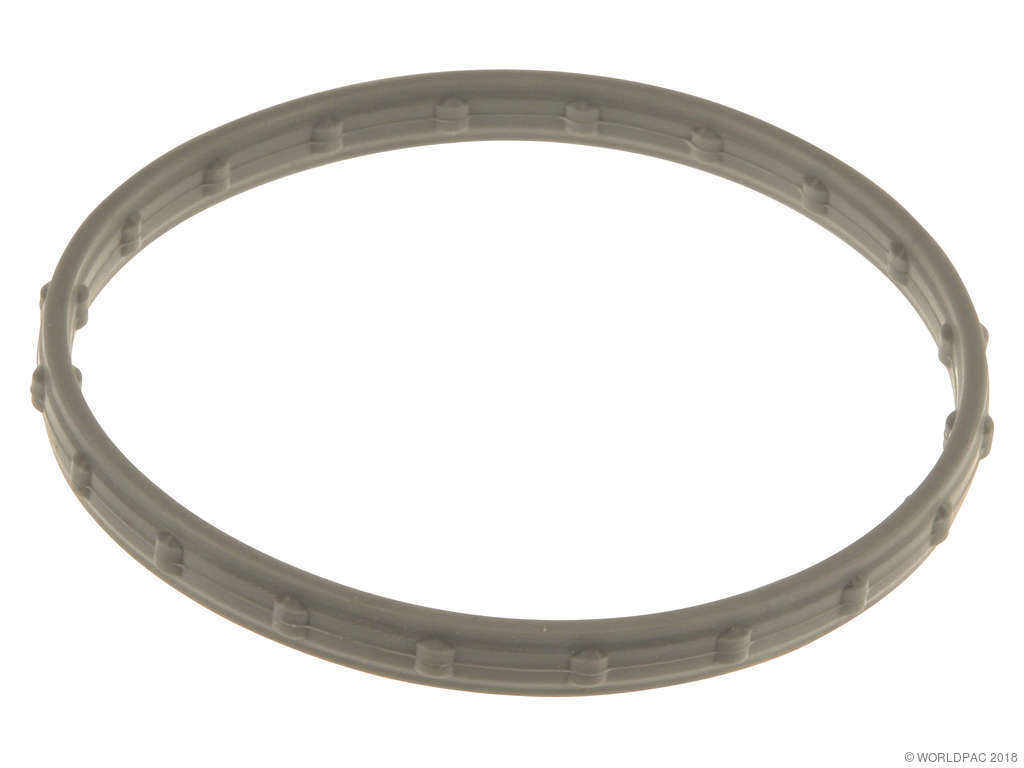
Typical fix: Replace the Throttle Position Sensor with the updated part (P/N 35107-3C100NFFF) and its O-ring, 🎬 Watch: Step-by-step Hyundai TPS replacement walkthrough then perform an ECM software update as specified in the TSB. Skipping the software update may cause the code to return.
Est. part cost: $25-$50 - Outdated Engine Control Module (ECM) Software 🟡 Medium Probability → Shop Engine Control Module (ECM) The official Hyundai TSB for P2135 explicitly pairs the TPS replacement with a mandatory ECM update, suggesting the original software logic was too sensitive or could not properly compensate for minor sensor variances, especially as the sensor aged. The update is critical for the repair's longevity.
How to confirm: A Hyundai dealership or a shop with a GDS (Global Diagnostic System) tool can check the current software version (ROM ID) against the latest available updates listed in the TSB.
Typical fix: Flash the ECM with the latest software calibration. This is a required step when replacing the TPS for this issue.
Est. part cost: $0 - Poor Connection or Damaged Wiring ⚪ Low Probability
How to confirm: Visually inspect the wiring harness and connector at the throttle body for any signs of damage, corrosion, or loose pins. Perform a continuity and resistance check on the wiring between the TPS and the ECM. Wiggle the harness while monitoring live data to see if the voltage readings jump.
Typical fix: Repair the damaged section of the wiring harness or clean/replace the connector.
Est. part cost: $5-$50
Rare But Worth Checking
- Faulty Throttle Body Assembly: → Shop Fuel Injection Throttle Body While the sensor is the most common failure point on this specific vehicle, issues with the throttle plate motor or internal mechanics can also cause correlation errors. This is a more likely cause if cleaning the throttle body doesn't help and the sensor has been replaced.
- Faulty Powertrain Control Module (PCM/ECM): → Shop Engine Control Module (ECM) This is very rare. The ECM should only be considered a potential cause after all other possibilities, including sensors, wiring, and the throttle body itself, have been definitively ruled out.
Diagnosis Steps
- Connect an OBD-II scanner and confirm that P2135 is the primary code stored. Check for any other related codes like P0638, P2106, or P1295.
- Using the scanner's live data function, monitor the voltage readings for 'TPS1' and 'TPS2'.
- With the engine off but ignition on, slowly press the accelerator pedal to the floor. The voltage for TPS1 should increase smoothly, while the voltage for TPS2 should decrease smoothly. They should have an inverse relationship.
- If you see any jumps, dropouts, or if the signals do not correlate (differ by more than 8%), the TPS is likely faulty. 🎬 Watch: How to test and replace electronic throttle bodies
- Visually inspect the wiring harness and connector going to the throttle body. Look for any frayed wires, corrosion, or bent pins.
- If wiring and sensor data point to a bad sensor, follow the TSB procedure: replace the TPS and its O-ring with the updated part.
- Have a Hyundai dealer or qualified shop with a GDS tool update the ECM software to the latest version, as recommended by TSB 10-FL-010. Confirm the new ROM ID is installed.
- Clear all fault codes and perform a test drive to ensure the problem is resolved. Some sources suggest a throttle relearn procedure may be necessary, which can sometimes be accomplished by idling the engine for several minutes after the repair.
Parts You'll Likely Need
- Throttle Position Sensor (TPS)
(OEM #35107-3C100NFFF)— This is the most common failure part for code P2135 on this vehicle, as identified in a Hyundai Technical Service Bulletin. The 'NFFF' suffix indicates a revised, updated part that supersedes older versions like 35107-3C100FFF.
Trusted brands: Hyundai (Genuine), Kia (Genuine), Standard Motor Products (SMP), Beck/Arnley
OEM price range: $25-$50
Aftermarket price range: $20-$40
Related Codes That Often Appear With This One
- P0638 — This code for 'Throttle Actuator Control Range/Performance' is specifically mentioned in the same Hyundai TSB as P2135, indicating they share the same root cause and are often triggered together. NHTSA ODI #10633373 notes this code can be associated with "Power Management" symptoms.
- P2106 — This code means 'Throttle Actuator Control System - Forced Limited Power'. It is an informational code that confirms the ECM has put the vehicle into 'Limp Mode' as a direct result of the P2135 fault.
- P1295 — Similar to P2106, this is a manufacturer-specific code indicating the Electronic Throttle Control (ETC) system has entered a power management mode due to a detected fault.
Technical Service Bulletins (TSBs) & Recalls
- TSB-10-FL-010: Addresses DTC P2135/P0638 or cold engine RPM fluctuation, instructing technicians to replace the TPS and perform an ECM update for 2009-2010 Genesis Sedans, 2007-2010 Veracruz, 2007-2010 Azera, and 2009-2010 Sonata with 3.3L/3.8L engines.
Platform-Specific Known Issues
- Hyundai issued Technical Service Bulletin 10-FL-010 in August 2010, which directly addresses DTC P2135 (and P0638) on the 2009-2010 Genesis Sedan. The prescribed fix is to replace the TPS and update the ECM software. This TSB also applies to other Hyundai models with the 3.3L and 3.8L Lambda engines, confirming a wider issue with this component and software pairing.
Mechanic-Grade Diagnostic Values
- TPS1 vs TPS2 Voltage Correlation — expected: Signals should be inverse. The sum of TPS1 and TPS2 voltage should be consistently around 5.0V. The difference between the average values should be less than 8%.. 🎬 See: Understanding P2135 causes and voltage correlation Failure: A difference greater than 8% between the two sensor signals for a sustained period will trigger the code.
- TPS1 Output Voltage (KOEO) — expected: Approx. 0.0V at 0° throttle opening, rising to approx. 2.3V at 50% throttle opening.. Failure: Voltage that is erratic, does not increase smoothly with throttle application, or is stuck at a specific value.
- TPS2 Output Voltage (KOEO) — expected: Approx. 5.0V at 0° throttle opening, decreasing to approx. 2.7V at 50% throttle opening.. Failure: Voltage that is erratic, does not decrease smoothly with throttle application, or is stuck at a specific value.
Scan Tool Commands That Help
- Hyundai GDS (Global Diagnostic System): S/W Management (Software Update) — This is a mandatory step after replacing the TPS per TSB 10-FL-010. It flashes the ECM with updated logic to prevent the P2135 code from returning with the new sensor.
- Hyundai GDS (Global Diagnostic System): Active Test -> ETC Motor — To verify the electronic throttle control motor's physical function independently. This helps rule out a seized throttle plate or a failed motor, isolating the fault to the sensor or wiring.
- Hyundai GDS (Global Diagnostic System): Reset Adaptive Values — After cleaning the throttle body or replacing the TPS/throttle body assembly, this function resets the learned values to their defaults, forcing the ECM to recalibrate to the new/clean component state.
Wiring & Ground Locations
- ECM (Engine Control Module) — Located in the left rear of the engine compartment.. This is the termination point for all TPS wiring. A poor connection at the main ECM harness connector could cause P2135. All voltage and signal tests ultimately lead back to the pins on this module.
- ECM Power Ground — The ECM grounds are typically secured to the chassis near the module itself in the left rear of the engine compartment. Look for black wires from the harness terminating on a bolt to the body.. A poor ground connection for the ECM can cause a floating reference voltage, leading to incorrect sensor readings and triggering correlation codes like P2135. This should be checked if sensor values appear erratic but the sensor and wiring test good.
- Throttle Body Connector — The electrical connector is located directly on the electronic throttle body assembly, which is mounted between the air intake tube and the intake manifold.. This is the most common location for wiring issues. Check for corrosion on the pins, spread terminals, or damage to the harness where it connects to the sensor/throttle body.
Real Owner Repair Stories
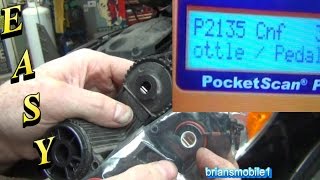
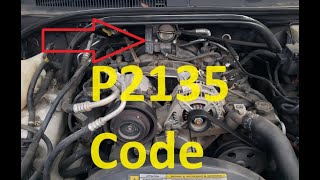
- YouTube video by 'briansmobile1' (2008 Hyundai Veracruz 3.8L (platform mate with same engine and issue)) — Check engine light with codes P2135, P1295, and P2106. Vehicle was in limp mode.
❌ Tried (didn't work) The video directly proceeds to the known common failure, no other failed attempts were detailed.
✅ What actually fixed it Replaced the throttle position sensor with the updated part (ending in 'FFF'). The video specifically highlights that this is a known issue and an updated part is available, which solved the problem. - NHTSA ODI #11061416 — An owner of a platform-mate Veracruz reported a second occurrence of the P2135 code and check engine light, which caused the vehicle to enter limp home mode while driving on a highway.
- NHTSA ODI #10846204 — An owner of a similar Hyundai model reported that after the engine was shut off and restarted, the acceleration pedal worked without problem, despite stored codes P2135, P0221, P2106, P0121, and P2110.
- NHTSA ODI #11019236 — A report describes a vehicle that was "throttled" and could only be driven a couple miles per hour, with a diagnostic scan revealing codes P2106, P1295, and P2135.
- NHTSA ODI #10626110 — An owner reported that the car shut off immediately because it could not respond to the throttle, with a tow truck scan showing codes P2106, P1295, and P2135.
OEM Part Supersession History
35107-3C100FFF→35107-3C100NFFF— The original sensor was prone to failure, leading to P2135. The updated 'NFFF' part is a revised design intended to be more durable and is the required replacement part according to TSB 10-FL-010.
Heads up: While the old part may physically fit, it is the problematic version. Using a new 'NFFF' part without the corresponding ECM software update may still lead to the code returning.351073c000fff→35107-3C100NFFF— This appears to be an even earlier part number that was also replaced by the updated 'NFFF' version.
Model Year Variations Within This Range
- 2009-2011 vs 2012-2014: The 2012 model year marked a facelift for the Genesis sedan, which included engine updates (GDI for the 3.8L V6). While the P2135 code can still occur, the specific throttle body part numbers may differ between the pre-facelift (2009-2011) and post-facelift (2012-2014) models. It is crucial to verify the part number by VIN. However, the underlying cause (faulty TPS and software logic) remains the same across the generation.
Diagnostic Flowchart
Other Known Issues on This Vehicle
Issues unrelated to this code that are worth knowing about as an owner of this generation:
- Excessive Oil Consumption 🟠 Medium — Reported in some 3.8L and 5.0L engines, particularly earlier models. Hyundai considers up to 1 quart per 1,000 miles 'acceptable' under some TSBs. Class action lawsuits have been filed regarding this issue on various Hyundai models with Lambda engines. (Ref: Multiple TSBs exist for oil consumption testing, but no universal recall.)
- Worn Motor Driven Power Steering (MDPS) Coupler 🟡 Low — A common issue where a flexible rubber coupler in the steering column wears out, causing a clicking or clunking noise when turning the wheel. It is primarily an annoyance and not a safety failure. (Ref: TSB 17-ST-002 (and others) extended the warranty for this part to 10 years/100,000 miles on many Hyundai models.)
- No Sound from Speakers / Audio System Failure 🟡 Low — Owners report the audio system (especially with navigation) intermittently or permanently losing all sound output. A hard reset or a software update can sometimes fix it, but in other cases, the amplifier unit requires replacement.
- Brake Failure / HECU Issues 🔴 High — Some 2009 models were noted for complaints of brake failure. Hyundai has extended the warranty on the Hydraulic Electronic Control Unit (HECU) for some models due to potential electrical shorts, though a direct link to the Genesis sedan isn't always clear. (Ref: Warranty Extension TSB #22-BR-001H-1 covers the HECU on some Genesis (BH) models.)
- Peeling Paint / Clear Coat Failure 🟡 Low — Some owners, particularly of the Genesis Coupe but also reported on sedans, have experienced premature peeling and flaking of the clear coat and paint, especially on bumpers and hoods.
Used vs. New Parts: Buying Guide for This Vehicle
When a used part is the smart pick: For this specific repair, using a used part is strongly discouraged. The Throttle Position Sensor (TPS) is a known high-failure item with a specific, updated OEM part designed to fix the problem. A used sensor from a junkyard is highly likely to be the old, failure-prone version and will likely cause the code to return quickly. A used complete throttle body assembly might be considered only if the entire unit is confirmed faulty, but even then, the integrated sensor is a risk.
Donor-vehicle mileage cap: roughly under 15000 miles for the part to have meaningful remaining life.
What to inspect on the donor part:
- Not applicable, as a new, updated OEM sensor is the only reliable fix.
OEM-only on this vehicle (don't cheap out):
- Throttle Position Sensor (TPS) - The fix is tied to a specific updated OEM part number (35107-3C100NFFF) and a corresponding software update. Aftermarket sensors may not be compatible with the required ECM flash and may fail prematurely.
Brands owners have reported issues with on this vehicle:
- Any brand for the TPS sensor itself. While brands like Standard Motor Products or Beck/Arnley are typically reputable, the official Hyundai TSB and widespread forum evidence strongly point towards using only the genuine, updated Hyundai/Kia part (35107-3C100NFFF) paired with the dealer software update for a permanent solution.
Real Owner Stories
Aggregated from forums and TSBs cited above. Mileages and costs reflect what owners reported in those sources.
2009 Hyundai Genesis 3.8L
Symptoms: Experienced P2135 along with P2106 and P1295 codes. The vehicle was entering limp mode with a check engine light.
What fixed it: Replacing the TPS and having the dealer perform the 'ECM upgrade for campaign 928'.
Source hint: hyundai-forums.com
2009-2010 Hyundai Genesis Sedan
Symptoms: Limp mode and check engine light. Some users found that replacing only the sensor was a temporary fix.
What fixed it: Replacing the TPS (part 35107-3C100NFFF) and getting the dealer to perform the ECM update permanently solved the issue.
Source hint: genesisowners.com
2008 Hyundai Veracruz (3.8L Lambda)
Symptoms: Faulty throttle response due to a contaminated sensor.
What fixed it: Installation of the updated TPS part ending in 'FFF' which features an improved O-ring design to keep out dirt and moisture.
Source hint: YouTube - briansmobile1 video 'Hyundai P2135'
Related OBD-II Codes
Frequently Asked Questions
Does TSB 10-FL-010 apply to my 2009 Hyundai Genesis Sedan?
What is the specific part number for the updated Throttle Position Sensor?
Can I just replace the sensor myself to fix the P2135 code?
Is there a specific software update I should ask the dealer for?
My Genesis is surging when the engine is cold; is this related to P2135?
What is the maximum allowable voltage difference between the two TPS signals?
Helpful Videos


We Have This Part in Stock




The information in this article is provided for general reference and educational purposes only. Vehicle specifications, procedures, and part compatibility can vary by production date, trim level, and region. Always consult your vehicle's factory service manual and verify part numbers before purchasing or performing repairs. Safety-critical components such as airbags, seat belts, and braking systems should be installed by a qualified professional.
- Hyundai Genesis:
- 🧭 Diagnostic Flowchart
- 🎬 Helpful Videos
- 🛍️ Shop This Part
- What's Unique About the 2009-2014 Hyundai Genesis
- Symptoms You May Notice
- Most Likely Causes
- Rare But Worth Checking
- Diagnosis Steps
- Parts You'll Likely Need
- Related Codes That Often Appear With This One
- Technical Service Bulletins (TSBs) & Recalls
- Platform-Specific Known Issues
- Mechanic-Grade Diagnostic Values
- Scan Tool Commands That Help
- Wiring & Ground Locations
- Real Owner Repair Stories
- OEM Part Supersession History
- Model Year Variations Within This Range
- Other Known Issues on This Vehicle
- Used vs. New Parts: Buying Guide for This Vehicle
- Real Owner Stories
- 2009 Hyundai Genesis 3.8L
- 2009-2010 Hyundai Genesis Sedan
- 2008 Hyundai Veracruz (3.8L Lambda)
- Related OBD-II Codes
- Frequently Asked Questions
- 🎟️ Get 5% Off