

P2135 on 2006-2011 Subaru Impreza: Throttle Sensor Failure Causes and Fixes
On a 2006-2011 Impreza, P2135 almost always means the throttle position sensor has failed. Since the sensor is built into the throttle body, the fix is to replace the entire throttle body assembly. This is a very common failure. Expect to pay $150-$350 for an aftermarket part and perform a specific idle relearn procedure afterward. When this code appears, the Check Engine Light will illuminate, and the 'Cruise Control' light will typically flash, disabling cruise control as a safety measure.
- P2135 on a 2006-2011 Impreza almost always points to a failed throttle position sensor.
- The sensor is part of the complete throttle body assembly, so the entire unit must be replaced.
- A flashing cruise control light is a standard secondary symptom on this vehicle when the check engine light is on for this code.
- Driving with this code is not recommended due to the risk of sudden power loss or stalling.
What's Unique About the 2006-2011 Subaru Impreza
The 2006-2011 Impreza with the EJ253 engine uses an electronic throttle body (ETB), or 'Drive-by-Wire' system. Unlike older cars, there is no separate, easily replaceable throttle position sensor. The dual sensors are integrated directly into the throttle body assembly. This design means that a failure of the internal sensor circuitry, often due to wear on the resistive tracks inside the sensor, almost always requires the replacement of the entire throttle body unit. This is a very common failure point leading to this specific code on this platform and its mates.
Generation note: This range covers the end of the second generation (2006-2007, 'GD/GG') and the beginning of the third generation (2008-2011, 'GE/GH/GR/GV'). However, both generations in this range used the same EJ253 engine and a similar electronic throttle control system, so the causes and fixes for P2135 are consistent across these years.
Symptoms You May Notice
- Check Engine Light is on
- Flashing 'Cruise Control' light on the dashboard
- Vehicle enters 'limp mode' or 'Reduced Engine Power' mode
- Hesitation or stumbling upon acceleration
- Poor or no throttle response
- Engine stalls, especially when coming to a stop
- Rough or erratic idle, sometimes sticking at a high RPM (1500-2000)
- Engine revs on its own without pressing the gas pedal
- Replacing the Accelerator Pedal Position (APP) Sensor. A faulty pedal sensor will typically set its own specific codes, such as P2138. P2135 points specifically to the correlation error between the two sensors on the throttle body itself.
Most Likely Causes
- Failed Throttle Body Assembly 🔴 High Probability → Shop Fuel Injection Throttle Body The internal throttle position sensors are a very common failure point on the electronic throttle bodies used in this generation of Subaru. The resistive tracks inside the sensor wear out over time, creating 'dead spots' that cause the voltage signal to drop out.
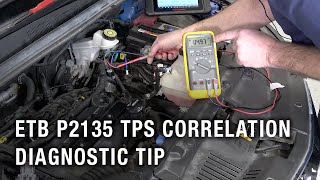
How to confirm: Using a scan tool with live data, graph the voltage of 'TP Sensor 1' and 'TP Sensor 2' while slowly pressing the accelerator pedal with the engine off, key on. A healthy sensor shows two smooth, opposing lines (one increasing, one decreasing). A failing sensor will show one or both lines dropping out, becoming erratic, or spiking. The sum of the two voltages should remain constant, typically around 5.0V. 🎬 Watch: How to diagnose TPS correlation issues
Typical fix: Replace the entire throttle body assembly. After replacement, a specific 'idle relearn' or 'throttle body adaptation' procedure is required for the engine to idle correctly.
Est. part cost: $150-$350 (Aftermarket), $500-$700+ (OEM) - Wiring or Connector Issue 🟡 Medium Probability The connector at the throttle body is subject to constant engine vibration, which can lead to fretting corrosion on the pins or wires breaking internally near the connector over time.
How to confirm: Visually inspect the wiring harness and the 6-pin connector at the throttle body for any signs of damage, corrosion, or loose pins. With the scan tool graphing the TP sensor voltages, gently wiggle the connector and harness to see if it causes the signal to drop out. Use a multimeter to check for a stable 5V reference and good ground at the connector.
Typical fix: Repair the damaged section of wiring or replace the connector pigtail. Apply dielectric grease to the connector pins before reconnecting to prevent future corrosion.
Est. part cost: $10-$50
Rare But Worth Checking
- Failing Powertrain Control Module (PCM/ECM): → Shop Engine Control Module (ECM) This is very uncommon and should only be considered after the throttle body and all related wiring have been thoroughly tested and ruled out. A PCM failure is the least likely cause.
- Debris in Throttle Body: → Shop Fuel Injection Throttle Body A physical object, like a piece of an old air filter or plastic, can become lodged in the throttle body, preventing the plate from moving correctly and causing a correlation error.
Diagnosis Steps
- Connect an OBD-II scanner and confirm P2135 is the primary code. Check for any other related codes like P0122, P0222, or P2101.
- Using the scanner's live data function, select and graph the voltage readings for Throttle Position Sensor 1 and Throttle Position Sensor 2.
- With the key on and engine off (KOEO), slowly press and release the accelerator pedal from fully closed to wide open. The two voltage signals should move smoothly and in opposition to each other. Any sudden drops, spikes, or flat spots indicate a sensor failure within the throttle body.
- If the live data test is inconclusive, turn the vehicle off and disconnect the throttle body electrical connector.
- Inspect the connector pins and wiring harness for any signs of corrosion, damage, or pushed-out pins. Wiggle the harness while monitoring live data to check for intermittent connections.
- Using a multimeter and wiring diagram, verify a stable 5-volt reference and a good ground signal are present at the connector.
- If the wiring and connector are in good condition and the sensor data is erratic, the throttle body assembly is the confirmed cause of the fault.
- After replacing the throttle body, perform a detailed idle relearn procedure. This is mandatory. A common procedure involves disconnecting the battery for 10-30 minutes, reconnecting, turning the key to 'ON' for 15 seconds without starting, then starting the engine and letting it idle with no accessories on for 10-15 minutes until the radiator fan cycles.
Parts You'll Likely Need
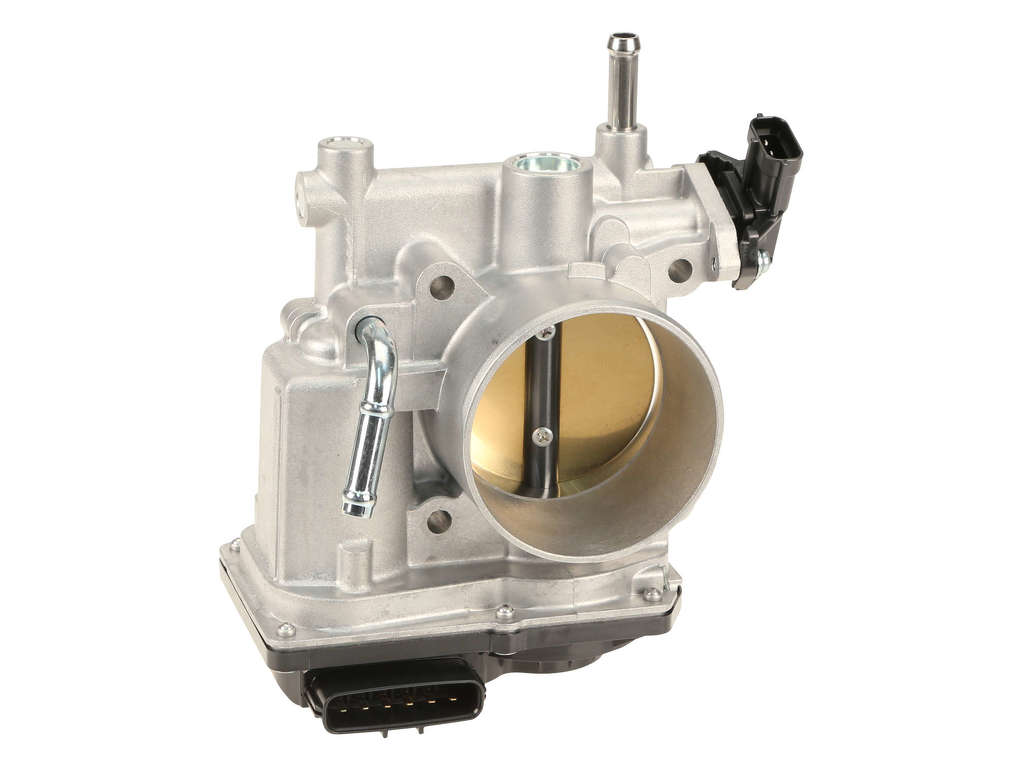
- Electronic Throttle Body Assembly
(OEM #16112AA230)— The throttle position sensors (TPS) are integrated into the throttle body. When they fail and cause code P2135, the entire assembly must be replaced. 🎬 See this throttle body replacement walkthrough
Trusted brands: Hitachi (Often the OEM supplier), Bosch, Standard Motor Products, Cardone (Remanufactured)
OEM price range: $500-$700
Aftermarket price range: $150-$350
Related Codes That Often Appear With This One
- P2101 — This code for 'Throttle Actuator Control Motor Circuit Range/Performance' can appear alongside P2135 as the ECM detects issues with both the sensor readings and its ability to control the throttle plate motor, since they are in the same assembly.
- P2109 — This code for 'Throttle/Pedal Position Sensor 'A' Minimum Stop Performance' can be triggered when the sensor correlation fault prevents the ECM from verifying the throttle's closed position.
- P0122 — Indicates 'Throttle Position Sensor 'A' Circuit Low', a hard fault in one of the two sensors that directly causes the correlation error with sensor 'B'.
- P0222 — Indicates 'Throttle Position Sensor 'B' Circuit Low', a hard fault in the second sensor that causes the correlation error with sensor 'A'.
Technical Service Bulletins (TSBs) & Recalls
- MSA5T0722A / MSA5T0723A: While not a recall, these Subaru documents update the diagnostic steps for technicians dealing with DTCs P2101, P2102, and P2135, indicating it is a known issue the manufacturer has addressed in its service literature.
Platform-Specific Known Issues
- Flashing Cruise Control Light: On most Subarus of this era, whenever a significant engine-related trouble code like P2135 is set, the vehicle's computer will automatically disable the cruise control system as a safety precaution. This is indicated by a steadily flashing 'CRUISE' or 'CRUISE CONTROL' light on the instrument cluster. This is normal behavior and will resolve itself once the P2135 fault is repaired and the codes are cleared.
- Mandatory Idle Relearn Procedure: After replacing the throttle body or even just disconnecting the battery, the ECU's learned values for idle control are lost. A specific and sometimes lengthy idle relearn procedure must be performed. Failure to do so can result in a persistently high or unstable idle. The procedure generally involves a battery disconnect, a key-on period for the throttle plate to self-calibrate, and a long, uninterrupted idle period.
Mechanic-Grade Diagnostic Values
- Throttle Position Sensor 1 (Main) and 2 (Sub) Voltage - Live Data — expected: Both sensors should show opposing, smooth voltage changes. At idle, TPS1 is ~0.5V and rises to ~4.5V at wide-open throttle. TPS2 does the opposite. The combined voltage of both sensors should remain steady around 5.0V throughout the pedal travel.. Failure: On a graph, any sharp spikes, dropouts to 0V, or flat spots in one or both sensor readings as the pedal is pressed indicates a failing sensor inside the throttle body. The voltage readings diverging by more than 0.2V from their expected correlation will trigger the code.
- Throttle Body Connector Pin Voltage — expected: With the key on, engine off, and connector unplugged: Pin 5 should have a steady 5V reference from the ECM. Pin 3 should show a good ground (near 0V). Pins 4 and 6 are the signal return wires and will show voltage only when connected and operating. Pins 1 and 2 are for the throttle motor.. Failure: Absence of the 5V reference or a poor ground indicates a wiring or ECM issue, not a faulty throttle body.
Scan Tool Commands That Help
- Subaru Select Monitor (SSM) or equivalent professional scanner: Current Data Display / Graphing — This is the primary diagnostic step. It is used to simultaneously graph the live voltage data from 'Throttle Sensor Voltage V' (for both sensors) to visually confirm if their signals are correlating correctly or if one is dropping out.
- Subaru Select Monitor (SSM) or equivalent professional scanner: Clear Memory — This command is used after the physical repair (e.g., throttle body replacement) is complete to erase the P2135 code from the ECM's memory. This is a required step before performing the idle relearn procedure.
Wiring & Ground Locations
- Throttle Body 6-Pin Connector — Directly on the electronic throttle body, located between the air intake hose and the intake manifold.. This is the single connection point for both throttle position sensors and the throttle actuator motor. Corrosion, pushed-out pins, or wire damage at this connector is a common cause of P2135. A pinout is typically: Pin 1: Motor (+), Pin 2: Motor (-), Pin 3: Sensor Ground, Pin 4: TPS Sub-signal, Pin 5: 5V Reference, Pin 6: TPS Main-signal.
- Engine Ground Straps — Key ground points are typically from the engine block/intake manifold to the chassis/firewall and from the battery negative terminal to the chassis.. A corroded or loose main engine ground can cause floating voltages and erratic sensor readings throughout the engine management system, potentially triggering a P2135 code even if the throttle body and its dedicated wiring are good.
Real Owner Repair Stories
- YouTube comment on 'Causes and Fixes P2135' (Not specified, but applicable logic for electronic throttle systems.) — Persistent P2135 code over several years.
❌ Tried (didn't work) Spending thousands of dollars on unspecified repairs.
✅ What actually fixed it The owner reseated every wire harness from the throttle body to the gas pedal, including both plugs on the ECM. They also blew out and wiped the connectors. This simple physical layer check resolved the issue after years of problems.
OEM Part Supersession History
16112AA180→16112AA230, 16112AA300— Standard part revision and consolidation by the manufacturer.
Heads up: The listed part numbers are generally interchangeable for the specified vehicle range, but it is always critical to confirm fitment with a VIN at the time of purchase.
Diagnostic Flowchart
Other Known Issues on This Vehicle
Issues unrelated to this code that are worth knowing about as an owner of this generation:
- Head Gasket Failure 🔴 High — Very common on naturally aspirated EJ25 engines, typically occurring between 100,000 and 150,000 miles. The EJ253 is prone to external oil and coolant leaks from the head gaskets.
- AVCS Solenoid Failure or Clogged Filters 🟠 Medium — The Active Valve Control System (AVCS) solenoids can fail or the small filter screens in the oil feed banjo bolts can clog, leading to rough running, hesitation, and codes like P0026 or P0028. (Ref: Subaru issued a bulletin advising technicians to remove the banjo bolt screens during service to prevent clogging.)
- Catalytic Converter Inefficiency (P0420) 🟠 Medium — This code is very common at higher mileage (120,000+ miles) and often points to an aging front catalytic converter, though it can also be caused by a failing front oxygen (A/F) sensor.
- Front Oxygen (A/F) Sensor Failure 🟡 Low — The front air/fuel ratio sensor is a common failure item that can cause poor fuel economy, hesitation, and contribute to a P0420 code. (Ref: Subaru Service Program WXW-80 was issued for some models to address this.)
Used vs. New Parts: Buying Guide for This Vehicle
When a used part is the smart pick: A used OEM throttle body from a low-mileage donor vehicle can be a cost-effective alternative to a new OEM unit, often providing better reliability than a cheap, new aftermarket part. Given the high failure rate is due to electronic wear, this is only a good option if the donor's history and mileage are known.
Donor-vehicle mileage cap: roughly under 80000 miles for the part to have meaningful remaining life.
What to inspect on the donor part:
- Verify the part number on the used unit matches the original or a superseded number.
- Inspect the electrical connector pins for any signs of corrosion, bending, or damage.
- Check the throttle plate for excessive carbon buildup, which might indicate a high-mileage or poorly maintained donor.
- Ensure the throttle plate moves smoothly by hand (with the unit off the car) without any binding or sticking.
OEM-only on this vehicle (don't cheap out):
- While not strictly 'OEM-only', a genuine Subaru (often made by Hitachi) or Hitachi-branded aftermarket part is highly recommended over generic, unbranded options for longevity and proper calibration.
Aftermarket brands forum-validated for this vehicle:
- Hitachi (often the original OEM supplier)
- Bosch
- Standard Motor Products (SMP)
- Dorman (some models feature an improved shaft seal to prevent contamination)
Brands owners have reported issues with on this vehicle:
- Unbranded, 'white-box' parts from online marketplaces should be avoided, as users on various forums report a higher rate of premature failure or calibration issues, leading to the code returning.
Real Owner Stories
Aggregated from forums and TSBs cited above. Mileages and costs reflect what owners reported in those sources.
2006-2011 Subaru Impreza EJ253
Symptoms: The car had a rough or erratic idle, sometimes sticking at a high RPM between 1500-2000. It would also occasionally rev on its own without anyone pressing the gas pedal.
What fixed it: Replacement of the entire throttle body assembly followed by a specific idle relearn procedure.
Source hint: vehicle_specific_issues section regarding 'Mandatory Idle Relearn Procedure' and 'symptoms' list
2005-2009 Subaru Legacy 2.5L EJ253
Symptoms: The vehicle entered 'limp mode' with reduced engine power and the cruise control light was flashing.
What fixed it: Replacing the throttle body assembly because the internal resistive tracks had worn out, causing voltage dropouts.
Source hint: platform_mates section for Subaru Legacy and common_causes
2006-2010 Subaru Forester 2.5L EJ253
Symptoms: The engine would stall when coming to a stop and showed poor throttle response. A scan tool showed the TP sensor voltages were erratic when wiggling the harness.
What fixed it: Repairing the 6-pin connector at the throttle body and applying dielectric grease to the pins to stop vibration-induced signal dropouts.
Source hint: common_causes 'Wiring or Connector Issue' and platform_mates 'Subaru Forester'
Related OBD-II Codes
Frequently Asked Questions
Why is my 'CRUISE' light flashing on my 2007 Impreza along with the Check Engine Light?
Does Subaru have any technical service bulletins for P2135 on the EJ253 engine?
I just replaced my throttle body to fix P2135; why is my Impreza idling at 2000 RPM?
Can I just clean the throttle body to fix the P2135 code?
Is there a specific procedure to reset the idle on a 2006-2011 Impreza after a battery disconnect?
Should I buy a used throttle body or a cheap aftermarket one for my EJ253?
Helpful Videos


We Have This Part in Stock


The information in this article is provided for general reference and educational purposes only. Vehicle specifications, procedures, and part compatibility can vary by production date, trim level, and region. Always consult your vehicle's factory service manual and verify part numbers before purchasing or performing repairs. Safety-critical components such as airbags, seat belts, and braking systems should be installed by a qualified professional.
- Subaru Impreza:
- 🧭 Diagnostic Flowchart
- 🎬 Helpful Videos
- 🛍️ Shop This Part
- What's Unique About the 2006-2011 Subaru Impreza
- Symptoms You May Notice
- Most Likely Causes
- Rare But Worth Checking
- Diagnosis Steps
- Parts You'll Likely Need
- Related Codes That Often Appear With This One
- Technical Service Bulletins (TSBs) & Recalls
- Platform-Specific Known Issues
- Mechanic-Grade Diagnostic Values
- Scan Tool Commands That Help
- Wiring & Ground Locations
- Real Owner Repair Stories
- OEM Part Supersession History
- Other Known Issues on This Vehicle
- Used vs. New Parts: Buying Guide for This Vehicle
- Real Owner Stories
- 2006-2011 Subaru Impreza EJ253
- 2005-2009 Subaru Legacy 2.5L EJ253
- 2006-2010 Subaru Forester 2.5L EJ253
- Related OBD-II Codes
- Frequently Asked Questions
- 🎟️ Get 5% Off