

P2138 on 2017-2022 Honda CR-V: Accelerator Pedal Sensor Failure Causes and Fixes
P2138 on a 2017-2022 Honda CR-V almost always indicates a failing Accelerator Pedal Position (APP) sensor. This causes a cascade of warning lights and limp mode. Replacing the entire accelerator pedal assembly is the common fix, costing around $150-$350 for a new OEM part, though used OEM parts can be found for under $60.
- P2138 on a 2017-2022 CR-V is a serious code that makes the vehicle unsafe to drive.
- The cause is almost certainly a failed Accelerator Pedal Position (APP) sensor.
- The fix is to replace the entire accelerator pedal assembly, which is a simple DIY job for most people requiring basic tools.
- Do not confuse the symptoms with a fuel injector issue, which is also common on early models of this generation but will not set the P2138 code.
- Before buying parts, use a scanner that can read live data to confirm that the two APP sensor signals are not correlating correctly.
- The OEM part number is likely 37971-TLA-A01 or its successor, 37971-TLA-A02.
What's Unique About the 2017-2022 Honda CR-V
For the 2017-2022 fifth-generation Honda CR-V, the P2138 code is a well-documented and common issue that leads directly to replacing the accelerator pedal assembly. Unlike some other vehicles where wiring or the throttle body might be common culprits, on this specific CR-V, the APP sensor itself is the overwhelming point of failure. The symptoms are often dramatic, with multiple warning lights appearing at once (Check Engine, VSA, EPS, etc.), which can be alarming but typically points to this single, relatively simple-to-fix part. This is because modern safety systems like stability control (VSA) and power steering (EPS) rely on accurate data from the accelerator pedal to function correctly.
Symptoms You May Notice
- Multiple warning lights on the dashboard simultaneously (Check Engine, Vehicle Stability Assist (VSA), Electric Power Steering, Collision Mitigation, etc.)
- Vehicle enters 'limp mode' with drastically reduced engine power.
- Hesitation, jerky, or poor acceleration.
- Sudden loss of throttle response or a 'dead pedal' feeling.
- Engine may stall or hesitate.
- Fuel Injectors: On 2017-2018 models specifically, failing fuel injectors can cause similar symptoms like multiple warning lights and poor performance. However, injector failure will not typically set a P2138 code. It's crucial to confirm the presence of P2138 before suspecting the APP sensor.
- Throttle Body: Some may suspect the throttle body or its position sensor, but for the P2138 code on this vehicle, the fault is almost always at the accelerator pedal, not the throttle body.
Most Likely Causes
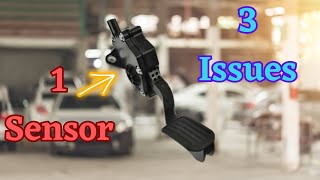
- Faulty Accelerator Pedal Position (APP) Sensor 🔴 High Probability → Shop Accelerator Pedal Assembly The APP sensor is integrated into the accelerator pedal assembly. This electronic component is a known failure point on this CR-V generation, appearing to be an isolated electronic issue rather than a systemic design flaw requiring a recall. The dual-sensor unit can develop internal faults where the two voltage signals no longer correlate, triggering the P2138 code.
How to confirm: Use an OBD-II scanner with live data capability. Monitor the voltage readings for APP Sensor 1 (or A) and APP Sensor 2 (or B) while slowly pressing and releasing the accelerator pedal. The voltages should change smoothly and in a predictable, correlated manner (often one rises as the other falls). A jump, drop, or unresponsive reading from one sensor confirms the failure.
Typical fix: Replace the entire accelerator pedal assembly. The APP sensor is not sold separately and is part of the pedal unit. The repair is simple, typically requiring only a 10mm socket 🎬 Watch: Step-by-step guide to replacing the accelerator pedal assembly. and about 30 minutes.
Est. part cost: $150-$350
Rare But Worth Checking
- Wiring or Connector Issue: While less common than sensor failure, damage to the wiring harness or corrosion in the 6-pin connector at the pedal assembly can cause the same symptoms. A visual inspection is always recommended before replacing parts. In some cases, a weak battery can cause low voltage issues that trigger this code intermittently.
- Faulty Powertrain Control Module (PCM): → Shop Engine Control Module (ECM) This is extremely rare. The PCM is the last item to suspect after definitively ruling out the APP sensor and its wiring. A PCM failure would likely be accompanied by other, unrelated trouble codes and is often misdiagnosed.
Diagnosis Steps
- Confirm the Code: Use an OBD-II scanner to verify that P2138 is the active or pending code. Note any other codes present.
- Check Live Data: Access the live data stream on your scanner. Select the PIDs for 'APP Sensor 1' and 'APP Sensor 2'.
- Test Sensor Correlation: With the engine off and ignition on, slowly press the accelerator pedal to the floor and release it. Watch the voltage readings. They should move in a smooth, inverse relationship. For example, one may sweep from ~0.9V to ~4.5V while the other sweeps from ~0.5V to ~2.5V. Any glitches, flat spots, or lack of response points to a bad sensor.
- Inspect the Connector: Visually inspect the 6-pin electrical connector at the top of the accelerator pedal assembly. Look for loose pins, corrosion, or damaged wires.
- Rule Out Other Issues: If the sensor data looks perfect and the wiring is intact, consider an intermittent connection or a low battery voltage issue before suspecting the PCM. However, over 95% of the time for this code on this vehicle, the pedal assembly is the fault.
- Replace the Assembly: If the sensor is confirmed bad, replace the entire accelerator pedal assembly. It is typically held in by two 10mm nuts and has one electrical connector. Disconnect the negative battery terminal before starting.
Parts You'll Likely Need
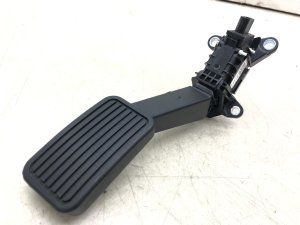
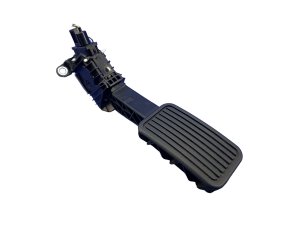
- Accelerator Pedal Assembly
(OEM #37971-TLA-A01, 37971-TLA-A02 (replaces A01))— This is the most common failure for code P2138 on this vehicle. The Accelerator Pedal Position (APP) sensor is integrated into this assembly and is not available as a separate component.
Trusted brands: Honda (Genuine OEM), Hella, Standard Motor Products
OEM price range: $250-$350
Aftermarket price range: $150-$250
Platform-Specific Known Issues
- As of early 2026, no official recalls have been issued by Honda for this specific problem on the 2017-2022 CR-V, though the issue is widely reported by owners in online forums.
- A Technical Service Bulletin (TSB) exists for older Acura models (TL/TSX) for the same code, indicating a history of this issue in Honda products, but no specific TSB for the 2017-2022 CR-V was found.
- Owner experiences consistently report a sudden onset of multiple warning lights and limp mode, with replacement of the accelerator pedal assembly resolving the issue completely. Some owners opt for used OEM parts from salvage yards as a cost-effective solution.
Mechanic-Grade Diagnostic Values
- APP Sensor A vs. APP Sensor B Voltage Relationship — expected: On some Honda platforms, APP Sensor A's voltage should be approximately double that of APP Sensor B at all pedal positions.. Failure: A deviation from this 2:1 ratio indicates a fault in the sensor assembly or wiring.
- APP Sensor 5V Reference Voltage — expected: Approximately 5.0 volts between the specified terminals at the APP sensor connector with the key on, engine off.. Failure: A voltage reading significantly lower or higher than 5.0V points to a wiring issue or a problem with the PCM's 5V reference circuit.
Scan Tool Commands That Help
- Honda Diagnostic System (HDS): Reset PCM — After replacing the accelerator pedal assembly, the PCM must be reset to clear fault memory and allow the system to recognize the new component.
- Honda Diagnostic System (HDS): PCM Idle Learn Procedure — This procedure should be performed after resetting the PCM to allow the engine computer to relearn the engine's idle characteristics for optimal performance.
- Honda Diagnostic System (HDS): Jump SCS Line — This is a diagnostic step used to isolate circuits when testing for continuity issues in the wiring harness between the APP sensor and the PCM.
Wiring & Ground Locations
- PCM Connector A (49P) — Located at the Powertrain Control Module (PCM).. This is the main connector where signals from the APP sensor terminate. Technicians test for continuity at specific pins on this connector to diagnose wiring faults.
- APP Sensor 6P Connector — The 6-pin electrical connector attached to the accelerator pedal assembly.. This is the primary point for inspecting for corrosion, loose pins, or damage, and for performing voltage tests directly at the sensor.
- PCM Connector A, Pin 28 (APS1) — Pin 28 (Orange wire) on the 49-pin PCM Connector A.. This is the specific pin for the APP Sensor 1 signal wire, used for continuity testing between the PCM and the pedal connector.
- PCM Connector A, Pin 29 (APS2) — Pin 29 (Purple wire) on the 49-pin PCM Connector A.. This is the specific pin for the APP Sensor 2 signal wire, used for continuity testing between the PCM and the pedal connector.
Real Owner Repair Stories
- Reddit user on r/crv (2006 Honda CR-V) — Check Engine Light and VSA light came on, vehicle entered limp mode, and code P2138 was stored.
❌ Tried (didn't work) Unplugging and re-plugging the wiring harness., Getting a new battery.
✅ What actually fixed it The user was advised by a Honda dealer that the APP sensor was the cause. While the issue was intermittent and went away on its own temporarily, the confirmed diagnosis pointed to replacing the accelerator pedal position sensor assembly.
OEM Part Supersession History
37971-TLA-A01→37971-TLA-A02— Standard part revision by the manufacturer. The new part is a direct replacement for the original.
Diagnostic Flowchart
Documented NHTSA Reports
Honda CR-V Diagnostic Report
Symptoms: An owner reported the vehicle broke down in the middle of the road. A Honda mechanic diagnosed the issue as code P2138, though the initial visit did not resolve the problem and the vehicle broke down again.
Source: NHTSA ODI #11436067
Honda Accord (Platform Reference)
Symptoms: A report stated the gear shift indicator was blank. A mechanic retrieved code P2138, described as an incorrect voltage position sensor and throttle body sensor. Both the throttle body and accelerator pedal were replaced.
Source: NHTSA ODI #11500262
Honda Element (Platform Reference)
Symptoms: An owner reported issues while on the highway or turning left, with the only warning being a dashboard light. Computer testing showed code P2138(37) relating to APP Sensor A/B.
Source: NHTSA ODI #11090933
Honda Accord (Platform Reference)
Symptoms: A driver experienced a dangerous situation where multiple misfire codes (P0300-P0306) appeared alongside P2138. The TCS and Check Engine lights illuminated, though the car drove fine after waiting 30 minutes.
Source: NHTSA ODI #10564597
Real Owner Stories
Aggregated from forums and TSBs cited above. Mileages and costs reflect what owners reported in those sources.
2006 Honda CR-V
Symptoms: Experienced classic P2138 symptoms including the vehicle going into limp mode.
What fixed it: Confirmed the APP sensor as the likely culprit and required replacement.
Source hint: Reddit r/crv - 'Replace accelerator pedal position sensor or not? (2006 CR-V)'
Honda Civic (10th Gen Platform-Mate)
Symptoms: Triggered codes P2138 and P0651.
What fixed it: Replaced the pedal assembly, but the issue returned, highlighting a rare case where the problem might be more complex (final resolution not reported).
Source hint: Reddit r/civic - 'APP (accelerator pedal position) sensor malfunction - anybody had this issue? Codes: P2138, P0651'
Acura TSX (Platform-Mate)
Symptoms: Experienced hesitation and non-smooth accelerator response alongside the P2138 code.
What fixed it: Replaced the APP sensor/pedal assembly, which completely cured the hesitation and cleared the code.
Source hint: Acurazine - 'Success: APP sensor replacement cured P2138 and non-smooth accelerator response'
Related OBD-II Codes
Frequently Asked Questions
Is there a recall for the P2138 code on my 2017-2022 Honda CR-V?
Can I just replace the APP sensor on my CR-V instead of the whole pedal?
Why did my VSA, Electric Power Steering, and Collision Mitigation lights all come on at once?
Is there a Technical Service Bulletin (TSB) for this issue?
How much does it cost to fix the P2138 code on a CR-V?
Does this issue affect other Honda models besides the CR-V?
Helpful Videos
We Have This Part in Stock

The information in this article is provided for general reference and educational purposes only. Vehicle specifications, procedures, and part compatibility can vary by production date, trim level, and region. Always consult your vehicle's factory service manual and verify part numbers before purchasing or performing repairs. Safety-critical components such as airbags, seat belts, and braking systems should be installed by a qualified professional.
- Honda CR-V:
- 🧭 Diagnostic Flowchart
- 🎬 Helpful Videos
- 🛍️ Shop This Part
- What's Unique About the 2017-2022 Honda CR-V
- Symptoms You May Notice
- Most Likely Causes
- Rare But Worth Checking
- Diagnosis Steps
- Parts You'll Likely Need
- Platform-Specific Known Issues
- Mechanic-Grade Diagnostic Values
- Scan Tool Commands That Help
- Wiring & Ground Locations
- Real Owner Repair Stories
- OEM Part Supersession History
- Documented NHTSA Reports
- Honda CR-V Diagnostic Report
- Honda Accord (Platform Reference)
- Honda Element (Platform Reference)
- Honda Accord (Platform Reference)
- Real Owner Stories
- 2006 Honda CR-V
- Honda Civic (10th Gen Platform-Mate)
- Acura TSX (Platform-Mate)
- Related OBD-II Codes
- Frequently Asked Questions
- 🎟️ Get 5% Off