

P2764 on 2011-2013 Dodge Durango: TCC Solenoid Circuit Low Causes and Fixes
For a Dodge Durango with a W5A580/NAG1 transmission, code P2764 is most often caused by a failed conductor plate, which houses the TCC solenoid. This internal transmission component is a known failure point. The fix involves replacing the conductor plate, filter, and fluid, costing between $600 and $1,200 at a shop.
- P2764 on a 2011-2013 Durango almost always points to a problem inside the W5A580/NAG1 transmission.
- The most likely cause is a failed conductor plate, which houses the TCC solenoid.
- A leaking electrical connector is another common cause and should be inspected first.
- This is not a DIY-friendly repair; professional service is strongly recommended.
- Ensure only ATF+4 specification fluid is used when servicing the transmission.
What's Unique About the 2011-2018 Dodge Durango
The 2011-2013 Dodge Durango (both V6 and V8 models) used the Mercedes-designed W5A580, also known as the NAG1, 5-speed automatic transmission. On this specific transmission, the TCC solenoid is not a standalone part but is integrated into a larger printed circuit board assembly called the conductor plate. This plate, which contains all the solenoids and speed sensors, is submerged in hot transmission fluid and is a very common failure point due to heat and vibration causing cracks in its plastic body or solder joints. Another frequent issue with the NAG1 is the transmission electrical connector leaking fluid, which can wick up the wiring harness and cause various electrical faults, including this one.
Symptoms You May Notice
- Check Engine Light is on
- Transmission goes into 'limp mode' (stuck in 2nd or 3rd gear)
- Harsh or erratic shifting
- Vehicle stalls when coming to a stop or when shifting into Drive
- Shuddering or vibration during light acceleration
- Noticeable slip in the transmission, where engine RPMs rise without a corresponding increase in speed
- Decreased fuel economy
- Replacing the entire valve body when only the conductor plate is faulty.
- Replacing the torque converter without first thoroughly testing the conductor plate and its circuits.
- Replacing the entire transmission when a relatively inexpensive internal electronic component has failed.
Most Likely Causes
- Failed Conductor Plate 🔴 High Probability The conductor plate in the NAG1 transmission is a well-documented failure item. The plastic housing and embedded electrical traces can develop hairline cracks or faults over time due to constant heat cycles and vibration, leading to low voltage or open circuits for the solenoids and integrated speed sensors.
How to confirm: After verifying the external wiring is intact, a technician will need to drop the transmission pan and valve body to access the conductor plate. The circuit for the TCC solenoid can then be tested for resistance directly at the plate's connector. A healthy TCC solenoid should read around 2.5-4.0 Ohms; a reading far outside this range indicates a faulty conductor plate.
Typical fix: Replace the conductor plate, transmission filter, pan gasket, and electrical connector plug. Refill with the correct type of transmission fluid.
Est. part cost: $150-$300 - Leaking Transmission Electrical Connector 🟡 Medium Probability → Shop Transmission Assembly The o-rings on the 13-pin electrical connector for the NAG1 transmission are known to fail, allowing transmission fluid to seep into the connector pins. This fluid can then travel up the wiring harness via capillary action, contaminating the Transmission Control Module (TCM) and causing various circuit faults.
How to confirm: Unplug the main transmission harness connector (located on the front right side of the transmission) and inspect for any signs of reddish transmission fluid inside the connector or on the pins. It is also wise to inspect the TCM connector for any signs of fluid contamination.
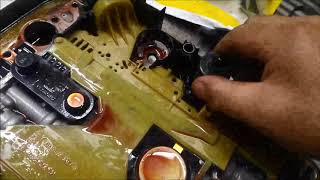
Typical fix: Replace the electrical connector plug adapter (Mopar P/N 68021352AA), which includes new o-rings. If fluid has wicked 🎬 See how to replace the leaking transmission electrical connector. up the harness, the harness may need to be cleaned or replaced, and the TCM inspected.
Est. part cost: $15-$40 - Low or Contaminated Transmission Fluid ⚪ Low Probability → Shop Transmission Assembly The NAG1 transmission is sensitive to fluid level and condition. Leaks can develop, and water intrusion through a faulty dipstick tube seal is a known issue that can contaminate the fluid and cause shuddering or solenoid issues.
How to confirm: Check the transmission fluid level and condition using the correct procedure for this transmission (which requires a special dipstick tool, as it doesn't have one from the factory). The fluid should be bright red and not smell burnt.
Typical fix: If low, top off with the correct fluid (Shell ATF 3403-M 115, Mopar ATF+4, or equivalent MB 236.14 spec fluid) and inspect for leaks. If contaminated, perform a transmission fluid and filter change.
Est. part cost: $80-$150
Rare But Worth Checking
- Failed Torque Converter: → Shop Automatic Transmission Torque Converter While less common than the conductor plate, an internal failure of the torque converter's lock-up clutch can also trigger this code. A Chrysler TSB (e.g., #9004009) for a different transmission (62TE) notes that if the solenoid tests okay for P2764, the torque converter is the likely culprit, a diagnostic logic often applied to the NAG1 as well.
- Faulty Transmission Control Module (TCM): → Shop Transmission Assembly In rare cases, the TCM itself can fail, causing it to incorrectly report a low voltage condition. This is more likely if the leaking 13-pin connector has allowed fluid to travel up the harness and saturate the module. This should only be considered after all other possibilities have been ruled out.
Diagnosis Steps
- Scan the TCM for any other stored trouble codes.
- Check the transmission fluid level and condition. Note: This requires a special dipstick tool (e.g., Dorman 917-327) as the vehicle is not equipped with one from the factory.
- Inspect the main transmission electrical connector (13-pin) for fluid leaks. If fluid is present, replace the connector adapter (Mopar P/N 68021352AA) and clean the harness.
- If the connector is dry, use a high-end scan tool to monitor the TCC solenoid's commanded state and voltage.
- Test the resistance of the TCC solenoid circuit from the TCM connector. 🎬 Watch: How to test the conductor plate from the TCM. For the NAG1, the TCC solenoid should be around 2.5-4.0 Ohms. An open or shorted reading points to a wiring or conductor plate issue.
- Raise the vehicle and drop the transmission pan.
- Visually inspect the fluid and pan for excessive metal debris, which could indicate a more severe mechanical failure (e.g., torque converter).
- Remove the valve body to access the conductor plate. 🎬 Watch: Step-by-step guide to replacing the conductor plate and solenoids.
- Test the resistance and continuity of the TCC solenoid circuit directly at the conductor plate to confirm it is the point of failure.
- If the conductor plate is found to be faulty, replace it along with the transmission filter, pan gasket, and electrical connector as a complete service.
Parts You'll Likely Need
- Transmission Conductor Plate
(OEM #52108308AC)— This is the most common failure point for code P2764 on the W5A580/NAG1 transmission. It contains the circuitry for all transmission solenoids and speed sensors.
Trusted brands: Mopar, Dorman (917-678), SKP
OEM price range: $200-$250
Aftermarket price range: $120-$180 - Transmission Service Kit (Filter, Gasket, Connector Plug)
(OEM #68021352AA (for connector plug))— This is required for the conductor plate replacement. The filter and gasket must be replaced, and it is best practice to replace the electrical connector plug at the same time to prevent future leaks.
Trusted brands: Mopar, Wix, Mahle, Vaico
OEM price range: $70-$100
Aftermarket price range: $40-$60 - ATF+4 or MB 236.14 Spec Transmission Fluid — The transmission must be refilled with the correct fluid type after service. While often serviced with Mopar ATF+4, the original specification is Shell ATF 3403-M 115 or a fluid meeting the MB 236.14 spec. A drain and fill with pan drop typically requires 5-7 quarts.
Trusted brands: Mopar ATF+4, Shell ATF 134, Valvoline MaxLife ATF, Pennzoil Platinum ATF+4
OEM price range: $15-$25 per quart
Aftermarket price range: $8-$15 per quart
Related Codes That Often Appear With This One
- P0700 — P0700 is a generic code indicating that the Transmission Control Module (TCM) has stored a fault. It will almost always be present alongside a specific transmission code like P2764.
- P0740 — This code also relates to the Torque Converter Clutch circuit. It often appears with P2764 and points to the same set of potential failures, particularly the conductor plate or torque converter.
- P0717, P0718, P0722, P0723 — These codes relate to input and output speed sensor circuits. Since the speed sensors are integrated into the same conductor plate on the NAG1, their failure often accompanies solenoid circuit codes like P2764, further pointing to a bad conductor plate.
Technical Service Bulletins (TSBs) & Recalls
- TSB #9004009 / 21-015-09: While this TSB is specifically for the 62TE transmission, its diagnostic logic (if the solenoid tests good, the torque converter is bad) is often applied by technicians to other transmissions, including the NAG1, when P2764 is present.
- ATRA Technical Bulletin #1648: Discusses P2764 causing the engine to die when stopping, identifying a defective TCC solenoid as the cause.
Platform-Specific Known Issues
- A known issue for the W5A580/NAG1 transmission is water intrusion into the fluid via a poorly sealed dipstick/fill tube, which can cause TCC shudder and solenoid problems.
Mechanic-Grade Diagnostic Values
- TCC Solenoid Resistance — expected: 2.0 - 4.0 Ohms. Failure: A reading of infinite resistance (open circuit) or near zero Ohms (short circuit).
- TCC Solenoid Resistance (at TCM connector) — expected: 2.7 Ohms (approx.). Failure: Significant deviation from 2.7 Ohms, or an open/short reading.
- Other NAG1 Solenoid Resistances (for comparison) — expected: Shift Solenoids: ~4.5 Ohms; Line Pressure Solenoid: ~5.5 Ohms. Failure: N/A, for baseline comparison when testing the entire conductor plate.
Scan Tool Commands That Help
- Mopar wiTECH or equivalent advanced scanner (e.g., JScan): Reset Learned Adaptives (NAG1) — This procedure should be performed after replacing the conductor plate, valve body, or transmission control module to allow the TCM to re-calibrate and establish a new baseline for shifting.
- Mopar wiTECH or equivalent: Store Adaptives — After performing the adaptation drive cycle, this command can be used to manually store the new values immediately, rather than waiting for the automatic 10-minute interval.
Wiring & Ground Locations
- TCM Connector C2 — The Transmission Control Module (TCM) is typically located under the dashboard, below the steering column.. This is the remote testing point for the entire conductor plate. Pin 38 is the common ground for the solenoids, and Pin 17 is the specific control circuit for the TCC lock-up clutch solenoid. Testing resistance between these two pins can diagnose the conductor plate without dropping the transmission pan.
- Main Engine/Chassis Ground Straps — Key grounds are located from the battery negative terminal to the chassis and from the engine block/alternator to the frame. While specific diagrams for the Durango are complex, ensuring these main grounds are clean and tight is a critical first step in diagnosing any electrical fault.. A 'Circuit Low' code can be caused by a poor ground connection, which increases resistance in the circuit and can be misinterpreted by the TCM as a fault within the component itself. Verifying main system grounds is essential.
Real Owner Repair Stories
- YouTube creator 'BoostedMotorsports' (Dodge Charger with NAG1/W5A580 Transmission (same as Durango)) — Transmission would go into limp mode (stuck in gear) after coming to a stop, requiring a restart. The issue was triggered by a lost input speed sensor signal.
❌ Tried (didn't work) The video focuses directly on the successful repair.
✅ What actually fixed it The problem was resolved by replacing the transmission conductor plate, which houses the faulty speed sensor. The repair also included a new transmission filter, pan gasket, and the 13-pin electrical connector plug as part of a complete service.
OEM Part Supersession History
52108308AB→52108308AC— Part revision to improve durability and address common failure points of the original conductor plate design.Multiple (e.g., 52108322AA, 52108323AB, etc.)→68021352AA— Consolidation of multiple previous part numbers for the 13-pin connector plug into a single, updated part.
Model Year Variations Within This Range
- 2011-2013: These model years were the primary users of the W5A580/NAG1 5-speed transmission in the Durango. Starting in 2014, the V6 models switched to the ZF 8-speed, with the V8 models following suit. The causes and fixes in this guide are specific to the NAG1 and do not apply to the later 8-speed transmissions.
Diagnostic Flowchart
Other Known Issues on This Vehicle
Issues unrelated to this code that are worth knowing about as an owner of this generation:
- Totally Integrated Power Module (TIPM) Failure 🔴 High — Very common on 2011-2013 models. Can cause a wide range of random electrical issues like no-start conditions, fuel pump staying on, wipers/horn activating randomly, and door lock malfunctions. (Ref: Multiple recalls and a class-action lawsuit were issued for related fuel pump relay issues within the TIPM.)
- 5.7L HEMI V8 Camshaft/Lifter Failure ('Hemi Tick') 🔴 High — A well-documented issue, particularly in 2011-2016 models, often appearing after 80,000 miles. Caused by failure of the MDS lifter rollers, leading to a ticking noise that can progress to camshaft damage and engine misfires. (Ref: A class-action lawsuit exists, but no official recall has been issued. Chrysler released internal STAR Case Report S1709000010 acknowledging the issue.)
- 3.6L Pentastar V6 Oil Cooler/Filter Housing Leak 🟠 Medium — Common across all Pentastar-equipped Durangos. The plastic housing, located in the engine valley, is prone to cracking from heat cycles, causing significant oil leaks.
- Heater Core Clogging / No Heat on Driver's Side 🟠 Medium — Frequently reported problem where casting sand from the engine block manufacturing process clogs the heater core, resulting in poor or no heat output, typically affecting the driver's side first.
- Water Leaking into Racetrack Taillight Assembly 🟡 Low — Common on 2014+ models, but also seen on earlier third-gen Durangos. Poor seals allow water to enter the center taillight assembly, causing LEDs to fail. (Ref: Recall V08 / NHTSA 19V-203 addresses this for some models.)
Used vs. New Parts: Buying Guide for This Vehicle
When a used part is the smart pick: For this repair, sourcing a used part is generally not recommended. The primary failure component, the conductor plate, is an electronic part with a known high failure rate due to heat and age. A used plate carries a significant risk of being near the end of its life or already faulty. A complete used transmission from a low-mileage, verified donor vehicle could be a cost-effective alternative to a full rebuild if more than just the conductor plate is damaged.
Donor-vehicle mileage cap: roughly under 70000 miles for the part to have meaningful remaining life.
What to inspect on the donor part:
- Verify donor vehicle mileage with a VIN check if possible.
- Ask for video of the donor vehicle running and driving.
- Inspect the transmission fluid from the donor; it should be bright red and not smell burnt.
- Check the donor's 13-pin connector for any signs of fluid leaks before purchase.
OEM-only on this vehicle (don't cheap out):
- Transmission Conductor Plate
Aftermarket brands forum-validated for this vehicle:
- Dorman (specifically part 917-678, noted for having an improved speed sensor spring)
- Vaico
- Meyle
Brands owners have reported issues with on this vehicle:
- Unbranded, no-name conductor plates from online marketplaces are a significant gamble. Many forum users report these failing quickly or being dead on arrival. Stick to Mopar or well-regarded aftermarket brands.
Real Owner Stories
Aggregated from forums and TSBs cited above. Mileages and costs reflect what owners reported in those sources.
2012 Jeep Grand Cherokee
Symptoms: The vehicle went into limp mode and the Check Engine Light came on, storing codes P0700 and P2764.
What fixed it: The discussion pointed to a common conductor plate failure as the root cause, which is diagnosed after first checking the 13-pin connector for fluid leaks.
Source hint: jeepgarage.org - 'Limp Mode, P0700, P2764'
Dodge Charger with W5A580/NAG1
Symptoms: The car was stalling when coming to a stop.
What fixed it: The owner had a successful repair by replacing both the conductor plate and the leaking 13-pin electrical connector.
Source hint: chargerforums.com - 'P2764 Code, Help!'
Mercedes-Benz with 722.6/NAG1 Transmission
Symptoms: During a transmission service, fluid was found seeping from the 13-pin electrical connector.
What fixed it: The owner preventatively replaced the 13-pin connector with an updated part to avoid future fluid leaks that could lead to electrical faults and transmission codes.
Source hint: PeachParts Mercedes-Benz Forum - '722.6 Transmission: Always replace 13-pin connector when doing tranny service?'
Related OBD-II Codes
Frequently Asked Questions
My 2012 Durango doesn't have a transmission dipstick. How do I check the fluid level if I suspect it's related to my P2764 code?
I found red fluid inside the main electrical plug on my Durango's transmission. What part do I need to fix this leak?
How common is a conductor plate failure on the W5A580/NAG1 transmission in these Durangos?
What is the correct transmission fluid for my 2011-2018 Durango with the 5-speed NAG1 transmission?
My mechanic is testing the TCC solenoid for P2764. What should the resistance reading be for a good solenoid?
I have a 2012 Jeep Grand Cherokee with code P2764. Is the problem the same as on the Durango?
Besides a bad part, could something else cause TCC shudder and solenoid problems on my Durango?
Helpful Videos
We Have This Part in Stock


The information in this article is provided for general reference and educational purposes only. Vehicle specifications, procedures, and part compatibility can vary by production date, trim level, and region. Always consult your vehicle's factory service manual and verify part numbers before purchasing or performing repairs. Safety-critical components such as airbags, seat belts, and braking systems should be installed by a qualified professional.
- Dodge Durango:
- 🧭 Diagnostic Flowchart
- 🎬 Helpful Videos
- 🛍️ Shop This Part
- What's Unique About the 2011-2018 Dodge Durango
- Symptoms You May Notice
- Most Likely Causes
- Rare But Worth Checking
- Diagnosis Steps
- Parts You'll Likely Need
- Related Codes That Often Appear With This One
- Technical Service Bulletins (TSBs) & Recalls
- Platform-Specific Known Issues
- Mechanic-Grade Diagnostic Values
- Scan Tool Commands That Help
- Wiring & Ground Locations
- Real Owner Repair Stories
- OEM Part Supersession History
- Model Year Variations Within This Range
- Other Known Issues on This Vehicle
- Used vs. New Parts: Buying Guide for This Vehicle
- Real Owner Stories
- 2012 Jeep Grand Cherokee
- Dodge Charger with W5A580/NAG1
- Mercedes-Benz with 722.6/NAG1 Transmission
- Related OBD-II Codes
- Frequently Asked Questions
- 🎟️ Get 5% Off