

U0001 on 2005-2015 Audi Q7: High-Speed CAN Bus Failure Causes and Fixes
On a 2005-2015 Audi Q7, code U0001 is almost always caused by water leaks corroding wiring harnesses or the CAN Gateway module. Check for damp carpets under the front seats and in the rear cargo area before replacing any parts. The fix is typically repairing the corroded wires, which are often the orange/brown and orange/green CAN wires under the driver's or passenger's side carpet.
- Code U0001 on a 2005-2015 Q7 is a critical network failure, and the vehicle should not be driven.
- The most likely cause is water damage. Before buying any parts, thoroughly check for dampness under the front and rear carpets and in the cargo area.
- Common failure points from water are wiring splices in the floor, the Transmission Control Module (under passenger seat), and the CAN Gateway.
- Repairing corroded wiring is the most common fix, but it can be labor-intensive.
- Replacing modules like the CAN Gateway is expensive and requires special programming by a professional with the right tools.
What's Unique About the 2005-2015 Audi Q7
The first-generation Audi Q7 (Typ 4L) is notoriously prone to water ingress issues that directly lead to the U0001 code. Clogged sunroof drains, plenum drains under the windshield, or AC evaporator drains allow water to saturate the carpets. This moisture then corrodes critical wiring splices and control modules located in the floor pan. Key vulnerabilities include the Transmission Control Module (TCM) under the passenger seat and crucial CAN bus wire splices (often orange/green and orange/brown wires) located in the wiring channels under the front carpets. The CAN Gateway module itself can also be damaged by these leaks, causing the entire network to fail.
Symptoms You May Notice
- Multiple warning lights on the dashboard at once (ABS, Airbag, Check Engine, EPC, TPMS)
- Vehicle enters 'limp mode' with reduced engine power
- Transmission stuck in one gear or unable to shift out of Park
- Engine will not start or cranks but does not fire
- MMI (infotainment) screen is black or non-functional
- Backup camera fails to display
- Power seats, air conditioning, or other interior electronics stop working
- Inability for a diagnostic scanner to communicate with multiple control modules
- Replacing a single control module that is offline without first checking for wiring corrosion. The new module will also fail to communicate if the wiring is the root cause, wasting money.
- Assuming the CAN Gateway is faulty without testing the CAN bus resistance and checking for water damage first. Wiring repair is often the true fix.
Most Likely Causes
- Corroded Wiring Harness or Splices Due to Water Ingress 🔴 High Probability The Q7 has several drains (sunroof, plenum, A/C evaporator) that are known to clog, causing water to leak into the cabin and pool under the carpets, directly onto main wiring harnesses. The CAN bus wires, typically twisted pairs of orange/brown and orange/green, are particularly susceptible to corrosion at splice points within the floor channels.
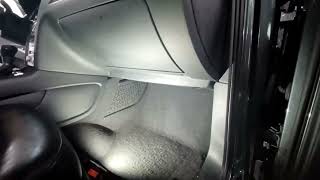
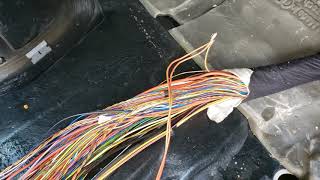
How to confirm: Peel back the carpets in the front footwells (especially passenger side) and check the foam padding for any signs of dampness or moisture. Visually inspect the wiring looms and any visible splice points for green or white corrosion. The issue is often found in the main wiring loom that runs along the floor, under the sill plates.
Typical fix: The corroded section of the wire must be cut out, and a new piece of automotive-grade wire soldered in its place with heat-shrink tubing to protect the repair. This is often a labor-intensive job that requires removing seats and carpets for access.
Est. part cost: $10-$50 - Faulty CAN Gateway Module (J533) 🟡 Medium Probability The location of the gateway module (J533) in the Q7 is typically behind the glove box or integrated into the instrument cluster in some models, making it vulnerable to water damage from plenum or sunroof leaks. 🎬 Watch: How to clear a clogged A/C drain line Internal failure can also occur.
How to confirm: After confirming the wiring is intact, the gateway is the next logical suspect. Diagnosis requires a scan tool like VCDS to see if the gateway itself is offline or reporting communication faults with multiple other modules. A technician may also test the CAN wires directly at the module's connectors.
Typical fix: The module must be replaced. The new module must be programmed to the vehicle by a dealer or specialist with online access to Audi's servers to remove 'Component Protection'. This process adapts the new module to the car's specific features and VIN.
Est. part cost: $75-$350 (Used), $500-$1700 (New) - Faulty Individual Control Module 🟡 Medium Probability A single module on the network (e.g., Transmission, ABS, Amplifier) can short internally and disrupt all communication. Water damage is a common cause of failure for the TCM (under passenger seat) and the audio amplifier (in the right rear cargo area, 🎬 Watch this guide to fixing sunroof water leaks susceptible to rear sunroof drain leaks).
How to confirm: A technician can use a process of elimination, disconnecting modules one by one from the CAN bus to see if communication is restored. For the fiber-optic (MOST) bus, a special loop connector is used to bypass modules. A full VCDS scan will often show which module is not responding.
Typical fix: Replace the identified faulty module. Some modules, like the amplifier or MMI controller, may also require Component Protection programming.
Est. part cost: $100-$1000+ - Weak Battery or Poor Ground Connection ⚪ Low Probability → Shop Vehicle Battery
How to confirm: Test the battery voltage with a multimeter; it should be above 12.4V with the engine off. Check the main battery terminals and chassis ground straps for tightness and corrosion. The Q7 is a complex vehicle with high electrical demands, and low voltage can cause unpredictable communication errors.
Typical fix: Clean terminals or replace the battery. This is a common first step as low voltage can cause many random communication faults.
Est. part cost: $0-$300
Diagnosis Steps
- Check and Charge Battery: Ensure the battery voltage is stable and above 12.4V. A weak battery can cause numerous communication errors in complex vehicles like the Q7.
- Perform Full Vehicle Scan: Use an Audi-specific scan tool (like VCDS or ODIS) to identify which modules are not communicating. This provides a map of the problem and shows the extent of the network failure.
- Inspect for Water Ingress: This is the most critical step for a Q7. Pull up the driver and passenger side carpets and check the foam underneath for dampness. Also check the spare tire well and the area around the amplifier in the right rear cargo area, as rear sunroof drains often leak there.
- Inspect Wiring and Connectors: If water is found, carefully unwrap the affected wiring harnesses and look for swollen wires or green/white corrosion at splice points. Pay close attention to the harness under the passenger seat (for the TCM) and the main looms in the footwells, specifically looking for the twisted orange/brown and orange/green CAN wires.
- Test CAN Bus Resistance: With the battery disconnected, measure the resistance between Pin 6 (CAN-H) and Pin 14 (CAN-L) at the OBD-II port. A healthy network should read approximately 60 Ohms. A reading of 120 Ohms suggests an open circuit or a missing termination resistor, while a reading near 0 Ohms indicates a short circuit.
- Isolate Modules: If wiring appears okay, disconnect individual control modules one at a time and re-check if communication is restored. Start with modules in areas known for water damage (Amplifier, TCM, KESSY module). For the MOST bus (infotainment), a fiber optic loop can be used to bypass each component.
- Inspect CAN Gateway (J533): If all else fails, inspect the CAN Gateway module and its connectors for damage or corrosion. Its location is typically behind the glove box. Check for any signs of water intrusion from a leaking plenum drain.
Parts You'll Likely Need
- Wiring Harness Repair Supplies — The most common fix is repairing corroded sections of the CAN bus wiring caused by water leaks.
Trusted brands: Generic automotive-grade wire, solder, heat-shrink tubing
Aftermarket price range: $10-$50 - CAN Gateway Module
(OEM #4L0907468 / 4L0910468)— This is the central computer for the network. It can fail internally or from water damage. Replacement requires special programming.
Trusted brands: Bosch (OEM)
OEM price range: $500-$1700
Aftermarket price range: $75-$350 (Used) - Transmission Control Module (TCM) — Located under the passenger seat, it is highly susceptible to water damage which can take down the CAN bus.
Trusted brands: Bosch (OEM)
OEM price range: $800-$1500
Aftermarket price range: $200-$500 (Used/Remanufactured) - Sunroof Drain Tube / Plenum Drain Grommet — Often the source of the water leak needs to be fixed to prevent a recurrence. The drain tubes can become clogged, disconnected, or kinked.
Related Codes That Often Appear With This One
- U-codes (e.g., U0101, U0121, U0146) — U0001 indicates a total bus failure. It is often accompanied by many other 'U' codes, each indicating a 'Lost Communication' with a specific module (e.g., TCM, ABS, Gateway).
- 00456 — This fault code specifically indicates 'Access/start control module -J518- no communication' and can be logged in various modules when the CAN bus is down.
Technical Service Bulletins (TSBs) & Recalls
- TSB #A901554 2040593: Addresses sporadic no-start conditions where DTC 00456 (no communication with Access/Start module) is logged, which can be a symptom of the U0001 CAN bus failure.
Platform-Specific Known Issues
- Clogged Sunroof Drains: The drain tubes, especially in the rear, can detach or clog, dumping water into the headliner, down the C-pillars, and into the rear cargo area, often destroying the Bose or B&O audio amplifier, which is on the network. The front drains can also clog, leaking water into the A-pillars and footwells.
- Clogged Plenum Drains: Drains located under the plastic cowl below the windshield get blocked with leaves and debris. This causes water to overflow into the HVAC intake and leak into the passenger footwell, or worse, damage electronics mounted on the firewall.
- Clogged A/C Evaporator Drains: The drain tubes for the air conditioning condenser can get blocked, causing condensation to back up and leak directly into the driver and passenger footwells. This is a common source of water, especially in warmer climates.
- Kinked/Crushed Drain Hoses: Early model year Q7s were known to have drain hoses that could be crushed or kinked by cable ties during assembly, leading to blockages even if the drains themselves are clear.
Mechanic-Grade Diagnostic Values
- CAN Bus Network Resistance — expected: Approximately 60 Ω (Ohms). Failure: A reading of ~120 Ω indicates an open circuit or one of the two terminating resistors is missing. A reading near 0 Ω indicates a short between CAN High and CAN Low wires. A reading of ~40 Ω may indicate a third, improper resistor on the network.
- CAN High (CAN-H) Voltage to Ground — expected: Idles at ~2.5V, goes to ~3.5V during data transmission.. Failure: Significant deviation from 2.5V at idle, or voltage that doesn't change, can indicate a short or open. A reading of 0V indicates a likely short to ground.
- CAN Low (CAN-L) Voltage to Ground — expected: Idles at ~2.5V, drops to ~1.5V during data transmission.. Failure: Significant deviation from 2.5V at idle, or voltage that doesn't change, can indicate a short or open. A reading of 0V indicates a likely short to ground.
Scan Tool Commands That Help
- VCDS (VAG-COM): Gateway Installation List — After connecting to the 19-CAN Gateway, this function queries the gateway for a list of all expected control modules and their status ('OK', 'Malfunction', 'Cannot be reached'). This provides a quick, top-down view of the entire network, showing which modules are offline and helping to isolate the break in communication. It is also used to 'register' new modules when they are installed.
- ODIS (Offboard Diagnostic Information System): Guided Fault Finding — This is the dealer-level diagnostic procedure. For a U0001 code, it will generate a test plan that systematically checks modules, wiring, and the gateway based on the specific vehicle configuration. It is essential for tasks like Component Protection removal on new modules.
Wiring & Ground Locations
- Ground Point 43 / 44 — Located on the left and right lower A-pillars, respectively.. These are primary grounding points for many modules in the dashboard area, including the CAN Gateway (J533). Corrosion or looseness at these points due to water leaks from the sunroof or plenum drains can cause intermittent or total CAN bus failure.
- Ground Point 35 — Located under the front passenger's seat.. This ground is critical for the Transmission Control Module (TCM), which is located in the same area. Water pooling under the passenger seat often corrodes this ground point, causing the TCM to fail and take down the Powertrain CAN bus.
- Ground Point 51 — Located in the right side of the luggage compartment.. This is the ground point for the MMI amplifier and other infotainment modules located in the rear. A leak from the rear sunroof drain can corrode this ground, causing the MOST (infotainment) bus to fail, which can sometimes lead to faults on the main CAN bus.
- J533 CAN Gateway Connector — Typically behind the glove box.. The Powertrain CAN bus is on Pins 5 (Low) and 17 (High), and the Convenience CAN bus is on Pins 6 (Low) and 18 (High) of the main connector. Probing these pins for resistance and voltage is a key diagnostic step when the gateway is suspected to be faulty.
Real Owner Repair Stories
- AudiWorld Forums (2008 Audi Q7 4.2) — Multiple warning lights (ABS, Airbag, Parking Brake), MMI screen dead, car would not start, gear selector indicator flashing.
❌ Tried (didn't work) Replacing the battery., Checking all fuses.
✅ What actually fixed it The KESSY (Keyless Entry/Start) module, located under the driver's side carpet, was completely submerged in water due to a clogged sunroof drain. The module was corroded and shorting out the Convenience CAN bus. The module was replaced, the corroded connector pins were repaired, and the drain was cleared. The CAN bus communication was immediately restored. - Audizine Forums (2011 Audi Q7 3.0T) — Sudden loss of power steering, EPC light, Check Engine light, transmission stuck in gear. Scanner could not communicate with most modules.
❌ Tried (didn't work) Inspecting wiring in footwells (no water found)., Testing CAN resistance at OBD port (showed 120 Ohms, indicating an open circuit)., Disconnecting the ABS module and TCM one by one with no change.
✅ What actually fixed it The fault was traced to the Steering Column Control Module (J527). An internal failure within the module caused it to stop communicating and broke the CAN bus loop, creating the 120 Ohm reading. Replacing the J527 module and performing a basic setting adaptation with VCDS resolved all communication issues.
OEM Part Supersession History
4L0907468 / 4L0910468→Multiple revisions exist (e.g., ending in A, B, C, etc.).— Hardware and software updates to improve stability and add features for different model years and MMI systems.
Heads up: A gateway from a MMI 3G vehicle (post-2009) will not work correctly in a MMI 2G vehicle (pre-2009) and vice-versa, even if it physically fits. All replacement gateways, new or used, require online dealer-level tools to remove Component Protection.
Model Year Variations Within This Range
- 2005-2009 (Pre-Facelift): These models are equipped with the MMI 2G infotainment system. The CAN Gateway (J533) architecture is specific to this system. A separate Battery Manager module (J644) is used.
- 2010-2015 (Facelift): These models feature the updated MMI 3G or 3G+ system, which has a different user interface and network topology. The CAN Gateway (J533) was updated, and the battery management function was integrated directly into the gateway (Component: GW-BEM). This change means troubleshooting battery-related CAN faults requires looking at the gateway's coding and status in VCDS.
Diagnostic Flowchart
Other Known Issues on This Vehicle
Issues unrelated to this code that are worth knowing about as an owner of this generation:
- Timing Chain Tensioner Failure (3.0T V6) 🔴 High — Common, especially on cold starts. A 1-3 second rattle is the primary symptom. Often occurs after 70,000 miles. (Ref: TSB 151628 was issued for this issue, recommending updated tensioner parts.)
- Carbon Buildup on Intake Valves (FSI/TFSI Engines) 🟠 Medium — Inevitable on all direct-injection engines (4.2 FSI, 3.6 FSI, 3.0T). Symptoms like misfires and power loss often appear every 40,000-60,000 miles.
- Air Suspension Failure 🔴 High — Very common. Failures include leaking air springs/struts, faulty compressors, and bad control modules or sensors, leading to an uneven ride height or a complete failure to adjust.
- Excessive Oil Consumption 🟠 Medium — Frequently reported on V6 and V8 engines, particularly the 4.2 TDI. Can be caused by worn piston rings or failing PCV systems.
- MMI System Electrical Faults 🟡 Low — Owners report issues with the MMI screen going black, freezing, or not turning on. This can sometimes be fixed with a system reset, but may also indicate a failing control board or water damage to related components.
Used vs. New Parts: Buying Guide for This Vehicle
When a used part is the smart pick: For electronic modules like the CAN Gateway (J533), Transmission Control Module (TCM), or Amplifier, a used part can be a cost-effective option, BUT ONLY if you have confirmed access to a workshop with Audi-specific tools (ODIS) that can perform the online 'Component Protection' removal. Without this step, the used part will not function in your vehicle.
Donor-vehicle mileage cap: roughly under 120000 miles for the part to have meaningful remaining life.
What to inspect on the donor part:
- CRITICAL: Ask the seller for photos of the donor vehicle's VIN tag and, if possible, the odometer. This helps verify the source is not from a flood-damaged vehicle.
- Inspect connector pins on the module for any signs of green/white corrosion, rust, or water marks. Refuse any module that shows signs of moisture.
- For modules located in the cabin (TCM, Amplifier, KESSY), check the module's casing for any water lines or mineral deposits.
- Purchase from a reputable auto recycler that offers a warranty and guarantees the part is tested and functional.
OEM-only on this vehicle (don't cheap out):
- CAN Gateway (J533)
- Transmission Control Module (TCM)
- Keyless Entry Module (KESSY)
- Steering Column Control Module (J527)
Aftermarket brands forum-validated for this vehicle:
- For this specific U0001 repair, there are no reliable aftermarket electronic control modules. Repairs are limited to OEM parts (new or used) or wiring repair.
Brands owners have reported issues with on this vehicle:
- Any non-OEM electronic control modules advertised as 'plug and play' for this vehicle should be avoided, as they will not integrate with the vehicle's Component Protection system.
Real Owner Stories
Aggregated from forums and TSBs cited above. Mileages and costs reflect what owners reported in those sources.
2015 Audi Q7
Symptoms: The owner experienced hot and cold water leaks in both the driver and passenger footwells.
What fixed it: The community diagnosed the issue as likely being caused by clogged A/C evaporator drains, which is a common source of water intrusion separate from sunroof or plenum leaks.
Source hint: AudiWorld Forums: 2015 Audi Q7 Water leak driver and passenger footwell
2007 Audi Q7
Symptoms: The vehicle had a complete communication failure, preventing diagnostic tools from connecting to modules.
What fixed it: The diagnostic path recommended by experts was to first check for water ingress in the cabin and then to specifically investigate the CAN Gateway (J533) as the likely point of failure.
Source hint: Ross-Tech Forums: 2007 Audi Q7 No Communication
Related OBD-II Codes
Frequently Asked Questions
My Audi Q7 has water in the passenger footwell. What is the most likely cause of the leak?
I was told my CAN Gateway Module (J533) needs to be replaced. Can I just install a used one myself?
My mechanic's scanner can't communicate with my Q7. What's the first thing I should check?
My MMI screen is black and the stereo is dead. Is this related to the U0001 code?
When I inspect the wiring for water damage, what specific wires should I be looking for?
Is there an official Audi TSB that relates to a no-start condition and communication problems?
Helpful Videos


The information in this article is provided for general reference and educational purposes only. Vehicle specifications, procedures, and part compatibility can vary by production date, trim level, and region. Always consult your vehicle's factory service manual and verify part numbers before purchasing or performing repairs. Safety-critical components such as airbags, seat belts, and braking systems should be installed by a qualified professional.
- Audi Q7:
- 🧭 Diagnostic Flowchart
- 🎬 Helpful Videos
- What's Unique About the 2005-2015 Audi Q7
- Symptoms You May Notice
- Most Likely Causes
- Diagnosis Steps
- Parts You'll Likely Need
- Related Codes That Often Appear With This One
- Technical Service Bulletins (TSBs) & Recalls
- Platform-Specific Known Issues
- Mechanic-Grade Diagnostic Values
- Scan Tool Commands That Help
- Wiring & Ground Locations
- Real Owner Repair Stories
- OEM Part Supersession History
- Model Year Variations Within This Range
- Other Known Issues on This Vehicle
- Used vs. New Parts: Buying Guide for This Vehicle
- Real Owner Stories
- 2015 Audi Q7
- 2007 Audi Q7
- Related OBD-II Codes
- Frequently Asked Questions
- 🎟️ Get 5% Off