

U0001 on 2007-2012 Hyundai Santa Fe: High-Speed CAN Bus Failure Diagnosis and Fixes
The U0001 code on a 2007-2012 Hyundai Santa Fe indicates a complete breakdown in the vehicle's main communication network. The most common causes are wiring damage, corroded connectors, or a single faulty control module (like the ABS or ECU) bringing the entire network down. Diagnosis is complex, often requiring professional tools to check network resistance and isolate the failed component.
- U0001 is a critical network failure, not a single part failure. Do not replace expensive modules like the ECM or TCM without a complete diagnosis.
- Diagnosis should always start with the simplest things: check the battery's health and ensure the terminals are clean and tight.
- A key diagnostic step is measuring the resistance between pins 6 and 14 of the OBD-II port (with the battery disconnected). A reading of ~60 ohms is healthy.
- This is not a beginner-friendly DIY repair. The complexity of the network and the need for specialized tools mean professional service is highly recommended.
What's Unique About the 2007-2012 Hyundai Santa Fe
The second-generation (CM) Hyundai Santa Fe integrates numerous modules onto a central high-speed CAN bus. A failure in any single part of this network—be it a wire, connector, or an individual module—can cause a total communication blackout and trigger the U0001 code. Unlike some vehicle-specific codes that point to a single part, U0001 on this platform indicates a system-wide failure that requires a logical, step-by-step diagnostic process to isolate the source of the disruption. The terminating resistors are typically located within the ECM and the instrument cluster.
Symptoms You May Notice
- Multiple warning lights on the dashboard (Check Engine, ABS, Airbag, Traction Control).
- Engine may stall, crank but not start, or not crank at all.
- Transmission may be stuck in one gear (limp mode) or shift harshly.
- Gauges on the instrument cluster may stop working or behave erratically.
- Loss of power features like windows, locks, or infotainment.
- A standard OBD-II scanner may be unable to communicate with the vehicle at all.
- Power steering assist may be lost.
- Replacing the ECM or TCM without proper diagnosis. The U0001 code indicates a network-wide problem; it's more often caused by wiring or a different module on the network than the one that stored the code.
- Overlooking a simple ground issue or corroded battery terminal, leading to unnecessary and expensive module replacement.
Most Likely Causes
- Damaged Wiring or Corroded Connectors 🔴 High Probability Wiring harnesses in the engine bay are exposed to heat, vibration, and moisture. Key areas to inspect on the Santa Fe include the main harness near the battery, the connectors at the ABS module which can be exposed to the elements, and the wiring under the dash near the main junction block. Corrosion on pins or a bad ground connection are common failure points.
How to confirm: Visually inspect major wiring harnesses for chafing, breaks, or signs of rodent damage. Disconnect major module connectors (ECM, TCM, ABS) and check for green or white corrosion on the pins. Use a multimeter to check for continuity on the CAN High and CAN Low wires between modules. Check major ground points, especially those on the engine block and chassis near the battery, for tightness and corrosion.
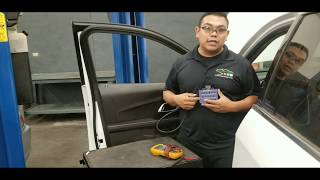
Typical fix: Repair the damaged section of wire with a solder and heat-shrink butt connector. Clean corroded connectors with a specialized electronic cleaner and a small brush. If the connector or terminals are too damaged, the connector pigtail may need to be replaced. 🎬 See this real-world Santa Fe broken connector repair Ensure all ground connections are clean and secure.
Est. part cost: $10-$50 - Faulty Control Module 🟡 Medium Probability Any single module on the network can fail internally, causing it to short out the communication lines or stop responding, which brings down the entire network. The ABS module, in particular, has been subject to recalls on some 2007 models for internal circuit issues that could lead to a short. While the recall addresses a fire risk, an internal module failure can also manifest as a U0001 code.
How to confirm: This is a process of elimination. With the battery disconnected, unplug modules one by one (starting with easily accessible ones like the ABS module or TCM) and re-check the CAN bus resistance at the OBD-II port. If the resistance returns to the normal ~60 ohms after unplugging a specific module, that module is likely the culprit.
Typical fix: Replace the faulty control module. The new module will likely require programming or initialization by a dealer or a qualified shop with OEM software.
Est. part cost: $200-$1200 - Poor Battery Connection or Weak Battery ⚪ Low Probability → Shop Vehicle Battery While not a direct cause, low system voltage or voltage spikes from a bad battery/alternator can corrupt data on the CAN bus and cause modules to drop offline, setting a U0001 code. This is a common issue across many modern vehicles, including Hyundai.
How to confirm: Test the battery voltage with the engine off; it should be above 12.4 volts. Check that the battery terminals are clean and tight. Perform a load test on the battery and check the alternator output (should be 13.5-14.5 volts with the engine running).
Typical fix: Clean the battery terminals thoroughly. If the battery fails a load test, replace it.
Est. part cost: $150-$250
Rare But Worth Checking
- Aftermarket Electronics Interference: A poorly installed remote starter, alarm system, or stereo that is improperly tapped into the CAN bus wiring can introduce electrical noise or shorts, causing a U0001 code.
- Failed Terminating Resistor: The CAN bus has two 120-ohm resistors at each end of the network (often inside the ECM and another module like the instrument cluster). If one of these fails, the total network resistance will be incorrect (~120 ohms instead of ~60 ohms), causing communication to fail.
Diagnosis Steps
- Check Battery Health: Ensure the battery is fully charged (12.4V+ engine off) and that terminals are clean and tight. A weak battery can cause myriad communication issues.
- Scan for All Codes: Use an advanced scan tool to attempt communication with all modules on the vehicle. Note which modules are responding and which are not. This can provide clues to the location of the fault.
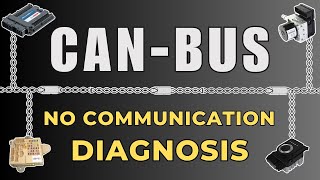
- Check CAN Bus Resistance: With the key off and battery disconnected, use a multimeter to measure the resistance between Pin 6 (CAN High) and Pin 14 (CAN Low) at the OBD-II diagnostic port. 🎬 Watch: How to test a CAN bus network with a multimeter A healthy network should read approximately 60 ohms. A reading of 120 ohms indicates an open circuit or a missing terminating resistor. A reading near 0 ohms indicates a short between the two CAN wires. 🎬 Watch: Step-by-step CAN bus resistance and short circuit diagnostics
- Visual Inspection: Thoroughly inspect the main engine and body wiring harnesses for any signs of physical damage, chafing, or corrosion, paying close attention to areas near the battery, under the fuse box, and where the harness may rub against the chassis or engine components.
- Isolate the Faulty Module: If the resistance is incorrect (e.g., near 0 ohms or 120 ohms), begin unplugging modules one at a time and re-checking the resistance. When the resistance returns to 60 ohms, the last module unplugged is likely the source of the problem. Common modules to check are the ABS, TCM, and Instrument Cluster.
- Check Power and Grounds: If a specific module is not communicating, use a wiring diagram to check for proper power and ground at that module's connector. A bad ground is a common point of failure. On a 2009 Santa Fe, for example, ground G52 is located at the left rear of the engine compartment and is critical for the PCM.
Parts You'll Likely Need
- Control Module (ABS, TCM, BCM, etc.) — An internal failure of any module on the network can short the communication lines, bringing the entire system down. This is found through a process-of-elimination diagnosis.
Trusted brands: Hyundai (OEM)
OEM price range: $400-$1500
Aftermarket price range: $200-$800 (Remanufactured) - Wiring Harness Pigtail/Connector — Corrosion or physical damage at a module's connector is a frequent cause of communication loss. Replacing the connector pigtail is often necessary if cleaning doesn't work or the pins are too damaged.
Trusted brands: Dorman, Hyundai (OEM)
OEM price range: $40-$100
Aftermarket price range: $20-$60
Related Codes That Often Appear With This One
- U0100 — Lost Communication With ECM/PCM
- U0101 — Lost Communication with TCM
- U0121 — Lost Communication With Anti-Lock Brake System (ABS) Control Module
- C1611 — CAN Timeout - logged by modules when they stop receiving messages from another critical module.
- C1616 — CAN Bus Off - indicates a module has detected too many errors and has stopped transmitting to protect the network.
Platform-Specific Known Issues
- ABS Module Failure: → Shop ABS Control Module While not explicitly causing U0001 in all cases, the ABS module on 2007 Santa Fe models was subject to a recall for potential internal short circuits due to moisture ingress. An internal failure of this module can disrupt CAN communication. Owners on forums have discussed various electrical issues stemming from the ABS system.
Mechanic-Grade Diagnostic Values
- CAN High Voltage (Key On, Engine Off) — expected: 2.5V - 3.5V (measured between Pin 6 at OBD-II port and chassis ground). Failure: Voltage stuck at 0V, 5V, or battery voltage indicates a short or open. A steady 2.5V with no fluctuation indicates no communication.
- CAN Low Voltage (Key On, Engine Off) — expected: 1.5V - 2.5V (measured between Pin 14 at OBD-II port and chassis ground). Failure: Voltage stuck at 0V, 5V, or battery voltage indicates a short or open. A steady 2.5V with no fluctuation indicates no communication.
- CAN Bus Resistance — expected: ~60 Ohms (measured between Pin 6 and Pin 14 at OBD-II port with battery disconnected). Failure: 120 Ohms indicates an open circuit or a failed terminating resistor. ~0 Ohms indicates a short between CAN High and CAN Low wires.
- Module Ground Circuit Resistance — expected: Less than 0.5 Ohms. Failure: Higher resistance indicates a poor ground connection, which can prevent a module from communicating effectively.
Scan Tool Commands That Help
- Hyundai GDS (Global Diagnostic System): Fault Code Searching / DTC Analysis — This function performs a network-wide scan to see which modules are responding and which are not. It's the first step to see the scope of the communication failure and can retrieve module-specific codes that a generic scanner might miss.
- Hyundai GDS (Global Diagnostic System): Current Data (Live Data) — After identifying which modules are online, a technician can view live data from those modules to see if they are receiving plausible information from other parts of the network. This can help identify if a module is online but receiving corrupted data.
- Hyundai GDS (Global Diagnostic System): ETM (Electrical Troubleshooting Manual) — The GDS software includes integrated wiring diagrams (ETM) specific to the vehicle's VIN. This is critical for tracing CAN wires and checking for power and ground at specific module connector pins without having to consult separate resources.
Wiring & Ground Locations
- CAN Junction Block — Typically located behind the driver's side dashboard, often integrated into or near the interior fuse panel (I/P Junction Box).. This is the central hub where the CAN bus wires from various modules connect. A poor connection, corrosion, or damage at this block can cause a network-wide failure and is a key inspection point.
- G52 — Located at the left rear of the engine compartment (for 2009 models).. This is a primary ground point for the Powertrain Control Module (PCM). A loose or corroded connection here can starve the PCM of a proper ground, causing it to drop off the network and trigger a U0001 code.
- G39 — Also located at the left rear of the engine compartment, near G52 (for 2009 models).. This is another critical ground for engine and transmission electronics. A fault here can affect multiple modules simultaneously.
- OBD-II Port (DLC) — Under the driver's side dashboard.. Pins 6 (CAN High) and 14 (CAN Low) are the primary diagnostic access points for the high-speed CAN bus. All network-level voltage and resistance tests are performed here.
Real Owner Repair Stories
- Hyundai-Forums user (2007 Hyundai Santa Fe) — Vehicle would not start, multiple warning lights on, scanner could not communicate with most modules.
❌ Tried (didn't work) Checking all fuses., Testing battery and alternator., Inspecting visible wiring in the engine bay.
✅ What actually fixed it The instrument cluster was internally shorted, bringing down the entire CAN bus. The cluster contains one of the network's terminating resistors. After unplugging the instrument cluster, the CAN bus resistance reading at the OBD-II port returned to a normal value, and the scanner could communicate with the other modules. Replacing the instrument cluster resolved the U0001 code and all associated symptoms.
Model Year Variations Within This Range
- 2010-2012: The 2010 model year refresh introduced new engine options (2.4L I4 and 3.5L V6) and updated electronics. While the fundamental CAN bus architecture is similar, wiring diagrams and module locations may differ slightly from the 2007-2009 models. For example, a 2010 wiring diagram shows specific C-CAN (Chassis CAN) and P-CAN (Powertrain CAN) lines connecting at the instrument cluster and other modules. It is critical to use a wiring diagram specific to the vehicle's model year and engine for accurate diagnosis.
Diagnostic Flowchart
Other Known Issues on This Vehicle
Issues unrelated to this code that are worth knowing about as an owner of this generation:
- Leaking Valve Cover Gaskets (V6 Engines) 🔴 High — Common on 3.3L V6 models. Oil leaks from the front valve cover gasket directly onto the alternator, causing premature alternator failure. (Ref: Service Campaign 936 / TSB# 15-01-031)
- Faulty Fuel Level Sending Units 🟠 Medium — Widespread on 2007-2009 models, causing inaccurate fuel gauge readings and often triggering a check engine light.
- Prematurely Worn Suspension Components 🟠 Medium — Ball joints, tie rods, and control arm bushings can wear out faster than expected, leading to suspension noise and alignment problems.
- Failing Oil Pressure Sensor/Switch (V6) 🟠 Medium — The oil pressure switch on V6 engines is prone to developing leaks.
- Automatic Transmission Shifting Problems 🟠 Medium → Shop Transmission Assembly — Some owners report harsh shifting or erratic gear changes, which may be related to internal components or fluid temperature sensors.
- Clogged EGR Valve (2.7L V6 / 2.4L I4) 🟡 Low — The EGR valve can become clogged with carbon, leading to a rough or erratic idle.
Used vs. New Parts: Buying Guide for This Vehicle
When a used part is the smart pick: Used control modules (ECM, TCM, BCM, ABS Module) from a reputable salvage yard can be a cost-effective option, especially for older vehicles. They are a good choice when the original part is discontinued or prohibitively expensive.
Donor-vehicle mileage cap: roughly under 150000 miles for the part to have meaningful remaining life.
What to inspect on the donor part:
- Match part numbers EXACTLY. Minor variations can lead to incompatibility.
- Choose a donor vehicle that was not involved in a flood or fire.
- Inspect the connector pins on the used module for any signs of corrosion, damage, or being bent.
- If possible, get the VIN of the donor vehicle. This can be crucial for programming.
OEM-only on this vehicle (don't cheap out):
- While used modules are viable, be aware that many (like the ECM or Instrument Cluster) will require VIN programming by a dealer or a specialized shop with Hyundai-specific software (GDS) to function correctly. The cost of programming should be factored into the total repair cost.
Aftermarket brands forum-validated for this vehicle:
- For remanufactured modules, brands like Cardone or Blue Streak Electronics (BSE) are generally considered reliable options if a new OEM part is unavailable.
Brands owners have reported issues with on this vehicle:
- Avoid unbranded, no-name electronic modules from online marketplaces, as they often lack proper quality control and may not be programmable.
Real Owner Stories
Aggregated from forums and TSBs cited above. Mileages and costs reflect what owners reported in those sources.
2008 Hyundai Santa Fe CRDi
Symptoms: CAN bus malfunction, vehicle is difficult to move and may stall. Owner already replaced fuel pump, fuel filter, ECU, fuel rails, MAF sensor, crankshaft sensor, and radiator without success.
What fixed it: The owner was seeking a reputable auto electrician to diagnose the CAN bus malfunction after multiple mechanical parts failed to resolve the U0001 code.
Source hint: Reddit r/phcars
Related OBD-II Codes
Frequently Asked Questions
Could the recall on my 2007 Santa Fe's ABS module be related to the U0001 code?
I have a 3.3L V6 Santa Fe; could an oil leak cause communication codes like U0001?
Where should I check for wiring issues on my Santa Fe to resolve this code?
How can I tell if a specific module is crashing the CAN bus on my vehicle?
My fuel gauge is acting up and I have a U0001 code; are they related?
Helpful Videos
We Have This Part in Stock

The information in this article is provided for general reference and educational purposes only. Vehicle specifications, procedures, and part compatibility can vary by production date, trim level, and region. Always consult your vehicle's factory service manual and verify part numbers before purchasing or performing repairs. Safety-critical components such as airbags, seat belts, and braking systems should be installed by a qualified professional.
- Hyundai Santa Fe:
- 🧭 Diagnostic Flowchart
- 🎬 Helpful Videos
- 🛍️ Shop This Part
- What's Unique About the 2007-2012 Hyundai Santa Fe
- Symptoms You May Notice
- Most Likely Causes
- Rare But Worth Checking
- Diagnosis Steps
- Parts You'll Likely Need
- Related Codes That Often Appear With This One
- Platform-Specific Known Issues
- Mechanic-Grade Diagnostic Values
- Scan Tool Commands That Help
- Wiring & Ground Locations
- Real Owner Repair Stories
- Model Year Variations Within This Range
- Other Known Issues on This Vehicle
- Used vs. New Parts: Buying Guide for This Vehicle
- Real Owner Stories
- 2008 Hyundai Santa Fe CRDi
- Related OBD-II Codes
- Frequently Asked Questions
- 🎟️ Get 5% Off