

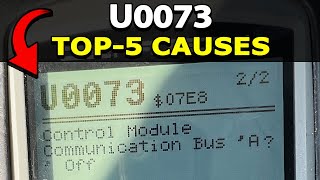
U0073 on 2014-2024 Infiniti Q50: Control Module Communication Bus 'A' Off Explained
The U0073 code on an Infiniti Q50 means there's a communication failure on the main vehicle network (CAN bus). This often causes multiple warning lights, a no-start condition, or erratic system behavior. The most common causes are a weak battery, corroded grounds, or damaged wiring, rather than a failed module.
- U0073 on a Q50 indicates a serious network failure; do not continue driving.
- Always check the battery (including the secondary one in the trunk, if equipped) and ground connections before attempting more complex diagnostics.
- The problem is more likely to be in the wiring, a ground, or the power supply than a failed expensive computer.
- Due to the complexity, professional diagnosis with advanced tools is strongly recommended to avoid costly misdiagnoses.
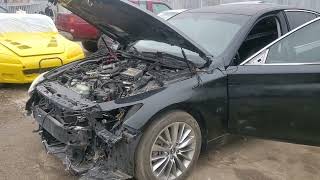
- If the car was recently in an accident or had electrical work done, suspect wiring damage near the repair area.
What's Unique About the 2014-2024 Infiniti Q50
On the Infiniti Q50, which is packed with electronic modules, a U0073 code often creates a cascade of seemingly unrelated error messages and warning lights. A unique point of failure on some Q50 models is a secondary battery located in the trunk (on Hybrid models), which, if it fails, can disrupt communication with the Transmission Control Module (TCM) and trigger this code. Additionally, due to complex wiring, especially around the IPDM (Intelligent Power Distribution Module) in the engine bay and the BCM under the dash, these vehicles can be prone to hard-to-find wiring shorts or corrosion issues that take down the network. Water intrusion into the BCM located in the passenger kick panel is a known failure point discussed by owners, often caused by clogged sunroof drains.
Symptoms You May Notice
- Multiple warning lights on the dashboard (Check Engine, ABS, VDC, etc.)
- Vehicle will not crank or start
- Engine stalls while driving
- Transmission may not shift correctly or may go into limp mode
- Loss of power steering assist, especially on models with Direct Adaptive Steering (DAS)
- Power door locks, windows, or interior lights stop working.
- Scan tool cannot communicate with multiple control modules
- Instrument cluster gauges drop to zero or behave erratically
- Replacing the ECM or another expensive module without first verifying battery voltage, ground connections, and the integrity of the CAN bus wiring. The issue is more often in the wiring or power supply than the module itself.
- Overlooking a failing secondary battery on Hybrid models, leading to unnecessary replacement of other components.
Most Likely Causes
- Weak or Dead Battery / Poor Charging System 🔴 High Probability → Shop Vehicle Battery Modern vehicles like the Q50 are highly sensitive to voltage. If system voltage drops below a stable 12.4V, modules may not initialize correctly, causing network communication errors. Some Q50 Hybrid models have a second battery in the trunk that can also cause these issues if it fails.
How to confirm: Test the battery voltage with a multimeter. It should be at least 12.4V with the engine off and 13.7V-14.7V while running. Load test the battery to ensure it can hold a charge under load, as a simple voltage check can be misleading.
Typical fix: Recharge or replace the weak battery. Clean the battery terminals.
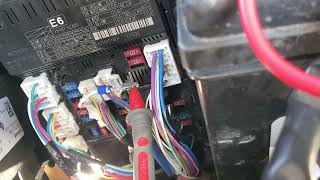
Est. part cost: $150-$400 - Corroded or Loose Ground Wires 🟡 Medium Probability Poor ground connections are a frequent source of electrical gremlins. Key ground points for the main harness, BCM, or near the fuse box can corrode, creating high resistance and disrupting module communication. Wiring diagrams show critical ground points in the engine compartment (E134, E135) and under the dash (M111, M93) that can be sources of failure.
How to confirm: Visually inspect major ground points in the engine bay (especially near the battery and on the engine block), under the dash, and in the trunk. Check for tightness and signs of corrosion. Perform a voltage drop test on the ground circuit to identify high resistance.
Typical fix: Disassemble, clean the corroded ground connection point and terminal with a wire brush, apply dielectric grease, and re-secure it tightly.
Est. part cost: $0-$10 - Damaged Wiring or Connectors 🟡 Medium Probability The CAN bus wires are a twisted pair. If they are pinched, chafed, or damaged (often from previous accidents or repairs), the network signal can be shorted or lost. Water intrusion in kick panels (especially the passenger side where the BCM is located) or near the firewall can also corrode connectors. The main CAN communication lines run through connectors like B104 in the left kick panel.
How to confirm: Visually inspect the wiring harness for damage, especially around the engine bay, firewall, and under the dashboard. Check resistance between the CAN High (Pin 6) and CAN Low (Pin 14) pins at the OBD-II port (should be ~60 ohms with the battery disconnected). If the reading is 120 ohms, one of the two terminating resistors is offline. If it's near 0 ohms, the CAN High and Low wires are shorted together.
Typical fix: Repair the damaged section of the wiring harness and protect it from future damage. Clean or replace corroded connectors.
Est. part cost: $10-$300 - Faulty Aftermarket Electronics ⚪ Low Probability Improperly installed remote starters, alarms, or audio systems can interfere with the CAN bus network by tapping into the wrong wires, introducing electrical noise, or causing voltage drops.
How to confirm: If the issue started after an aftermarket part was installed, temporarily disconnect it completely from the vehicle's wiring and see if communication is restored.
Typical fix: Remove the faulty device or have it professionally re-installed.
Est. part cost: $0
Rare But Worth Checking
- Failed Control Module (e.g., IPDM, BCM, ECM, ABS Actuator): While less common than wiring or voltage issues, a single module can fail internally and short out the entire network, pulling it down. On the Q50, the IPDM (Intelligent Power Distribution Module), BCM (Body Control Module), and ABS actuator are common points of failure. Diagnosis involves disconnecting modules one by one to see if communication returns, which is a labor-intensive process.
- Water Intrusion into BCM: Owners have reported that clogged sunroof drains can lead to water leaking into the passenger footwell and damaging the Body Control Module (BCM), causing a U0073 and a host of other electrical issues. This is a well-documented failure pattern in online forums.
Diagnosis Steps
- Check Battery Health: Ensure the battery is fully charged (at least 12.4V) and the terminals are clean and tight. Perform a load test.
- Perform a Full System Scan: Use a professional scan tool to see which modules are not communicating. This helps narrow down the search and identify the first module to drop off the network.
- Inspect Grounds: Visually inspect and tighten all major chassis and engine ground connections. Key locations include the engine compartment (points E134, E135) and under the dash (M111, M93).
- Visual Inspection of Wiring: Look for any obvious signs of damage, corrosion, or previous poor repairs on the wiring harness, especially near the engine, firewall, and in the driver/passenger kick panels near connectors B104 and B106.
- Check for Aftermarket Devices: If any are present, disconnect them to see if the fault clears.
- Measure CAN Bus Resistance: With the battery disconnected, measure the resistance between Pin 6 (CAN High) and Pin 14 (CAN Low) on the OBD-II port. A healthy network should read approximately 60 ohms. A reading of 120 ohms indicates a break in the circuit or a missing terminating resistor. A reading near 0 ohms indicates a short between the CAN lines.
- Check for Water Intrusion: Inspect the passenger footwell and kick panel area for any signs of moisture, which could indicate a leaking sunroof drain and a damaged BCM.
- Isolate Modules: If the resistance is incorrect or the problem persists, begin disconnecting individual modules one at a time (starting with the most likely culprits like ABS, BCM, or IPDM) and re-checking the network until communication is restored. This is a methodical but effective way to find a module that is shorting the bus.
Parts You'll Likely Need
- Battery — A weak or failing battery is a primary cause of network communication codes on voltage-sensitive vehicles like the Q50.
Trusted brands: Interstate, DieHard, Bosch
OEM price range: $250-$400
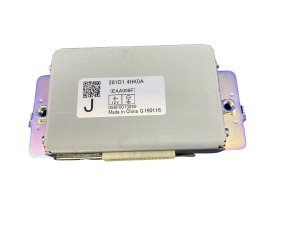
Aftermarket price range: $150-$250 - Intelligent Power Distribution Module (IPDM)
(OEM #284B7-3JV2C, 284B7-3JV0D)— This module acts as a central hub for power and communication. An internal short can bring down the entire CAN network. This is a rare but documented failure point.
Trusted brands: Infiniti (OEM)
OEM price range: $400-$700
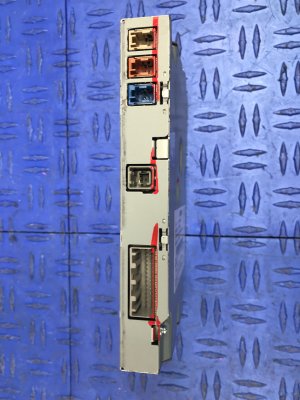
Aftermarket price range: $200-$400 (Used/Remanufactured) - Body Control Module (BCM) — The BCM is a central communication hub and is highly susceptible to damage from water intrusion caused by clogged sunroof drains, a known issue on the Q50.
Trusted brands: Infiniti (OEM)
OEM price range: $500-$800
Aftermarket price range: $150-$400 (Used/Remanufactured, requires programming)
Related Codes That Often Appear With This One
- U0100 — Lost Communication With ECM/PCM
- U0101 — Lost Communication with TCM
- U0122 — Lost Communication With Vehicle Dynamics Control Module
- U1000 — A general CAN Communication Circuit code often stored by Nissan/Infiniti vehicles alongside more specific U-codes.
Technical Service Bulletins (TSBs) & Recalls
- R20C5: A recall for 2021 models where the ECM software could incorrectly reduce engine power, potentially leading to a stall. While not directly a U0073 cause, it highlights the platform's sensitivity to software and module communication.
- ITB17-004a: This TSB addresses the accessory drive belt being noisy or coming off on 2016-2017 Q50/Q60 models due to a misaligned A/C compressor. A shredding belt can damage nearby wiring harnesses, potentially causing a CAN bus short circuit and a U0073 code as collateral damage.
Platform-Specific Known Issues
- On models equipped with a secondary battery in the trunk (Hybrids), its failure is a known cause for communication loss with the Transmission Control Module (TCM), triggering U-codes.
- Technicians have documented cases where the IPDM in the engine bay fails internally, shorting the CAN bus to ground and causing a no-communication, no-start condition.
- Clogged sunroof drains are a common problem that can cause water to leak into the passenger side A-pillar and footwell, damaging the BCM and its connectors, leading to U0073 and other electrical faults. This is a frequently discussed topic in owner forums.
Mechanic-Grade Diagnostic Values
- CAN Bus Resistance (Battery Disconnected) — expected: ~60 Ohms. Failure: 120 Ohms indicates an open circuit or one missing terminating resistor. ~0 Ohms indicates a short between CAN High and CAN Low wires.
- CAN High Voltage (Key On, Engine Off, referenced to ground) — expected: ~2.5V to 3.5V (averages around 2.7V). Failure: Voltage stuck at 0V, 5V, or 12V indicates a short to ground or power. A reading of 2.5V when the CAN Low also reads 2.5V can indicate the wires are shorted together.
- CAN Low Voltage (Key On, Engine Off, referenced to ground) — expected: ~1.5V to 2.5V (averages around 2.3V). Failure: Voltage stuck at 0V, 5V, or 12V indicates a short to ground or power. The sum of CAN High and CAN Low voltages should be approximately 5V.
- CAN High/Low to Ground Resistance (Battery Disconnected) — expected: Open circuit / infinite resistance (OL).. Failure: Any reading showing continuity to ground indicates a short in the respective CAN line.
Scan Tool Commands That Help
- Infiniti CONSULT-III / CONSULT-III Plus: CAN Diagnosis Support Monitor — This is the dealership-level tool function used to see a live list of all modules on the CAN network and their communication status (transmitting/receiving/error). It is the most effective way to pinpoint which module is offline or not communicating correctly.
- Infiniti CONSULT-III / CONSULT-III Plus: Self-Diagnostic Results — After replacing a module like the BCM, IPDM, or ABS actuator, this function is used to confirm the new module is online and communicating. It's also used to perform VIN registration and configuration of the new part.
- Infiniti CONSULT-III / CONSULT-III Plus: Work Support for DAST — If the Direct Adaptive Steering (DAS) module is suspected or has been replaced, this function is required to perform calibration and initialization. Failure to do so will leave the steering system in a fault mode.
Wiring & Ground Locations
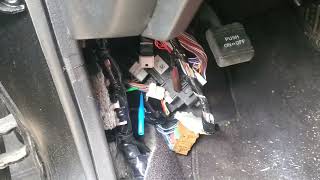
- CAN Junction Connector (Right Side) — In the passenger side kick panel area, often taped to the main harness.. This connector is a common failure point due to water intrusion from clogged sunroof drains. Corrosion on the pins inside this junction can take down the entire network, causing a U0073. Wiggling this connector while checking CAN resistance can reveal an intermittent fault.
- Ground Points E134 / E135 — Located on the left and right rear of the engine compartment, on the chassis.. These are primary ground points for multiple engine bay modules, including the IPDM E/R and ABS actuator. Corrosion or looseness here can cause intermittent communication failures for these critical modules.
- Ground Points M93 / M111 — M93 is at the left end of the dash structure. M111 is on the lower right center of the dash structure.. These are the main interior ground points for modules like the BCM, Combination Meter, and Data Link Connector (OBD-II port). A poor connection at these locations can disrupt the entire in-cabin network.
- Firewall Grommet (Driver's Side) — The main wiring harness passes through a large rubber grommet in the firewall, near the brake fluid reservoir.. This area is a common chafe point, especially if aftermarket accessories (like amplifiers or gauges) have been improperly run through it. A nicked CAN wire here can short to ground or to another wire, causing a U0073.
Real Owner Repair Stories
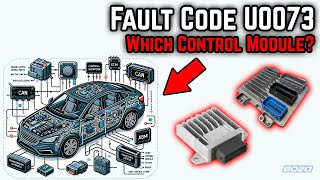
- YouTube diagnostic video (Vehicle appears to be a Toyota/Lexus but demonstrates an identical diagnostic process applicable to the Q50.) — Multiple communication codes including U0073, hard steering, A/C blowing hot air, transmission indicator lights off.
❌ Tried (didn't work) Initial scan showed multiple communication failures.
✅ What actually fixed it A CAN resistance check at the OBD-II port showed 120-138 ohms, indicating an open circuit. Wiggling a CAN junction connector in the right kick panel caused the resistance to fluctuate. The connector was found to have water damage/corrosion. Cleaning the connector and re-seating it restored the correct 60-72 ohm reading and resolved all symptoms. - Reddit user comment in r/q50 (2014 Q50) — Water leaking onto the BCM (Body Control Module).
❌ Tried (didn't work) Initially just cleaning the clogged sunroof drain.
✅ What actually fixed it The user states the issue is not just a clog, but that the drain seal at the firewall fails, causing water to drain back inside the car. The permanent fix was to remove the 12V battery to gain access and apply silicone RTV around the drain where it passes through the firewall to prevent the BCM from getting destroyed by water. - YouTube DIY Repair Video (Infiniti Q50) — No-start condition after a water leak.
❌ Tried (didn't work) The owner had a plastic bag taped over the sunroof, indicating a known leak.
✅ What actually fixed it The technician identified water dripping on the BCM in the passenger kick panel. The BCM was removed, cleaned (presumably with electronics cleaner), and reinstalled. The car then started and ran correctly. The permanent fix shown was to re-route the factory sunroof drain tube to splice into the A/C drain hose, completely bypassing the problematic firewall exit point.
OEM Part Supersession History
284B7-3JV0D→284B7-3JV2C, 284B7-3JV2D— Revision and update to the Intelligent Power Distribution Module (IPDM).
Heads up: While these parts may physically interchange, using the wrong revision for your vehicle's specific year and options (e.g., Hybrid vs. non-Hybrid) can cause communication or feature failures. Always verify the correct part number with a VIN.
Model Year Variations Within This Range
- 2014-2015: Early models with Direct Adaptive Steering (DAS) were subject to multiple recalls and voluntary service campaigns (like NHTSA recall 16V-430 and Infiniti campaign P4204) to reprogram or replace the DAS control modules due to software logic failures that could cause a loss of steering assist. This makes the DAS module a higher probability failure point on these specific years.
Diagnostic Flowchart
Other Known Issues on This Vehicle
Issues unrelated to this code that are worth knowing about as an owner of this generation:
- VR30DDTT Turbocharger Failure 🔴 High — More common on early 2016-2018 models. Can occur under 60,000 miles. Symptoms include white smoke from the exhaust and excessive oil consumption. (Ref: Infiniti offered an extended warranty on turbos for some model years.)
- VR30DDTT Serpentine Belt Failure 🔴 High — Common on 2016-2017 models due to a misaligned A/C compressor pulley, causing the belt to shred or slip off, leading to a loss of power steering and overheating. (Ref: ITB17-004a / ITB19-027)
- VR30DDTT Porous Engine Block/Cracked Cylinder Head 🔴 High — Affects some 2016+ 3.0t engines, leading to internal coolant loss (coolant mixing with oil). Often requires engine replacement under warranty. The issue is debated, with some sources claiming it's a porous block and others cracked heads.
- Direct Adaptive Steering (DAS) Failure 🔴 High — Affects early models (2014-2016) equipped with the steer-by-wire system. Software glitches could cause a sudden loss of steering responsiveness. (Ref: Multiple recalls were issued, including NHTSA Campaign Number 16V244000, to reprogram the DAS ECU.)
- Infotainment System Lag and Failure 🟡 Low — Common across all model years. The dual-screen InTouch system is known for being slow, freezing, and rebooting randomly. No definitive fix is available, though software updates sometimes provide minor improvements.
Used vs. New Parts: Buying Guide for This Vehicle
When a used part is the smart pick: For major electronic modules like the IPDM or BCM, a used part from a reputable dismantler can offer significant savings. Since these parts don't typically have mechanical wear components, a used unit from a lower-mileage, non-flood-damaged vehicle is a viable option, provided it is the exact same part number.
Donor-vehicle mileage cap: roughly under 80000 miles for the part to have meaningful remaining life.
What to inspect on the donor part:
- Verify the donor vehicle was not a flood car, as this is the primary killer of electronics.
- Match the OEM part number EXACTLY. Do not rely on visual similarity.
- Inspect connectors for any signs of corrosion, bent pins, or heat damage.
- Purchase from a seller that offers a warranty and return policy.
OEM-only on this vehicle (don't cheap out):
- Direct Adaptive Steering (DAS) Control Module: Due to the extreme safety-critical nature of this steer-by-wire system and the complex programming required, only a new OEM part installed and calibrated by a dealer or qualified specialist is recommended.
Brands owners have reported issues with on this vehicle:
- Avoid generic, unbranded BCM or IPDM units from online marketplaces. These often have programming issues or are not fully compatible, leading to more diagnostic headaches.
Real Owner Stories
Aggregated from forums and TSBs cited above. Mileages and costs reflect what owners reported in those sources.
2014-2024 Infiniti Q50
Symptoms: Multiple warning lights on the dash, car stalls and dies, and the vehicle will not start. Codes U0073, U0101, U0122, U0140, and U0155 were present.
What fixed it: The issue was traced to a faulty ABS actuator module that was pulling down the CAN bus network.
Source hint: infinitiq50.org thread titled 'Multiple warning lights, car stalls and dies, U0073, U0101, U0122, U0140, U0155'
2014-2024 Infiniti Q50
Symptoms: No-start condition with multiple U-codes including U0073, U0101, U0155, U0140, and U0122.
What fixed it: The community suggested checking the battery, ground connections, and the BCM for water damage as primary culprits.
Source hint: infinitiq50.org thread titled 'U0073 U0101 U0155 U0140 U0122 car wont start'
2014-2024 Infiniti Q50
Symptoms: No-communication and no-start condition.
What fixed it: Technicians found the IPDM (Intelligent Power Distribution Module) in the engine bay had failed internally, shorting the CAN bus to ground.
Source hint: vehicle_specific_issues section regarding internal IPDM failure
Related OBD-II Codes
Frequently Asked Questions
Could the secondary battery in my Q50 Hybrid be causing the U0073 communication code?
I have water leaking into my passenger footwell; could this be related to my U0073 code?
Does TSB ITB17-004a regarding the drive belt apply to my U0073 issue?
Can a faulty ABS actuator cause multiple U-codes and a no-start condition on the Q50?
Where are the main ground points I should check on my Q50 to resolve communication errors?
Is there a specific connector in the kick panel known for CAN bus issues?
Helpful Videos

We Have This Part in Stock

The information in this article is provided for general reference and educational purposes only. Vehicle specifications, procedures, and part compatibility can vary by production date, trim level, and region. Always consult your vehicle's factory service manual and verify part numbers before purchasing or performing repairs. Safety-critical components such as airbags, seat belts, and braking systems should be installed by a qualified professional.
- Infiniti Q50:
- 🧭 Diagnostic Flowchart
- 🎬 Helpful Videos
- 🛍️ Shop This Part
- What's Unique About the 2014-2024 Infiniti Q50
- Symptoms You May Notice
- Most Likely Causes
- Rare But Worth Checking
- Diagnosis Steps
- Parts You'll Likely Need
- Related Codes That Often Appear With This One
- Technical Service Bulletins (TSBs) & Recalls
- Platform-Specific Known Issues
- Mechanic-Grade Diagnostic Values
- Scan Tool Commands That Help
- Wiring & Ground Locations
- Real Owner Repair Stories
- OEM Part Supersession History
- Model Year Variations Within This Range
- Other Known Issues on This Vehicle
- Used vs. New Parts: Buying Guide for This Vehicle
- Real Owner Stories
- 2014-2024 Infiniti Q50
- 2014-2024 Infiniti Q50
- 2014-2024 Infiniti Q50
- Related OBD-II Codes
- Frequently Asked Questions
- 🎟️ Get 5% Off