

U0100 on 2009-2015 BMW X1: Lost Communication With ECM/PCM Causes and Fixes
U0100 on a BMW X1 most often means a communication failure with the engine computer due to a weak battery, a corroded ground strap, or water damage. Start by testing the battery and checking the main engine ground. If those are good, the issue is likely a more complex wiring or module fault that requires professional diagnosis.
- U0100 on your X1 indicates a serious communication failure with the engine computer; the vehicle should not be driven.
- Before suspecting an expensive computer failure, ALWAYS test the battery first. A weak battery is the most common cause.
- Check all power and ground connections to the ECM/DME for corrosion or damage.
- Due to the complexity of the CAN bus network, diagnosis is best left to a professional with BMW-specific tools.
- If the ECM/DME needs replacement, it must be programmed to your vehicle's VIN.
What's Unique About the 2009-2015 BMW X1
The first-generation BMW X1 (E84) relies on a complex network of electronic modules. Like many modern BMWs, its systems are very sensitive to battery voltage. A weak or dying battery is a surprisingly common trigger for communication codes like U0100, causing modules to drop off the network before any mechanical fault occurs. Furthermore, the E84 is known for specific failure points like a corroded engine-to-chassis ground strap and potential for water ingress into the electronics box housing the DME, both of which can directly cause a U0100 code. Owners often report a no-start condition accompanied by multiple, seemingly unrelated warning lights (4x4, DSC, Brake), which points directly to this type of network failure.
Symptoms You May Notice
- Engine will not start (no-crank or crank-no-start).
- Check Engine Light is on.
- Multiple other warning lights on the dashboard, such as for the braking system (ABS), chassis stability (DSC), and 4x4 system.
- Engine stalling intermittently while driving.
- Noticeable loss of engine power or erratic performance.
- Transmission may not shift correctly or may enter a failsafe mode.
- Scan tool cannot communicate with the Engine Control Module (ECM/DME).
- Wipers, lights, or cooling fan running continuously with ignition on.
- Replacing the ECM/DME without first thoroughly checking the battery, battery registration status, and the engine-to-chassis ground strap. These simple electrical issues are far more common than a failed computer.
Most Likely Causes
- Weak or Faulty Battery 🔴 High Probability → Shop Vehicle Battery Modern BMWs have high electrical demands and sensitive modules. Low voltage from an aging battery is a very common cause of network communication errors, often triggering a U0100 code before any other symptoms appear.
How to confirm: Use a multimeter to test the battery voltage with the car off. A healthy battery should read at least 12.4-12.6 volts. If it's below 12V, it's discharged or faulty. Have the battery load tested at an auto parts store.
Typical fix: Recharge or replace the battery. A new battery must be 'registered' with the vehicle's computer using a capable scan tool. Failing to register the new battery tells the car to continue charging it as if it were old, leading to overcharging, premature failure, and other electrical issues.
Est. part cost: $200-$400 - Poor Power or Ground Connection to ECM 🔴 High Probability The main engine-to-chassis ground strap on the E84 is notoriously prone to corrosion, especially in regions with harsh winters. This corroded strap creates high resistance, preventing the starter from drawing enough current and causing voltage drops that disrupt module communication.
How to confirm: Visually inspect the braided ground strap, which typically runs from the driver's side engine mount to the chassis. It may look intact but can disintegrate upon being touched. A temporary test is to connect a jumper cable from the engine block to a clean chassis ground point; if the car starts, the strap is bad.
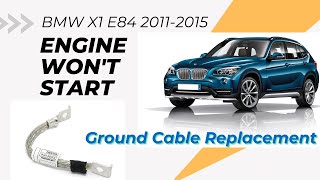
Typical fix: Replace the corroded ground strap. 🎬 Watch this step-by-step guide to replacing your X1 ground cable. The OEM part is inexpensive, and aftermarket versions are also available.
Est. part cost: $10-$50 - Water Intrusion into DME Housing 🟡 Medium Probability The DME is located in a plastic electronics box (E-box) in the engine bay, often under the cowl near the windshield. Clogged cowl drains can cause this box to fill with water, submerging the DME and its connectors, leading to corrosion and short circuits.
How to confirm: Open the black plastic E-box in the engine bay and inspect for any signs of moisture, standing water, or corrosion on the DME connectors and pins. A corroded pin is a definitive sign of water damage.
Typical fix: If caught early, drying the components and cleaning the connectors may work. Often, the water damage is severe enough to require replacement of the DME. The new DME must be cloned from the old one or programmed to the vehicle's VIN and immobilizer system.
Est. part cost: $500-$2000 - CAN Bus Wiring Fault 🟡 Medium Probability Wiring can be damaged from vibrations, improper repairs, or rodent damage. The PT-CAN wires (typically twisted pair) are critical for engine and transmission function.
How to confirm: This is an advanced diagnostic step. A technician will use a multimeter to check for ~60 Ohms of resistance across pins 6 (CAN-H) and 14 (CAN-L) at the OBD-II port. A reading of 120 Ohms indicates an open circuit, while ~0 Ohms indicates a short.
Typical fix: Locate the damaged section of the CAN bus wiring and repair or replace it. This may involve tracing wires and unplugging modules one by one to isolate the fault.
Est. part cost: $5-$200 - Failed Engine Control Module (ECM/DME) ⚪ Low Probability → Shop Engine Control Module (ECM) While robust, the ECM can fail due to internal shorts from water damage, or voltage spikes. It is typically the last item to be condemned after all other possibilities (power, ground, wiring) are ruled out.
How to confirm: If the battery, all power/ground connections, and the CAN bus wiring have been tested and confirmed to be good, and the DME is still not communicating, the module itself is the likely point of failure.
Typical fix: Replace the ECM/DME. The new unit must be programmed and coded to the vehicle's specific VIN and options, which requires specialized equipment.
Est. part cost: $800-$2000
Rare But Worth Checking
- Faulty CAN Bus Terminating Resistor: The CAN bus network has two 120-Ohm resistors. If one of the modules containing a resistor fails (often the DME or DSC module on this platform), it can disrupt the entire network.
- Interference from Aftermarket Electronics: Poorly installed piggyback tunes (like a JB4), remote starters, or alarms can interfere with CAN bus signals or cause connector pin issues at the DME, leading to communication errors.
- Faulty Junction Box Electronics (JBE): The JBE module acts as a gateway for some communication lines and powers various components. A failure within the JBE can sometimes cut power or communication to the DME, causing symptoms like wipers or lights acting erratically.
Diagnosis Steps
- Check the battery's state of charge and overall health. A voltage below 12.4V is a red flag. Charge and re-test, or replace if necessary, ensuring the new battery is registered.
- Using a BMW-capable scan tool, perform a full vehicle scan to see which modules are offline and which are reporting communication faults.
- Inspect the main engine-to-chassis ground strap for corrosion. It is located on the driver's side, connecting the engine mount area to the frame rail. Test by bridging the connection with a jumper cable. 🎬 See how to quickly diagnose a no-start using jumper cables.
- Check all fuses related to the engine control module and powertrain, both in the glove box fuse panel and in the E-box.
- Visually inspect the ECM/DME and its connectors for any signs of physical damage, corrosion, or water intrusion by opening the plastic electronics box in the engine bay.
- If the above steps don't resolve the issue, proceed to advanced diagnostics. Measure the resistance between Pin 6 and Pin 14 of the OBD-II port. The reading should be approximately 60 Ohms.
- If resistance is incorrect (120 Ohms or near 0 Ohms), begin unplugging modules on the PT-CAN network one by one (DME, EGS/TCM, DSC) to isolate the source of the wiring or module fault.
- If all wiring, power, and grounds are confirmed good, the ECM/DME is the prime suspect and should be tested or replaced by a professional.
Parts You'll Likely Need
- Battery — A weak or failing battery is the most frequent trigger for this communication code on modern BMWs.
Trusted brands: Varta, Bosch, Interstate
OEM price range: $300-$500
Aftermarket price range: $200-$400 - Engine Ground Strap
(OEM #12427549396)— This specific part is a known failure point on the E84 platform, leading to no-start conditions and communication faults due to corrosion.
Trusted brands: BMW (OEM)
OEM price range: $25-$40
Aftermarket price range: $10-$20 - Engine Control Module (ECM/DME) — Failure of the DME itself, often due to water damage or internal shorts, is the ultimate cause after all other wiring and power/ground issues are eliminated.
Trusted brands: Bosch (OEM), Remanufactured/Cloned Service
OEM price range: $1500-$2400
Aftermarket price range: $400-$800 (for cloning/reman)
Related Codes That Often Appear With This One
- U0101 — Lost Communication with TCM (Transmission Control Module). The TCM and ECM are on the same high-speed PT-CAN bus. A network-wide failure will often cause both codes to appear.
- U-codes in other modules (ABS, DSC, etc.) — When the ECM stops communicating, all other modules that rely on its data (like engine speed, torque, etc.) will log a communication fault code.
Platform-Specific Known Issues
- A user on XBimmers forum reported a no-start, clicking sound, and a series of errors including fuel pump and transmission faults. The cause was a completely corroded engine ground strap that disintegrated when touched. Replacing it for $10 solved the problem.
- A repair shop, Burch Motor Works, documented a case of a BMW X1 that would not communicate with the engine ECU. They found the electronics box in the engine bay had suffered from water ingress, which damaged the ECU. They were able to fix it by programming a used ECU.
- Another XBimmers user experienced a no-crank no-start with a U0100 code and a 'Braking/Chassis Stability Error' message. The discussion pointed towards the battery as the likely culprit for the communication loss.
Mechanic-Grade Diagnostic Values
- PT-CAN Bus Total Resistance — expected: ~60 Ohms. Failure: A reading of ~120 Ohms indicates an open circuit or a faulty terminating resistor in a module. A reading near 0 Ohms indicates a short between CAN-High and CAN-Low wires.
- PT-CAN Bus Voltage — expected: CAN-High (Pin 6 to ground) should be ~2.5V static, pulsing higher during communication. CAN-Low (Pin 14 to ground) should be ~2.5V static, pulsing lower during communication.. Failure: Voltages that are stuck high (e.g., 5V or 12V) or low (0V) indicate a short to power or ground. No voltage suggests a module power supply issue.
- Terminating Resistor Internal Resistance — expected: ~120 Ohms. Failure: A significantly different reading indicates the module containing the resistor (e.g., DME or DSC) is faulty.
Hidden / Shadow Codes Worth Checking
- CD8B: Local-CAN communication failure. This is a more specific BMW hex code indicating a general communication problem on the bus where the DME resides. (see via BMW-specific diagnostic software like ISTA or a high-end scanner capable of reading manufacturer codes.)
- 2D58 / 2D59: DME digital motor electronics, internal failure. These codes point more directly to an internal fault within the DME itself, rather than just a communication line issue. (see via BMW-specific diagnostic software like ISTA.)
- 2811: Local CAN Communication Error. Similar to CD8B, this indicates a generic communication bus error detected by the DME. (see via BMW-specific diagnostic software.)
Scan Tool Commands That Help
- ISTA (Rheingold): Control unit tree / Module tree view — This is the first step in diagnosis. It provides a graphical overview of all control modules on the network and shows which ones are not responding (typically shown in red or yellow), immediately pointing to the scope of the communication failure.
- ISTA (Rheingold): Calculate test plan — After identifying the non-communicating module (DME), ISTA will generate a guided diagnostic procedure. This plan will prompt the technician to check specific fuses, power supplies, ground connections, and CAN bus wiring related to the fault, in a logical order.
- ISTA (Rheingold): DME Replacement / Programming — This function is required after physically installing a new or used DME. It involves programming the module with the correct vehicle software and coding it with the car's specific VIN and options to ensure it integrates with the immobilizer (CAS) and other systems.
Wiring & Ground Locations
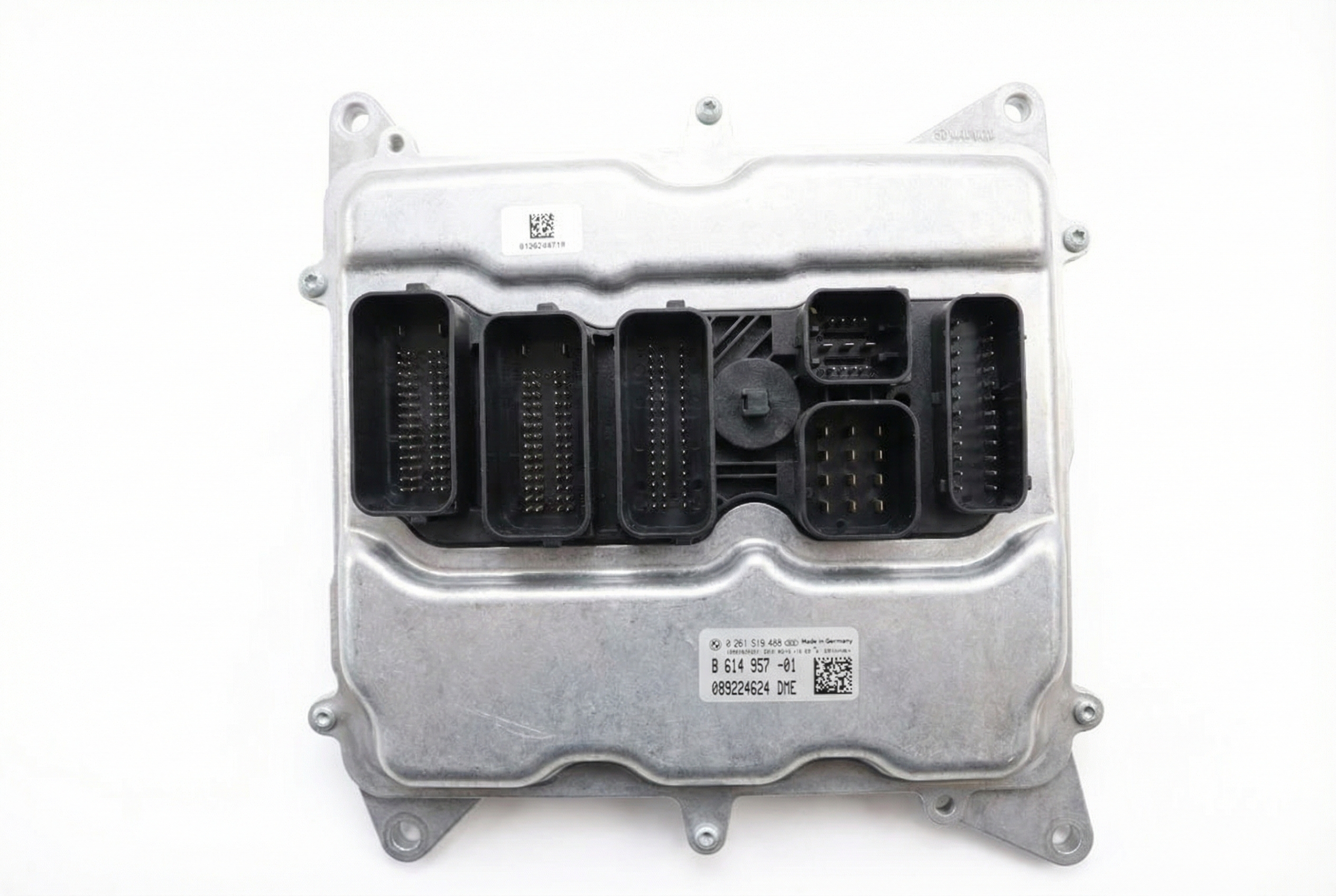
- DME (ECM) — Located in the engine compartment, inside a black plastic electronics box (E-box), usually on the passenger side near the firewall/cowl.. This is the module that is offline. Its connectors are a primary point for checking power, ground, and for signs of water intrusion.
- Engine Ground Strap (Part # 12427549396) — A braided metal strap connecting the driver's side engine mount/bracket area to the vehicle's chassis frame rail.. This is the main ground for the engine and starter. Corrosion here creates high resistance, causing voltage drops that disrupt module communication and can cause a no-start, directly leading to U0100.
- PT-CAN Wires — A twisted pair of wires (often green and orange/green) running between major powertrain modules like the DME, DSC (ABS), and EGS (Transmission). Key pins at the DME are Pin 1 (CAN-L) and Pin 14 (CAN-H) on one of the main connectors.. These two wires are the direct communication link. A short or break in either wire will sever communication with the DME.
- Junction Box Electronics (JBE) — Located behind the glove box fuse panel. The entire fuse panel assembly must be removed to access it.. The JBE acts as a gateway and power distributor. A fault within the JBE can cut power or communication pathways to other modules, including the DME.
Real Owner Repair Stories
- YouTube user Igor Kadulenkov (2015 BMW X1 (E84)) — Car suddenly stopped starting, just a clicking sound. Multiple electrical malfunction errors on the dash.
❌ Tried (didn't work) Testing the battery, which was found to be good.
✅ What actually fixed it The engine-to-chassis ground cable was corroded and failing. A temporary fix using a jumper cable from the engine block to a chassis ground point allowed the car to start, confirming the bad ground strap. Replacing the ground strap permanently resolved the issue.
OEM Part Supersession History
12147647343→12148610679— Part revision and update by BMW.
Heads up: While many DMEs for a given engine are physically interchangeable, they must be programmed for the specific vehicle's VIN and immobilizer (CAS) system. A used DME cannot be simply swapped; it must be 'cloned' from the original or have its immobilizer data reset by a specialist service.
Model Year Variations Within This Range
- 2012-2015 (LCI - Life Cycle Impulse): The E84 received a facelift (LCI) for the 2013 model year in North America (mid-2012 in Europe). While the core electrical architecture and common causes for U0100 remained the same, some engine options changed (e.g., introduction of the N20 4-cylinder turbo). This means DME part numbers will differ between a 2011 X1 with an N52 engine and a 2014 X1 with an N20 engine. The physical location of components like the DME and ground strap are largely identical.
Diagnostic Flowchart
Other Known Issues on This Vehicle
Issues unrelated to this code that are worth knowing about as an owner of this generation:
- N20 Engine Timing Chain Guide Failure 🔴 High — Common on models with the N20 engine built before March 2015. Symptoms like a high-pitched whine can appear, and failure can be catastrophic for the engine. (Ref: BMW SIB B11 03 17 extended the warranty for this issue to 7 years/70,000 miles.)
- Oil Filter Housing Gasket (OFHG) Leak 🟠 Medium — Very common across many BMW engines of this era, including those in the X1. The gasket becomes hard and brittle, leaking oil onto the alternator and serpentine belt, which can cause their failure.
- Transfer Case (xDrive Models) Actuator Motor Failure 🟠 Medium — A frequent problem on xDrive models where the plastic gear inside the actuator motor strips. This leads to 4x4, ABS, and Brake warning lights, and sometimes a clicking noise after shutting the car off or thumping during shifts.
Used vs. New Parts: Buying Guide for This Vehicle
When a used part is the smart pick: A used DME from a reputable salvage yard is a cost-effective option, but ONLY if you have a plan for programming. It is not a plug-and-play part. You will need to send your original DME (even if it's dead), your CAS module, and a key to a specialist service that can clone the data from your original unit to the used donor unit.
Donor-vehicle mileage cap: roughly under 120000 miles for the part to have meaningful remaining life.
What to inspect on the donor part:
- Verify the part number on the used DME matches a compatible number for your vehicle's engine and year.
- Inspect the donor DME's connectors for any bent, corroded, or pushed-out pins.
- Ask the seller if the donor vehicle had any flood or fire damage. Avoid these units completely.
- Choose a seller that offers a warranty, even if it's just 30-90 days, to protect against receiving a dead-on-arrival unit.
OEM-only on this vehicle (don't cheap out):
- Engine Ground Strap: The OEM part is inexpensive and known to fit correctly. The cost savings on an aftermarket version are minimal and not worth the risk of poor fitment or lower quality braiding.
Aftermarket brands forum-validated for this vehicle:
- Bosch (for new DMEs, as they are the original equipment manufacturer)
- Varta / Bosch / Interstate (for batteries)
Brands owners have reported issues with on this vehicle:
- URO Parts (for electrical components, based on general community feedback for BMWs).
Real Owner Stories
Aggregated from forums and TSBs cited above. Mileages and costs reflect what owners reported in those sources.
BMW X1 (E84)
Symptoms: No-start, clicking sound, and a series of errors including fuel pump and transmission faults.
What fixed it: Replacing a completely corroded engine ground strap that disintegrated when touched.
Cost: $10-$10
Source hint: XBimmers / bimmerpost.com: Thread 'Ground Strap Starting Issue - Solved'
BMW X1 (E84)
Symptoms: Vehicle would not communicate with the engine ECU.
What fixed it: Programming a used ECU after finding the electronics box in the engine bay had suffered from water ingress.
Source hint: Burch Motor Works case study cited in article context
BMW X1 (E84)
Symptoms: No-crank no-start with a U0100 code and a 'Braking/Chassis Stability Error' message.
What fixed it: Battery replacement was identified as the likely solution for the communication loss.
Source hint: XBimmers / bimmerpost.com: Thread 'U0100 Lost Communication with ECM/PCM A Code'
Related OBD-II Codes
Frequently Asked Questions
My 2009-2015 BMW X1 won't start and the wipers are running continuously. Is this related to U0100?
Can a bad ground strap on my X1 cause a U0100 code?
I just replaced the battery in my X1 to fix a communication error; do I need to do anything else?
Where is the DME located on the BMW X1, and can water get into it?
How can I test if my X1's ground strap is the cause of the U0100 no-start?
What should the resistance be when testing the CAN bus at the OBD-II port?
Helpful Videos
We Have This Part in Stock

The information in this article is provided for general reference and educational purposes only. Vehicle specifications, procedures, and part compatibility can vary by production date, trim level, and region. Always consult your vehicle's factory service manual and verify part numbers before purchasing or performing repairs. Safety-critical components such as airbags, seat belts, and braking systems should be installed by a qualified professional.
- BMW X1:
- 🧭 Diagnostic Flowchart
- 🎬 Helpful Videos
- 🛍️ Shop This Part
- What's Unique About the 2009-2015 BMW X1
- Symptoms You May Notice
- Most Likely Causes
- Rare But Worth Checking
- Diagnosis Steps
- Parts You'll Likely Need
- Related Codes That Often Appear With This One
- Platform-Specific Known Issues
- Mechanic-Grade Diagnostic Values
- Hidden / Shadow Codes Worth Checking
- Scan Tool Commands That Help
- Wiring & Ground Locations
- Real Owner Repair Stories
- OEM Part Supersession History
- Model Year Variations Within This Range
- Other Known Issues on This Vehicle
- Used vs. New Parts: Buying Guide for This Vehicle
- Real Owner Stories
- BMW X1 (E84)
- BMW X1 (E84)
- BMW X1 (E84)
- Related OBD-II Codes
- Frequently Asked Questions
- 🎟️ Get 5% Off