

U0100 on 2007-2012 Dodge Caliber: Causes for Lost Communication With ECM/PCM and Fixes
On a 2007-2012 Dodge Caliber, code U0100 is most often caused by a wiring harness shorting to ground behind the driver's side fender or a faulty Totally Integrated Power Module (TIPM). This usually results in a no-start or stalling condition. Checking the pink/grey power wire to the PCM in the driver's fender well is the first, most critical diagnostic step before replacing expensive modules.
- Do not immediately assume the PCM has failed. The problem is more likely in the wiring that powers it or the TIPM that controls it.
- The most important diagnostic step is to physically inspect the wiring harness behind the driver's side fender liner for damage.
- A weak battery can cause communication codes; always test it first as it's the simplest fix.
- Due to the risk of stalling, this code is considered critical and the vehicle should not be driven until repaired.
- The TIPM (fuse box) is a known weak point on this vehicle and is a high-probability cause for this code.
What's Unique About the 2007-2012 Dodge Caliber
The Dodge Caliber, along with its platform-mates the Jeep Compass and Patriot, is particularly known for two electrical weaknesses that directly cause the U0100 code. First, the main wiring harness is prone to chafing and shorting out against the vehicle body inside the driver's side fender well. This is a very common failure point. Second, the Totally Integrated Power Module (TIPM), which serves as the main fuse and relay center, is notoriously poorly sealed from the elements and has a high failure rate, leading to a host of electrical problems including loss of communication with the PCM.
Symptoms You May Notice
- Engine will not crank or start ('no-crank, no-start').
- Engine stalls intermittently while driving, sometimes dying at a stop light.
- Check Engine Light is illuminated.
- Multiple other warning lights may appear on the instrument cluster, sometimes all at once.
- Erratic behavior of other electrical components like wipers, headlights, or horn (often related to TIPM failure).
- Starter solenoid clicks once, then all electrical power in the cabin seems to die until the key is cycled.
- Transmission may enter 'limp mode', stuck in a single gear.
- Replacing the PCM without first thoroughly checking for the wiring harness short behind the driver's fender. This is the most common misdiagnosis, as the symptoms point to a failed PCM, but the root cause is a lack of power to it.
- Replacing the battery or starter when the underlying issue is a faulty TIPM or wiring short causing a no-crank condition.
Most Likely Causes
- Chafed Wiring Harness Shorting to Ground 🔴 High Probability The wiring harness, specifically the power feed wire to the PCM (often a pink/grey or pink/white wire), is routed in a way that it can rub against a metal body ground stud behind the driver's side fender liner, wearing through the insulation and causing a direct short to ground.
How to confirm: Visually inspect the wiring harness leading to the PCM, located behind the driver's side front wheel well liner. Check for power on the appropriate pin at the PCM connector (Pin 1 on the C1 connector for a 2007-2009 model). A short to ground will show 0 volts where battery voltage should be present. Wiggling the harness in this area may cause the fault to appear or disappear.
Typical fix: Repair the damaged section of the wire and protect the harness from future chafing using loom, tape, or by re-routing it slightly away from the metal stud.
Est. part cost: $5-$25 - Faulty Totally Integrated Power Module (TIPM) 🔴 High Probability → Shop Fuse Box The TIPM on this platform is not adequately sealed against moisture. Water and road salt can get inside through unsealed openings, causing corrosion and failure of the internal multi-layer circuit board and relays, which control power to the PCM and other modules.
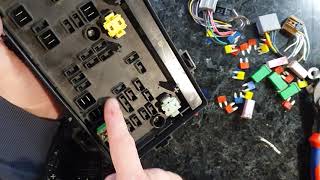
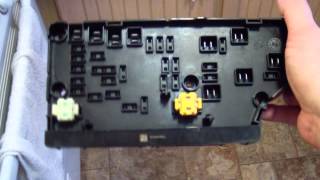
How to confirm: A mechanic can use a bidirectional scan tool to check if the TIPM is receiving commands but not sending power to the correct circuits. Swapping with a known-good TIPM is another diagnostic method. Visual inspection of the TIPM's internal board after disassembly may show obvious signs of green or white corrosion. 🎬 See what the internal corrosion looks like inside a failed TIPM.
Typical fix: Replacement of the entire TIPM unit. Some companies offer repair or remanufacturing services which can be more cost-effective.
Est. part cost: $350-$800 - Weak or Failed Battery / Poor Battery Connections 🟡 Medium Probability → Shop Vehicle Battery
How to confirm: Test the battery voltage with a multimeter; it should be at least 12.4-12.6 volts with the engine off. Low voltage can cause various communication codes. Ensure battery terminals are clean and tight.
Typical fix: Recharge or replace the battery and clean the terminals.
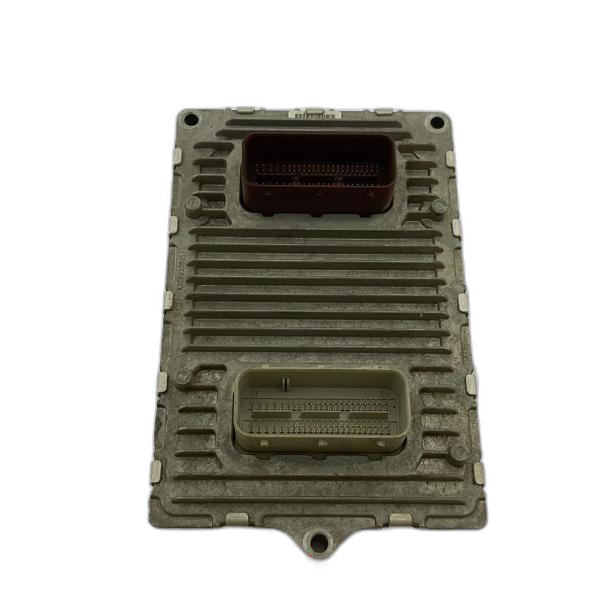
Est. part cost: $150-$250 - Failed Powertrain Control Module (PCM) ⚪ Low Probability → Shop Engine Control Module (ECM) A specific recall (H33 / 08V528000) was issued for a small number of 2009 models due to a manufacturing defect that could cause the PCM circuit board to break. Generally, the PCM is a robust component.
How to confirm: This is typically diagnosed by exclusion. If the battery, wiring (especially the fender harness), and TIPM are all confirmed to be good and providing correct power/ground to the PCM, but it still won't communicate, the PCM itself is the likely fault.
Typical fix: Replace the PCM. The new module will require programming to the vehicle's VIN.
Est. part cost: $400-$900
Rare But Worth Checking
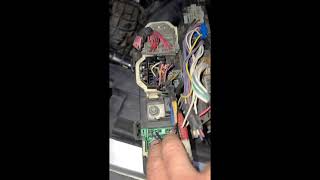
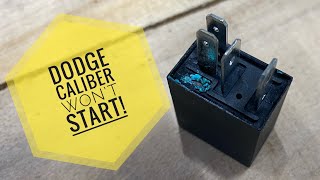
- Corroded Relay Bank in Wheel Well: On some Calibers, there is a separate, smaller relay box tucked into the driver's side wheel well, near the main harness that chafes. Due to its poor placement, it is highly susceptible to water and salt, causing the relays and terminals to corrode completely, leading to a no-start condition that can be misdiagnosed as a TIPM or PCM failure. 🎬 Watch: How to find and fix the corroded wheel well relays.
- CAN Bus Network Fault: While the power supply wiring is the most common cause, the issue could be a fault in the CAN bus twisted pair wiring itself, or another module on the network failing and disrupting all communication.
Diagnosis Steps
- Check Battery Health: Ensure the battery has a full charge (12.4V+ engine off) and that the terminals are clean and tight. Low voltage is a common cause for network codes.
- Scan for All Codes: Use an advanced scanner to check for codes in all modules (TIPM, ABS, etc.), not just the engine computer. Note which modules are not communicating. A scanner that shows network topology can be very helpful.
- Inspect PCM Wiring Harness (CRITICAL STEP): Remove the driver's side front wheel and fender liner. Carefully inspect the entire harness going to the PCM for any signs of rubbing, chafing, or exposed wires, especially where it passes near a prominent metal body stud. Pay close attention to the pink/grey or pink/white wire.
- Test PCM Power and Ground: With the key on, use a multimeter or test light to verify that the PCM is receiving battery voltage on its main power pins (e.g., Pin 1 on the C1 connector, a pink/grey wire) and has a solid ground connection on its ground pins (e.g., Pins 2 and 4). Wiggle the harness during testing.
- Inspect the TIPM: Check the TIPM connectors for any signs of green/white corrosion or water intrusion. Check fuses related to the PCM and other modules.
- Diagnose TIPM Function: This step may require a professional. A bidirectional scanner can be used to command the TIPM to activate circuits (like the PCM power relay) to see if it is functioning internally.
- Test CAN Bus Resistance: With the battery disconnected, measure the resistance between Pin 6 (CAN-High) and Pin 14 (CAN-Low) at the OBD-II port. A reading of approximately 60 ohms indicates the network terminating resistors are intact. A reading of 120 ohms means one of the two terminating resistors (often in the PCM or TIPM) is offline. A reading near 0 ohms indicates a short between the two CAN wires.
- Condemn the PCM: If all wiring, power sources, and the TIPM have been proven to be good, the PCM is the most likely remaining point of failure.
Parts You'll Likely Need
- Totally Integrated Power Module (TIPM)
(OEM #4692333, 4692169, 68028007, 68048227AA (Part numbers are year/model specific, always verify with VIN))— This is the central fuse and relay box and is a very common failure point on the Caliber, causing a wide range of electrical issues including U0100.
Trusted brands: Mopar, Dorman, Cardone
OEM price range: $600-$900
Aftermarket price range: $350-$600 - Powertrain Control Module (PCM) — This is the part that has lost communication. While less likely to be the root cause than wiring or the TIPM, it can fail internally.
Trusted brands: Mopar, Cardone, Standard Motor Products
OEM price range: $600-$900
Aftermarket price range: $300-$500 - Engine Wiring Harness
(OEM #e.g., 68043104AB for 2009 models (Verify with VIN))— In cases of severe chafing or corrosion, a section of the harness or the entire engine harness may need replacement.
Trusted brands: Mopar
OEM price range: $500-$1000
Aftermarket price range: N/A
Related Codes That Often Appear With This One
- U0101 — Lost Communication with TCM. The Transmission Control Module (TCM) is on the same communication network and is often powered by the same circuits from the TIPM. A fault affecting the PCM often affects the TCM as well.
- U0141 — Lost Communication with Body Control Module (or TIPM). Since the TIPM acts as the gateway and body controller, a U0100 caused by a faulty TIPM will often be accompanied by codes indicating other modules cannot talk to the TIPM/BCM.
Technical Service Bulletins (TSBs) & Recalls
- Recall H33 / NHTSA 08V528000: Powertrain Control Module adhesive may cause the printed circuit board to break.
- STAR Case S1208000132: Notes an intermittent no-start condition can be caused by a poor connection at the C201 connector under the dash, affecting the power feed to the ignition switch.
- Bulletin #08-068-16: A manufacturer service bulletin for related Dodge platforms notes that software updates should be performed to reduce the potential for misdiagnosis of U0100, U0140, and U0101, which can lead to incorrect module replacement.
Platform-Specific Known Issues
- Recall H33 (NHTSA ID: 08V528000) was issued for 712 vehicles in the 2009 model year (including Caliber, Compass, and Patriot) due to a PCM manufacturing defect where a new adhesive could cause the circuit board to break and lead to stalling.
Documented NHTSA Reports
- An owner reported in NHTSA ODI #11331197 that every single time their vehicle died while driving or failed to start while parked, they received a U0100 engine code.
- NHTSA ODI #11153349 describes a situation where a vehicle displayed multiple communication errors including U0100, U0101, and U1120 in reference to communication with the TCM and PCM.
- An owner filed a complaint under NHTSA ODI #11615856 stating that after their vehicle stalled, an independent mechanic found the U0100 code, which the owner noted was related to an important safety risk.
- NHTSA ODI #11210296 notes a case where a vehicle was driven to a shop after a failure and was diagnosed with U0100 "Lost Communication with the Engine Control Module."
Mechanic-Grade Diagnostic Values
- CAN Bus Network Resistance — expected: ~60 Ω (Ohms) when measured between Pin 6 (CAN-H) and Pin 14 (CAN-L) at the DLC with the battery disconnected.. Failure: A reading of ~120 Ω indicates one of the two terminating resistors is offline; a reading near 0 Ω indicates a short between the CAN high and low wires.
- CAN Bus Voltage (Key On, Engine Off) — expected: CAN High (Pin 6 to ground): ~2.6-2.7V. CAN Low (Pin 14 to ground): ~2.3-2.4V. The two voltages should add up to approximately 5V.. Failure: Voltages that are stuck high, low, or near zero indicate a short to power, short to ground, or an open circuit. The network bias voltage should rest at 2.5V.
- PCM Power Supply Voltage at Connector C1 — expected: Battery voltage (~12V) at Pin 1 (Pink/Grey wire) with key on.. Failure: 0 volts indicates a loss of power from the TIPM or a short to ground in the harness, which is the common chafing issue.
- PCM Ground Circuit Resistance — expected: Less than 0.1 Ω between PCM ground pins and a known good chassis ground.. Failure: High resistance indicates a poor ground connection, which can cause communication faults.
Scan Tool Commands That Help
- wiTECH or equivalent Chrysler-compatible scanner: ECU View / Network Topology — Use this function to get a visual representation of the CAN bus network. It will show which modules are actively communicating and which are not responding (often colored red), immediately confirming the PCM is offline and showing which other modules are logging the U0100 fault.
- High-level bidirectional scanner: TIPM Actuation Tests (e.g., 'Fuel Pump Relay Command', 'PCM Power Relay Command') — If the PCM is not receiving power, use this command to force the TIPM to activate the power relay for the PCM. If the relay clicks and power is sent, the TIPM is likely responding correctly, and the issue is in the wiring. If the relay does not activate, the TIPM itself may be faulty.
Wiring & Ground Locations
- PCM Connector C1 — On the Powertrain Control Module (PCM), located in the engine bay, typically near the firewall or inner fender. C1 is a 58-way black connector on 2007 models.. This connector contains the main power and ground pins for the PCM. Pin 1 (Pink/Grey wire) is the fused main relay output, and Pins 2 & 4 (Black/Yellow wire) are grounds. Testing here is the fastest way to confirm if the PCM is receiving power.
- PCM Connector C2 — On the Powertrain Control Module (PCM), adjacent to C1. It is a 96-way black connector on 2007 models.. Contains many of the sensor input/output and communication circuits. A fault here is less likely for a U0100 but may be relevant if other codes are present.
- G102 / G103 — G102 is on the left side of the engine compartment. G103 is on the top left side of the transaxle (for 2011 models).. These are primary engine and transmission-related grounds. A loose or corroded connection at these points can cause a variety of issues, including communication codes. The PCM relies on a solid ground connection to function.
- Ground Stud (Fender Well) — A metal body stud located behind the driver's side fender liner, along the routing path of the main wiring harness going to the PCM.. This is the exact location of the most common point of failure. The PCM power wire (Pink/Grey) rubs against this stud, chafes through the insulation, and shorts to ground, cutting power to the PCM and causing the U0100 code.
- TIPM Connector C4 — One of the large multi-pin connectors on the Totally Integrated Power Module (fuse box) in the engine bay.. While not the primary connector for PCM power, inspecting all TIPM connectors, including C4, for corrosion or water intrusion is a key diagnostic step, as any fault within the TIPM can disrupt network communication.
Real Owner Repair Stories
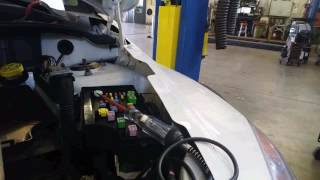
- YouTube channel 'Ratchets And Wrenches' (2009 Dodge Caliber 2.0L) — No-crank, no-start condition. The vehicle died at a stop light and would not restart. Scan tool showed U0100 'Lost Communication with ECM/PCM' and the ECU was missing from the system list.
❌ Tried (didn't work) The technician immediately suspected the common wiring issue and did not report trying other part swaps first.
✅ What actually fixed it The Pink/Grey wire in the harness behind the driver's side fender well had rubbed against the body and shorted to ground. The mechanic confirmed this by testing Pin 1 at the PCM connector and finding it was grounded. The fix was to repair the damaged wire and insulate it from the body.
OEM Part Supersession History
68028007AA, 68028007AB→68028007AC (or higher suffix like AD)— Revisions to address internal component failures and improve reliability.
Heads up: Part number 68028007AC is also a valid replacement for part number 68048117AA on these models. Always verify the part number with the vehicle's VIN, as programming is required.
Model Year Variations Within This Range
- 2007-2009: These early models are most frequently cited for the TIPM part number 68028007xx failures. While the wiring chafe issue can occur on all years, the specific TIPM part numbers are most associated with this range.
- 2010-2012: Post-facelift models may have different TIPM part numbers (e.g., 68048227AA). While the underlying architecture and failure modes (wiring chafe, TIPM failure) are the same, the specific replacement part must be verified by VIN. Ground locations and wire colors appear to be largely consistent.
Diagnostic Flowchart
Real Owner Stories
Aggregated from forums and TSBs cited above. Mileages and costs reflect what owners reported in those sources.
2009 Dodge Caliber 2.0L
Symptoms: Engine exhibited a no-crank, no-start condition.
What fixed it: Found the pink/grey wire shorted to a ground stud behind the driver's side fender liner. Repaired the damaged section of the wire.
Source hint: YouTube: 'U0100 09 Dodge Caliber 2.0 no crank no start FIX'
2007 Dodge Caliber
Symptoms: Wipers and headlights stopped working.
What fixed it: Disassembled the TIPM and found severe internal corrosion caused by water and salt ingress due to the lack of waterproofing.
Source hint: YouTube: '2007 Dodge Caliber TIPM inspection - look at the guts!'
2009 Dodge Caliber
Symptoms: Experienced an intermittent no-start problem.
What fixed it: Traced the issue to a poor connection at the C201 connector under the dash, which was affecting the power feed to the ignition switch.
Source hint: DodgeForum.com: '2009 Caliber Starting issues' (citing STAR Case S1208000132)
2009 Dodge Caliber SXT 2.0L
Symptoms: Attempting to crank the engine caused the starter solenoid to click once, and then all electrical power in the cabin died until the key was cycled.
What fixed it: Diagnosed as a failure of the Totally Integrated Power Module (TIPM) shutting down under load.
Source hint: Reddit (r/MechanicAdvice): 'Bad Tipm? Dodge caliber'
Related OBD-II Codes
Frequently Asked Questions
Is there a recall for the PCM on my Dodge Caliber that could cause a U0100 code?
My Caliber has a U0100 code and the wipers and headlights are acting crazy. What causes this?
Where should I look for wiring damage that causes a U0100 code on a Caliber?
I have an intermittent no-start condition on my 2009 Caliber, but the fender wiring looks fine. What else could it be?
How can I test if the CAN bus network is intact on my Caliber?
Do the Jeep Compass and Patriot have the same U0100 issues as the Caliber?
Helpful Videos
We Have This Part in Stock

The information in this article is provided for general reference and educational purposes only. Vehicle specifications, procedures, and part compatibility can vary by production date, trim level, and region. Always consult your vehicle's factory service manual and verify part numbers before purchasing or performing repairs. Safety-critical components such as airbags, seat belts, and braking systems should be installed by a qualified professional.
- Dodge Caliber:
- 🧭 Diagnostic Flowchart
- 🎬 Helpful Videos
- 🛍️ Shop This Part
- What's Unique About the 2007-2012 Dodge Caliber
- Symptoms You May Notice
- Most Likely Causes
- Rare But Worth Checking
- Diagnosis Steps
- Parts You'll Likely Need
- Related Codes That Often Appear With This One
- Technical Service Bulletins (TSBs) & Recalls
- Platform-Specific Known Issues
- Documented NHTSA Reports
- Mechanic-Grade Diagnostic Values
- Scan Tool Commands That Help
- Wiring & Ground Locations
- Real Owner Repair Stories
- OEM Part Supersession History
- Model Year Variations Within This Range
- Real Owner Stories
- 2009 Dodge Caliber 2.0L
- 2007 Dodge Caliber
- 2009 Dodge Caliber
- 2009 Dodge Caliber SXT 2.0L
- Related OBD-II Codes
- Frequently Asked Questions
- 🎟️ Get 5% Off