

U0100 on 2007-2010 Hyundai Elantra: Lost Communication with ECM Fixes
This code means a critical communication failure with the Engine Control Module (ECM). The most common causes are a weak battery, corroded ground connections, or a wiring issue. On the Elantra HD, pay special attention to the main engine-to-chassis ground strap and the battery terminal connectors. A faulty ECM is possible but less likely.
- U0100 is a critical code indicating a loss of communication with the engine's main computer; do not drive the vehicle.
- Always start diagnosis with the simplest and most common causes: the battery and ground connections.
- A visual inspection of the wiring harness for damage can sometimes reveal the problem without any special tools.
- Due to the complexity of network diagnostics, professional help is highly recommended to avoid replacing expensive parts unnecessarily.
- This code is often accompanied by other 'U' codes, which can help pinpoint whether the issue is with one module or the entire network.
What's Unique About the 2007-2010 Hyundai Elantra
For the 2007-2010 'HD' generation Elantra, this code often points towards foundational electrical issues rather than a specific, unique part failure. Due to the vehicle's age, problems like corroded ground straps and battery terminal issues are frequent culprits that disrupt the sensitive CAN bus network. The main engine-to-chassis ground strap, located on the bottom of the engine/transaxle, is a common failure point. Additionally, the positive battery terminal cap assembly can corrode internally and cause communication-disrupting electrical noise. While module failure is possible, owners and technicians often find success by thoroughly checking the basics—battery, grounds, and visible wiring—before suspecting an expensive computer. A key detail for this generation is that models with a manual transmission often do not have a factory immobilizer, making a used ECM replacement a simple plug-and-play job if the part number is matched exactly.
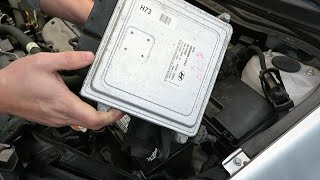
🎬 Watch this step-by-step guide on replacing the Elantra ECM.Symptoms You May Notice
- Check Engine Light is on
- Vehicle will not start, or the starter does not engage
- Engine stalls intermittently while driving
- Reduced engine power or 'limp mode'
- Poor fuel economy
- Transmission may shift harshly or not at all
- Multiple warning lights on the dashboard (e.g., ABS, Airbag, Power Steering) may illuminate simultaneously
- Gauges on the instrument cluster may stop working or behave erratically
- Replacing the ECM without first checking the battery, grounds, and wiring. A simple, inexpensive fix is often overlooked for the most expensive component.
- Replacing the battery without cleaning the terminal connectors or checking the integrity of the main ground straps, leaving the root cause of the poor connection unresolved.
Most Likely Causes
- Weak or Failing Battery 🔴 High Probability → Shop Vehicle Battery As vehicles age, batteries lose their capacity. Low voltage is a very common cause of communication network errors, as modules require a stable voltage (typically above 10V during cranking) to initialize and communicate properly.
How to confirm: Test the battery voltage with a multimeter. A healthy battery should read about 12.6 volts with the engine off and should stay above 10 volts while cranking the engine. Many auto parts stores will load test a battery for free.
Typical fix: Recharge or replace the battery.
Est. part cost: $100 - $250 - Corroded or Loose Battery Terminals/Ground Straps 🔴 High Probability → Shop Engine Ground Strap Over time, engine bay grounds can corrode or loosen, creating high resistance that disrupts module communication. The main engine-to-chassis ground strap on the HD Elantra is located on the bottom of the engine/transaxle area and is exposed to the elements, making it a prime suspect. The positive battery terminal assembly itself has also been reported to corrode internally, creating electrical noise that triggers a U0100 code.
How to confirm: Visually inspect the battery terminals for corrosion. Locate the main engine and chassis ground straps and check for tightness, corrosion, or fraying. Perform a voltage drop test across the ground cables; a reading of more than 0.1-0.2 volts (100-200 mV) indicates excessive resistance.
Typical fix: Clean the battery terminals and ground connection points with a wire brush. Replace corroded or broken ground straps. The positive terminal assembly may need replacement if it's the source of the issue.
Est. part cost: $10 - $60 - Damaged Wiring Harness or Connectors 🟡 Medium Probability Vibrations, heat, and age can cause wires in the CAN bus harness to chafe, break, or connectors to become loose. The ECM is located attached to the air cleaner box, and the wiring in that area should be inspected carefully.
How to confirm: Visually inspect the wiring harnesses leading to the ECM and TCM for any signs of physical damage, chafing, or corrosion at the connectors. This requires locating the modules, often under the hood or behind the dashboard. A wiring diagram is essential for tracing the CAN High and CAN Low wires.
Typical fix: Repair the damaged section of wiring or replace the affected connector.
Est. part cost: $20 - $300 - Faulty Engine Control Module (ECM) ⚪ Low Probability → Shop Engine Control Module (ECM) While not extremely common, internal failure of the ECM due to age, heat, or voltage spikes can occur. This is more likely if water intrusion has occurred near the ECM, which is mounted to the air filter box.
How to confirm: This is typically a last resort after all other possibilities (wiring, power, grounds) have been exhaustively ruled out by a professional using advanced diagnostic tools.
Typical fix: Replace the ECM. This may require programming by a dealer or specialized shop to match the vehicle's VIN, though many used units for this generation with manual transmissions are plug-and-play if the part number and immobilizer status match.
Est. part cost: $400 - $1000
Rare But Worth Checking
- Faulty module on the CAN bus:
- Aftermarket Accessories:
Diagnosis Steps
- Check Battery Health: Ensure the battery is fully charged (12.6V) and terminals are clean and tight. A weak battery is the #1 cause.
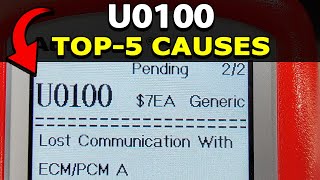
- Scan All Modules: Use a high-quality OBD-II scanner that can read codes from all vehicle modules (ECM, TCM, ABS, BCM). Note which modules are not responding. A basic scanner may not be able to communicate at all. 🎬 See a breakdown of the top 5 causes for U0100 codes.
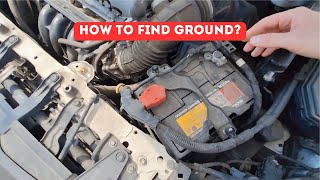
- Inspect Grounds: Locate and inspect the main battery-to-chassis ground and the critical engine-to-chassis ground strap. On the HD Elantra, this strap is often found on the bottom of the engine/transaxle assembly. Check for corrosion, tightness, and physical damage.
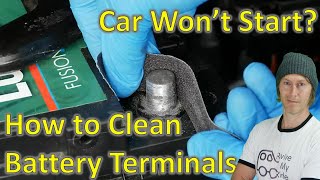
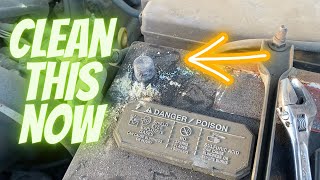
- Inspect Battery Terminals: Pay close attention to the positive battery terminal assembly. There are owner reports of internal corrosion in this specific part causing a U0100 code. 🎬 Learn how to properly clean battery terminals and remove corrosion.
- Visual Wiring Inspection: Carefully inspect the wiring harness connected to the ECM (mounted on the air cleaner box) for any visible damage, such as chafed wires, rodent damage, or corrosion.
- Check Fuses: Check all fuses related to the ECM, TCM, and other control modules in both the interior and under-hood fuse boxes.
- Check CAN Bus Terminating Resistors: This is an advanced step. The CAN bus has two 120-ohm terminating resistors. With the battery disconnected, measure the resistance between the CAN High (Pin 6) and CAN Low (Pin 14) pins at the OBD-II port. A healthy network should read approximately 60 ohms.
- Check for Power and Ground at the ECM: Using a wiring diagram, verify that the ECM connector pins are receiving proper battery voltage and have a solid ground connection. A voltage drop on a ground pin should not exceed 100-200mV.
- Isolate Modules: If multiple modules are offline, a technician may disconnect them one by one to see if a single faulty module is bringing down the entire network.
- Suspect the ECM: If all wiring, power, and grounds are confirmed to be good, and the ECM is the only module not communicating, the ECM itself may be faulty.
Parts You'll Likely Need
- Battery — A weak or failing battery is a primary cause of communication codes due to low voltage.
Trusted brands: Interstate, DieHard, Duralast
OEM price range: $150-$250
Aftermarket price range: $100-$200 - Engine Control Module (ECM)
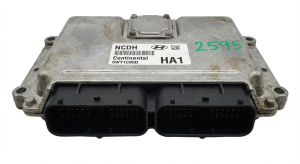
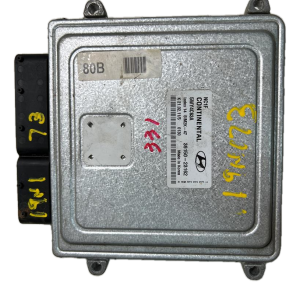
(OEM #39150-23022, 39150-23023, 39150-23033)— The module itself can fail internally, though this is less common than wiring or power supply issues.
Trusted brands: Hyundai (OEM), Flagship One (Remanufactured), AutoECMs (Refurbished)
OEM price range: $800-$1200
Aftermarket price range: $250-$500 - Engine Ground Strap
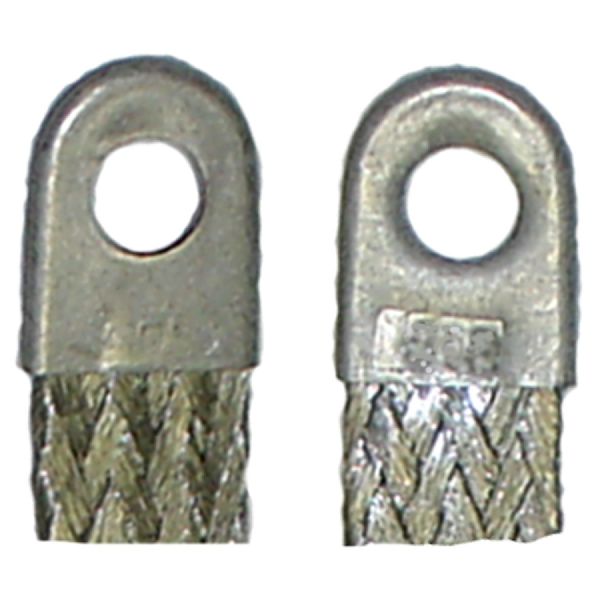
(OEM #91860-2H220)— This strap provides the primary ground path for the engine electronics and is exposed to the elements, making it prone to corrosion and breakage.
Trusted brands: Hyundai (OEM), Standard Motor Products
OEM price range: $25-$50
Aftermarket price range: $10-$30
Related Codes That Often Appear With This One
- U0101 — Lost Communication with TCM. The TCM and ECM are on the same CAN network, so a network-wide failure often logs codes for multiple modules.
- U0121 — Lost Communication with ABS Control Module. Like the TCM, the ABS module is on the same network, and a general communication failure will log codes for multiple modules.
- P0562 — System Voltage Low. This code often accompanies U0100 and strongly points to a failing battery or charging system as the root cause of the communication failure.
- U0073 — Control Module Communication Bus 'A' Off. This indicates a more severe, total network shutdown, whereas U0100 can mean just the ECM has dropped off. Seeing both points to a major bus failure.
Platform-Specific Known Issues
- Corroded Main Ground Strap: → Shop Engine Ground Strap Owners on forums like 2CarPros have noted that the main engine-to-chassis ground strap is a common point of failure. It is located underneath the engine/transmission and is susceptible to corrosion, leading to a host of electrical issues including communication codes. A voltage drop test is the best way to confirm a bad ground.
- Internal Corrosion of Positive Battery Terminal: → Shop Vehicle Battery A detailed owner experience documented how a U0100 code, along with other electrical warnings, was traced back to a faulty OEM positive battery terminal cap (Part 91971-2B370). Despite the battery and alternator testing good, the corroded terminal introduced enough electrical noise to disrupt module communication. Replacing this specific part resolved the issue.
Mechanic-Grade Diagnostic Values
- CAN Bus Resistance — expected: ~60 Ω (measured between Pin 6 and Pin 14 of the OBD-II port with battery disconnected). Failure: A reading of ~120 Ω indicates an open circuit or a missing terminating resistor. A reading near 0 Ω indicates a short between the CAN High and CAN Low wires.
- CAN Bus Voltage (Key On, Engine Off) — expected: CAN High (Pin 6) should be ~2.5V to 3.5V. CAN Low (Pin 14) should be ~1.5V to 2.5V. Both lines should show a bias near 2.5V at rest.. Failure: A line stuck at 0V, 5V, or battery voltage indicates a short to ground or power. No differential change in voltage indicates a hard fault.
- ECM Ground Pin Voltage Drop — expected: < 100 mV (0.1V). Failure: A reading greater than 100-200 mV (0.1-0.2V) while the circuit is under load indicates excessive resistance in the ground circuit, which is a very common cause of communication faults.
- ECM Power Pin Voltage (Key On) — expected: Battery Voltage (~12.6V). Failure: Voltage significantly below battery voltage, or no voltage, points to an issue with the main relay, a fuse, or the power supply wiring to the ECM. Voltage below 10V during cranking is a red flag.
Scan Tool Commands That Help
- Hyundai GDS (Global Diagnostic System): Vehicle S/W Management -> Resetting Adaptive Values — This function should be used after replacing the ECM. It clears all learned fuel trims, idle speeds, and other operational data, forcing the new module to relearn the engine's characteristics from a baseline. This can sometimes resolve communication or performance issues that are software-related after a hardware swap.
Wiring & Ground Locations
- Engine Control Module (ECM) — In the engine compartment, bolted directly to the side of the black plastic air filter housing, near the battery.. This is the module that has lost communication. Physical access is required to test its power, ground, and CAN bus wires directly at the connectors, and to inspect for damage or corrosion.
- Engine-to-Chassis Ground Strap — Typically a braided strap or thick cable running from the engine block or transmission housing to the vehicle's frame or firewall. Its exact location can vary but is often on the lower part of the engine/transaxle assembly.. This is the primary ground path for the ECM and other engine electronics. If it's corroded, loose, or broken, it can cause unstable voltage and disrupt CAN bus communication, directly causing a U0100 code.
- ECM Power and Ground Pins — On the main connectors of the ECM. Based on 2010 diagrams, Pin 5 is a key power supply from the main relay, and Pins 1 and 3 are power grounds.. These specific pins must be tested with a multimeter to confirm the ECM is receiving stable power and has a solid ground. A failure at these pins will prevent the ECM from powering on and communicating, regardless of the CAN bus wiring health.
Real Owner Repair Stories
- 2CarPros Forum User (Hyundai Elantra (year not specified, but HD generation)) — No-start, clicking from the under-hood fuse box, dash lights go blank when trying to start, U0100 and U0100pd codes present.
❌ Tried (didn't work) The owner had replaced a badly damaged engine wiring harness with a used one from eBay before the problem started., Tested the starter motor, which was confirmed to be good.
✅ What actually fixed it The diagnostic path pointed towards two likely culprits: an incorrect replacement wiring harness that was not fully compatible, or, more likely, one or more critical ground wires were not reconnected properly during the harness swap. The user also decided to replace the battery, as a weak battery can cause identical symptoms. The final resolution was not posted, but the story highlights how previous repairs and basic ground connections are critical points of failure. - YouTube Creator, DC Auto Enhancement (2009 Hyundai Elantra) — Multiple strange and conflicting oxygen sensor codes, leading to suspicion of a faulty ECM.
❌ Tried (didn't work) Manual testing of oxygen sensors with a multimeter showed they were functioning correctly, indicating the codes were erroneous.
✅ What actually fixed it The creator replaced the ECM with a used unit from a donor vehicle, carefully matching the OEM part number (39150-23023). The video documents the entire process, confirming the ECM's location on the airbox and the straightforward mechanical swap. After the replacement, the creator noted that the vehicle's mileage on the odometer did not change, suggesting it is stored in the instrument cluster or BCM, not the ECM for this model. This confirms that for many non-immobilizer HD Elantras, an ECM swap is a simple plug-and-play procedure.
OEM Part Supersession History
39150-23022→39150-23020, 39150-23021, 39150-23023— Minor hardware or software revisions.
Heads up: These part numbers are generally listed as interchangeable for the same application (e.g., manual transmission, federal emissions). Always confirm with the parts supplier.
Model Year Variations Within This Range
- 2007-2010: The most significant variation is the presence of a factory anti-theft immobilizer. Many manual transmission models for the North American market did NOT come with an immobilizer. On these vehicles, replacing the ECM is a plug-and-play operation, requiring only that the part number on the replacement ECM matches the original. No programming is needed. Vehicles with an immobilizer (common on automatic transmission models) will display a small dashboard light showing a car with a key inside it. For these vehicles, a replacement ECM (new or used) MUST be programmed to the car's VIN and keys by a dealer or a locksmith with appropriate tools.
Diagnostic Flowchart
Other Known Issues on This Vehicle
Issues unrelated to this code that are worth knowing about as an owner of this generation:
- ABS Module Electrical Short (Fire Risk) 🔴 High → Shop ABS Control Module — Widespread enough to trigger a major safety recall (NHTSA #20V061000). (Ref: Recall 188. The fix involves installing a relay in the main junction box to cut power to the ABS module when the ignition is off.)
- Faulty Stop Lamp Switch 🟠 Medium — Common failure leading to a large recall campaign. (Ref: Recall 110 / NHTSA #13V113000. Switch malfunction can cause brake lights to fail, stay on, or prevent shifting from Park.)
- Transmission Output Speed Sensor Failure 🟠 Medium → Shop Transmission Assembly — A very common failure on models with the A4CF2 4-speed automatic transmission, typically occurring with age/mileage. (Ref: While no specific recall, the issue is well-documented in forums and by mechanics. Often presents with code P0722 and locks the transmission in 3rd gear.)
- Electronic Power Steering (EPS) Failure 🔴 High — Affects 2008-2010 models and led to a recall. (Ref: Recall 103 / NHTSA #11V176000. The EPS control unit can fail, resulting in a sudden loss of power steering assist.)
- Clogged Oil Control Valve (OCV) 🟡 Low — A common issue on the 2.0L Beta II engine if oil changes are neglected. Leads to code P0012 and poor engine performance. (Ref: No recall, but a widely known maintenance-related failure.)
- Cracked Charcoal Canister / Rusted Fuel Filler Neck 🟡 Low — Common source of EVAP leak codes like P0442 as the vehicle ages. (Ref: No recall. A smoke test is often required for diagnosis.)
Used vs. New Parts: Buying Guide for This Vehicle
When a used part is the smart pick: A used OEM ECM from a junkyard or online seller is an excellent, cost-effective choice for this vehicle, *especially* for manual transmission models without a factory immobilizer. Since it's often a plug-and-play swap, it becomes a simple DIY repair. For other components like wiring harnesses or ground straps, used is a perfectly acceptable option.
Donor-vehicle mileage cap: roughly under 150000 miles for the part to have meaningful remaining life.
What to inspect on the donor part:
- For an ECM, ensure the part number matches your original module EXACTLY.
- Inspect the ECM case for any signs of physical damage, pry marks, or heavy corrosion.
- Check the electrical connector pins to ensure they are all straight, clean, and free of any green or white corrosion.
- Ask the seller if the donor vehicle had any flood or fire damage. Avoid these parts.
OEM-only on this vehicle (don't cheap out):
- Engine Control Module (ECM): While a used OEM part is great, it is strongly recommended to avoid new aftermarket ECMs from unknown brands. Stick with original Hyundai parts (new or used) or units from reputable remanufacturers like Flagship One to ensure software compatibility.
Real Owner Stories
Aggregated from forums and TSBs cited above. Mileages and costs reflect what owners reported in those sources.
2007-2010 Hyundai Elantra
Symptoms: U0100 code along with other electrical warnings; battery and alternator tested good.
What fixed it: Replacing the OEM positive battery terminal cap (Part 91971-2B370) due to internal corrosion.
Source hint: vehicle_specific_issues: Internal Corrosion of Positive Battery Terminal
2007-2010 Hyundai Elantra
Symptoms: Electrical issues and communication codes; suspected bad ground.
What fixed it: Cleaning or replacing the main engine-to-chassis ground strap located underneath the engine/transmission.
Source hint: 2CarPros.com forum thread cited in vehicle_specific_issues
Related OBD-II Codes
Frequently Asked Questions
Where is the ECM located on my 2007-2010 Hyundai Elantra?
I heard there is a specific battery part that causes U0100 on this car. What is it?
Where should I look for the main ground strap on my Elantra HD?
Can I use a used ECM from a manual transmission Elantra to fix this?
Why are my ABS and Airbag lights on at the same time as the U0100 code?
How much voltage should my Elantra battery show during startup to avoid communication codes?
Helpful Videos

Used OEM Parts in Stock
New Aftermarket Parts Available

The information in this article is provided for general reference and educational purposes only. Vehicle specifications, procedures, and part compatibility can vary by production date, trim level, and region. Always consult your vehicle's factory service manual and verify part numbers before purchasing or performing repairs. Safety-critical components such as airbags, seat belts, and braking systems should be installed by a qualified professional.
- Hyundai Elantra:
- 🧭 Diagnostic Flowchart
- 🎬 Helpful Videos
- 🛍️ Shop This Part
- What's Unique About the 2007-2010 Hyundai Elantra
- Symptoms You May Notice
- Most Likely Causes
- Rare But Worth Checking
- Diagnosis Steps
- Parts You'll Likely Need
- Related Codes That Often Appear With This One
- Platform-Specific Known Issues
- Mechanic-Grade Diagnostic Values
- Scan Tool Commands That Help
- Wiring & Ground Locations
- Real Owner Repair Stories
- OEM Part Supersession History
- Model Year Variations Within This Range
- Other Known Issues on This Vehicle
- Used vs. New Parts: Buying Guide for This Vehicle
- Real Owner Stories
- 2007-2010 Hyundai Elantra
- 2007-2010 Hyundai Elantra
- Related OBD-II Codes
- Frequently Asked Questions
- 🎟️ Get 5% Off