

U0100 on 2017-2020 Hyundai Elantra: Lost Communication With ECM/PCM Causes and Fixes
This code means the main engine computer (ECM) has lost communication. On the 2017-2020 Elantra, the most likely cause is a weak battery or a poor electrical connection. Before suspecting the expensive ECM, check the battery voltage and clean the battery terminals. A new battery costs around $150-$250.
- Do not immediately assume the expensive ECM has failed. Start with the basics.
- The most likely cause of U0100 on a 2017-2020 Elantra is a weak battery or a loose/corroded battery terminal.
- Driving with this code is unsafe due to the high risk of the engine stalling unexpectedly.
- Check all related fuses (ECM, ABS, etc.) before performing more complex wiring diagnostics.
- If the ECM does need to be replaced, it will require professional programming to work with your car.
What's Unique About the 2017-2020 Hyundai Elantra
For the sixth-generation (AD) Elantra, this code is most often an electrical issue rather than a failed computer. These cars are sensitive to battery voltage, and a weak battery is a primary suspect for causing network communication problems. In fact, Hyundai issued a service campaign for some 2017 models to re-torque the battery terminals, highlighting the importance of solid connections. While the ECM can fail, it's crucial to rule out these simpler electrical faults first.
Symptoms You May Notice
- Check Engine Light is on
- Vehicle will not start (engine may or may not crank)
- Engine stalls intermittently while driving
- Multiple warning lights on the dashboard (e.g., ABS, Traction Control, EPS)
- Transmission may not shift correctly or may be stuck in one gear ('limp mode')
- Reduced engine power
- Replacing the ECM without first thoroughly checking the battery, fuses, and all power/ground connections. The ECM is expensive and often not the root cause.
Most Likely Causes
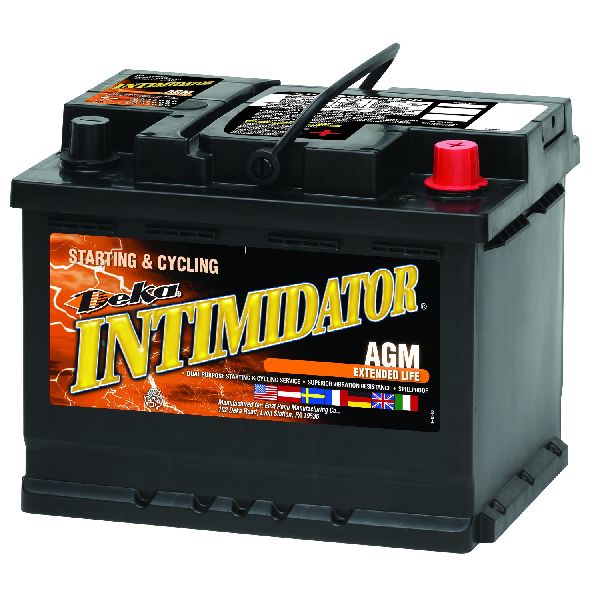
- Weak or Faulty Battery 🔴 High Probability → Shop Vehicle Battery Modern vehicle electronics are highly sensitive to voltage. A battery that is failing or has low charge can cause communication modules to drop off the network, and it is the most common cause of U0100.
How to confirm: Test the battery voltage with a multimeter. A healthy, fully charged battery should read approximately 12.6 volts with the engine off. If it's below 12.4 volts, it may need charging or replacement. Perform a load test to ensure it holds voltage under load. If it won't hold a charge, it needs replacement.
Typical fix: Recharge or replace the battery. Ensure battery terminals are clean and tight. The correct battery size is typically a Group H5 or H6, depending on the engine. A TSB was issued for the 2017 model to verify battery terminal torque.
Est. part cost: $150-$250 - Poor Ground Connections 🟡 Medium Probability Corroded or loose ground straps for the engine, chassis, or ECM can create electrical interference and disrupt CAN bus signals.
How to confirm: Visually inspect the main ground straps from the battery to the chassis and from the engine block to the chassis. Look for corrosion, fraying, or looseness. Use a multimeter to check for voltage drop between the battery negative post and the engine block/chassis (should be less than 0.1 volts).
Typical fix: Clean the contact points of the ground straps with a wire brush and ensure they are securely fastened.
Est. part cost: $0-$20 - Damaged Wiring or Connectors 🟡 Medium Probability The wiring harness leading to the ECM can be susceptible to damage from engine vibration, heat, or rodents. The main ECM connectors can also become corroded or have bent pins.
How to confirm: Visually inspect the wiring harness going to the ECM for any signs of chafing, melting, or chew marks. Disconnect the ECM connectors (with the battery disconnected) and check for green or white corrosion on the pins.
Typical fix: Repair the damaged section of the wiring harness. Clean corroded connectors with an electrical contact cleaner. If the harness is severely damaged, it may need to be replaced.
Est. part cost: $20-$800 - Blown Fuse ⚪ Low Probability An electrical short in a related component can blow a fuse that powers the ECM or another module on the network, causing a communication loss.
How to confirm: Check all fuses in the engine bay and interior fuse panels related to the ECM, PCM, and other control units. A blown fuse for a seemingly unrelated module can sometimes cause network failure.
Typical fix: Replace the blown fuse. If the fuse blows again immediately, there is an underlying short circuit that must be diagnosed.
Est. part cost: $1-$10
Rare But Worth Checking
- Faulty Engine Control Module (ECM): → Shop Engine Control Module (ECM) This is the 'last resort' cause. The ECM is a robust component and typically fails only after all other possibilities (power, ground, wiring) have been exhausted. Internal failure can be caused by voltage spikes or water damage.
- Faulty Third-Party Module: A short circuit in another module on the CAN bus (like the ABS module, instrument cluster, or even a rearview camera) can disrupt the entire network and prevent the ECM from communicating. Aftermarket remote starters or alarms are also common culprits.
Diagnosis Steps
- Check Battery Health: Using a multimeter, verify the battery has at least 12.4 volts with the car off. Perform a load test to ensure it's not failing under load. Clean any corrosion from the terminals and ensure they are tight.
- Inspect Fuses: Check all fuses in both the engine and interior fuse boxes, especially those labeled ECM, PCM, ECU, or BCM. Replace any that are blown.
- Scan for Other Codes: Use an OBD-II scanner to see if other 'U' codes are present. If many modules are offline, it points to a network-wide issue. If only the ECM is offline, the problem is more isolated to its power, ground, or the module itself.
- Inspect Wiring and Grounds: Visually inspect the main wiring harness to the ECM for any signs of physical damage, chafing, or melting. Locate and inspect the main engine and chassis ground straps for tightness and corrosion.
- Check CAN Bus Resistance: Disconnect the battery. At the OBD-II port, measure the resistance between Pin 6 (CAN High) and Pin 14 (CAN Low). A healthy network should read approximately 60 ohms. A reading of 120 ohms suggests a break in the wiring or a missing terminating resistor (often inside a module, or because a module is disconnected for testing). A reading near 0 ohms indicates a short circuit between the two CAN wires.
- Verify ECM Power and Ground: Using a wiring diagram for your specific Elantra, check for battery voltage and a good ground at the appropriate pins on the ECM connector. If power or ground is missing, trace that circuit back to find the fault.
- Consider the ECM: If all wiring, power, and grounds are confirmed to be good, and the CAN network is intact, the ECM itself is the most likely remaining point of failure.
Parts You'll Likely Need
- Battery — Low system voltage from a weak or failing battery is the most common trigger for this communication code on modern vehicles.
Trusted brands: Hyundai OE, Interstate, DieHard
OEM price range: $200-$300
Aftermarket price range: $150-$250 - Engine Control Module (ECM/PCM) — If all electrical tests pass, the module itself may have failed internally. This is the least common, but most expensive, fix.
Trusted brands: Hyundai OE (Genuine), Bosch (often the OE supplier), Remanufactured/Rebuilt Units
OEM price range: $800-$1200
Aftermarket price range: $400-$700 (Remanufactured)
Related Codes That Often Appear With This One
- U0101 — Lost Communication with TCM. The TCM (Transmission Control Module) is on the same CAN bus. A network-wide failure will often set communication codes for multiple modules simultaneously.
- U0121 — Lost Communication with ABS Control Module. Like the TCM, the ABS module relies on ECM data and a network failure will cause it to log a code.
- P0562 — System Voltage Low. This code strongly points to a failing battery or charging system as the root cause of the communication failure.
Technical Service Bulletins (TSBs) & Recalls
- NHTSA Recall 21V301000 (Hyundai Campaign 209): Addresses improperly heat-treated piston oil rings on 2019-2020 2.0L Nu MPI engines, which can cause engine damage and stalling.
- TSB 23-EM-007H: Provides a procedure for combustion chamber cleaning to address oil consumption issues on gasoline engines.
- NHTSA Recall 17V213000 (Hyundai Recall 161): For 2017 models, addresses a faulty electronic power steering connector that could lead to loss of steering assist.
Platform-Specific Known Issues
- A service campaign (TSB #5NP-J4Z4M-09) was issued for some 2017 Elantra models to verify and correct the battery terminal and mounting bracket torque, indicating that loose battery connections are a known issue from the factory that can cause electrical problems.
Mechanic-Grade Diagnostic Values
- CAN Bus Resistance (at OBD-II Port) — expected: ~60 Ω. Failure: 120 Ω indicates a single terminating resistor is offline or there's a break in the circuit. 0 Ω indicates a short between CAN High and CAN Low wires.
- CAN High Voltage (Key On, Engine Off) — expected: 2.5V to 3.5V (average ~2.6V on a multimeter). Failure: Voltage stuck at 0V, battery voltage, or outside the expected range indicates a short or open circuit.
- CAN Low Voltage (Key On, Engine Off) — expected: 1.5V to 2.5V (average ~2.4V on a multimeter). Failure: Voltage stuck at 0V, battery voltage, or outside the expected range indicates a short or open circuit.
- ECM Power and Ground Pins — expected: Battery voltage (~12.6V) at power pins and less than 0.1V (voltage drop) at ground pins.. Failure: No voltage at power pins indicates a blown fuse or open wire. High voltage at ground pins indicates a bad ground connection.
- CAN Bus Baud Rate — expected: 500k. Failure: N/A - This is a configuration setting for advanced diagnostic tools.
Scan Tool Commands That Help
- Hyundai GDS (Global Diagnostic System): Vehicle S/W Management — Used for reprogramming a new or used ECM with the correct VIN and immobilizer information. It is also used to apply software updates that may resolve communication glitches.
- Hyundai GDS (Global Diagnostic System): Resetting Adaptive Values — After replacing an ECM or fixing a related electrical issue, this function clears learned engine parameters, forcing the module to relearn. This can sometimes resolve persistent communication issues that are software-based.
- J-2534 Passthru Device: ECM Reprogramming — An aftermarket tool that, with a valid Hyundai subscription, can perform ECM programming and updates, serving as an alternative to the dealer's GDS tool.
Wiring & Ground Locations
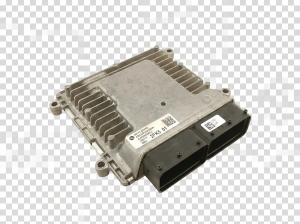
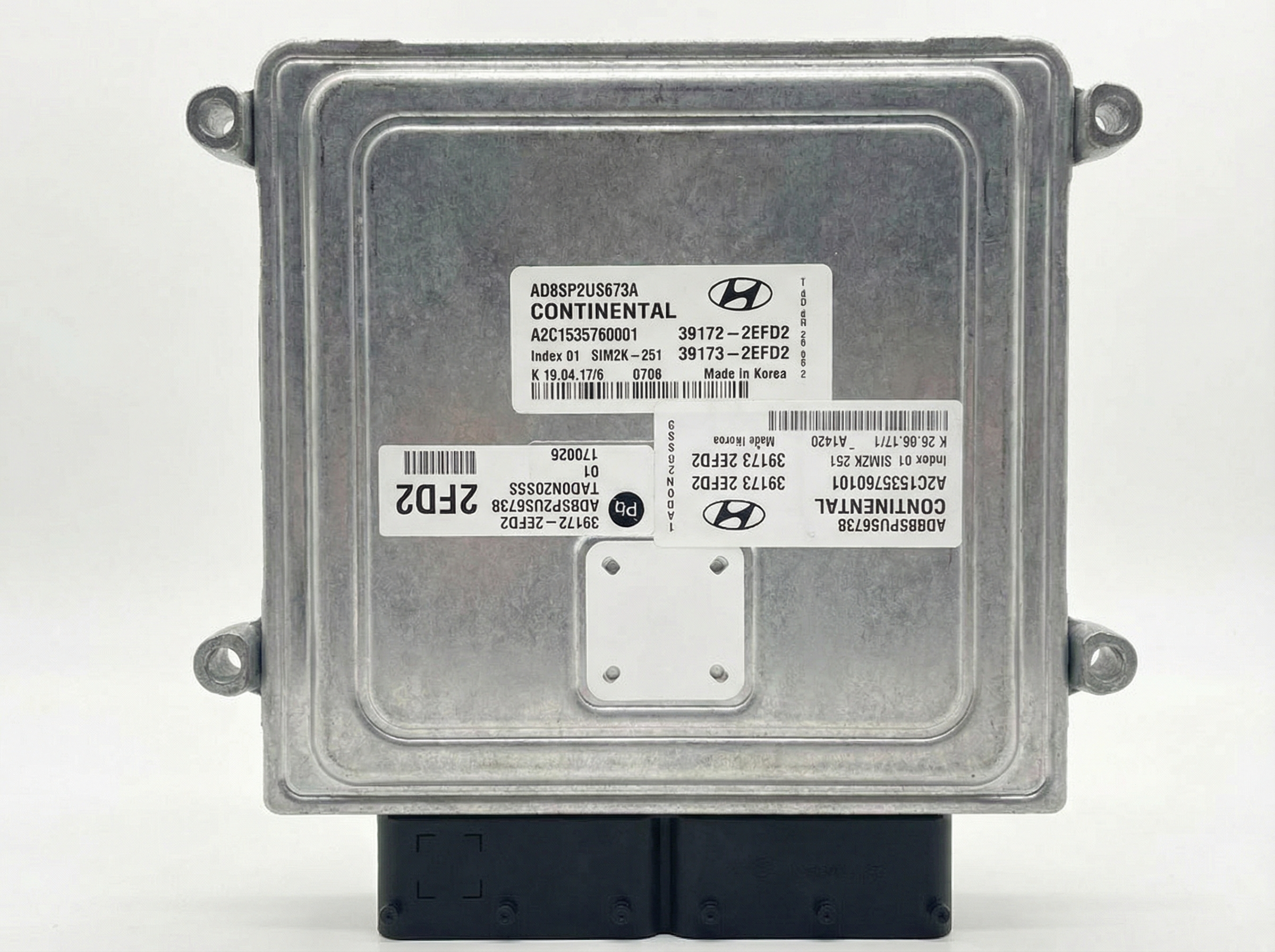
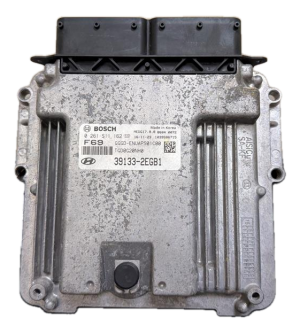
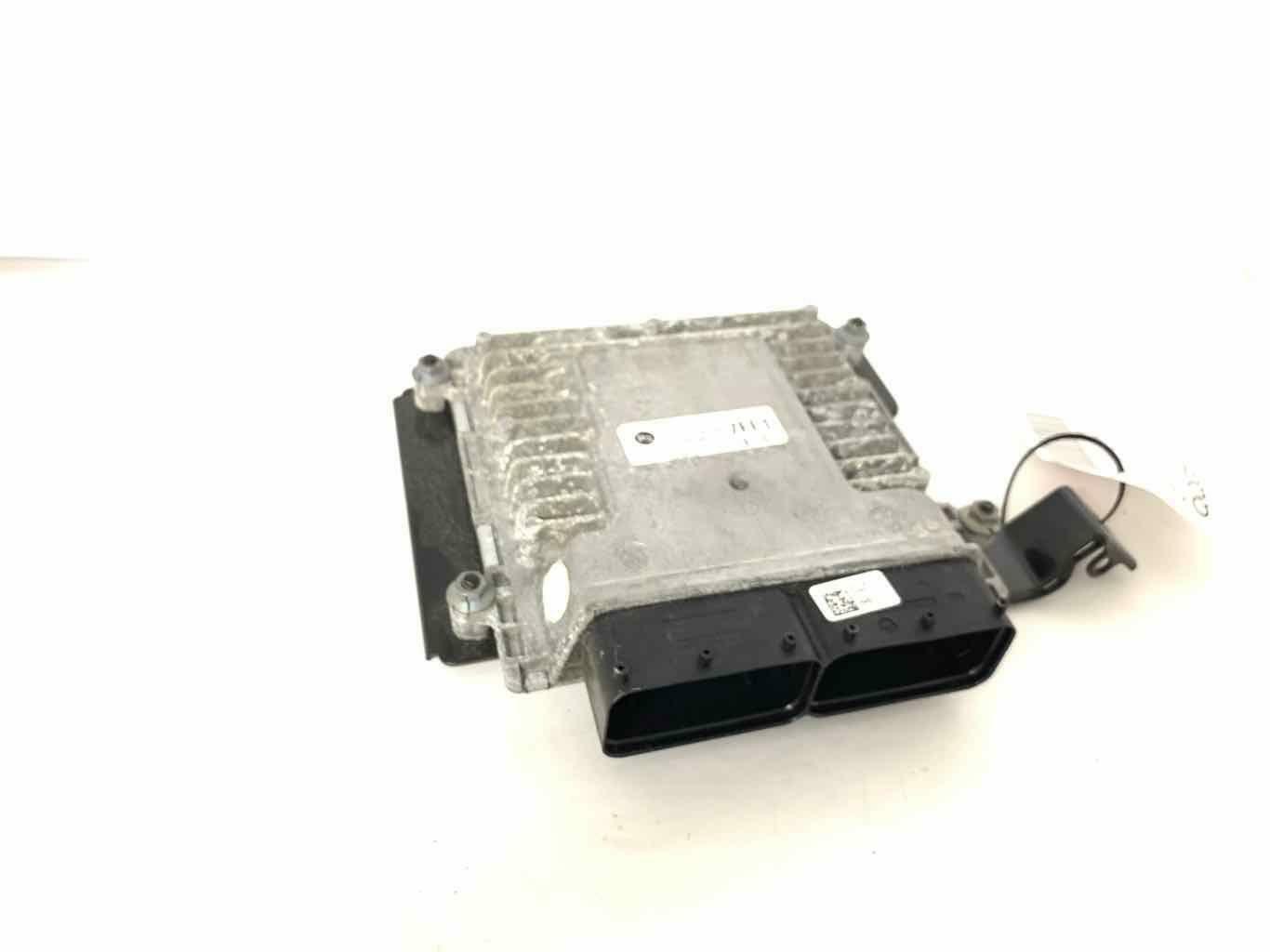
- ECM/PCM — In the engine bay, typically located near the battery or against the firewall. It is a metal box with large electrical connectors.. This is the module that has lost communication. All power, ground, and network connections to this module must be verified.
- OBD-II Port — Under the driver's side dashboard.. This is the primary access point for diagnosing the CAN bus. Resistance and voltage checks are performed between Pin 6 (CAN High) and Pin 14 (CAN Low).
- Engine Compartment Fuse Box — Located in the engine compartment on the left side, near the battery.. Contains main fuses and relays for the ECM and other critical modules. A failure in this box, such as a faulty relay or corroded connection, can cut power to the ECM.
- Instrument Panel Fuse Box — Located on the driver's side of the instrument panel, behind a cover.. Contains fuses for various interior modules that share the CAN bus. A short in one of these circuits could potentially disrupt network communication.
Real Owner Repair Stories
- YouTube user comment on 'HYUNDAI Elantra no crank not start, solution.' (Hyundai Elantra, year unspecified) — No crank, no start, no Check Engine Light on the dash, and no communication with a diagnostic tool.
❌ Tried (didn't work) Checking fuses, which all appeared to be fine.
✅ What actually fixed it The problem was a faulty engine room module (the main fuse and relay box in the engine compartment). Internal relays that power the ECM had failed. Replacing the entire module restored communication and allowed the car to start.
Model Year Variations Within This Range
- 2019-2020: The 2019 model year introduced a facelift to the Elantra, which included revised exterior styling and updated infotainment systems. While the core 2.0L engine and network architecture remained similar, there could be minor differences in wiring harness routing or connector types. Always verify part numbers and wiring diagrams specific to the vehicle's production date.
Diagnostic Flowchart
Other Known Issues on This Vehicle
Issues unrelated to this code that are worth knowing about as an owner of this generation:
- Piston Ring Failure / Engine Damage 🔴 High — Affects 2019-2020 models with the 2.0L Nu MPI engine. Can lead to oil consumption, engine damage, stalling, and potential fire risk. (Ref: NHTSA Recall 21V301000 (Hyundai Campaign 209). Dealers inspect and replace the engine if necessary, and install Piston Ring Noise Sensing System (PNSS) software.)
- Engine Oil Consumption and Piston Slap 🟠 Medium — Common complaint on the 2.0L Nu MPI engine across multiple model years, often starting after 60,000 miles. Caused by piston ring and cylinder wall wear. (Ref: Hyundai has issued TSBs like 23-EM-007H for combustion chamber cleaning and guidelines for diagnosing and repairing oil consumption.)
- Loss of Power Steering 🔴 High — A recall was issued for some 2017 Elantra models for a damaged Electronic Power Steering (MDPS) connector that could cause a sudden loss of steering assist. (Ref: NHTSA Recall 17V213000 (Hyundai Recall 161).)
- Brake Booster Failure 🔴 High — Some 2017 models were recalled for a brake booster that could fail, resulting in a loss of power brake assist and increased stopping distance. (Ref: NHTSA Recall 17V063000 (Hyundai Recall 157).)
Used vs. New Parts: Buying Guide for This Vehicle
When a used part is the smart pick: Using a used part makes sense for the Engine Room Fuse/Relay Box, as it is a direct-fit component that does not typically require programming. It can be a cost-effective solution if the original has failed internally.
Donor-vehicle mileage cap: roughly under 100000 miles for the part to have meaningful remaining life.
What to inspect on the donor part:
- Ensure the donor vehicle was not in a flood or fire.
- Inspect the part for any signs of melting, heavy corrosion, or physical damage to the casing.
- If possible, match part numbers on the unit to ensure compatibility.
OEM-only on this vehicle (don't cheap out):
- Engine Control Module (ECM/PCM) - While used ECMs are available, they are locked to the original vehicle's VIN and immobilizer. They require specialized tools like the Hyundai GDS to be reprogrammed, which many independent shops cannot do. Some third-party services offer 'plug-and-play' refurbished ECMs where they program your VIN beforehand, but this adds complexity. For guaranteed compatibility, a new OEM part programmed by a dealer is the safest route.
Brands owners have reported issues with on this vehicle:
- Unknown/unbranded ECM 'repair' services on marketplaces like eBay without a lifetime warranty and clear programming instructions.
Real Owner Stories
Aggregated from forums and TSBs cited above. Mileages and costs reflect what owners reported in those sources.
2017 Hyundai Elantra
Symptoms: Electrical problems stemming from the battery area; loose connections identified from the factory.
What fixed it: Verified and corrected the battery terminal and mounting bracket torque per the service campaign instructions.
Source hint: TSB #5NP-J4Z4M-09
2019-2020 Hyundai Elantra 2.0L Nu MPI
Symptoms: Engine stalling and potential engine damage related to oil consumption.
What fixed it: Dealer inspection and replacement of the engine if necessary, plus installation of Piston Ring Noise Sensing System (PNSS) software.
Source hint: NHTSA Recall 21V301000 (Hyundai Campaign 209)
2017 Hyundai Elantra
Symptoms: Sudden loss of power steering assist while driving.
What fixed it: Repair of a damaged electronic power steering (MDPS) connector.
Source hint: NHTSA Recall 17V213000 (Hyundai Recall 161)
2017-2020 Hyundai Elantra 2.0L Nu MPI — ~60000 miles
Symptoms: Engine oil consumption and piston slap sounds developing after mid-range mileage.
What fixed it: Combustion chamber cleaning procedure as outlined in technical service bulletins.
Source hint: TSB 23-EM-007H
Related OBD-II Codes
Frequently Asked Questions
My 2017 Elantra has a loose battery terminal; is there a specific TSB for this?
Could the power steering recall on my 2017 Elantra be related to communication codes?
I have a 2019 Elantra with the 2.0L Nu MPI engine; is there a recall that might cause stalling and codes?
What battery size should I buy for my 2017-2020 Elantra to prevent U0100 voltage issues?
Can a blown fuse in the engine bay cause a U0100 communication loss?
Is there a specific maintenance recommendation for the 2.0L Nu engine to avoid long-term electrical or mechanical failure?
Helpful Videos



Used OEM Parts in Stock
New Aftermarket Parts Available


The information in this article is provided for general reference and educational purposes only. Vehicle specifications, procedures, and part compatibility can vary by production date, trim level, and region. Always consult your vehicle's factory service manual and verify part numbers before purchasing or performing repairs. Safety-critical components such as airbags, seat belts, and braking systems should be installed by a qualified professional.
- Hyundai Elantra:
- 🧭 Diagnostic Flowchart
- 🎬 Helpful Videos
- 🛍️ Shop This Part
- What's Unique About the 2017-2020 Hyundai Elantra
- Symptoms You May Notice
- Most Likely Causes
- Rare But Worth Checking
- Diagnosis Steps
- Parts You'll Likely Need
- Related Codes That Often Appear With This One
- Technical Service Bulletins (TSBs) & Recalls
- Platform-Specific Known Issues
- Mechanic-Grade Diagnostic Values
- Scan Tool Commands That Help
- Wiring & Ground Locations
- Real Owner Repair Stories
- Model Year Variations Within This Range
- Other Known Issues on This Vehicle
- Used vs. New Parts: Buying Guide for This Vehicle
- Real Owner Stories
- 2017 Hyundai Elantra
- 2019-2020 Hyundai Elantra 2.0L Nu MPI
- 2017 Hyundai Elantra
- 2017-2020 Hyundai Elantra 2.0L Nu MPI — ~60000 miles
- Related OBD-II Codes
- Frequently Asked Questions
- 🎟️ Get 5% Off