

U0100 on 2019-2026 Volvo S60: Lost Communication With ECM Fixes
U0100 on a modern Volvo S60 means the Engine Control Module (ECM) is offline. The most likely causes are a weak battery, a software glitch in the telematics module (TCAM), or a poor ground connection. Before major repairs, fully charge and test the battery, perform a TCAM reset, and inspect major ground points.
- Always start with the simplest fixes: check the battery's health and perform the TCAM module reset before assuming a major component has failed.
- U0100 is a serious code that can leave you stranded; it should be addressed promptly.
- Due to the complexity of the S60's network, professional diagnosis with Volvo-specific tools is strongly recommended if the basic checks don't solve the problem.
- Do not replace the expensive ECM unless all other possibilities (power, grounds, wiring, software, other modules) have been completely ruled out.
What's Unique About the 2019-2026 Volvo S60
The 2019-2026 Volvo S60 is built on the advanced Scalable Product Architecture (SPA) platform. This design relies heavily on multiple computer networks (CAN and LIN bus) for all functions. Unlike older cars, a communication code like U0100 is frequently caused by software glitches or issues with secondary modules. For example, Volvo has a specific procedure to restart the Telematics and Connectivity Antenna Module (TCAM) to resolve network problems, which can sometimes resolve broader communication faults. Furthermore, a failing component on a sub-network, like an aftermarket alternator or electric water pump on the LIN bus, can disrupt the entire system and trigger a U0100 code by creating network noise.
Symptoms You May Notice
- Check Engine Light is on.
- Engine may not start or is hard to start.
- Intermittent stalling while driving.
- Rough or erratic idle.
- Transmission may not shift correctly or may feel stuck in gear ('limp mode').
- Loss of other systems like ABS or traction control, possibly with other warning lights.
- Reduced engine power or vehicle entering 'limp mode'.
- Multiple, seemingly unrelated warning messages on the instrument cluster.
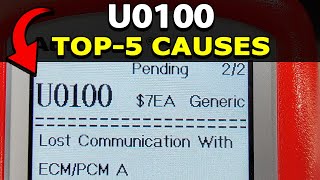
- Replacing the ECM without first checking the battery, ground connections, and performing a software reset. The ECM is expensive 🎬 Watch: Top 5 causes for the U0100 lost communication code. and often not the root cause.
- Replacing the battery without checking the alternator's charging output. A faulty alternator/voltage regulator can cause a 'Low Battery Voltage' message and lead to network codes, even with a new battery.
Most Likely Causes
- Weak or Failing Battery 🔴 High Probability → Shop Vehicle Battery Modern vehicles like the SPA-platform S60 are extremely sensitive to battery voltage. A low or unstable voltage is a leading cause of network communication faults, often triggering a U0100 code before any other symptoms appear.
How to confirm: With the engine off, measure the battery voltage using a multimeter. A healthy battery should read approximately 12.6 volts. Anything below 12.4V is suspect. Perform a load test to confirm its health, as a battery can show good voltage but fail under load. Check terminals for tightness and corrosion.
Typical fix: Recharge or replace the battery. Ensure the replacement battery meets or exceeds OEM specifications for Cold Cranking Amps (CCA) and capacity. Clean the battery terminals thoroughly.
Est. part cost: $250-$450 - Software Glitch / TCAM Module Lock-up 🟡 Medium Probability The S60's complex software, particularly the Telematics and Connectivity Antenna Module (TCAM), can experience glitches that interrupt network communication. Volvo has an official procedure for this issue on models 2023 and newer, but owners of earlier models have also used it successfully to resolve connectivity and other electronic issues.
How to confirm: Attempt to restart the Telematics and Connectivity Antenna Module (TCAM). Press and hold the front windshield defroster button for about 20-30 seconds until the 'SOS' button in the overhead console begins to flash. Release the button and wait a few minutes for the system to reboot. Some owners report needing to let the car sit locked for an hour after a failed reset attempt for the module to fully power cycle.
Typical fix: Perform the TCAM reset. If this fails, a full software update at a Volvo dealership may be required. In some cases, disconnecting the 12V battery and the TCAM backup battery for several minutes can force a hard reset.
Est. part cost: $0 for reset, dealer software update cost varies. - Corroded or Loose Ground Straps 🟡 Medium Probability → Shop Engine Ground Strap Ground straps provide the return path for the electrical system. The main engine-to-chassis ground strap is exposed to the elements and can corrode, creating high resistance. This leads to unpredictable electrical faults, including communication codes.
How to confirm: Visually inspect the main ground straps: from the battery to the chassis, and from the engine block to the chassis. On some Volvos, a key ground is located on the top of the engine near the timing belt cover. 🎬 See how to repair a missing LIN bus message without new parts. Look for any signs of green/white corrosion, fraying, or looseness. Use a multimeter to check for voltage drop across the ground connections; a good ground should have minimal voltage drop (less than 0.2 volts).
Typical fix: Clean the contact points with a wire brush to bare metal and re-secure the strap. Applying dielectric grease to the connection after tightening can help prevent future corrosion. Replace the ground strap if it is badly corroded or damaged.
Est. part cost: $20-$75 - Blown Fuse or Faulty Relay ⚪ Low Probability A fuse or relay protects the ECM and other modules. While not a common failure, a blown fuse will cut power and cause immediate communication loss. A failing ECM power relay is a known issue on some other vehicle platforms that can cause intermittent U0100 codes.
How to confirm: Consult the owner's manual for the location of the fuse boxes (engine bay and cabin). Visually inspect the fuses related to the ECM, PCM, and network gateways. Swap the ECM power relay with an identical one from a non-critical system (like the horn) to see if the problem is resolved.
Typical fix: Replace the blown fuse with a new one of the correct amperage. Replace the faulty relay.
Est. part cost: $5-$30
Rare But Worth Checking
- Faulty Component on LIN Bus: On SPA platform vehicles, a failing component like the alternator or electric water pump can disrupt the LIN bus, a sub-network that communicates with the ECM. A YouTube video by user 'fintech' on an XC90 demonstrated that a cheap aftermarket alternator and water pump, which share a LIN bus, caused intermittent charging errors and communication faults. Replacing them with OEM parts resolved the issue. 🎬 Watch: Troubleshooting SPA LIN bus issues and alternator faults. This can cause a U0100 code even if the ECM itself is fine. Diagnosis often requires a Volvo-specific scanner to see which module is not communicating.
- Damaged CAN Bus Wiring / Water Intrusion: Physical damage to the twisted-pair CAN bus wires from an accident, rodent damage, or abrasion can cause a short or open circuit. A more insidious cause on SPA platforms is water intrusion from clogged sunroof drains, which allows water to pool under the carpets and corrode the main body wiring harness and its connectors, leading to chaotic electrical failures.
- Failed Engine Control Module (ECM): → Shop Engine Control Module (ECM) While possible, the ECM itself is one of the least likely components to fail. All other possibilities, especially power, ground, and software issues, should be thoroughly ruled out before condemning the ECM. An ECM failure is often misdiagnosed when the actual cause is a bad power relay or ground.
Diagnosis Steps
- Read All Codes: Use a high-quality OBD-II scanner to read codes from all available modules, not just the engine. Note any other 'U' codes that are present, as they can help pinpoint the scope of the network failure.
- Check Battery Health: Measure battery voltage (should be ~12.6V engine off). Perform a load test to ensure the battery is stable under load. A weak battery is the #1 cause of spurious electronic faults on these cars. Clean any corrosion from the terminals and ensure they are tight.
- Perform TCAM Reset: Press and hold the front defroster button for ~20-30 seconds until the SOS light flashes. Wait several minutes for the system to reboot and see if the code clears. This can resolve software-induced network glitches.
- Inspect Fuses and Relays: Check all fuses related to the ECM/PCM and other control modules in the engine bay and interior fuse panels. Consider swapping the ECM power relay with a known good one.
- Inspect Grounds and Wiring: Visually inspect the main battery, chassis, and engine ground straps for corrosion or damage. Pay close attention to the engine-to-chassis strap. Check the wiring harness going to the ECM for any visible signs of damage, abrasion, or corrosion. Check for moisture under the front carpets, which could indicate water intrusion affecting the main harness.
- Advanced Diagnostics (Professional): If the above steps do not resolve the issue, the next steps involve using a multimeter to check CAN bus resistance and voltages at the OBD-II port, and a Volvo VIDA scanner to perform network tests on individual modules.
Parts You'll Likely Need
- Battery — A weak or failing battery is the most common cause of network communication codes on modern Volvos.
Trusted brands: Volvo (OEM), Interstate, DieHard - Engine Ground Strap — Corrosion on the main engine ground is a common cause of intermittent and difficult-to-diagnose electrical issues, including communication faults.
Trusted brands: Volvo (OEM), Dorman
Related Codes That Often Appear With This One
- U0101 — Indicates 'Lost Communication with TCM' (Transmission Control Module). Since the ECM and TCM are on the same high-speed network, a network-wide problem will often cause both codes to appear together.
- U0155 — Indicates 'Lost Communication with Instrument Panel Cluster'. If the network gateway or a shared power/ground is the issue, communication to multiple modules is often lost simultaneously.
- U0140 — Indicates 'Lost Communication with Body Control Module' (or CEM on Volvos). This points towards a more systemic network failure rather than an issue with a single module.
Technical Service Bulletins (TSBs) & Recalls
- While no TSB explicitly for U0100 on this model was found, TSBs like TJ34936110 ('No internet connection') and others related to software updates for modules on the 2021-2024 S60 suggest that software is a key area of focus for fixing communication issues.
Platform-Specific Known Issues
- Software updates are frequently released by Volvo to address various module communication and performance issues. A trip to the dealer for a 'Total Upgrade' is a common fix for persistent electronic gremlins.
- The Telematics and Connectivity Antenna Module (TCAM) can lock up, causing various connectivity-related symptoms. Volvo has a specific owner-level reset procedure for this.
Mechanic-Grade Diagnostic Values
- CAN Bus Network Resistance — expected: Approximately 60 Ohms. Failure: A reading of 120 Ohms indicates an open circuit or a missing terminating resistor. A reading significantly less than 60 Ohms (e.g., ~40 Ohms) suggests an extra terminating resistor or a shorted module.
- CAN Bus High (CAN-H) Voltage — expected: Fluctuates between 2.5V and 3.5V (average ~2.6V on a multimeter). Failure: A static voltage, 0V, or battery voltage indicates a short to ground, short to power, or an open circuit.
- CAN Bus Low (CAN-L) Voltage — expected: Fluctuates between 2.5V and 1.5V (average ~2.4V on a multimeter). Failure: A static voltage, 0V, or battery voltage indicates a short to ground, short to power, or an open circuit.
- Disconnected Module CAN Port Resistance — expected: 28k Ohms to 50k Ohms. Failure: Low resistance (e.g., under 10k Ohms) between the module's CAN pins and its ground pin suggests a failed internal CAN transceiver.
Hidden / Shadow Codes Worth Checking
- Module-Specific Prefixes (e.g., CEM-U0100, BCM-U0100): While U0100 is a generic code, a Volvo-specific scanner like VIDA will show which specific module logged the fault (e.g., CEM-U010100 for Central Electronic Module losing communication with the TCM). Seeing which modules are complaining and which are silent is key to finding the source of the network disruption. (see via Volvo VIDA diagnostic software.)
Scan Tool Commands That Help
- Volvo VIDA: Advanced Test -> Enable Program Mode — Use this function to actively poll individual control modules on the network. After enabling program mode, you can select a module in the vehicle graphic and VIDA will attempt to read its hardware/serial number. If it succeeds, the module is online; if it fails, that module is offline and is a focal point for diagnosis.
- Volvo VIDA: Software Download / ECM Reload — If a communication fault is suspected to be caused by corrupted software in the ECM, a 'reload' or 'software download' can be performed. This re-flashes the module with the correct software, potentially resolving glitches that cause network communication to fail.
Wiring & Ground Locations
- OBD-II Port Pins 6 & 14 — Under the driver's side dashboard, standard OBD-II connector.. This is the primary access point for testing the entire high-speed CAN bus. Measuring resistance (60 Ohms) and voltage here gives a quick health check of the main network backbone without disconnecting any components.
- Terminating Resistors — The high-speed CAN bus has two 120-Ohm resistors. One is typically located within the Engine Control Module (ECM). The second is in another key module, often the ABS module or the Central Electronic Module (CEM) on modern Volvos.. If either of these modules is disconnected or has an internal failure, the network resistance will change from 60 Ohms to 120 Ohms, causing signal reflections and communication errors like U0100.
- Central Electronic Module (CEM) — Typically located in the passenger compartment, often under the dashboard/glovebox area.. The CEM acts as a central gateway, routing signals between different vehicle networks. A failure in the CEM, its power, its ground, or its connectors can isolate the ECM from the rest of the car, triggering U0100. It is also a common point of failure due to water intrusion from clogged sunroof drains.
Real Owner Repair Stories
- YouTube video regarding a 2012 Volvo S60 (2012 Volvo S60 (P3 Platform, but principle applies)) — No communication with Transmission Control Module (TCM), code CEM-U010100.
❌ Tried (didn't work) Scanning with a generic tool might only show a generic 'U' code without pointing to the specific module or circuit.
✅ What actually fixed it The problem was a single blown 15-amp fuse in the engine bay fuse box that supplied power to the TCM, causing the communication loss. Replacing the fuse restored communication.
"I Checked Everything" — The Actual Cause
- A common scenario for network codes like U0100 is when the CAN bus wiring tests perfectly (correct resistance and voltage), yet the code persists. The actual cause is often a faulty module on a sub-network (like the LIN bus) that is flooding the main network with corrupt data. Technicians miss this because their electrical tests on the CAN bus itself show no faults. The solution requires a scanner like VIDA to identify which module is behaving erratically, as noted in the 'Faulty Component on LIN Bus' cause.
Model Year Variations Within This Range
- 2022-2023+: Around the 2023 model year, Volvo transitioned the S60's infotainment system from the older Sensus system to a new Google-based Android Automotive OS. This represents a significant change in the software and hardware of a major network module. While both can cause network issues, the diagnostic and software update procedures for the head unit differ significantly between the two systems.
- 2023+: Volvo officially streamlined the trim levels to Core, Plus, and Ultimate, replacing the previous Momentum, R-Design, and Inscription structure. This primarily affects feature packaging but underscores the mid-cycle refresh that also included the infotainment update.
Diagnostic Flowchart
Other Known Issues on This Vehicle
Issues unrelated to this code that are worth knowing about as an owner of this generation:
- Premature Brake Rotor Warping 🟠 Medium — Commonly reported by owners, sometimes within the first 20,000 miles. Leads to steering wheel vibration (judder) under braking. (Ref: No official recall, but dealers often replace rotors and pads under warranty for early failures. Some owners switch to aftermarket pads to resolve the issue long-term.)
- Infotainment System / TCAM Glitches 🟠 Medium — Frequent complaints across the SPA lineup regarding the Sensus and newer Android Automotive OS. Symptoms include loss of connectivity, GPS failure, and black screens. (Ref: Multiple software updates have been released. The TCAM reset procedure is a common workaround. A TSB exists for TCAM issues that may require a dealer visit.)
- Parasitic Battery Drain 🟠 Medium → Shop Vehicle Battery — Some owners report modules failing to shut down properly after the car is locked, leading to a drained battery overnight or after a few days. (Ref: Diagnosis can be difficult. Often related to software or a faulty module (e.g., VCM - Vehicle Communication Module).)
- Water Leaks from Clogged Sunroof Drains 🔴 High — A known issue where clogged drains allow water to leak into the cabin, pooling under the carpets and corroding the main wiring harness and electronic modules. (Ref: No recall, but it is a well-documented problem. Prevention involves periodically cleaning the sunroof drains.)
- Supercharger Issues (T6 Engine) 🟠 Medium — The supercharger on the twin-charged T6 engine can sometimes fail or develop leaks. It is not extremely common but is a known potential failure point.
Used vs. New Parts: Buying Guide for This Vehicle
When a used part is the smart pick: Used parts are a smart choice for simple, non-coded components. This includes ground straps, battery cables, and fuses/relays pulled from a donor vehicle.
Donor-vehicle mileage cap: roughly under 100000 miles for the part to have meaningful remaining life.
What to inspect on the donor part:
- For ground straps/cables, inspect for any signs of corrosion (green or white powder), fraying of the woven wire, or damage to the insulation.
- Ensure connectors and terminal ends are not bent, cracked, or heavily corroded.
- For relays, check for any signs of heat damage or melting on the plastic casing.
OEM-only on this vehicle (don't cheap out):
- Engine Control Module (ECM)
- Central Electronic Module (CEM)
- Alternator
- Electric Water Pump
Aftermarket brands forum-validated for this vehicle:
- For the battery, which is a common cause, high-quality AGM batteries from brands like Bosch, Varta, or Interstate that meet or exceed OEM specifications are considered reliable replacements.
Brands owners have reported issues with on this vehicle:
- Avoid non-OEM electronic components that communicate on the vehicle's network (CAN or LIN bus), such as alternators or water pumps. As noted in 'Rare Causes', cheap aftermarket versions of these parts are a known source of network communication faults on the SPA platform.
Real Owner Stories
Aggregated from forums and TSBs cited above. Mileages and costs reflect what owners reported in those sources.
2022 Volvo S60 (Android Automotive)
Symptoms: Loss of internet connectivity and various electronic glitches related to the TCAM module.
What fixed it: Performed a TCAM reset by holding the front defroster button for 20-30 seconds until the SOS light flashed.
Source hint: Reddit r/Volvo - Resetting TCAM in Volvo with android automotive
Volvo S60 (SPA Platform)
Symptoms: Intermittent stalling, engine cut-out, and no-start conditions with random communication codes.
What fixed it: The owner suspected the ECM after checking power and grounds, highlighting the diagnostic complexity of U0100 when power delivery is inconsistent.
Source hint: Volvo Owners Club Forum - Cut-Out, intermittent start, random codes
Volvo S60 (SPA Platform)
Symptoms: Communication errors and charging system warnings appearing after a part replacement.
What fixed it: Replacing a non-OEM alternator/component with an OEM part to restore proper LIN bus communication.
Source hint: YouTube - Volvo Alternator Troubleshooting SPA LIN Bus
Related OBD-II Codes
Frequently Asked Questions
How do I perform a TCAM reset on my 2023 or newer Volvo S60 to fix communication issues?
Could a non-OEM part like an alternator cause a U0100 code on my SPA-platform S60?
What is the recommended battery voltage for the S60 to avoid network communication faults?
Does Volvo have a specific TSB for internet connectivity issues that might relate to communication codes?
Where should I check for corrosion that might cause intermittent stalling and U0100?
What is a 'Total Upgrade' at the Volvo dealership?
Helpful Videos

We Have This Part in Stock

The information in this article is provided for general reference and educational purposes only. Vehicle specifications, procedures, and part compatibility can vary by production date, trim level, and region. Always consult your vehicle's factory service manual and verify part numbers before purchasing or performing repairs. Safety-critical components such as airbags, seat belts, and braking systems should be installed by a qualified professional.
- Volvo S60:
- 🧭 Diagnostic Flowchart
- 🎬 Helpful Videos
- 🛍️ Shop This Part
- What's Unique About the 2019-2026 Volvo S60
- Symptoms You May Notice
- Most Likely Causes
- Rare But Worth Checking
- Diagnosis Steps
- Parts You'll Likely Need
- Related Codes That Often Appear With This One
- Technical Service Bulletins (TSBs) & Recalls
- Platform-Specific Known Issues
- Mechanic-Grade Diagnostic Values
- Hidden / Shadow Codes Worth Checking
- Scan Tool Commands That Help
- Wiring & Ground Locations
- Real Owner Repair Stories
- "I Checked Everything" — The Actual Cause
- Model Year Variations Within This Range
- Other Known Issues on This Vehicle
- Used vs. New Parts: Buying Guide for This Vehicle
- Real Owner Stories
- 2022 Volvo S60 (Android Automotive)
- Volvo S60 (SPA Platform)
- Volvo S60 (SPA Platform)
- Related OBD-II Codes
- Frequently Asked Questions
- 🎟️ Get 5% Off